Why Investing in Timeless Tailoring Saves You Money on Your Wardrobe Long-Term
In an era dominated by micro-trends, rapid fashion cycles, and synthetic mass production, the modern wardrobe is facing a silent crisis: disposability. Every season, consumers purchase low-cost garments that pill after three washes, stretch out of shape by month two, and end up in a landfill—or deep in the back of a closet—before the year is out.
At NYAttitude (nyattitude.com), we champion a different philosophy. Spanning the sleek corporate towers of New York, the tech-driven innovation hubs of San Francisco, the sun-drenched coastal elegance of California, the booming creative epicenters of Texas, and the weather-ready urban landscapes of Washington, one universal truth unites every sharp wardrobe: quality tailoring is not an expense; it is a high-yield financial investment.
In this comprehensive guide, we unpack the economic, psychological, and stylistic architecture of timeless tailoring. You will learn the exact mathematics behind Cost-Per-Wear (CPW), how structural garments preserve value, how custom fitting transforms off-the-rack pieces, and how building a tailored capsule wardrobe saves you thousands of dollars over a decade.
1. The Real Cost of Fast Fashion: The “Cheap Clothes” Illusion
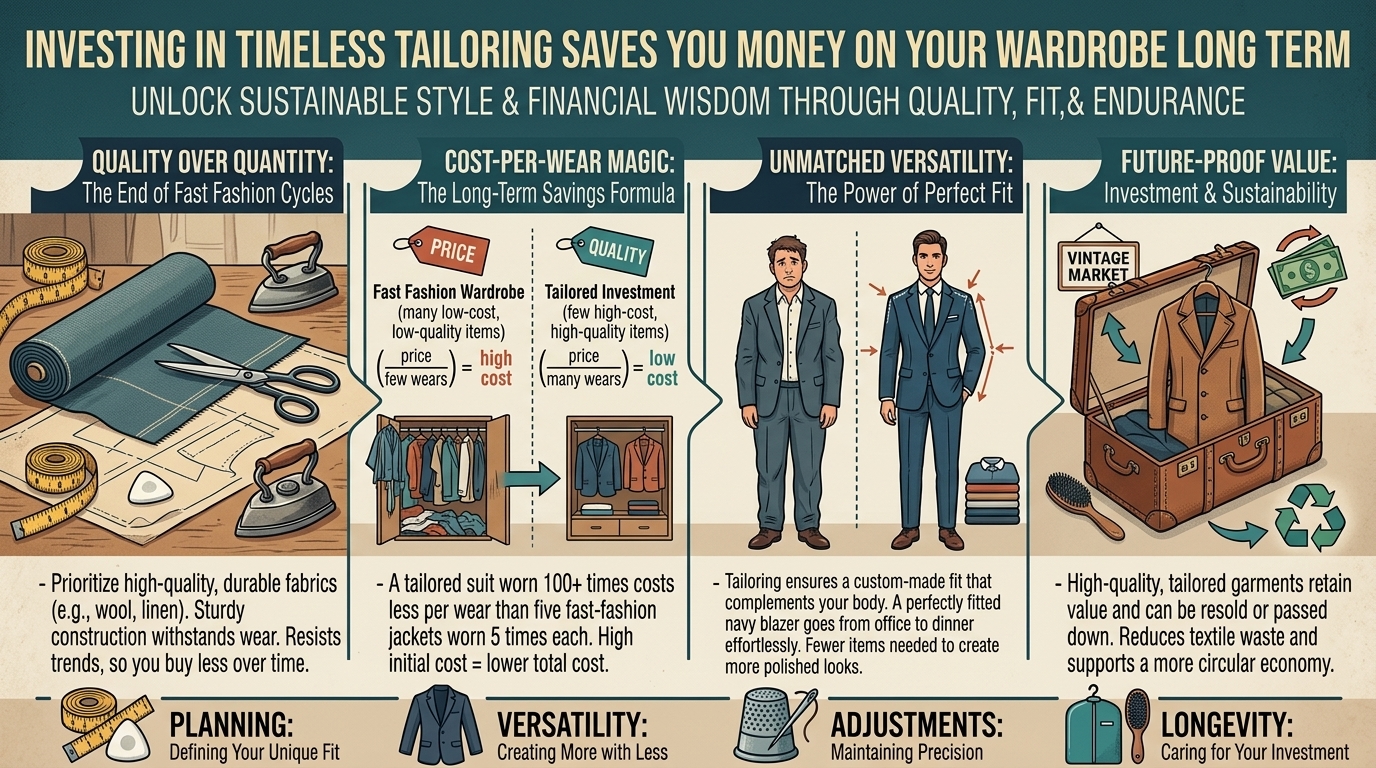
The primary appeal of mass-market fast fashion is low upfront price. A $40 unstructured blazer or a $25 off-the-rack trouser feels like a bargain at the register. However, fast fashion relies on planned obsolescence and low-grade materials designed to degrade quickly.
The Hidden Financial Drain
When you buy cheap, un-tailored clothing, you incur hidden costs:
- Frequent Replacement Cycles: Replacing a $40 blazer every 6 months costs $400 over 5 years—resulting in zero residual value and subpar fit.
- Maintenance Disasters: Synthetic fabrics (polyester, acrylic, rayon) trap odors, fray at seams, and shrink unpredictably in standard washes.
- Alteration Pitfalls: Cheap garments often lack seam allowance (extra interior fabric), making them impossible for a tailor to let out or take in as your body naturally changes.
2. The Mathematics of Fashion: Calculating Cost-Per-Wear (CPW)
To understand why timeless tailoring saves money, you must evaluate clothing using Cost-Per-Wear (CPW) rather than purchase price alone.
$$\text{Cost-Per-Wear (CPW)} = \frac{\text{Total Purchase Price} + \text{Alteration Costs}}{\text{Total Number of Times Worn}}$$
Comparing Fast Fashion vs. Investment Tailoring
┌─────────────────────────────────────────────────────────────────────────────┐
│                      5-YEAR COST-PER-WEAR ANALYSIS                          │
├───────────────────────────────────┬─────────────────────────────────────────┤
│ FAST FASHION BLAZER               │ TIMELESS TAILORED BLAZER                │
├───────────────────────────────────┼─────────────────────────────────────────┤
│ Initial Price: $60                │ Initial Price: $450                     │
│ Tailoring Cost: $0 (un-tailorable)│ Precision Tailoring: $50                │
│ Total Investment: $60             │ Total Investment: $500                  │
├───────────────────────────────────┼─────────────────────────────────────────┤
│ Lifetime Wears: 15 times          │ Lifetime Wears: 250 times               │
│ (Degrades/loses shape after 1 yr) │ (Worn 1x/week for 5 years)              │
├───────────────────────────────────┼─────────────────────────────────────────┤
│ FINAL CPW: $4.00 per wear         │ FINAL CPW: $2.00 per wear               │
└───────────────────────────────────┴─────────────────────────────────────────┘
As shown in the matrix above, the initial $500 investment in a tailored wool-blend jacket actually costs half as much per wear as the “cheap” option while delivering vastly superior fit, comfort, and professional presence.
3. Structural Anatomy: What Makes Tailored Garments Last Decades?
Timeless tailoring relies on centuries-old garment construction techniques designed for longevity, breathability, and repairability.
                  ANATOMY OF A QUALITY TAILORED JACKET

   ┌─────────────────────────────────────────────────────────────┐
   │ 1. NATURAL CANVAS LINING (Horsehair/Wool)                   │
   │    Conforms to your body shape over time via body heat.     │
   └──────────────────────────────┬──────────────────────────────┘
                                  │
                  ┌───────────────┴───────────────┐
                  ▼                               ▼
      [ PREMIUM NATURAL FABRIC ]       [ INTERIOR SEAM ALLOWANCE ]
      • 100% High-twist wool, linen,   • Generous 0.5" - 1" fabric
        or cashmere blends.              inlays for future adjustments.
      • Breathable & wrinkle-resistant. • Allows letting out/taking in.
                  │                               │
                  └───────────────┬───────────────┘
                                  ▼
   ┌─────────────────────────────────────────────────────────────┐
   │ 4. REINFORCED STITCHING & HAND-SEWN BUTTONHOLES             │
   │    Prevents tension tearing at stress points & armholes.    │
   └─────────────────────────────────────────────────────────────┘
Key Structural Advantages:
- Full or Half-Canvas Construction: Unlike cheap fused (glued) jackets that bubble after dry cleaning, canvased jackets mold to your silhouette, improving in fit over time.
- High-Grade Natural Fibers: Super 100s–120s wool, natural linen, and long-staple cotton resist tearing, regulate body temperature, and hold crisp iron creases.
- Alteration Inlays: Quality tailored pants and jackets leave extra interior fabric along the center seam, side seams, and hems, allowing a tailor to alter the garment across weight fluctuations.
4. Regional Style Adaptations: Tailoring for Texas, California, NY, & Washington
Tailoring is not limited to formal tuxedos or heavy three-piece wool suits. Modern tailoring adapts to regional climates and professional standards across major fashion hubs:
| Region / City | Climate & Lifestyle Demand | Optimal Tailoring Strategy | Recommended Fabrics |
| New York City | Fast-paced, four-season transit, high corporate/creative standards. | Sharply structured silhouettes, dark-tone suits, tailored topcoats. | Mid-weight worsted wool, flannel, wool-cashmere blends. |
| San Francisco & California | Tech-casual, layer-dependent mornings to mild afternoons. | Soft-shouldered blazers (Neapolitan style), unlined tailored trousers. | Breathable hopsack wool, cotton-twill, unstructured linen-wool blends. |
| Texas (Austin, Dallas, Houston) | Intense sun, heat resistance, elevated Western/business crossover. | Deconstructed light jackets, tailored high-rise chinos, breathable trousers. | Lightweight tropical wool, crisp linen, stretch-cotton blends. |
| Washington (Seattle) | Persistent moisture, cool maritime weather, outdoor-urban mix. | Tailored water-resistant trench coats, structured heavy knits, lined blazers. | Heavyweight wool gabardine, water-repellent performance wool. |
5. 5 Practical Tips to Save Money Through Tailoring Today
Tip 1: Buy Off-the-Rack for the Shoulders, Tailor the Rest
When shopping, ensure jackets fit perfectly in the shoulders and neck collar. Shoulder alterations are complex and expensive. Adjusting sleeve length, taking in the waist, or hemming trousers is affordable and yields a custom look.
Tip 2: Build a 5-Piece Tailored Core Capsule
Rather than owning 20 poorly fitting outfits, invest in five high-yield tailored foundation pieces:
- 1 Navy or Charcoal Half-Canvased Blazer
- 1 Pair of Flat-Front Tailored Wool Trousers
- 1 Structured Crisp White Cotton Button-Down
- 1 Tailored Trench Coat or Overcoat
- 1 Versatile Dark-Wash Tailored Denim Jeans
Tip 3: Establish a Relationship with a Local Alterations Master
A skilled local tailor is your greatest financial asset in fashion. They can taper baggier thrift store finds, replace plastic buttons with horn or mother-of-pearl, and repair minor tears before they ruin a garment.
Tip 4: Master Garment Preservation Techniques
Extend dry cleaning intervals. Dry cleaning chemicals degrade natural wool fibers. Instead, brush wool jackets with a horsehair clothes brush after wearing, hang them on wide wooden hangers, and use steam to eliminate wrinkles and odor naturally.
Tip 5: Shop High-End Consignment & Vintage Archives
Search thrift archives or consignment shops in cities like New York or San Francisco for vintage 1980s or 1990s tailored suits. Because older garments were constructed with superior fabrics and generous seam allowances, taking a $50 vintage wool suit to a tailor for $60 in adjustments gets you a $1,200-quality outfit for $110.
Frequently Asked Questions (FAQ)
Q1: Isn’t custom tailoring only for wealthy executives or formal events?
No. Modern tailoring applies to everyday wear—including smart-casual chinos, dark denim, button-down shirts, and unstructured jackets. Having an inexpensive shirt tailored to your body makes it look significantly more expensive than an un-tailored designer piece.
Q2: How much should I expect to spend on basic garment alterations?
Basic alterations are highly cost-effective: hemming trousers typically costs $15–$25, taking in a shirt waist costs $20–$35, and shortening jacket sleeves costs $30–$50.
Q3: How can tailored clothing save money if my body weight fluctuates?
Unlike fast-fashion garments that tear or stretch permanently, quality tailored garments include interior seam allowances (inlays). A skilled tailor can let out trousers or jackets by 1 to 2 inches, accommodating natural weight changes without requiring new purchases.
Q4: What is the single most important detail to check when buying a suit off-the-rack?
The shoulder seam. The seam should sit flat right at the edge of your natural shoulder bone. If the shoulder pads overhang or pull tightly across your upper back, put the jacket back—shoulder alterations are costly and difficult to execute cleanly.
Q5: How many times can a quality wool suit be worn before cleaning?
A 100% natural wool suit rarely requires dry cleaning. Wool naturally repels dirt and bacteria. Air out your suit after wearing, steam out wrinkles, and dry clean it only once or twice a season unless visibly soiled.
Q6: What does “unstructured tailoring” mean, and is it durable?
Unstructured tailoring removes heavy interior padding and stiff chest canvas, resulting in a lightweight, soft-fit garment. When constructed from high-tensile fabrics like hopsack wool or heavy linen, unstructured blazers remain extremely durable while providing maximum comfort in warmer climates like Texas or California.
Q7: Why does fast fashion feel softer on the rack than quality raw wool or structured cotton?
Fast fashion manufacturers use synthetic chemical washes to make cheap polyester blends feel artificially soft on store hangers. However, these fibers break down after a few washes. High-quality natural wool and crisp cotton start slightly structured but soften naturally over years of wear while maintaining their shape.
Q8: Can women’s wardrobe pieces benefit from tailoring as much as men’s?
Absolutely. Tailoring blazers, high-waisted trousers, pencil skirts, and dresses to fit precise waist, hip, and shoulder proportions instantly elevates an outfit and prevents fabric gaping or pulling.
Q9: How do I identify if an older jacket has full-canvas construction when thrifting?
Perform the “Pinch Test”: pinch the fabric on the jacket front just above the bottom buttonhole. Pull the outer layer and inner lining apart. If you feel a third floating middle layer sliding freely between them, the jacket is canvased. If it feels like one thick glued layer, it is fused.
Q10: How does tailored fashion align with modern sustainability goals?
Investing in tailored clothing is one of the most effective ways to practice sustainable fashion. By purchasing fewer, higher-quality garments that last decades and can be repaired or altered, you significantly reduce textile waste and industrial carbon emissions.
Conclusion: Value Beats Price Every Time
True style is not about buying more—it is about wearing better. By shifting your mindset away from impulse fast-fashion purchases and toward timeless tailoring, you unlock a wardrobe that fits your body, withstands daily wear, elevates your confidence, and saves you thousands of dollars long-term.
Whether you’re building a sleek corporate wardrobe in New York, curating an effortless elevated-casual look in California or Texas, or layering for maritime weather in Washington, intentional fit is your greatest style asset. Explore more curated fashion insights, wardrobe strategies, and regional style intelligence directly at NYAttitude (nyattitude.com).