There is a distinct, vibrating pulse that takes over New York City twice a day. As the clock ticks toward 8:00 AM and again as it hits 5:00 PM, a massive, unstoppable human tide shifts through the five boroughs. Millions of commuters pour out of brownstones, high-rises, and outer-borough apartments, flooding subway platforms, jamming turnstiles, and surging across concrete avenues with single-minded urgency.
If you have recently relocated from the wide-open highways of Texas, the laid-back coastal drives of California, the serene pine-lined paths of Washington, or the steep hills of San Francisco, the sheer velocity of an NYC rush hour can feel like stepping directly into the path of a freight train. It is loud, aggressive, sensory-overloaded, and unapologetically chaotic.
Yet, navigating this daily gauntlet without losing your cool is an art form. Mastering rush hour energy is what separates frantic newcomers from seasoned urban survivors. This ultimate guide breaks down the psychology, tactical strategies, and insider rules for conquering the New York City rush hour like a pro.
The Anatomy of the NYC Rush Hour: Understanding the Beast
To survive chaos, you must first understand its mechanics. The New York commuter isn’t inherently angry; they are governed by an ironclad equation: Time equals livelihood.
When every second counts—whether catching a transfer to make a morning meeting or rushing home before daycare pickup—delays have a cascading effect. This is why pedestrian traffic behaves less like a casual stroll and more like a fluid, highly compressed hydrodynamic system.
The Major Shockpoints
- The Turnstile Bottleneck: The split-second hesitation of someone hunting for their MetroCard or OMNY tap card can cause a backup of dozens of frustrated bodies behind them.
- The Platform Edge: As subterranean temperatures rise and train screeches echo off tiled walls, the platform transforms into a pressure cooker of anticipation.
- The Sidewalk Gridlock: Midtown avenues during the 5:00 PM exodus feature competing streams of pedestrians, delivery cyclists, rogue tourists stopping dead in their tracks, and honking yellow cabs.
Psychological Survival: Shifting Your Mindset
When you are squeezed into a subway car so tightly that your feet barely touch the floor and a stranger’s backpack is pressed against your face, your nervous system’s primitive alarm bells start ringing. Panic, claustrophobia, and irritability are natural initial reactions—but yielding to them drains your vital energy.
1. Reframe the Chaos as a Shared Symphony
Instead of viewing your fellow commuters as obstacles or adversaries, try viewing them as co-conspirators in a massive, synchronized urban dance. Everyone on that platform is chasing a dream, trying to support a family, or heading home to a hot meal. Recognizing the shared humanity within the crowd shifts your perspective from isolation to connection.
2. Practice Radical Detachment
In traffic psychology, road rage happens when drivers take other people’s driving maneuvers personally. The same applies to the subway. If someone shoves past you, avoids eye contact, or takes the seat you were eyeing, do not let it ruin your day. Detach your self-worth from the mechanics of the commute.
Tactical Strategies: Step-by-Step Rules for a Smooth Commute
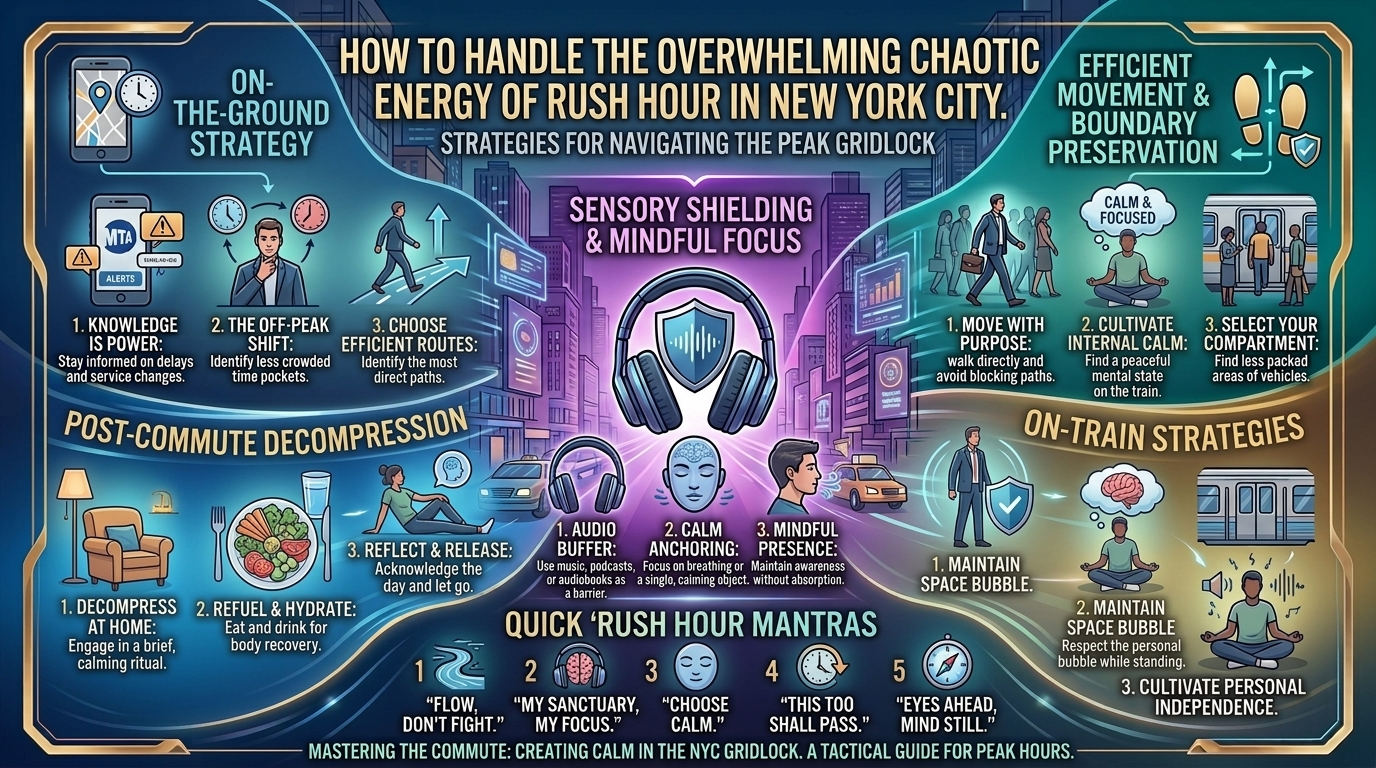
Surviving the rush hour crush requires operational discipline. Follow these field-tested tactics to glide through the chaos with ease:
Rule #1: Master the “Ready Position” at Transit Hubs
Never wait until you are standing directly in front of the turnstile to figure out how you are paying. Have your OMNY card, smartphone, or transit pass in your hand before you reach the barrier. Efficiency keeps the line moving and protects you from receiving the dreaded New York sigh of disapproval.
Rule #2: Obey the Unwritten Platform Etiquette
- Let People Off First: Always stand to the sides of the subway doors and allow passengers to exit before you attempt to push your way inside. Violating this rule is the ultimate commuter faux pas.
- Remove Your Backpack: If the train is crowded, take your backpack off your back and hold it down by your legs or between your feet. A backpack on your back doubles your physical footprint and hits fellow passengers in the face.
Rule #3: Curate Your Sensory Environment
The sensory assault of screaming announcements, screeching brakes, and overlapping conversations can fry your nerves. Take control of your auditory landscape:
- Invest in high-quality noise-canceling headphones.
- Curate a dedicated “commute playlist” of calming ambient music, grounding podcasts, or audiobooks that transport your mind away from the physical crush.
Rule #4: Find Alternative Routes and Timing Windows
If your schedule allows for even a 30-minute shift, you can completely bypass peak chaos.
- The Shoulder Hours: Traveling slightly before the core rush (e.g., leaving for work at 7:15 AM instead of 8:15 AM) yields noticeably emptier trains and calmer platforms.
- Micro-Routing: Use alternative bus lines or walking routes that avoid heavy tourist bottlenecks like Times Square or Herald Square during peak evening hours.
10 Frequently Asked Questions (FAQs)
1. Why do New Yorkers walk so fast during rush hour?
Walking slowly in New York is viewed as a disruption to the city’s operational flow. Walking fast is a learned defense mechanism to ensure you reach your destination on time while avoiding the swirling eddies of pedestrian traffic.
2. How do I cope with severe claustrophobia on crowded subway cars?
Focus entirely on your breathing, look up toward the ceiling rather than staring at the packed crowd around you, and position yourself near the doors so you can step out onto platforms during longer station stops if needed.
3. What should I do if someone is being aggressively rude or hostile on my commute?
Practice non-engagement. Do not make eye contact, do not argue, and do not escalate the situation. Walk away or move to a different subway car at the next stop. Your safety and peace of mind are always more important than winning an argument.
4. Are there specific apps that help predict subway delays and crowd levels?
Yes! Apps like Transit, Citymapper, and official MTA apps provide real-time arrival updates, crowd density tracking, and alternative routing options to help you pivot around major delays.
5. How can I keep my personal belongings safe during peak crush hours?
Keep your backpack or purse zipped securely and worn on the front of your body or clutched tightly in front of you when standing in tightly packed crowds or on crowded train platforms.
6. Is it acceptable to eat or drink during the morning rush hour commute?
While grabbing a quick coffee is common, try to finish messy food before boarding crowded transit. Spilling coffee on a fellow commuter during a sudden train jolt is an avoidable nightmare.
7. How do I handle unexpected major transit delays without melting down?
Accept early on that the MTA is imperfect and delays will happen. Build extra time buffer into your daily schedule so a 15-minute signal delay causes a minor inconvenience rather than a professional catastrophe.
8. What are the quietest cars on a New York City subway train?
The very front and very back cars of the train often have fewer passengers than the middle cars because commuters cluster near the station stairs and escalators.
9. How do I politely signal that I need to squeeze past someone on a crowded sidewalk?
A polite, firm “Excuse me, thank you!” spoken in a calm, confident voice while stepping past is universally understood and respected, even amidst the chaos.
10. Why does the evening rush hour feel more chaotic than the morning rush?
Morning commuters are often waking up and moving with quiet, sleepy determination. Evening commuters are exhausted from a full workday, eager to get home, and dealing with cumulative fatigue, making the collective energy much more intense and impatient.
Conclusion
Navigating the overwhelming chaotic energy of rush hour in New York City is a quintessential rite of passage. While the rushing crowds, subterranean heat, and fast-paced environment can initially feel intimidating, developing tactical commuting habits transforms the experience from a daily stressor into a manageable routine. By protecting your personal space, mastering transit etiquette, and keeping your cool when things go sideways, you prove that you have what it takes to master the rhythm of the greatest city in the world.