The Best Neighborhood Walking Routes to Clear Your Mind After a Stressful Workday
Welcome to nyattitude.com, your ultimate digital resource for mastering the high-octane pace of metropolitan life without sacrificing your mental well-being. Whether you are wrapping up a grueling 10-hour strategy session in a glass skyscraper in Manhattan, logging out of a high-pressure tech sprint in Silicon Valley or San Francisco, fighting through transit fatigue in downtown Seattle, or closing out a massive corporate deal across bustling commercial hubs in Texas and California, one brutal truth unites us all: the transition from work mode to personal life is rarely smooth.
When your day is defined by endless Slack notifications, back-to-back video calls, shifting stakeholder demands, and relentless cognitive load, your nervous system remains trapped in a state of high alert long after your laptop lid snaps shut.
If you attempt to jump straight from corporate warfare into domestic relaxation, you bring the office home with you. That is why high-achievers and urban professionals rely on a powerful psychological reset: the decompression walk.
This comprehensive guide explores the neuroscience of post-work walking, highlights the best neighborhood walking routes across America’s top metropolitan markets (New York, San Francisco, California, Washington, and Texas), and offers practical tips to transform a simple stroll into a transformative mental reset.
Part 1: The Neuroscience of the Post-Work Walk
Why does walking through your neighborhood immediately after a stressful workday feel like a breath of fresh air for your brain? The answer lies in cognitive neuroscience.
1. Breaking the Attention Restorational Loop
During a workday, your brain relies heavily on Directed Attention—focusing intently on spreadsheets, code, emails, and meetings while actively suppressing distractions. This depletes your prefrontal cortex, leading to cognitive fatigue, irritability, and burnout.
- When you take a walk in an environment with “soft fascination” (such as passing trees, historic architecture, changing light, or neighborhood street life), your brain shifts into Attention Restoration Theory (ART) mode.
- Soft fascination requires zero cognitive effort, allowing your overworked neural networks to rest, repair, and recalibrate.
2. Bilateral Stimulation and Somatic Processing
Walking involves rhythmic, alternating left-to-right leg and arm movements. This bilateral physical stimulation acts as a form of somatic processing, helping your nervous system metabolize and discharge the accumulated adrenaline and cortisol trapped in your muscles during a high-stress day.
Part 2: Curated Neighborhood Walking Routes Across Major Metros
Every city has a unique spatial personality. Here are the finest neighborhood walking routes designed specifically for mental decompression across our core regions:
1. New York City: The West Village Brownstone & Hudson River Loop
- The Vibe: Historic charm meeting open water.
- The Route: Begin your walk near Christopher Street, weaving slowly through the quiet, tree-lined, winding cobblestone streets of the West Village. Admire the historic 19th-century brownstones, ironwork fences, and pocket-sized neighborhood gardens. Gradually make your way west toward the Hudson River Greenway.
- The Decompression Factor: Walking past historic architecture grounds your mind in physical history away from digital screens, while stepping onto the river esplanade opens up wide horizons, cooling breezes off the water, and expansive views of the New Jersey skyline as the sun sets.
2. San Francisco: The Marina Green to Crissy Field Coastal Stroll
- The Vibe: Salty air, sweeping bay views, and maritime history.
- The Route: Start at the eastern edge of the Marina Green, walking westward along the flat, wide pedestrian path. Continue past the historic St. Francis Yacht Club, following the crushed gravel path through Crissy Field all the way toward Fort Point beneath the shadow of the Golden Gate Bridge.
- The Decompression Factor: The vast expanse of the San Francisco Bay, the sound of crashing waves, and the sight of fog rolling over the Marin Headlands provide an immediate, breathtaking shift in perspective that instantly shrinks office anxieties.
3. Seattle / Washington: The Capitol Hill Greenways & Volunteer Park Circuit
- The Vibe: Canopy shade, historic mansions, and Pacific Northwest serenity.
- The Route: Navigate away from the dense commercial core of Capitol Hill onto the neighborhood’s designated neighborhood greenways (quiet residential streets optimized for pedestrians). Wind your way upward into Volunteer Park, circling the historic water tower, the Dahlia gardens, and the conservatory.
- The Decompression Factor: Being immersed in deep-green Pacific Northwest conifers, towering Douglas firs, and damp, earthy cedar mulch triggers a physiological calming response, lowering heart rate and blood pressure within minutes.
4. Austin, Texas: The Lady Bird Lake Boardwalk Loop
- The Vibe: Urban skyline reflecting over calm riparian waters.
- The Route: Access the Lady Bird Lake Hike-and-Bike Trail near downtown Austin or the Boardwalk section near South Congress. Loop along the waterfront boardwalk structure that hovers directly over the water surface, keeping your eyes on the towering downtown skyline framed by native cypress trees.
- The Decompression Factor: The transition from the high-energy tech and music buzz of downtown Austin to the tranquil, natural riparian corridor provides a stark, refreshing psychological boundary between work and personal life.
5. Los Angeles / California: The Santa Monica Coastal Bluffs & Palisades Park
- The Vibe: Ocean breezes, swaying palm trees, and panoramic Pacific horizons.
- The Route: Walk the paved pathways of Palisades Park in Santa Monica, stretching atop the high coastal bluffs overlooking the Pacific Ocean and the historic Santa Monica Pier.
- The Decompression Factor: Gazing out at the endless horizon of the Pacific Ocean while walking under iconic California palms provides a legendary sensory reset, washing away the mental claustrophobia of corporate cubicles or home offices.
Part 3: Step-by-Step Blueprint for an Effective Decompression Walk
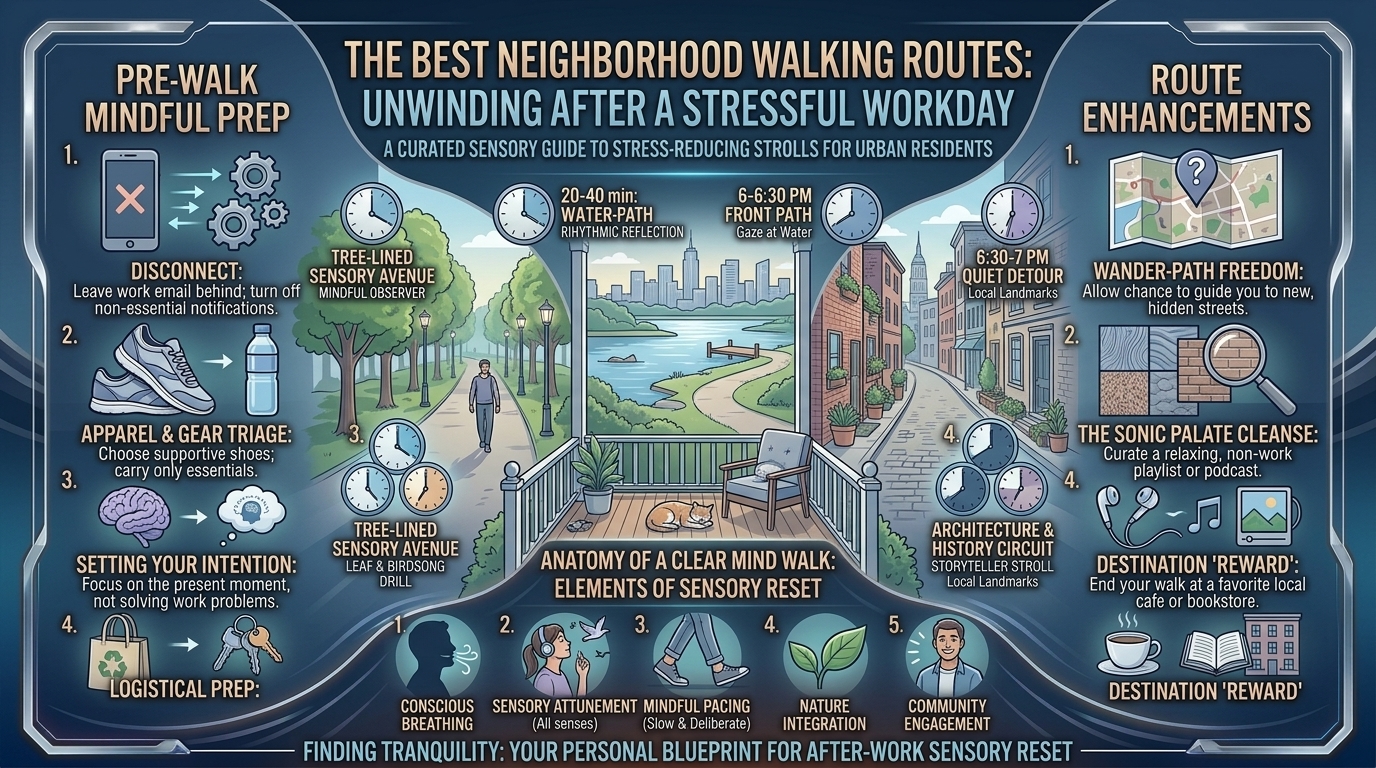
To turn an ordinary evening walk into a reliable stress-eradication tool, follow this 4-step framework:
Step 1: The Digital Detox Boundary
Before you step out your front door, put your phone on “Do Not Disturb” or silence work notifications. If you need your phone for a podcast or navigation, tuck it securely into a zipper pocket. Checking Slack or email during a decompression walk completely defeats the biological purpose of the exercise.
Step 2: The “Commute Eraser” Mindset Shift
Use the first 10 minutes of your walk to physically and mentally process the workday. Let your mind replay the stressful meeting or difficult conversation—and then consciously decide to let it go. Imagine packing those thoughts into a mental box and locking it until tomorrow morning.
Step 3: Shift to Sensory Grounding (The 5-4-3-2-1 Technique)
As you navigate your neighborhood route, actively engage your senses to pull your brain out of future-tripping or work-worry:
- 5 things you can visually see (architectural details, leaf colors, passing dogs).
- 4 things you can physically feel (the pavement beneath your shoes, the evening breeze).
- 3 things you can hear (rustling leaves, distant traffic hum, birdsong).
- 2 things you can smell (baked goods from a bakery, blooming jasmine, salt air).
- 1 thing you can taste (fresh water from your carry bottle).
Step 4: The Triumphant Return
When you walk back through your front door, establish a physical anchor—such as placing your keys in a designated tray, washing your hands with warm water, or changing out of your work clothes. This signals to your brain that the workday is officially over and your personal life has begun.
Part 4: Frequently Asked Questions (FAQ)
1. How long should a post-work decompression walk be?
For optimal stress relief and neurological reset, aim for 20 to 30 minutes. This duration is long enough to lower cortisol levels and engage attention restoration, but short enough that it doesn’t feel like an exhausting chore after a long workday.
2. Is it better to walk in silence or listen to music/podcasts?
It depends on how mentally depleted you feel. If your job required intense verbal communication all day, walking in complete silence or listening to ambient nature sounds is best. If you enjoy audio, choose light-hearted comedy podcasts or instrumental music rather than stressful news or business briefings.
3. What if I live in a heavily congested urban area with no quiet parks nearby?
You don’t need a pristine forest to decompress. Walking through a vibrant residential neighborhood, exploring side streets with interesting architecture, or walking along a waterfront esplanade works just as well. The key is breaking away from your workspace and moving your body.
4. Should I walk before or after dinner?
Most wellness experts recommend taking your decompression walk immediately after finishing work, before you sit down on the couch or begin cooking dinner. It serves as a vital psychological buffer between professional obligations and domestic life.
5. What if the weather is terrible (rain, extreme heat, or snow)?
Don’t let weather stop you from moving. If outdoor walking is impossible, substitute it with 20 minutes of indoor stretching, yoga, or pacing inside your apartment while listening to calming music. The physical movement and boundary-setting are what matter most.
6. Can walking really reduce corporate burnout?
Yes! Regular aerobic movement like walking reduces chronic stress hormone buildup, improves sleep quality, boosts mood-enhancing endorphins, and provides the necessary psychological detachment required to prevent long-term burnout.
7. Should I track my steps during a decompression walk?
If step-tracking motivates you, go ahead; however, if checking your fitness watch triggers performance anxiety or pressure to hit arbitrary numbers, leave the fitness tracking off. Your evening walk should be a pressure-free zone.
8. How do I handle lingering work thoughts that pop up during my walk?
Acknowledge the thought when it arises without judging yourself, visualize placing it on a passing cloud or leaf, and gently guide your attention back to your physical surroundings and your breath.
9. What should I wear on a post-work decompression walk?
Wear comfortable walking shoes or sneakers and weather-appropriate layers. Many professionals keep a dedicated pair of comfortable walking shoes right by the door so changing footwear becomes an effortless transition ritual.
10. Can I walk with a partner, roommate, or dog?
Walking with a dog or a partner can be wonderful, provided you establish ground rules. If you walk with a partner, agree to keep conversation light, uplifting, or entirely focused on how you both want to unwind, rather than venting about office politics for the entire route.
Conclusion
Surviving the high-stakes demands of modern corporate life requires more than just professional competence—it requires robust self-care systems. By carving out 20 to 30 minutes each evening for a deliberate, tech-free neighborhood decompression walk across iconic routes in New York, San Francisco, Seattle, Austin, or Los Angeles, you can shatter the cycle of chronic stress, protect your mental health, and reclaim your personal evenings. Step outside, leave the inbox behind, and walk your way to peace of mind.