There is a fascinating psychological phenomenon that occurs every Friday afternoon in Manhattan, Brooklyn, and transit hubs across the five boroughs. Millions of eager travelers stream out of Penn Station, Port Authority, and terminal gates, clutching oversized luggage, staring wide-eyed at towering skyscrapers, and stepping blindly onto crowded sidewalks. They have come for the ultimate weekend getaway: a 48-hour blitz of Broadway shows, iconic landmarks, pizza slices, and bright neon lights.
Whether you are visiting from the wide-open spaces of Texas, the laid-back coastlines of California, the evergreen valleys of Washington, or the steep hills of San Francisco, arriving in New York City for a weekend trip is an exhilarating experience.
However, there is a massive cultural and operational disconnect between the tourists who come to visit and the locals who actually live, work, and pay rent here. When visitors unknowingly violate unwritten urban rules, it causes a cascading bottleneck of friction, eye-rolls, and delayed commutes.
To help you blend in seamlessly, maximize your 48 hours, and win the secret respect of New Yorkers, here is the ultimate insider guide on what locals desperately wish every weekend tourist knew before stepping foot in the greatest city on earth.
1. The Sidewalk is Not a Theme Park Viewing Deck
The single biggest culture shock for first-time visitors is the velocity of New York pedestrian traffic. To a local, a sidewalk is a functional transportation highway; to a tourist, it is often treated like an open-air art museum gallery.
The Danger of the Sudden Stop
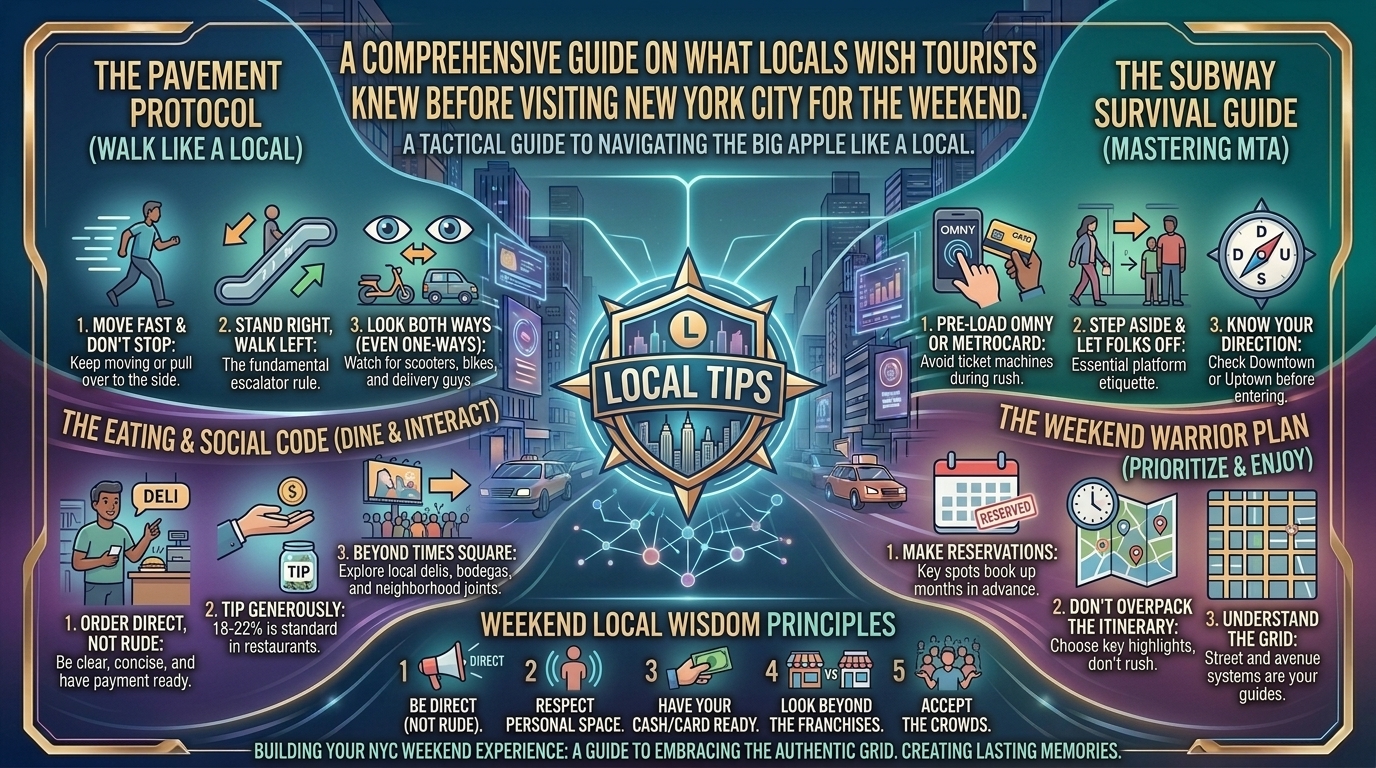
The absolute cardinal sin of NYC tourism is the Mid-Sidewalk Freeze. Imagine driving down a 70 mph interstate highway, and the car directly in front of you slams on its brakes with no warning, no blinker, and no shoulder to pull onto. That is exactly what happens when you step out of a subway stairwell, pause abruptly to take a photo of a yellow cab, or check Google Maps right in the middle of a heavily trafficked pedestrian flow.
- How to Do It Right: If you need to check your phone, look at a map, tie your shoe, or admire a skyscraper, pull over to the right. Step completely out of the foot traffic stream—against a building facade or near a tree pit—before coming to a stop.
2. Navigating the Subway Like a Seasoned Pro
The New York City Subway system moves over 3 million people every single day. It is a complex, 24/7 subterranean circulatory system that runs on strict efficiency. When tourists panic or stall in the stations, it ripples across the entire network.
The MetroCard/OMNY Tap Rule
Do not—under any circumstances—reach the front of a crowded turnstile line, stop completely, open your backpack, and start hunting through your pockets for your wallet or card.
- Be Ready: Have your OMNY-enabled phone, smart watch, or contactless credit card ready in your hand before you reach the barrier. Tap smoothly and keep walking.
- Stand Aside for Exiting Passengers: When waiting for a subway car to arrive, never crowd directly in front of the center doors. Stand strictly to the sides. Let all exiting passengers clear the train completely before you attempt to board.
3. Demystifying New York “Rudeness”
If you ask a visitor about their trip, they will often say, “The city was amazing, but people were so rude!”
Locals find this endlessly amusing because what tourists perceive as “rudeness” is actually a vital survival mechanism known as urban privacy boundaries.
- Time is Currency: In a city of 8 million people packed into 300 square miles, efficiency is mandatory. When a deli worker barks at you, “Next! What do you want?” they aren’t trying to insult your mother; they are trying to keep a line of 20 hungry people moving so everyone can get back to work on their lunch break.
- Directness Over Fluff: New Yorkers value speed and clarity. Small talk with strangers on a crowded morning commute is viewed with deep suspicion because everyone is trying to process a mountain of mental load. Don’t take it personally; match their pace, speak clearly, and keep moving.
4. Where to Eat: Avoiding the Times Square Tourist Traps
If you spend your weekend eating at massive national chain restaurants or overpriced tourist traps directly in the middle of Times Square, you are doing New York dirty. You will pay triple the price for mediocre food while surrounded exclusively by other tourists.
- Venturing Beyond Midtown: Some of the best culinary experiences in the world are hidden in plain sight across outer-borough neighborhoods. Take a quick subway ride down to the East Village for authentic Ukrainian pierogies, head to Queens for world-class dumplings, or explore Brooklyn for artisanal sourdough pizza.
- The Deli Culture: Do yourself a favor and skip the generic coffee shops. Walk into a classic neighborhood bodega, order a bacon, egg, and cheese on a roll (salt, pepper, ketchup), and experience the true fuel of the working New Yorker.
5. Master the Grid: Navigating Manhattan Geography
Getting lost in Manhattan can burn precious hours of your precious 48-hour trip. Fortunately, Manhattan’s layout is one of the most logical urban grids in the world.
- Avenues vs. Streets: Avenues run north and south (parallel to the rivers), while Streets run east and west.
- Numbering Logic: Streets generally increase in number as you go uptown (north). Avenues increase in number or letter as you move from east to west (e.g., First Avenue is on the east side, Eighth Avenue is on the west side).
- Uptown vs. Downtown: Knowing which direction you are heading is vital. “Uptown” means north (towards Harlem/The Bronx); “Downtown” means south (towards the Financial District). Always check the subway entrance signs before swiping your card to ensure you are entering the platform heading the correct direction!
10 Frequently Asked Questions (FAQs)
1. Should I tip service workers in New York City?
Yes, absolutely. Tipping is a mandatory part of the service economy in New York. Standard tipping for restaurant servers, bartenders, and delivery workers ranges from 18% to 22%. Taxi drivers and hotel bellhops also expect modest tips.
2. Is it safe to walk around New York City at night during a weekend trip?
Generally, yes. Major tourist areas, well-lit commercial avenues, and transit hubs remain heavily populated and safe late into the night. However, standard urban awareness applies: stay out of unlit parks after dark, keep your phone secure, and avoid empty, isolated side streets.
3. How much walking should I realistically expect to do?
Pack your most comfortable sneakers! It is completely normal for weekend tourists to log 15,000 to 25,000 steps (7 to 10 miles) in a single day simply walking between sights, exploring neighborhoods, and navigating subway transfers.
4. Are yellow cabs better than ride-sharing apps like Uber and Lyft?
During peak weekend evening hours in Midtown or the Theater District, yellow cabs are often faster and cheaper than ride-share apps because traditional taxis can utilize dedicated bus/taxi lanes and are constantly circulating.
5. Do I need to buy Broadway tickets months in advance?
For blockbuster shows featuring A-list celebrities, yes. However, if you are flexible, you can visit the TKTS Booth in Times Square on the day of the show to score heavily discounted tickets for amazing performances.
6. What is the best way to see the Statue of Liberty without paying for a pricey tour?
Skip the expensive commercial boat cruises. Instead, take the completely free Staten Island Ferry from the Whitehall Terminal in Lower Manhattan. It passes right by the Statue of Liberty, offers incredible skyline views, and takes less than an hour round-trip.
7. How do I avoid pickpockets and street scams in crowded areas?
Keep your wallet in your front pocket, wear your backpack on your front when riding crowded subways, and ignore aggressive street performers or vendors handing out “free” CDs or mixtapes in Times Square—nothing in NYC is truly free.
8. Can I drink alcohol in public parks or streets in New York?
Technically, public open consumption of alcohol is illegal in NYC parks and streets, though enforcement varies. Local police will generally ticket individuals who are disorderly or blatantly flaunting open containers. Stick to licensed bars, restaurants, and outdoor cafes.
9. What should I pack for a weekend trip to New York City?
Always pack layers and comfortable walking shoes. Weather in the city can shift rapidly, concrete traps heat in the summer and funnels freezing wind tunnels between skyscrapers in the winter, and indoor air conditioning or heating can be intense.
10. Why do locals seem to walk so fast everywhere they go?
Walking fast is the default urban speed. When you live in a city where everyone has tight schedules, long commutes, and endless places to be, a brisk pace keeps the collective human river moving smoothly without traffic jams.
Conclusion
Visiting New York City for a weekend is a transformative, unforgettable adventure. By respecting the local rhythm, ditching tourist traps for neighborhood gems, mastering basic subway etiquette, and keeping your eyes up while staying out of the pedestrian flow, you will transition from an obvious outsider to a savvy traveler.
Embrace the energy, keep a sense of humor when things get chaotic, and remember to explore more city guides, travel tips, and urban inspiration right here at nyattitude.com to make your next trip an absolute masterpiece!