Signing your first apartment lease in Manhattan is a quintessential rite of passage. It represents freedom, ambition, and the official transition into becoming a true resident of New York City. However, plunging into the Manhattan real estate market without preparation can quickly turn your dream apartment hunt into an expensive, high-stress ordeal.
Unlike almost any other rental market in the United States, Manhattan operates under its own distinct, unforgiving set of rules. From aggressive broker fees and stringent income requirements to co-op boards and hidden utility costs, renting an apartment here requires a strategic, highly informed approach.
This comprehensive guide breaks down everything you need to know before putting pen to paper on your first Manhattan lease.
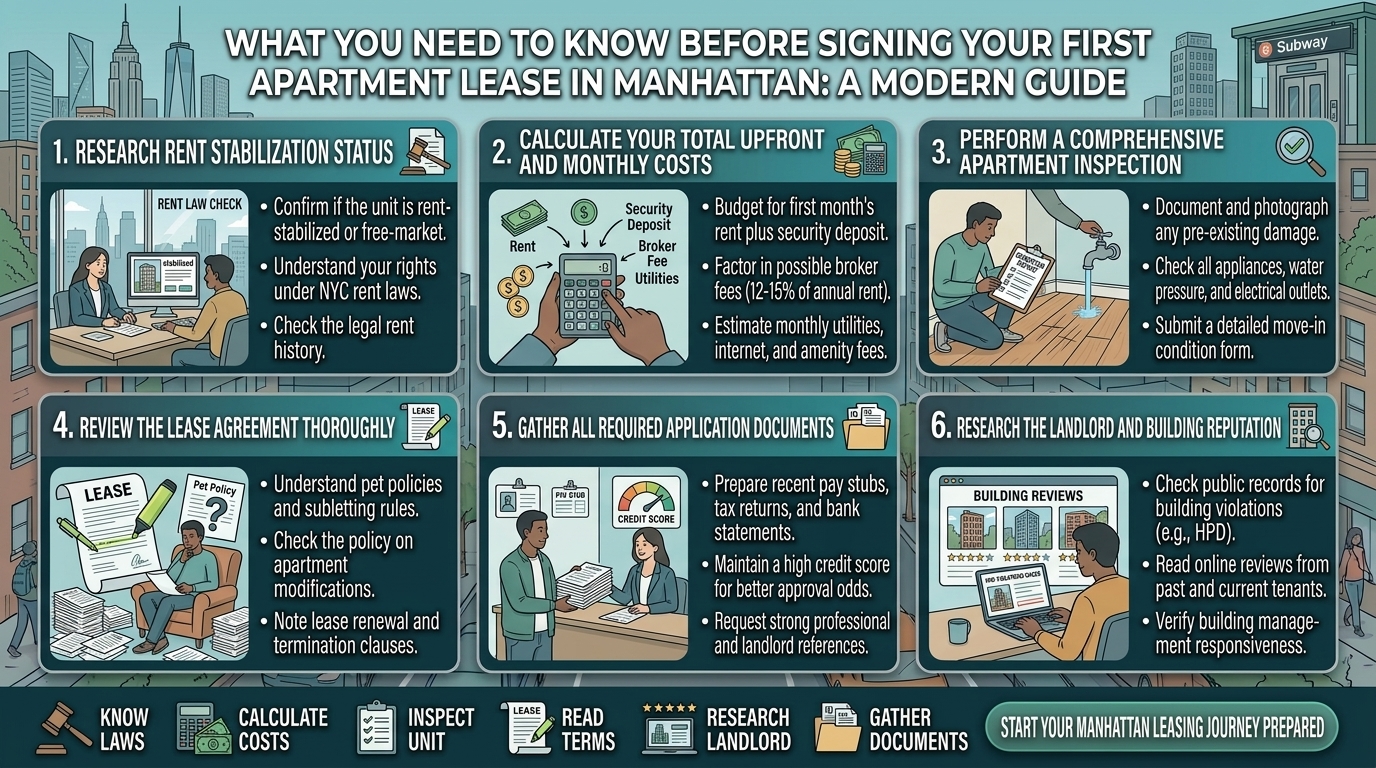
1. The Financial Reality: Upfront Costs Beyond the First Month’s Rent
The most common shock for first-time Manhattan renters is the sheer volume of cash required upfront. In most cities, you pay a security deposit and your first month’s rent. In Manhattan, moving into an apartment can easily require handing over four to five times your monthly rent before you even unpack a single box.
[Typical Upfront Costs Breakdown]
  ├── First Month's Rent
  ├── Security Deposit (Usually capped at 1 month's rent by NY law)
  ├── Broker Fee (Can range from 8% to 15% of annual rent)
  └── Application / Credit Check Fees (Per applicant/building)
- The Broker Fee Reality: Even if you find an apartment through a listing agent, expect to encounter a broker fee. This can range anywhere from 8% to 15% of the total annual rent, split or paid entirely by the tenant depending on market conditions.
- The 40x Rule: Landlords in Manhattan are notoriously strict about income verification. As a baseline rule, your annual gross income must equal at least 40 times the monthly rent. For example, a $3,000/month apartment requires a minimum annual income of $120,000.
- Guarantors: If you do not meet the 40x rule (common for recent graduates, freelancers, or entry-level professionals), you will need a personal guarantor. In Manhattan, guarantors typically must earn 80x the monthly rent and live in the Tri-State area (New York, New Jersey, or Connecticut), though institutional guarantor services like Insurent or TheGuarantors are increasingly accepted.
2. Decoding Lease Types: Market-Rate vs. Rent-Stabilized
Not all Manhattan apartments are created equal. Understanding the legal classification of your lease protects you from predatory price hikes and unlawful evictions.
Market-Rate Apartments
These make up the majority of available rentals. Landlords have the freedom to set rent at whatever the market will bear. When your lease expires after 12 or 24 months, the landlord can legally raise the rent by any percentage they choose.
Rent-Stabilized Apartments
If you are lucky enough to find one, a rent-stabilized apartment offers legal caps on annual rent increases set by the NYC Rent Guidelines Board, along with the right to automatic lease renewals. Look for telltale signs of stabilization in older pre-war buildings built before 1974 with six or more units.
3. Critical Clauses and Hidden Pitfalls in the Paperwork
Before you sign, read every single line of the lease rider. Manhattan landlords are known for slipping specific restrictions into their standard contracts.
- The Sublet Policy: If your career takes you out of town or you decide to break your lease early, what are the rules? NYC law grants tenants the right to sublet under specific conditions, but landlords often include strict approval clauses.
- Rider Restrictions: Check the lease for rules regarding washer/dryer units (often banned in older buildings), air conditioning units (must be installed professionally to avoid facade fines), hardwood flooring requirements (rules demanding 80% of floor area be covered by rugs), and pets (many buildings charge extra pet deposits or ban specific dog breeds/weights).
- Heat and Hot Water Laws: By NYC law, landlords must provide heat between October 1 and May 31. If the indoor temperature falls below specific legal thresholds during day or night hours, the landlord is in violation. Make sure utilities included in the rent are explicitly itemized.
4. Step-by-Step Apartment Hunting Checklist
- Organize Your Paperwork in Advance: Have digital and physical copies of your last two tax returns, current pay stubs, bank statements, employment verification letter, photo ID, and landlord recommendation letters ready before you start looking. Good apartments rent within hours.
- Inspect for Pests and Water Damage: Manhattan’s older housing stock means managing maintenance issues is standard. Check the building’s NYC Housing Preservation and Development (HPD) history online for open bedbug reports, mold violations, or heat complaints.
- Test Cell Service and Water Pressure: Run the shower to check pressure and hot water speed. Check your cell phone bars inside the unit—thick concrete and brick walls in pre-war buildings can completely block cellular signals.
- Understand the Neighborhood Noise Profile: Visit the apartment at night and on a weekend. A quiet Tuesday afternoon viewing can turn into a loud Friday night reality if your window faces a busy avenue, a fire station, or a rowdy bar patio.
5. Frequently Asked Questions (FAQ)
Q1: Can a Manhattan landlord charge more than one month’s rent for a security deposit?
A: No. Under New York State housing laws passed in 2019, security deposits for residential rentals are strictly capped at a maximum of one month’s rent, regardless of whether the apartment is rent-stabilized or market-rate.
Q2: What is a “good faith deposit,” and is it safe to pay?
A: A good faith deposit (often equal to one month’s rent or a holding fee) is sometimes requested by brokers to take an apartment off the market while your application is processed. Ensure you get a signed receipt stating explicitly under what conditions the deposit is fully refundable if your application is rejected by the landlord.
Q3: Are broker fees negotiable in Manhattan?
A: Yes, depending on market conditions and how long the apartment has been sitting vacant. In softer rental markets (typically winter months), landlords or brokers may offer “no-fee” listings or negotiate the percentage down.
Q4: What happens if I need to break my lease early?
A: Legally, a lease is a binding financial contract. If you break it without a valid legal reason (such as military deployment or uninhabitable conditions), you can be held liable for the remaining rent until a new tenant is found, though landlords have a legal “duty to mitigate damages” by trying to re-rent it quickly.
Q5: How do guarantors work if my parents live out of state?
A: Traditional Manhattan landlords prefer local tri-state guarantors. However, many modern management companies now accept third-party institutional guarantor corporations (for a fee equal to roughly 4% to 8% of the annual rent) if your personal income doesn’t hit the 80x threshold.
Q6: Do I really need renters insurance in Manhattan?
A: While not always legally mandated by every single landlord, renters insurance is exceptionally cheap (usually $15–$30/month) and protects your personal belongings against fire, water damage from upstairs neighbors, and theft. Many landlords now explicitly require it in the lease agreement.
Q7: What are “net-effective” versus “gross” rents?
A: Gross rent is the actual monthly price written on your lease. Net-effective rent factors in landlord concessions (such as “1 month free on a 12-month lease”), lowering the average monthly cost. Be careful: when your lease renews, the landlord can legally base the increase on the higher gross rent.
Q8: How far in advance should I start looking for a Manhattan apartment?
A: The Manhattan rental market moves at lightning speed. Apartments are typically listed only 30 to 45 days before their available move-in date. Starting your search 60+ days out is usually too early, as listings you see will be gone by the time you are ready to apply.
Q9: Are utilities usually included in Manhattan rent?
A: Rarely. In most Manhattan apartments, you will pay separately for electricity (conEd) and gas. Water is almost always covered by the landlord, and internet/cable is the tenant’s responsibility. Always ask for average monthly utility estimates before signing.
Q10: What is a co-op board package, and why is it so difficult?
A: If you are renting a co-operative apartment (rather than a condo), the building’s shareholder board must approve your tenancy. This requires submitting an exhaustive financial “board package,” reference letters, and sometimes attending an in-person interview. Co-op boards can reject applications without providing a reason.
Conclusion
Signing your first Manhattan apartment lease is an initiation into the gritty, fast-paced rhythm of New York City living. By mastering the financial requirements, reading every line of the lease rider, understanding local tenant laws, and keeping your paperwork organized, you can navigate the competitive market with confidence. Do your research, protect your rights, and secure your own slice of the Manhattan skyline.