Finding the perfect pair of vintage jeans often feels like discovering a hidden treasure. Unlike modern mass-produced denim engineered with synthetic stretch fibers, true vintage denim (crafted primarily before the mid-1990s) was built using 100% cotton selvedge and heavy-weave denim twill. This fabric does not simply stretch to fit—it molds to your body over time, developing a custom shape and a unique wash pattern that off-the-rack modern clothing cannot replicate.
However, hunting for rare vintage denim comes with unique challenges. Sizing standards have changed dramatically over the decades, shrink-to-fit cotton alters garment dimensions, and off-the-rack secondhand pieces were often broken in by someone else’s body.
At NY Attitude, we explore urban street style, vintage curation, and tailored capsule wardrobes. Whether sourcing rare selvedge in New York and San Francisco, hunting for vintage workwear across California and Texas, or styling rain-ready denim looks in Washington, this definitive guide provides the exact methodology professional archivists and stylists use to source, measure, evaluate, and fit rare vintage denim to every body shape.
1. Understanding Vintage Denim Architecture
+--------------------------------------------------------------------------+
|                     VINTAGE DENIM EVALUATION MATRIX                      |
+------------------------------------+-------------------------------------+
| 1. RAW MATERIAL COMPOSITION        | 100% Heavyweight Cotton (12oz-16oz) |
|    Rigid structural integrity      | Zero elastane or polyester stretch  |
+------------------------------------+-------------------------------------+
| 2. SHRINKS & PROPORTIONAL PATINA   | High-rise waists & deep pocket arcs |
|    Decade-specific pattern cuts    | Molds precisely to body heat & wear |
+------------------------------------+-------------------------------------+
| 3. TECHNICAL CONSTRUCTION SIGNS    | Single-stitch hems, copper rivets,  |
|    Authentic archivism markers     | Chain-stitched waistband & selvedge |
+------------------------------------+-------------------------------------+
Decade-by-Decade Fit Profiles
- 1960s–1970s Denim: Characterized by ultra-high rises, rigid hip huggers, dramatic flare or bootcut leg openings, and dark indigo or natural faded washes. Best for accentuating natural waistlines and balancing shoulder-to-hip proportions.
- 1980s Denim: Defined by high-waisted “mom jean” cuts, wide hips, tapered ankle openings, and heavy acid or stone washes. Ideal for curvier hips and thighs.
- 1990s Denim: Relaxed straight-leg profiles, mid-to-high rises, medium indigo washes, and minimalist workwear silhouettes. Offers a universal fit for almost every body shape.
| Vintage Era | Signature Cut | Primary Rise Height | Leg Opening | Best Body Shape Match |
| 1970s Flare / Bootcut | Fitted hip, wide flare | High (11″ – 13″) | Wide / Bell | Hourglass, Rectangle (creates curves) |
| 1980s Tapered Peg-Leg | Generous hip/thigh, tight ankle | Very High (12″ – 14″) | Narrow Taper | Pear, Hourglass (room in seat/thigh) |
| 1990s Straight-Leg | Relaxed seat, straight fall | Mid-to-High (10″ – 12″) | Straight | Athletic, Inverted Triangle, All shapes |
| Y2K Low-Rise (Early 00s) | Slim hip, low waist | Low (7″ – 9″) | Bootcut / Straight | Petite, Long-Torso / Rectangle |
2. 3-Step Strategy to Finding the Perfect Vintage Fit
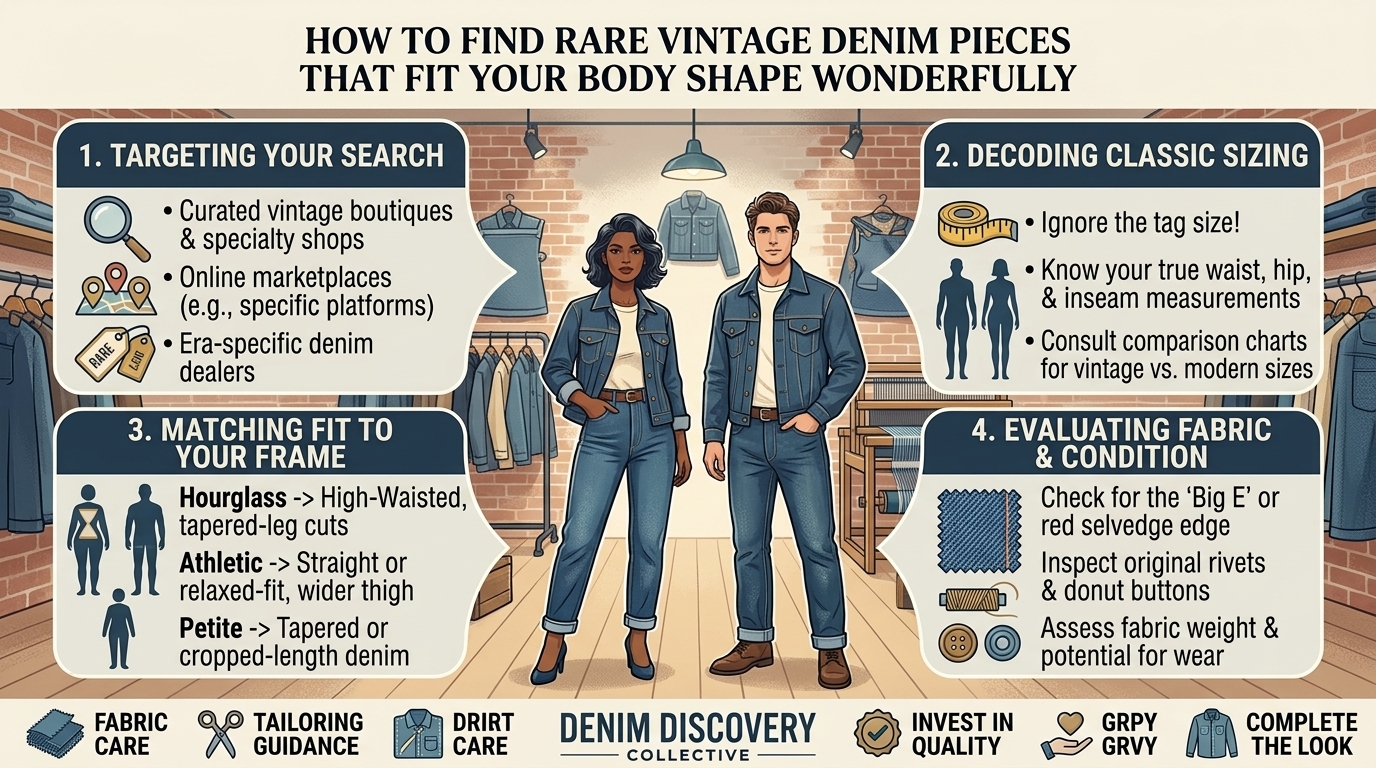
1.Step 1: Master the Flat-Lay Measurement Technique:Discard vintage tag sizes and rely strictly on physical tape measurements.
- Never Trust the Tag Size: A vintage 1970s tagged Size 32 often measures closer to a modern 28-inch waist due to shrinkage and legacy sizing standards.
- Measure Your Favorite Rigid Pants: Lay your best-fitting non-stretch pair of cotton pants flat on a table.
- Record the Big Four Metrics:
- Waist: Measure straight across the back waistband, pulled taut, and double it.
- Front Rise: Measure from the crotch seam straight up to the top of the waistband.
- Hip: Measure straight across the base of the zipper track from edge to edge, and double it.
- Inseam: Measure along the inner leg seam from the crotch point down to the bottom hem.
2.Step 2: Align Denim Silhouette with Body Proportions:Match vintage cut characteristics to your specific body geometry.
- Curvy & Pear Shapes (Smaller Waist, Fuller Hips/Thighs): Seek out 1980s high-rise tapered cuts or 1970s high-rise flares. Look for a deep front rise (12″+) and a generous hip measurement to prevent waistband gap.
- Athletic & Straight Shapes (Balanced Waist & Hips): Focus on 1990s mid-rise straight-leg cuts (such as classic 501-style patterns). These sit comfortably on the hips without squeezing.
- Petite Frames: Prioritize 1990s cropped straight-leg denim or vintage youth sizes. Ensure the knee position aligns properly with your leg length before committing to hemming.
3.Step 3: Execute the Hardware and Fabric Stress Test:Inspect fabric health, distressing, and seam allowances before buying.
- Check for Dry Rot & Fabric Thinning: Hold the denim up to strong light. Inspect high-friction areas (inner thighs, crotch seam, back seat). Thinning fabric will require reinforcement or darning.
- Inspect Crotch & Pocket Rivets: Verify that copper rivets are intact and that the crotch seam hasn’t been weak-stitched or blown out by previous owners.
- Check the Hemline Integrity: Look for original chain-stitching on the hem. If the jeans were shortened previously, ensure the leg taper was maintained correctly.
3. How to Tailor and Custom-Break In Vintage Denim
Even rare vintage denim rarely fits 100% perfectly right off the rack. Here is how professional stylists refine the fit:
- Use the “Original Hem” Tailoring Technique: If your rare vintage jeans are too long, instruct your tailor to preserve the original hem. This keeps the authentic rope-stitching, distressing, and wash fade at the bottom of the leg intact.
- Add Waist Darts for Waist-Gap Fixes: If denim fits your hips perfectly but gaps at the small of your back, a tailor can add two clean interior waist darts along the back yoke to cinch the waist without distorting the pocket placement.
- The Hot-Tub / Warm Soak Break-In Method: Put on your slightly stiff 100% cotton vintage jeans, sit in a warm bath for 20 minutes, then wear them until dry (or let them damp-air-dry on your body). The cotton fibers will contract and mold precisely to your natural curves as they dry.
10 Frequently Asked Questions (FAQ)
1. Why is vintage denim sizing so different from modern sizing?
Vintage sizing reflects older manufacturing standards, and 100% cotton shrinks and molds after years of washing and wearing. Modern vanity sizing also makes modern clothing sizes larger than historical equivalents.
2. Can you stretch out vintage 100% cotton denim if it feels too tight?
Yes. Pure cotton denim can stretch up to 0.5 to 1 full inch in high-pressure areas (waist, seat, and upper thighs) with heat, moisture, and consistent wear. It will not, however, stretch as easily as modern elastane-blend jeans.
3. How do I know if vintage jeans are authentic selvedge?
Turn the pant leg inside out and inspect the outer seam. Authentic selvedge denim features a clean, tightly woven fabric edge (often white with a woven red thread) running down the seam, rather than an exposed overlock/zigzag stitch.
4. What is a “crotch blowout,” and can it be repaired?
A crotch blowout is fabric tearing near the inner-thigh crotch seam caused by friction and wear. It can be repaired by a tailor using a technique called invisible darning, which reinforces the damaged area with matching thread gridwork.
5. How often should I wash rare vintage denim pieces?
Wash them as infrequently as possible—typically after 10 to 15 wears—unless visibly soiled. Spot clean minor dirt, and air them outdoors to refresh the fabric between wears.
6. What is the safest way to wash vintage denim without shrinking it?
Turn the jeans inside out, submerge them in cold water with a mild pH-neutral or denim-specific detergent, gently agitate by hand, and hang them to air-dry away from direct sunlight. Never use a hot machine dryer on rare vintage denim.
7. How do I prevent waistband gap on vintage jeans?
Choose high-rise cuts with a high hip-to-waist ratio (like 1980s tapered cuts), or take the jeans to a master tailor to add subtle internal waist darts along the rear waistband.
8. Are 1990s low-rise jeans flattering for all body types?
Low-rise Y2K jeans sit across the hips rather than the narrow natural waist. They tend to elongate the torso and shorten the leg line, making them ideal for long-legged or petite frames, but less supportive for pear or hourglass body shapes.
9. Where is the best place to source authentic vintage denim?
Curated vintage boutiques, specialized estate sales, flea markets (like those in Queens, Brooklyn, Rose Bowl, or Austin), and reputable online archives like Grailed, Depop, or specialized vintage dealers offer the best selection.
10. Is it worth buying distressed vintage denim with holes?
Yes, provided the tears are not near high-stress structural seams (like the crotch seam or zip fly). Natural distressing adds character, and small knee holes can be backed with cotton patches to prevent further tearing.
Conclusion
Finding rare vintage denim that flatters your body shape requires looking past tag numbers and focusing on actual flat-lay measurements, fabric weight, and era-specific silhouettes. By understanding how 1970s flares, 1980s tapered cuts, and 1990s straight legs interact with your natural body geometry, you can build a personalized vintage denim collection that looks custom-tailored.
For more vintage curation frameworks, street style tactics, and wardrobe care guides across New York, California, San Francisco, Texas, and Washington, stay tuned to NY Attitude.