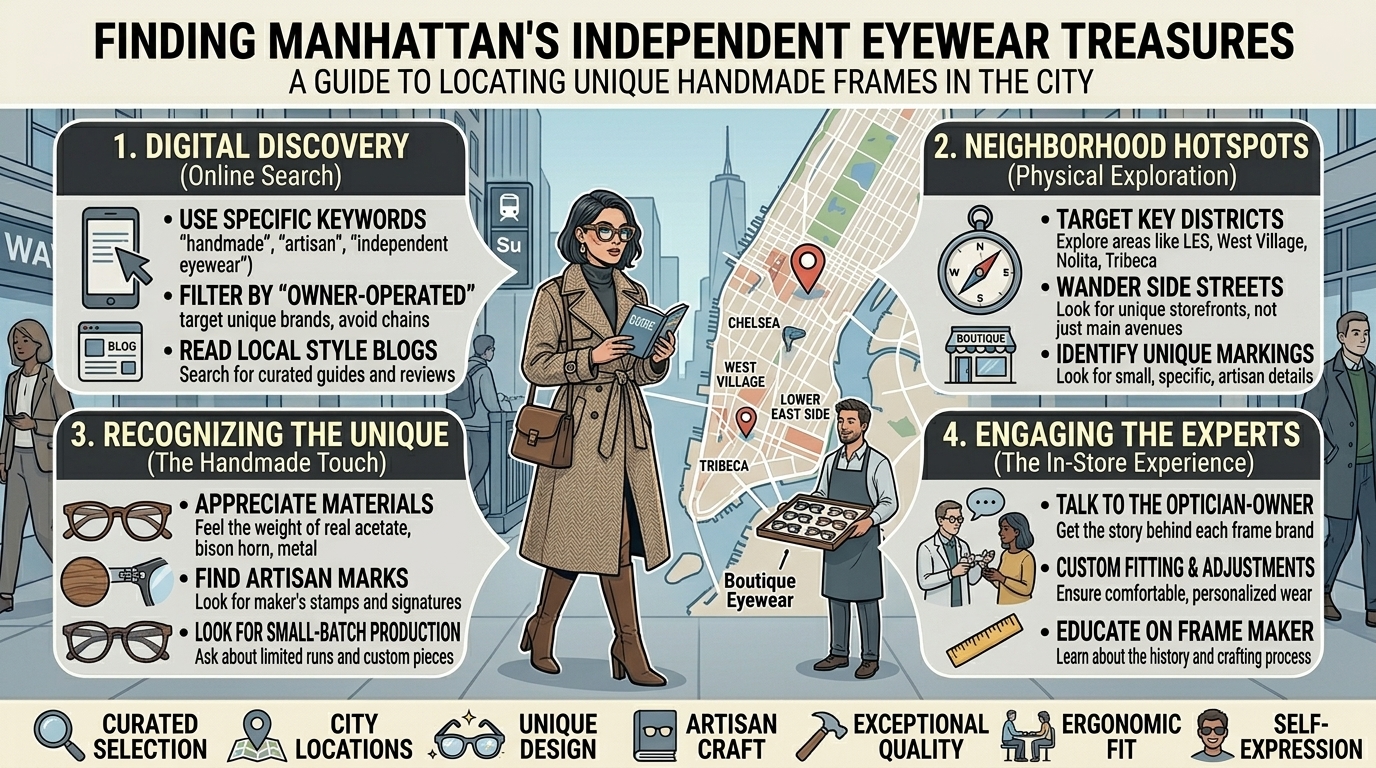
In an era of mass-produced, license-branded optical frames that saturate online direct-to-consumer platforms and chain retail optical hubs, finding genuinely distinctive, handcrafted eyewear has become a refined art form. For individuals who treat spectacles not merely as vision correction but as the primary architectural anchor of their personal identity, Manhattan remains a premier destination for independent eyewear craftsmanship.
From the cobblestone streets of SoHo and the historic storefronts of the Lower East Side to the refined brownstones of the Upper East Side and Flatiron’s design hubs, Manhattan hosts world-class independent eyewear boutiques. These specialized shops curate rare, handmade frames crafted by master artisans in Japan, France, Germany, Italy, and small domestic ateliers.
At NY Attitude, we bring you urban style strategies, artisanal craft breakdowns, and city shopping frameworks. Whether navigating independent retail hubs across New York, San Francisco, and California, exploring rain-ready optical solutions in Washington, or curating high-end sunwear for Texas, this comprehensive guide details how to locate, evaluate, and invest in unique handmade eyewear across Manhattan.
1. What Defines “Handmade” and “Independent” Eyewear?
Before embarking on your search across Manhattan’s neighborhoods, it is essential to understand the technical criteria that differentiate artisanal eyewear from mass-market production:
+--------------------------------------------------------------------------+
|                     EYEWEAR CRAFTSMANSHIP SPECTRUM                       |
+------------------------------------+-------------------------------------+
| 1. MASS-PRODUCED INJECTION MOLDED  | Molded plastics, stamped metals,    |
|    Fast fashion / Chain opticals   | automated mass assembly             |
+------------------------------------+-------------------------------------+
| 2. SEMI-HANDCRAFTED BATCHES        | CNC-milled acetate, hand-finished   |
|    Boutique brands & designer hubs | tumbling, assembly line riveting    |
+------------------------------------+-------------------------------------+
| 3. ARTISANAL HANDMADE (BESPOKE)    | Japanese Takumi hand-cured acetate, |
|    Independent master ateliers     | hand-hammered titanium, custom rivets|
+------------------------------------+-------------------------------------+
Technical Hallmarks of Handcrafted Eyewear
- Cured Cellulose Acetate: High-grade handmade frames utilize plant-based cellulose acetate (often sourced from Takiron in Japan or Mazzucchelli in Italy) that has been cured for months to drive out excess moisture. This process prevents warping, ensures rich depth of color, and allows for precise custom adjustments.
- Riveted Hinge Architecture: Unlike mass-market frames where metal hinges are simply heat-sunk or glued into plastic, artisanal frames feature genuine riveted hinges pinned completely through the acetate front and temples for structural longevity.
- Hand-Polished Finish: Artisanal frames undergo hours of tumbling in hardwood chips followed by hand-buffing using specialized polishing wheels, yielding a smooth luster that mass chemical dipping cannot replicate.
- Pure Japanese Titanium & Beta-Titanium: For metal frames, Japanese titanium craftsmanship represents the global benchmark. It offers lightweight durability, non-corrosive properties, and hypoallergenic safety.
| Craft Feature | Mass-Produced Frames | Independent Handmade Frames | Long-Term Advantage |
| Material | Petroleum plastic / cheap alloy | Cured plant acetate / Pure Titanium | Holds custom adjustments; non-allergenic |
| Hinge Construction | Heat-sunk plastic joints | Real pin-riveted 5 to 7-barrel hinges | Highly durable; easily repaired |
| Batch Size | 100,000+ units per run | Limited runs (50–500 units globally) | High exclusivity; unique aesthetic |
| Adjustability | Brittle; prone to snapping | Pliable under heat; custom fitting | Perfectly balanced on face without pinching |
2. Neighborhood Map: Top Manhattan Districts for Independent Eyewear
Finding rare eyewear boutiques requires knowing which Manhattan micro-neighborhoods harbor dedicated optical curators:
1.Step 1: Lower East Side & SoHo:Explore avant-garde design and rare Japanese imports.
- The Vibe: Creative, avant-garde, and high-design forward.
- What You Will Find: Boutiques in this corridor showcase rare Japanese Takumi optical frames, hand-cut titanium wire structures, bold architectural shapes, and limited-edition colorways from independent European labels.
2.Step 2: West Village & Greenwich Village:Find mid-century vintage archives and classic tailored frames.
- The Vibe: Historic, eclectic, and timelessly stylish.
- What You Will Find: Tucked along quiet tree-lined streets, Village boutiques excel in deadstock vintage frames, custom bespoke horn or wood opticals, and understated classic silhouettes built with modern hand-assembly techniques.
3.Step 3: Upper East Side & Flatiron District:Discover refined luxury, bespoke fits, and precious metals.
- The Vibe: Refined, executive, and high-lux.
- What You Will Find: These districts cater to clients seeking ultra-premium materials like solid gold detailing, genuine water buffalo horn, hand-carved wood, and customized bespoke fitting appointments with master opticians.
3. Five Steps to Buying Custom Handmade Eyewear in Manhattan
- Book a Consultation with a Licensed Dispensing Optician: Independent boutiques employ master opticians who analyze facial topology, bone structure, and pupillary distance to ensure the frame sits properly on your face.
- Evaluate the Acetate Weight and Balance: Pick up the frame. Handmade cured acetate has a balanced feel—neither flimsy nor uncomfortably heavy on the bridge of your nose.
- Inspect the Joint Construction: Turn the temple arms and check the hinges. Look for multi-barrel pin rivets (5-barrel or 7-barrel) that move smoothly without stiffness or wobble.
- Inquire About Production Runs: Ask the boutique staff about the brand’s origin, batch size, and maker. True independent labels produce small, numbered batches (e.g., frame 42 of 300).
- Customize Your Lenses: Pair high-end handmade frames with advanced anti-reflective, anti-scratch, high-index, or custom tinted lenses (such as flash mirrors or vintage gradient washes).
10 Frequently Asked Questions (FAQ)
1. Why are independent handmade frames more expensive than commercial optical store frames?
Handmade frames use premium materials (cured Japanese or Italian acetate, pure titanium) and undergo up to 300 individual manual steps—including hand-polishing and hand-pinning. Small production runs and master labor increase production costs, resulting in a durable piece of functional art.
2. How do I know if an eyewear boutique is truly independent?
Independent boutiques are privately owned and carry frame makers that operate outside of major optical conglomerates. They focus exclusively on design-led, independent brands rather than licensed fashion labels.
3. Can I get prescription lenses fitted in independent boutique frames?
Yes. Independent optical boutiques house licensed opticians who can ground custom prescription lenses (single vision, progressive, or reading) directly into your chosen handmade frame.
4. What is the difference between Japanese acetate and European acetate?
Japanese acetate (such as Takiron) is cured for an extended period, resulting in a denser, harder material that holds sharp edges, intricate polishes, and custom adjustments exceptionally well. European acetate (such as Mazzucchelli) is famous for rich color depth, unique pattern layering, and warm translucency.
5. Can genuine buffalo horn or wood frames be adjusted?
Yes, but only by experienced opticians using specialized heating equipment. Natural materials require careful maintenance (such as occasional moisturizing with natural creams) to preserve their luster and flexibility.
6. Are vintage deadstock frames safe to wear with new prescription lenses?
Yes, provided the acetate has not dried out or become brittle with age. Professional boutique opticians inspect vintage frames for structural integrity before fitting new lenses.
7. How should a handmade frame fit on my nose bridge?
The frame bridge should rest flush against the slope of your nose without gaps, pinching, or red pressure marks. Cured acetate and titanium nose pads can be custom-contoured by an optician for a balanced fit.
8. How long does a pair of handcrafted independent frames last?
With proper care and periodic adjustments by an optician, a high-quality handmade frame can last for decades. Unlike mass-produced plastic, cured acetate can be re-polished and re-aligned multiple times.
9. Can I buy sunglass frames and convert them into optical prescription glasses?
Yes. Almost all high-end acetate or titanium sunglass frames can be fitted with clear, anti-reflective prescription lenses, blue-light filtering lenses, or custom photochromic (transition) lenses.
10. Do independent Manhattan boutiques offer bespoke (fully custom) frame fitting?
Several elite Manhattan optical studios offer fully bespoke services, where measurements of your face, temple length, bridge width, and head circumference are taken to craft a one-of-a-kind frame from scratch.
Conclusion
Finding independent eyewear boutiques offering unique handmade frames in Manhattan is an engaging journey into true craft and personal style. By venturing beyond commercial chain stores into curated optical ateliers across SoHo, the Lower East Side, the West Village, and the Upper East Side, you gain access to rare materials, master opticians, and distinctive silhouettes.
For more urban shopping frameworks, artisanal fashion guides, and lifestyle insights across New York, California, San Francisco, Texas, and Washington, stay tuned to NY Attitude.