Why Confidence and Posture Change How an Outfit Looks on the City Streets
You can purchase an archive-piece designer coat, invest in rare Japanese selvedge denim, or hunt down an immaculate vintage leather trench from a boutique in SoHo. But the moment you step out onto the pavement, the visual success of that outfit is determined by a factor that no luxury fashion house can manufacture: how you carry your physical body through space.
From the fast-paced sidewalks of Manhattan and the steep inclines of San Francisco to the rainy transit corridors of Seattle, the coastal boulevards of Los Angeles, and the expansive downtown districts of Austin and Houston—city streets act as an unscripted, highly visual stage. The exact same outfit can look slouchy, uninspired, and awkward on one person, yet project authority, effortless style, and magnetic presence on another.
The secret difference lies in the intersection of biomechanical posture, psychological presence, and garment drape. Clothes are not static sculptures; they are dynamic textiles engineered to move around a living human frame. When your posture aligns correctly and your nonverbal confidence communicates ease, you change how light hits the fabric, how outerwear swings, and how passersby perceive your personal style.
At NY Attitude, we explore urban fashion frameworks, street style dynamics, and body language mechanics. Whether navigating cold commutes in New York and San Francisco, managing wet winter weather in Washington and California, or styling year-round street looks in Texas, this comprehensive guide breaks down why posture and confidence transform your wardrobe from basic clothes into an iconic street statement.
1. The Biomechanics of Garment Drape: How Posture Alters Clothes
To understand why posture dictates style, you must look at how clothing is designed and constructed. Pattern makers and tailors draft garments using an idealized, upright anatomical grid. When your natural body alignment strays significantly from that grid, the structural integrity of your clothes collapses.
+--------------------------------------------------------------------------+
|                 BIOMECHANICAL DRAPE & TENSION MATRIX                     |
+------------------------------------+-------------------------------------+
| 1. NEUTRAL SPINAL ALIGNMENT        | Tailored shoulders sit flat,        |
|    Symmetrical weight distribution | lapels lay flush against chest      |
+------------------------------------+-------------------------------------+
| 2. FORWARD HEAD & ROUNDED SHOULDERS| Lapels gape, back hem hitches up,  |
|    Upper-torso collapse            | chest fabric bunches awkwardly     |
+------------------------------------+-------------------------------------+
| 3. ANTERIOR PELVIC TILT            | Front waist dips, rear hem pulls,  |
|    Lower-body misalignment         | rise tightens across hip joints    |
+------------------------------------+-------------------------------------+
The Three Structural Distortions
- The Upper-Torso Collapse (Forward Head & Rounded Shoulders): Slouching forwards pulls shoulder seams forward, causing structured jacket lapels to gape open away from the chest. The back neck collar pulls away from your shirt, creating an unsightly gap. Additionally, the front panels of blazers and coats cross unevenly, distorting clean architectural lines.
- The Hip and Rise Pull (Pelvic Tilting): Tilting your pelvis excessively alters how trousers sit on your waist. High-waisted wool pants or raw denim distort along the crotch seam and thigh rise, causing fabric to wrinkle unnaturally across the front while bunching around the lower back seat.
- The Asymmetrical Stride (Uneven Weight Distribution): Carrying your body with rigid tension or shifting weight onto a single hip makes outerwear hang unevenly. A classic trench coat or heavy wool overcoat depends on fluid, symmetrical swing during movement to create a sleek silhouette.
| Posture Habit | Garment Impact | Visible Aesthetic Result | Simple Physical Correction |
| Rounded Shoulders | Pulls shoulder seams forward | Gaping lapels, tight back fabric | Retract shoulder blades back and down |
| Forward Head Drift | Lifts back collar off neck | Coat looks oversized/unfitted | Align ears directly over shoulders |
| Sunken Chest / Slouch | Flattens front profile | Blouses and shirts look saggy | Lift sternum upward 1 inch |
| Dragging Stride | Bunches trouser hems at ankles | Distorts leg line and shoe drape | Engage core; push off cleanly from midfoot |
2. The Psychology of Street Presence: Clothes follow Energy
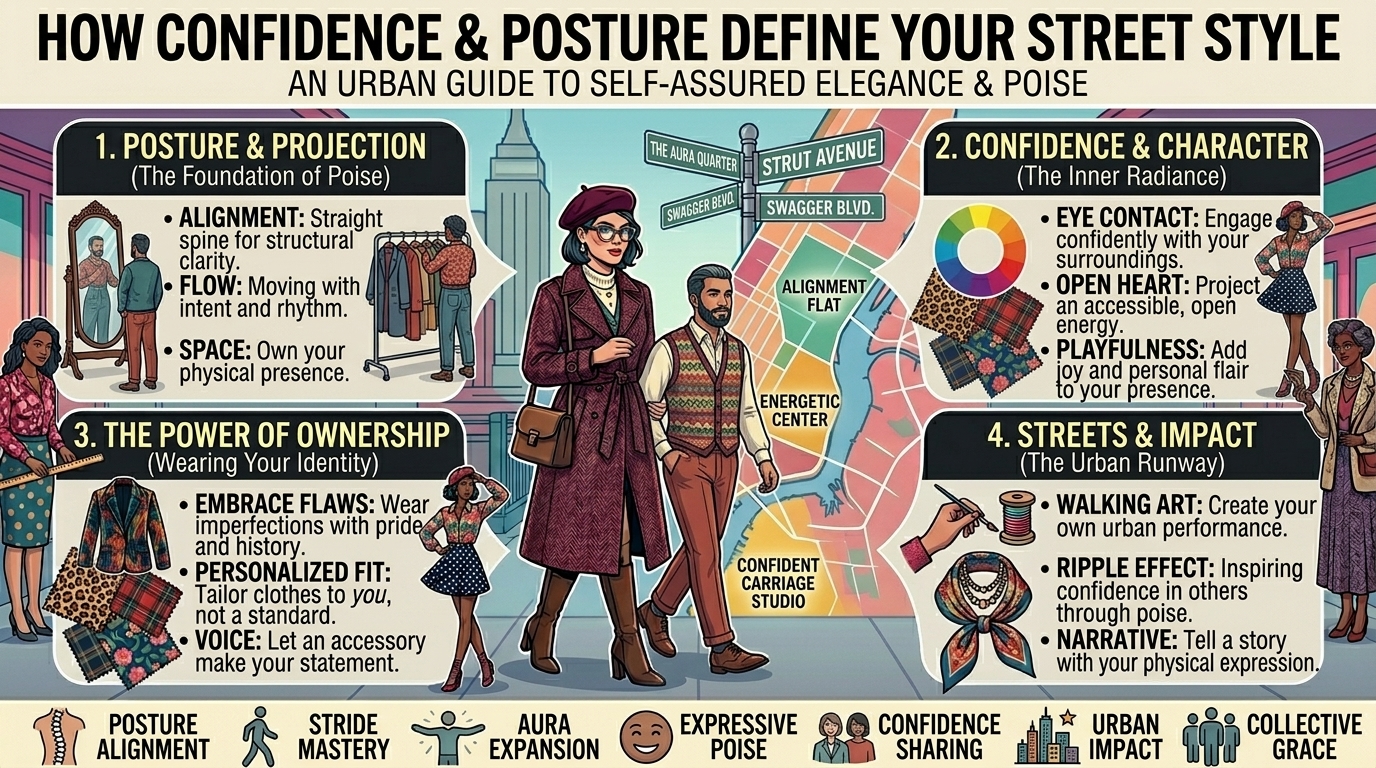
Street style is 50% textile and 50% nonverbal communication. Psychologists and sociologists refer to this dynamic as enclothed cognition combined with somatic presence—the psychological phenomenon where the clothes you wear alter your state of mind, while your physical posture simultaneously dictates how others interpret your authority, approachability, and taste level.
1.Step 1: Calibrate Your Skeletal Alignment:Align your spine to allow garments to hang according to their intended design.
- Lift the Sternum: Imagine a thin thread pulling your breastbone slightly upward and forward. This instantly opens your chest, drops your shoulders into their natural sockets, and allows jacket lapels to rest flush against your torso.
- Level Your Gaze: Looking down at pavement or phone screens pulls the cervical spine out of alignment. Keep your chin parallel to the ground and your gaze directed forward down the city block.
2.Step 2: Control Your Pace and Spatial Ownership:Eliminate frantic, hesitant movements to project effortless sophistication.
- Adopt an Unhurried Stride: Rushing frantically with short, choppy steps creates visual chaos. A deliberate, ground-covering gait allows long coats, wide-leg trousers, and scarves to flow fluidly.
- Reclaim Spatial Area: Keep your arms relaxed at your sides rather than crossed defensively over your chest. Allow your shoulders to occupy their full width inside your outerwear.
3.Step 3: Eliminate ‘Outfit Fidgeting’:Internalize your outfit choice to project unshakeable ease.
- Stop Adjusting in Public: Constantly tugging at your hem, checking your collar, or adjusting your waistband signals that you feel uncomfortable in your clothes.
- Embrace Intentional Nonchalance: Set your outfit before leaving home, then forget about it completely. Confidence is the quiet assurance that you look immaculate without needing constant reassurance.
3. Street-Tested Styling Formulas to Elevate Posture
While physical body alignment is fundamental, strategic clothing choices can visually reinforce and enhance your natural posture:
- Utilize High-Structure Shoulder Architecture: Tailored blazers and overcoats with light shoulder padding visually broaden the upper frame, compensating for slight shoulder rounding and establishing an authoritative triangular silhouette.
- Anchor Outfits with High-Support Footwear: Throw away flimsy, flat-soled shoes that encourage over-pronation and slouched walking. Choose cushioned lug-sole loafers, structured chelsea boots, or supportive leather sneakers that promote proper weight distribution from heel to toe.
- Frame the Neck and Jawline: High-neck turtlenecks, crisp stand-up collars, and structured lapels draw visual focus upward toward your head and neck, subtly emphasizing a strong, erect head position.
10 Frequently Asked Questions (FAQ)
1. How does good posture make inexpensive clothes look more expensive?
Proper posture aligns seam lines, prevents fabric from sagging or bunching, and allows inexpensive garments to drape smoothly over your frame, mimicking the clean fit of expensive, custom-tailored apparel.
2. Can the wrong footwear ruin your posture and overall outfit look?
Yes. Shoes lacking arch support or stability cause feet to roll inward (pronation), which tilts the pelvis, rounds the lower back, and distorts how trousers drop over your shoes.
3. What is “outfit fidgeting,” and why does it hurt your style profile?
Outfit fidgeting involves constantly pulling down shirt hems, adjusting belt buckles, or checking collar placement in store window reflections. It signals self-consciousness and destroys the impression of effortless style.
4. How can heavy winter coats affect walking posture?
Bulky or overly heavy wool coats can pull your shoulders forward and down. To combat this, select lightweight high-fill technical puffers or coats with internal waist structure that distribute garment weight across your core rather than your neck.
5. Why do wide-leg trousers look better when walking with a confident stride?
Wide-leg trousers depend on movement to showcase their architectural drape. A confident, deliberate stride creates air movement through the trouser leg, producing a striking fluid motion.
6. How do I fix forward head posture when walking in cold city wind?
Instead of hunching your neck down into your chest to block cold wind, raise your jacket collar or wrap a generous wool scarf around your neck to create a thermal barrier while keeping your spine straight.
7. What role does core strength play in looking good in clothes?
A strong physical core (abs, lower back, and glutes) stabilizes your pelvis and spine, allowing you to maintain an upright, relaxed posture naturally without tensing your shoulders or locking your knees.
8. Can wearing oversized streetwear still look good with proper posture?
Yes. Oversized fashion relies heavily on posture; an upright frame gives boxy garments clear architectural structure, whereas slouching inside oversized clothes makes you look swallowed up by fabric.
9. How does eye contact factor into urban street style presence?
Holding a calm, neutral gaze forward down the sidewalk communicates confidence, self-assurance, and ownership of your space, elevating your overall presence beyond just the clothes you are wearing.
10. How long does it take to retrain your walking posture for the street?
With conscious daily awareness—such as checking your alignment when stepping off curbs or catching your reflection in windows—it typically takes 3 to 4 weeks to build the muscle memory for effortless upright posture.
Conclusion
At its core, fashion is an interactive art form where your body serves as the canvas. No matter how rare, expensive, or carefully thrifted your wardrobe may be, it remains incomplete without physical confidence and strong posture. By aligning your spine, walking with deliberate purpose, and eliminating outfit self-consciousness, you transform simple garments into an unforgettable urban statement.
For more street-style breakdowns, body language frameworks, and urban lifestyle insights across New York, California, San Francisco, Texas, and Washington, stay tuned to NY Attitude.