Welcome to nyattitude.com—your premier cultural, lifestyle, and urban safety destination providing essential neighborhood guides, situational awareness strategies, and street-smart wisdom spanning New York, San Francisco, Texas, California, and Washington.
Introduction: Navigating the Midnight Metropolis
There is an intoxicating, cinematic magic to walking through the streets of New York City after midnight. When the daytime commuter crowds dissipate, the city transforms. The neon lights of neon signs reflect off damp pavement, the distant rumble of the subway echoes through sidewalk ventilation grates, and iconic skylines loom against velvet skies. For residents and visitors alike, late-night walks offer a rare moment of quiet reflection amidst a relentless metropolis.
However, navigating New York’s diverse neighborhoods after dark requires more than romanticism—it demands hyper-awareness, geographical intelligence, and street smarts. New York is famously one of the safest major cities in the United States per capita, but its safety profile shifts dramatically depending on the borough, the hour, the avenue, and your own behavioral cues.
Whether you are walking through the historic brownstones of the West Village, catching late-night transit in Brooklyn, or exploring the kinetic energy of downtown corridors, this comprehensive masterclass provides the ultimate engineering playbook for staying safe while walking alone late at night in New York City.
Part 1: The Geography of Safety—Understanding NYC Neighborhood Dynamics
New York City is an archipelago of distinct neighborhoods, each with its own architectural layout, lighting infrastructure, foot traffic patterns, and safety profile after dark. A blanket set of rules does not apply equally across all five boroughs.
1. Manhattan: High Traffic, Bright Lights, and Watchful Eyes
Manhattan below 96th Street is characterized by a grid system, high population density, 24-hour commercial activity, and strong street illumination.
- The Commercial Corridors: Avenues like Broadway, 8th Avenue, and major commercial strips in Chelsea, Greenwich Village, and the Financial District rarely go dark. Even at 3:00 AM, bodega lights, late-night diners, and delivery workers maintain ambient human presence.
- The Quiet Pockets: Conversely, narrow residential side streets in the East Village, Lower East Side, or parts of Harlem can empty out completely after 2:00 AM. Knowing when to transition from a quiet side street back onto a well-lit avenue is a vital survival skill.
2. Brooklyn & Queens: The Residential Frontier
Outside of Manhattan, residential density changes, and subway stations are often spaced further apart.
- Transit Deserts: Walking a mile from a subway station home in parts of Brooklyn (like Midwood or outer Crown Heights) or Queens (like Astoria or Flushing) late at night means navigating quieter, lower-lit residential blocks where pedestrian eyes on the street are sparse.
- Gentrifiers and Boundaries: In rapidly evolving neighborhoods, safety can shift drastically from one block to the next. Learning the local boundaries and sticking to commercial avenues late at night is essential.
Part 2: Step-by-Step Urban Safety Protocol
To ensure your late-night walks remain peaceful and secure, follow this step-by-step situational awareness framework:
Step 1: Master the Art of “Heads-Up” Walking
The single biggest risk factor for urban pedestrians is digital distraction.
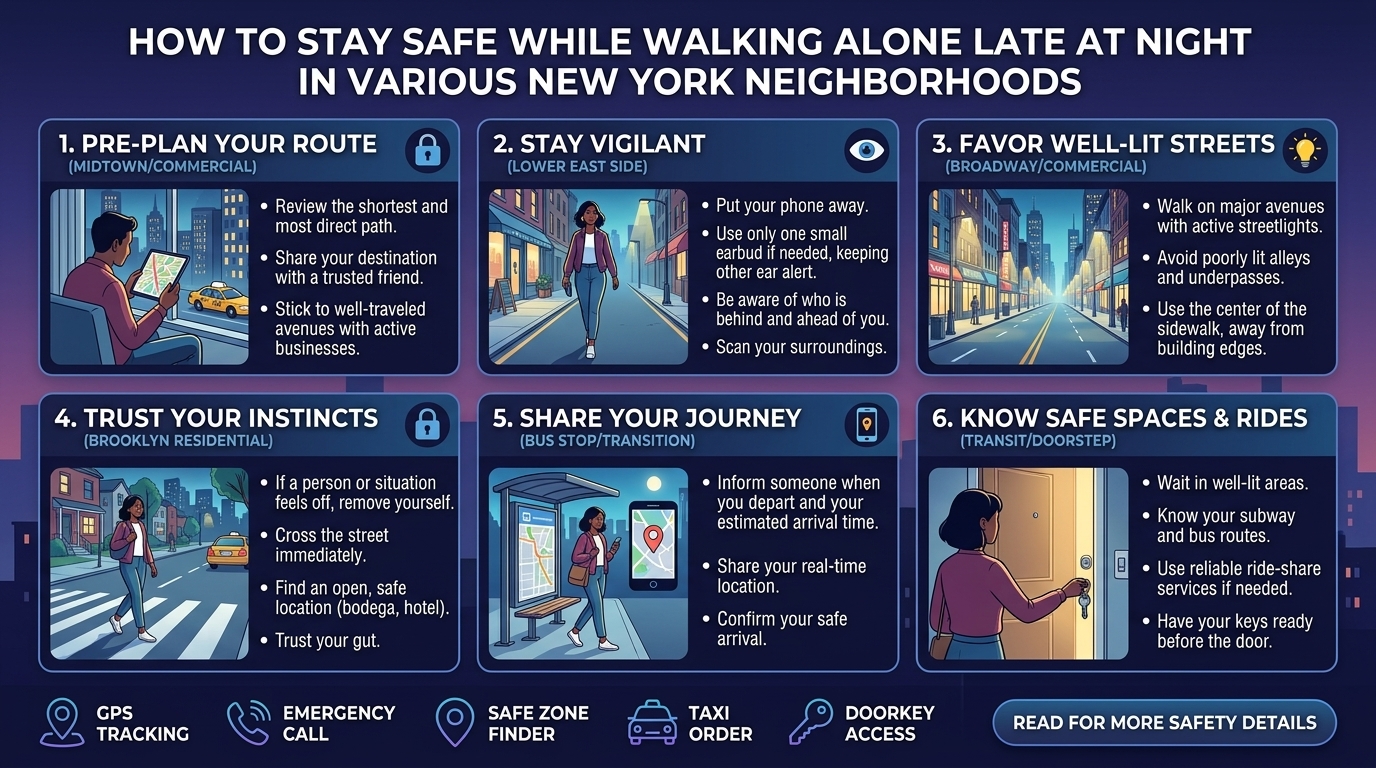
- Put the Phone Away: Walking alone while staring down at a glowing smartphone screen flashing directions or texting flags you instantly to opportunistic pickpockets and bad actors as unaware and vulnerable.
- Ditch Both Earbuds: Never walk alone at night with noise-canceling headphones playing music in both ears. If you must listen to music or podcasts, keep the volume low and use only one earbud, leaving your other ear completely open to ambient sound (footsteps, approaching vehicles, voices).
Step 2: Project “Controlled Confidence”
Muggings and street crimes are largely crimes of opportunity. Perpetrators instinctively scan crowds for targets displaying hesitation, confusion, or fear.
- Body Language Matters: Walk with a straight posture, an intentional stride, and your head up. Even if you are slightly lost, do not wander aimlessly while staring nervously at street signs. Step inside a well-lit bodega, 24-hour pharmacy, or hotel lobby to check your map in safety.
- Establish Eye Contact: Brief, neutral eye contact with people passing you signals that you see them and are paying attention. Perpetrators prefer targets who avoid looking at anyone.
Step 3: Optimize Your Route Strategy
- Stick to the Light and the Life: Choose routes that utilize well-lit commercial avenues rather than dark shortcuts through unpopulated parks, empty construction scaffolding, or deserted alleyways.
- Know the Open Beacons: Memorize the locations of 24-hour establishments along your route—such as Duane Reade/CVS pharmacies, diners, police precincts, and subway station token booths—so you always know where sanctuary is just seconds away.
Part 3: Transit Safety—Navigating Late-Night Subways and Rideshares
For most New Yorkers, a late-night walk is only one half of the journey; the other half involves public transit or ridesharing.
1. Navigating the Subway Platform After Midnight
- Stand in the Designated Waiting Area (MDA): Late at night, MTA subway stations feature yellow-striped “Safespot” waiting areas near the station booth or conductor car, equipped with intercoms and optimal camera coverage. Avoid waiting at the very dark, isolated ends of platforms.
- Ride Near the Conductor: Board subway cars in the middle of the train where the conductor’s booth is located, or sit in cars that have other passengers. Avoid empty subway cars late at night.
2. Smart Rideshare Verification
If you opt for an Uber or Lyft after a night out:
- Verify Before You Enter: Never open the door and hop into a car without checking the license plate, matching the car make and model, and asking the driver: “Who are you picking up?” Let them state your name rather than you asking, “Are you my Uber?”
- Track Your Route: Keep your GPS open on your phone during the ride to ensure the driver is following the optimal route.
Part 4: Essential Personal Safety Tools to Carry
Carrying discreet, legal self-defense and safety tools provides both practical protection and psychological peace of mind.
- A High-Lumen Flashlight: A compact, tactical flashlight capable of outputting 500+ lumens can temporarily blind and disorient an aggressive individual in the dark, giving you crucial seconds to escape.
- Personal Alarm: A keychain pull-alarm emits an ear-piercing 130-decibel siren when triggered, drawing immediate attention from surrounding buildings and deterring attackers.
- Legal Pepper Spray (OC Spray): In New York State, civilians are legally permitted to carry small canisters of self-defense pepper spray (purchased from licensed pharmacies or firearm dealers). Ensure you know how to operate the safety switch quickly.
Part 5: Frequently Asked Questions (FAQ)
1. Is it generally safe to walk alone at night in New York City?
Yes, compared to many global cities, Manhattan and major transit corridors are heavily policed and active. However, safety varies significantly by specific neighborhood, hour, and personal awareness.
2. What are the safest neighborhoods to walk through late at night?
Well-lit commercial and residential areas with high 24-hour foot traffic—such as the West Village, SoHo, the Upper East Side, and Midtown commercial corridors—are generally safe late at night.
3. Which areas should I avoid walking alone in late at night?
Isolated industrial zones, dark park paths after closing hours, unlit stretches near public housing developments without foot traffic, and deserted industrial waterfronts should be avoided after dark.
4. What should I do if someone approaches me aggressively on the street?
Do not engage in arguments or escalations. Yell “Back off!” or “Fire!” (which attracts more attention than calls for help) in a loud, commanding voice while immediately moving toward a crowded storefront or well-lit area.
5. Can I legally carry pepper spray in New York City?
Yes, New York residents and visitors are legally allowed to carry small self-defense pepper spray canisters, provided they are purchased from licensed New York vendors and the user is over 18 with no felony record.
6. Why is it dangerous to wear both earbuds at night?
Wearing noise-canceling earbuds in both ears completely strips away your auditory situational awareness, preventing you from hearing approaching footsteps, vehicle threats, or verbal warnings.
7. How do late-night subway stations change after midnight?
Train frequencies drop significantly after midnight (running every 15 to 30 minutes), meaning platforms are less crowded and require waiting in designated safe zones.
8. What is the safest way to get home if I feel unsafe walking?
If your gut tells you a street is unsafe, immediately step into a lit business or call a verified yellow cab, green taxi, or rideshare vehicle from a secure indoor location.
9. Are NYC parks safe to walk through at night?
No. Central Park, Prospect Park, and smaller neighborhood parks officially close at dusk or 1:00 AM. Walking deep into unlit park paths at night is strongly discouraged.
10. How can I project confidence even when I feel nervous?
Keep your head up, maintain a brisk, purposeful walking pace, keep your hands out of your deep coat pockets so you are ready to react, and project an air of destination-driven focus.
Conclusion
Walking alone late at night in New York City can be an exhilarating urban experience when approached with respect, preparation, and sharp situational awareness. By choosing well-lit commercial avenues, keeping your phone tucked away, mastering transit safety, and trusting your instincts, you can safely enjoy the midnight beauty of the greatest metropolis in the world.
Keep exploring nyattitude.com for more urban safety guides, neighborhood profiles, and lifestyle insights designed for smart explorers across New York, San Francisco, Texas, California, and Washington.