What Makes the Cultural Diversity in New York City Unlike Anywhere Else Globally
Welcome to nyattitude.com, your ultimate digital destination for exploring the pulse of America’s most dynamic metropolitan regions. Whether you are navigating the fast-paced corridors of Manhattan, managing tech innovation and multicultural hubs in San Francisco and California, connecting with global trade networks in Washington, or expanding business footprints across Texas, one truth remains unmatched: there is only one New York City.
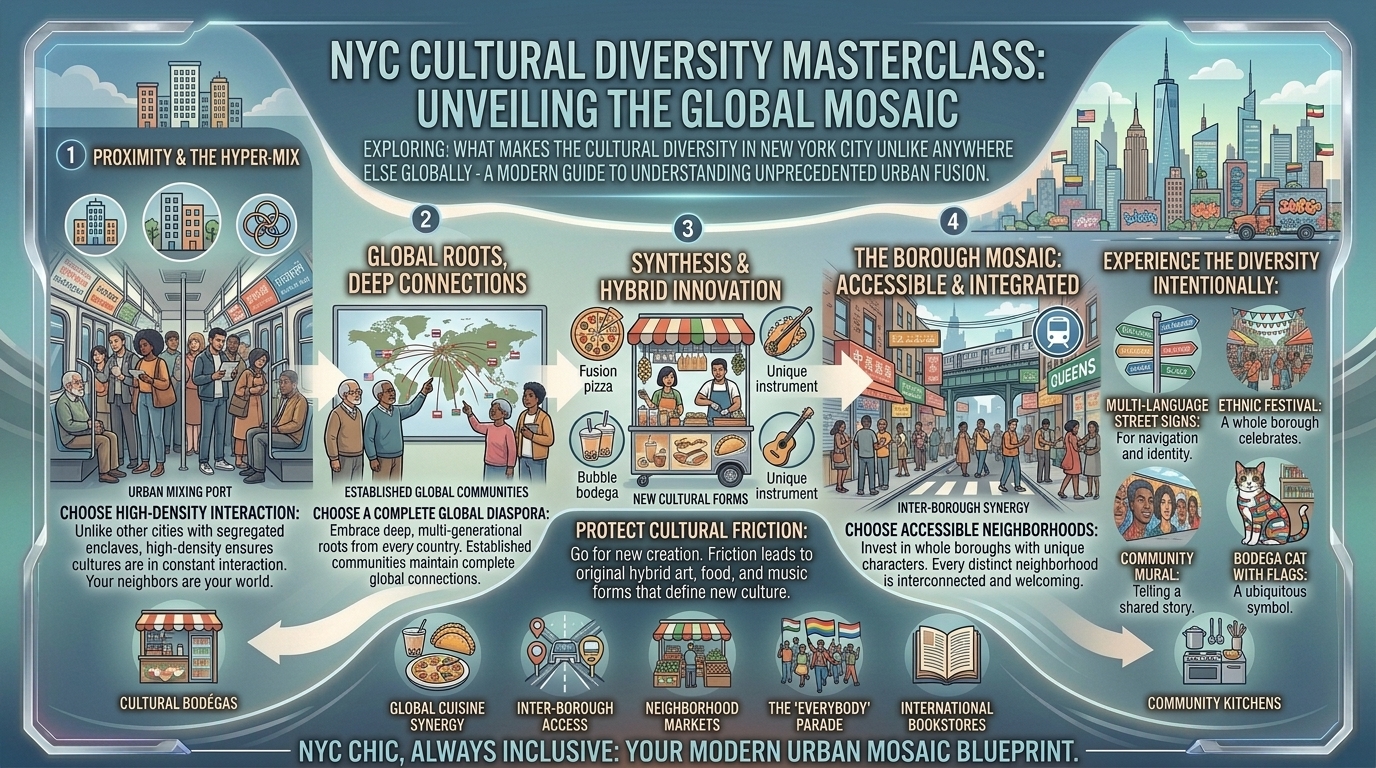
When discussing global cities, metropolises like London, Toronto, Sydney, and Tokyo often enter the conversation regarding diversity. Yet, New York City occupies a league entirely of its own. It is not merely a place where different nationalities live side-by-side; it is a hyper-dense, living, breathing laboratory of human culture where traditions fuse, languages collide on a single subway car, and global identities find a permanent home.
Roughly 37% of NYC’s population is foreign-born, with upwards of 800 distinct languages spoken across its five boroughs. But statistics only tell half the story. This comprehensive guide explores what makes New York City’s cultural diversity uniquely distinct from anywhere else on earth, examining its historical foundations, hyper-localized enclaves, economic engine, culinary landscapes, and a detailed FAQ section.
Part 1: The Historical Architecture of New York’s “Superdiversity”
To understand why New York’s cultural fabric is peerless, you have to look at the unique mechanics of its immigration history.
1. The Gateway Tradition (From Ellis Island to Modern Boroughs)
For over a century, New York has served as the primary psychological and physical gateway to the United States. While other cities grew through localized domestic migration or single-wave colonization, New York was continuously fed by successive, overlapping waves of global migration.
- In the 19th and early 20th centuries, it was shaped by Irish, Italian, German, and Eastern European Jewish immigrants.
- In the late 20th century and into the modern era, that wave expanded globally, drawing massive diasporas from the Dominican Republic, China, Jamaica, Guyana, Mexico, Ecuador, West Africa, South Asia, and the former Soviet Union.
2. The Evolution from “Melting Pot” to “Mosaic”
The old metaphor of the “melting pot” implied that immigrants had to strip away their native cultural identities to blend into a uniform American paste. New York shattered that paradigm. Instead, it became a cultural mosaic—or what sociologists call “superdiversity.” In NYC, you don’t have to assimilate into a bland monoculture; the city forces you to expand your worldview while letting you maintain the deep roots of your heritage. You can be 100% New Yorker and 100% Dominican, Korean, Nigerian, or Greek simultaneously.
Part 2: Hyper-Localized Cultural Enclaves (The Borough Blueprint)
In many global cities, immigrant communities are pushed out to suburban peripheries or isolated outskirts. In New York City, distinct global cultures thrive directly in the dense, beating heart of the urban center.
1. Queens: The Most Linguistically Diverse Place on Earth
If you walk down Roosevelt Avenue in Jackson Heights, Queens, you will witness a density of human diversity that exists nowhere else on the planet. Within a three-block radius, you can hear Spanish, Tibetan, Hindi, Nepali, Bengali, and Mandarin. Jackson Heights and neighboring Elmhurst house vibrant pockets known informally as Little Colombia, Little Tibet, and Little India.
2. Brooklyn: From Little Odessa to Little Caribbean
Brooklyn is a masterclass in contrasting cultural enclaves:
- Brighton Beach (“Little Odessa”): A coastal enclave where storefront signs are written in Cyrillic, and Russian, Ukrainian, and Central Asian cultures flourish along the boardwalk.
- Flatbush and Crown Heights: Home to one of the largest West Indian and Afro-Caribbean diasporas outside the Caribbean, driving the explosive energy of the annual West Indian American Day Carnival.
- Greenpoint (“Little Poland”): Historic bakeries, butcher shops, and community spaces honoring generations of Polish heritage.
3. Manhattan and the Bronx: Historic Roots and Modern Hubs
From Manhattan’s historic Chinatown (one of the oldest and largest Chinese communities in the Western Hemisphere) and Washington Heights (“Little Dominican Republic”) to the vibrant West African communities in Harlem (“Little Senegal”) and the rich Latino and Black cultural roots spanning the Bronx, diversity is woven into every zip code.
Part 3: The Sensory Manifestations of NYC Diversity
Diversity in New York is not an abstract political talking point; it is a visceral, multi-sensory daily experience.
1. The Global Culinary Ecosystem
You do not need a passport to taste the globe; you just need a MetroCard. Nowhere else can you eat authentic Shanghainese soup dumplings for breakfast in Flushing, authentic Guyanese curry for lunch in Richmond Hill, traditional Nigerian jollof rice for dinner in the Bronx, and fresh handmade burrata in Little Italy—all within a single afternoon. NYC food culture is driven by immigrant grandmothers, ambitious second-generation chefs, and neighborhood spots where recipes have been guarded for generations.
2. Linguistic Fluidity
Step onto a Manhattan cross-town bus or a Brooklyn-bound subway train, and you will hear a masterclass in global linguistics. It is entirely normal for a conversation to shift effortlessly between English, Spanish, Cantonese, French, and Yiddish. This linguistic fluidity forces New Yorkers to develop a unique form of cross-cultural empathy and patience.
Part 4: Frequently Asked Questions (FAQ)
1. What makes New York City more diverse than other global cities like London or Toronto?
While London and Toronto are exceptionally multicultural, New York’s diversity is defined by its extreme spatial density and historical continuity. In NYC, distinct cultures live packed tightly together in vertical neighborhoods, creating rapid, high-intensity cross-cultural collisions in art, music, fashion, and food that happen nowhere else.
2. What percentage of New York City’s population was born outside the United States?
Approximately 37% of NYC residents are foreign-born, numbering over 3 million people who hail from every corner of the globe.
3. How many languages are spoken in New York City?
Linguists and cultural historians estimate that as many as 800 distinct languages are spoken in New York City, making it the most linguistically diverse urban area in human history.
4. Which borough in NYC has the highest cultural diversity?
While every borough has unique ethnic majorities, Queens is widely recognized by sociologists and demographers as the most ethnically and linguistically diverse urban area on Earth, particularly neighborhoods like Jackson Heights, Flushing, and Astoria.
5. How has immigration shaped New York’s economy?
Immigrants make up nearly half of all business owners in New York City, driving foundational industries ranging from neighborhood bodegas and yellow cab networks to tech startups, financial institutions, and world-class culinary establishments.
6. Is New York’s diversity a recent phenomenon?
No. New York has been a port of entry and cultural crossroad since its founding days as New Amsterdam in the 17th century, where historical records indicate that dozens of languages were spoken among early European settlers, enslaved Africans, and Indigenous Lenape populations.
7. How do neighborhoods maintain their cultural authenticity amidst rapid gentrification?
Through fierce community organizing, multi-generational family-owned businesses, cultural merchant associations, ethnic religious institutions, and neighborhood festivals that proudly celebrate heritage against the backdrop of changing urban development.
8. What are the largest immigrant groups currently living in New York City?
The largest modern immigrant groups originate from the Dominican Republic, China, Jamaica, Mexico, Guyana, Ecuador, Haiti, and Trinidad and Tobago.
9. How does NYC’s public school system handle linguistic diversity?
NYC operates one of the largest public school systems in the world, offering dual-language immersion programs, English as a New Language (ENL) support, and instructional resources translated into dozens of core languages to support immigrant families.
10. Why do people say New York’s diversity builds unique psychological resilience?
Living among millions of people from radically different backgrounds forces urbanites to develop high emotional intelligence, adaptability, open-mindedness, and street-smart spatial awareness. You learn to embrace differences rather than fear them.
Conclusion
The cultural diversity in New York City is unlike anywhere else globally because it is not curated or superficial; it is organic, intense, and woven directly into the concrete foundation of daily life. From the food we eat and the languages we hear on the subway to the shared hustle that binds millions of different souls together, NYC remains the ultimate global crossroads. Honor the mosaic, embrace the cultural fabric, and experience the unmatched energy of the world’s greatest metropolis.
The Global Mosaic: Why New York City’s Diversity is Unmatched
Watch this immersive video feature exploring the neighborhoods, immigrant communities, linguistic diversity, and cultural heartbeat that make New York City entirely one of a kind.