Welcome back to NY Attitude—your definitive cultural compass, urban lifestyle journal, and self-expression hub, proudly serving communities from New York and San Francisco to Texas, Washington, and California.
Introduction: The Great Urban Echo Chamber
Step outside onto a bustling Saturday morning in any major cultural hub—whether you are grabbing an artisanal matcha in downtown Manhattan, navigating the tech-bohemian corridors of San Francisco, soaking up the creative pulse of Austin, or walking the waterfront in Seattle. Look closely at the crowds rushing past you.
You will notice an invisible, powerful current at play. It is a visual and behavioral homogenization. People wear the exact same curated capsule wardrobes dictated by algorithmic fashion trends, frequent the same hyper-viral coffee shops featured on TikTok, speak using the same internet vernacular, and decorate their apartments with identical minimalist aesthetics.
Modern cities are dynamic engines of opportunity, but they are also pressure cookers of conformity. The sheer velocity of viral culture makes it deceptively easy to lose your footing, shedding your personal eccentricities and deeply held values just to blend into the metropolitan background.
However, surrendering your individuality to chase fleeting trends is a fast track to psychological burnout and social invisibility. Maintaining your unique identity in a city full of trends isn’t just about standing out—it is an act of psychological preservation, creative survival, and authentic community building.
1. The Psychology of Urban Conformity: Why We Blend In
Before exploring how to protect your individuality, we must examine why cities exert such a magnetic pull toward uniformity.
- The Evolutionary Need for Safety in Numbers: Historically, humans relied on tribal alignment for survival. In massive, high-stimulus urban environments where you cross paths with thousands of strangers daily, your brain instinctively seeks protective camouflage to avoid unwanted friction or judgment.
- The Algorithmic Echo Chamber: Today’s trends are no longer organic grassroots movements; they are manufactured by hyper-targeted algorithms that feed millions of people the exact same visual cues simultaneously. If your phone tells you this is what a successful, stylish urbanite looks like twenty times a day, resisting that psychological conditioning takes conscious effort.
- The Fear of Social Irrelevance: In high-stakes metropolitan job markets and social circles, fitting in can feel like currency. People often suppress their quirkier tastes, unorthodox career paths, or unconventional creative visions out of a quiet terror of being perceived as “out of touch.”
2. Categorizing the Faces of Urban Trend Culture
To successfully navigate a city without losing your core self, you need to recognize how trends manifest in daily metropolitan life:
1. Fast-Cycle Micro-Trends (The Aesthetic Trap)
- What They Are: Aesthetic movements that cycle through social media feeds every few weeks (e.g., “Vanilla Girl,” “Mob Wife,” “Tech-Bro Minimalist,” or hyper-specific interior design aesthetics). They demand constant consumption and financial investment to keep up.
- The Danger: They trick you into believing your worth is tied to how fast you can adapt your personal style to match an online mood board.
2. The Cultural Monoculture (The Generic Metropolis)
- What It Is: The phenomenon where major commercial corridors across different cities start looking identical—featuring the exact same chain stores, exposed brick coffee shops, and minimalist gray-scale branding.
- The Danger: It strips cities of their distinct geographical soul, turning vibrant local communities into interchangeable backdrops.
3. Step-by-Step Blueprint for Protecting Your Individuality
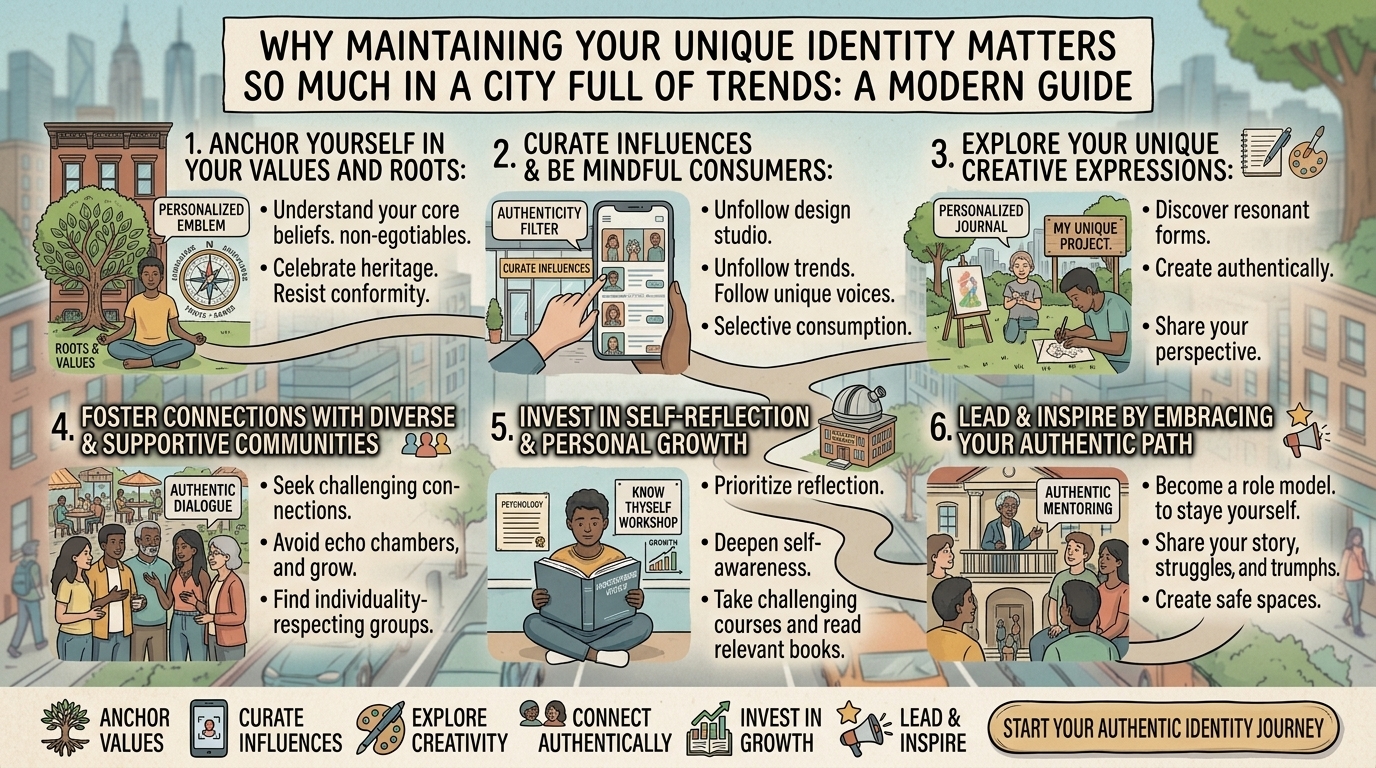
If you feel like you are slowly dissolving into the metropolitan background noise, follow this four-phase roadmap to reclaim your authentic voice:
Phase 1: Conduct an Aesthetic and Behavioral Audit
Take a quiet weekend morning to evaluate your life. Look at your wardrobe, your social media feeds, your leisure activities, and your career goals. Ask yourself a brutally honest question: “Did I choose this because I genuinely love it, or because I saw it validated online?” Purge the habits and items that are purely performative.
Phase 2: Curate Your Physical and Digital Inputs
Stop letting algorithms dictate your tastes. Unfollow accounts that make you feel inadequate or pressured to conform. Instead, lean into analog inspiration: read physical books, visit local art galleries featuring outsider artists, explore neighborhood archives, and talk to long-term residents who remember your city before the tech booms and corporate chains moved in.
Phase 3: Lean Into Your “Irreconcilable Oddities”
The traits that you view as awkward or unconventional are often the exact building blocks of your unique identity. Whether it’s an obscure hobby, a vintage fashion obsession that defies modern styles, or a contrarian perspective on urban living—lean into it. Authenticity carries an unmistakable gravity that polished conformity can never replicate.
4. Summary Table: Trend-Chasing vs. Authentic Identity
| Metric | Trend-Driven Living | Identity-Driven Living |
| Decision-Making Source | External validation, algorithms, peer pressure | Internal values, personal joy, deep conviction |
| Long-Term Mental Health | Exhausting, anxious, chronic fear of missing out | Grounded, confident, resilient against stress |
| Social Connection | Superficial, transient networking | Deep, meaningful, resonant bonds |
| Creative Output | Imitative, derivative, trend-chasing | Original, expressive, culturally additive |
5. Pro Tips for Urban Individualists
- Become a Flâneur (Mindful Urban Explorer): Take unplanned walks through your city without using Google Maps or listening to a podcast. Let your curiosity pull you down side streets, independent bookstores, and hidden community gardens. Rediscovering the city on your own terms breaks the trance of viral location-tagging.
- Value Substance Over Speed: Trends are built for speed and obsolescence. Invest your time, money, and creative energy into things that age like fine wine—durable clothing, long-term creative projects, and genuine face-to-face friendships.
- Embrace Creative Friction: Do not be afraid to disagree with the local consensus. True cultural progress in cities like New York, San Francisco, and Austin has always been driven by outliers who refused to accept the status quo.
6. Comprehensive Strategy Guide: Cultivating Personal Sovereignty
Maintaining your identity in a bustling metropolis requires building personal boundaries against societal pressures.
Designing Your Sanctuary Space
Your home should be an absolute fortress against external cultural noise. Design your living space to reflect your memories, travels, and personal passions rather than what is currently trending on interior design blogs. When your private environment honors who you truly are, stepping back out into the chaotic city becomes less intimidating.
Finding Your Micro-Community
You don’t need to appeal to the masses to thrive in a city of millions. The true superpower of urban living is density: tucked away in every major metropolis are micro-communities of passionate weirdouts, artists, intellectuals, and creators who celebrate authenticity. Seek out independent poetry readings, maker spaces, underground film screenings, and local neighborhood clubs where originality is currency.
7. Frequently Asked Questions (FAQ)
1. Isn’t trying to be “unique” just another form of trend-chasing?
There is a fine line between forced quirkiness (trying too hard to be different) and genuine authenticity. True individuality isn’t about shocking people or rejecting popular things just because they are popular; it is about making choices that align strictly with your inner compass, regardless of whether they are trendy or obscure.
2. How do I stop caring what trendy people think of my style or choices?
Confidence comes from competence and self-acceptance. When you invest time into developing real skills, deep friendships, and personal passions, the opinions of superficial acquaintances lose their weight entirely.
3. Can I maintain my unique identity while navigating a corporate urban career?
Absolutely. Professional environments often require a certain level of behavioral decorum, but you can maintain your core identity through your personal projects, creative outlets, ethical boundaries, and how you treat people.
4. Why are cities so prone to trend cycles compared to rural areas?
Cities concentrate creative talent, media companies, and consumer markets into a tight geographic space. This high-density network accelerates the birth, spread, and death of cultural trends at lightning speed.
5. How can I find authentic local spots in big cities like New York or San Francisco?
Ignore social media recommendation lists sponsored by corporate influencers. Instead, talk to neighborhood elders, local indie bookstore owners, and long-standing small business operators who understand the true pulse of the city.
6. Is it normal to feel lonely when you stop following trends?
Initially, yes. Stepping off the mainstream conveyor belt can create a temporary sense of alienation. However, that space quickly fills with deeper, higher-quality relationships with people who love you for who you actually are.
7. How do I balance keeping up with modern technology while retaining my individuality?
View technology and social media as tools rather than masters. Use them to connect with resources and people, but establish strict digital detox boundaries to protect your mental clarity.
8. What should I do if my close friends are obsessed with micro-trends?
You don’t need to drop your friends, but you can gently steer conversations and activities toward shared human experiences—like cooking together, hiking, or working on creative projects—rather than consumerist shopping outings.
9. Does age change how we relate to urban trend cycles?
As people mature, they generally develop a stronger sense of self and a lower tolerance for performative behavior. Youth culture is often deeply tied to trend validation, while maturity breeds comfort in one’s own skin.
10. Where can I find more inspiration on authentic living and urban culture?
You can explore thoughtful essays, lifestyle guides, and community perspectives right here on NY Attitude for ongoing inspiration on urban individuality.
8. Conclusion
A city full of trends is a double-edged sword: it offers endless stimulation, economic opportunity, and cultural vibrance, but it threatens to wash away your distinct voice in a sea of sameness. Maintaining your unique identity is not an act of arrogance; it is a vital contribution to the cultural ecosystem of your city. After all, a metropolis is only as vibrant, creative, and inspiring as the distinct human souls who refuse to blend into the background.
Stay tuned to NY Attitude for more lifestyle guides, cultural insights, and authentic urban living strategies!