How to Navigate Apartment Hunting Scams and Find a Legitimate Broker in New York
Navigating the New York City rental market can feel like navigating an obstacle course blindfolded. With hyper-competitive housing stock, notoriously high rents, and lightning-fast turnover rates, apartments in Manhattan, Brooklyn, Queens, and the outer boroughs disappear almost as quickly as they appear.
Unfortunately, this high-stakes environment acts as fertile ground for bad actors, con artists, and predatory fake agents. Whether you are relocating from across the country or moving across town, understanding how to spot modern rental fraud is vital.
This comprehensive guide breaks down everything you need to know about navigating apartment hunting scams, protecting your finances, verifying real estate credentials, and partnering with a trustworthy, legitimate broker in New York.
1. The Anatomy of an NYC Rental Scam
Rental scams have evolved far beyond the classic “out-of-town landlord who wants you to wire money via Western Union.” Today’s fraudsters use sophisticated tactics, cloned websites, stolen identities, and social engineering to exploit eager renters.
Common Types of Fraud in the Big Apple
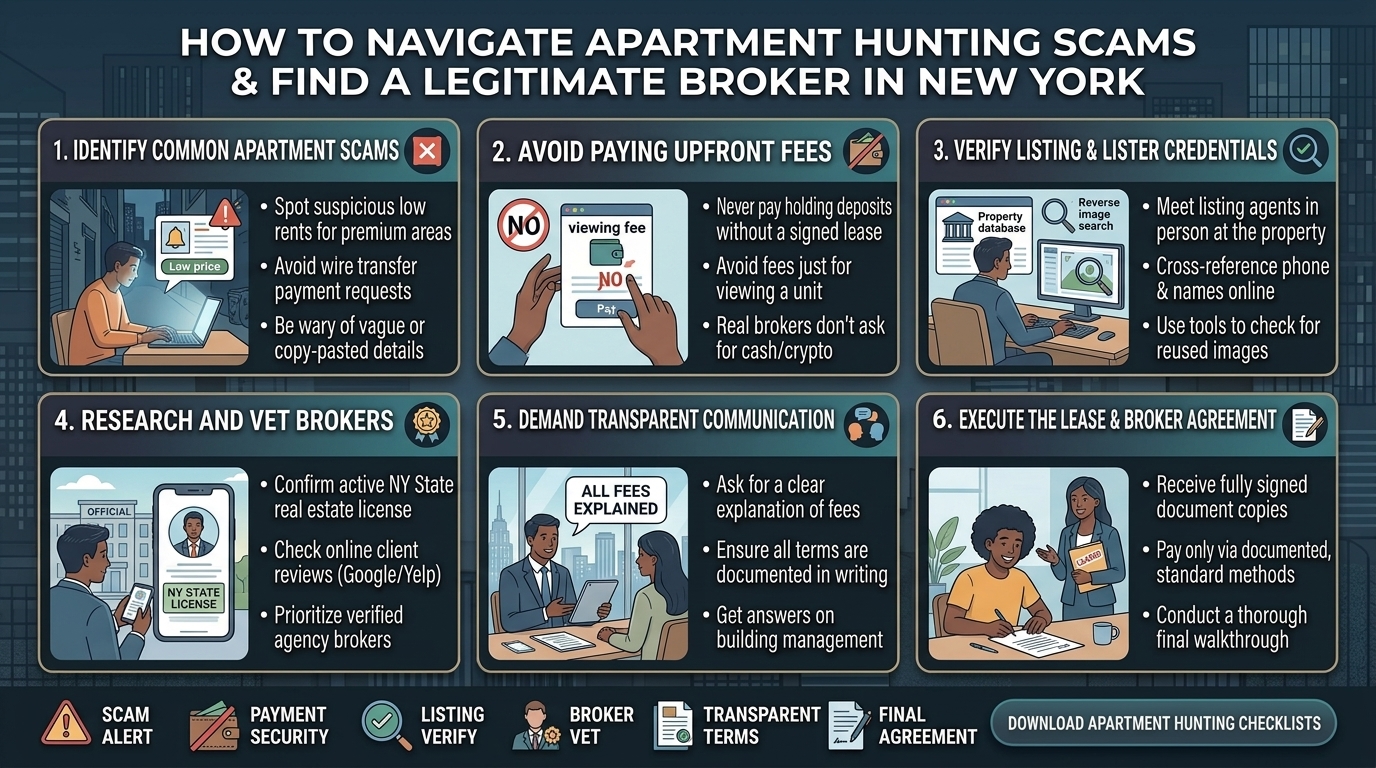
- The Phantom Rental: An apartment is advertised in a prime location (like the West Village or Williamsburg) at an unbelievable price. The “landlord” or “broker” claims they are traveling, missionary workers, or stationed overseas, and promises to mail keys via courier after you send a security deposit.
- The Bait-and-Switch: You fall in love with a spacious, sun-drenched one-bedroom listed online. When you arrive at the office, the agent claims that specific unit “just rented,” but immediately tries to pressure you into leasing a much smaller, overpriced, or rundown alternative.
- The Hijacked Listing: Scammers scour legitimate platforms like StreetEasy, Zillow, or Leasebreak, copy the photos and descriptions of a real apartment, and repost them on Craigslist, Facebook Marketplace, or unverified classified sites with a drastically lower price.
- The Unauthorized Sublease: A tenant with no legal right to sublet rents out a room or an entire apartment, collects the upfront cash, and leaves the unsuspecting subtenant to face eviction when the actual landlord or building management discovers the fraud.
2. Top Red Flags: How to Spot a Fake Listing Instantly
Before you ever text a phone number or hand over your personal data, screen every prospective listing for these major warning signs:
+-----------------------------------+---------------------------------------------------+
| Red Flag Signal                   | What It Actually Means                            |
+-----------------------------------+---------------------------------------------------+
| Price Too Good To Be True         | Below-market luxury units are traps to lure victims.|
| Missing Exact Address             | Scammers omit specific street/unit numbers. |
| Refusal to Show In-Person         | Excuses about keys, illness, or travel.        |
| Rushed Pressure Tactics           | "Send money now or someone else gets it".    |
| Untraceable Payment Demands       | Insistence on cash apps, crypto, or wire transfer.|
+-----------------------------------+---------------------------------------------------+
- Vague Location Data: If a listing talks about a neighborhood or cross-streets but deliberately omits the exact street address and unit number, investigate carefully. Legitimate exclusive listings always tie back to a precise brick-and-mortar location.
- Inconsistent Details Across Platforms: Run the address through search engines. If the photos associated with a 2nd-floor walkup in Astoria are simultaneously appearing on a listing for a high-rise in Chicago, you are dealing with stolen media.
- Pressure to Transmit Sensitive Documents Prematurely: Scammers frequently harvest identity theft material (Social Security numbers, bank statements, tax returns, copies of your passport) under the guise of a “pre-application check” before you have even toured the apartment.
3. How to Verify a New York Real Estate Broker
Working with a professional can streamline your search, but you must verify that your representative is licensed, legal, and accountable to state regulatory boards. In New York, anyone negotiating a lease for compensation must hold an active license with the Department of State (DOS).
Step-by-Step Broker Verification Process
- Check the NYS License Database: Go to the official New York Department of State Licensee Search portal. Search the individual’s full legal name or their unique license ID.
- Confirm Corporate Affiliation: Ensure the brokerage company name listed in the database matches the company the agent claims to represent. Watch out for “independent agents” who cannot name a licensed parent brokerage.
- Perform an Independent Callback: Never use the telephone number listed in a suspicious text message or email signature to verify a broker. Find the brokerage firm’s official corporate website independently via a search engine, call their main office line, and ask to speak directly with the agent or their managing broker.
- Evaluate Online Footprints and Reviews: Legitimate New York brokers typically feature comprehensive digital footprints, including professional profiles on major syndication sites, active listings on StreetEasy, and verifiable reviews on Google or Yelp.
4. Protecting Your Money: Safe Deposit and Payment Protocols
The single most vulnerable moment in apartment hunting is financial handover. Con artists thrive on urgency and fear of loss. Protect your capital by enforcing rigid transaction rules:
- Never Pay Before Signing: In standard New York leasing practice, you should never hand over funds or execute electronic transfers prior to reviewing, approving, and signing a binding lease agreement co-signed by the property owner or authorized management agent.
- Understand Fee Regulations: New York laws strictly regulate rental application fees. Under state housing laws, landlords and brokers cannot charge more than $20 for a background and credit check application fee.
- Reject High-Risk Payment Channels: Legitimate management companies and brokerages accept bank cashier’s checks, certified checks, or secure digital property management portals. Never use cash, wire transfers (like Western Union), prepaid debit cards, or unsecured peer-to-peer apps (like unverified personal Venmo or Zelle accounts).
- Keep a Paper Trail: Document every interaction, save signed receipts, keep copies of emails, text logs, and written disclosures regarding broker fees and security deposit escrow accounts.
5. Step-by-Step Action Plan to Secure a Legitimate NYC Apartment
To conquer the market safely, follow this battle-tested roadmap from initial search to lease execution:
- Step 1: Stick to Trusted Platforms. Prioritize high-accountability networks like StreetEasy, RentHop, or direct property management sites for large luxury developments rather than unregulated classified bulletin boards.
- Step 2: Cross-Reference Building Data. Look up the building address on municipal property data systems (like ACRIS in New York City) to confirm who actually owns the tax lot.
- Step 3: Conduct Live Visual Inspections. Always tour the apartment in person. If you are moving from out of state, hire a trusted local proxy or insist on a live, interactive video walkthrough where the agent opens closets, checks water pressure, and streams real-time environmental context.
- Step 4: Review Every Clause of the Lease. Read the rider, pet policies, heat/hot water clauses, and preferential rent riders meticulously before appending your signature.
6. Frequently Asked Questions (FAQ)
1. What should I do if I suspect an NYC apartment listing is a scam?
Immediately cease communication, take screenshots of the listing, URL, and messages, and report the fraud directly to the host platform (e.g., StreetEasy, Zillow, or Craigslist), the Federal Trade Commission (FTC), and the New York State Attorney General’s office.
2. Is it legal for an NYC broker to charge a broker fee?
Yes. In New York City, broker fees are legal and commonly range anywhere from 12% to 15% of the annual rent (or one month’s rent), depending on market conditions, unless the apartment is explicitly marketed as a “no-fee” listing paid by the landlord.
3. How can I check if a New York real estate broker is licensed?
You can verify any salesperson or broker instantly by visiting the public New York Department of State (DOS) Licensee Search website and looking up their name or license number.
4. Can a landlord or broker ask for a holding deposit before a lease is signed?
Generally, you should avoid giving any “holding deposit” before a formal lease is issued. If a holding agreement is used, ensure it is in writing, specifies that the deposit is fully refundable if the application is rejected, and is paid via a traceable method directly to an escrow account.
5. What is the maximum application fee a landlord can charge in New York?
Under New York tenant protection laws, landlords and brokerages are legally capped at charging no more than $20 for background and credit check application fees combined.
6. What payment methods are safest when paying rent or security deposits?
Always use official bank cashier’s checks, certified checks, or verified corporate tenant portals that issue immediate electronic receipts. Never pay via cash, wire transfer, or peer-to-peer smartphone apps sent to personal accounts.
7. How do I know if an apartment photo has been stolen from another listing?
Save the image file to your device and run it through a reverse-image search engine (like Google Images or TinEye). If the same photo pops up tied to addresses in entirely different states or cities, the listing is fraudulent.
8. What is a “bait-and-switch” scam in the rental market?
A bait-and-switch occurs when an agent advertises a gorgeous, affordable unit to reel you in, only to claim it is unavailable upon arrival and pressure you into touring lower-quality, overpriced alternatives.
9. What documents should I prepare in advance to speed up my search?
Legitimate agents will eventually ask for a packet containing your recent tax returns (W-2), recent pay stubs, bank statements, photo ID, and a credit report. Never submit these documents until you have verified the brokerage and confirmed an active, physical appointment.
10. What should I do if I already fell victim to an NYC rental scam?
Contact your bank or financial institution immediately to report fraudulent transactions and attempt payment recalls. File formal complaints with local law enforcement, the Internet Crime Complaint Center (IC3), and the FTC, and monitor your credit reports for identity theft exposure.
Conclusion
Apartment hunting in New York is an endurance test that requires a blend of speed, sharp intuition, and rigorous skepticism. By refusing to let urgency cloud your judgment, independently verifying every real estate professional through state licensing databases, and avoiding untraceable payment methods, you can successfully bypass predatory scams. Arm yourself with knowledge, protect your personal data, and step into your next New York home with absolute confidence.