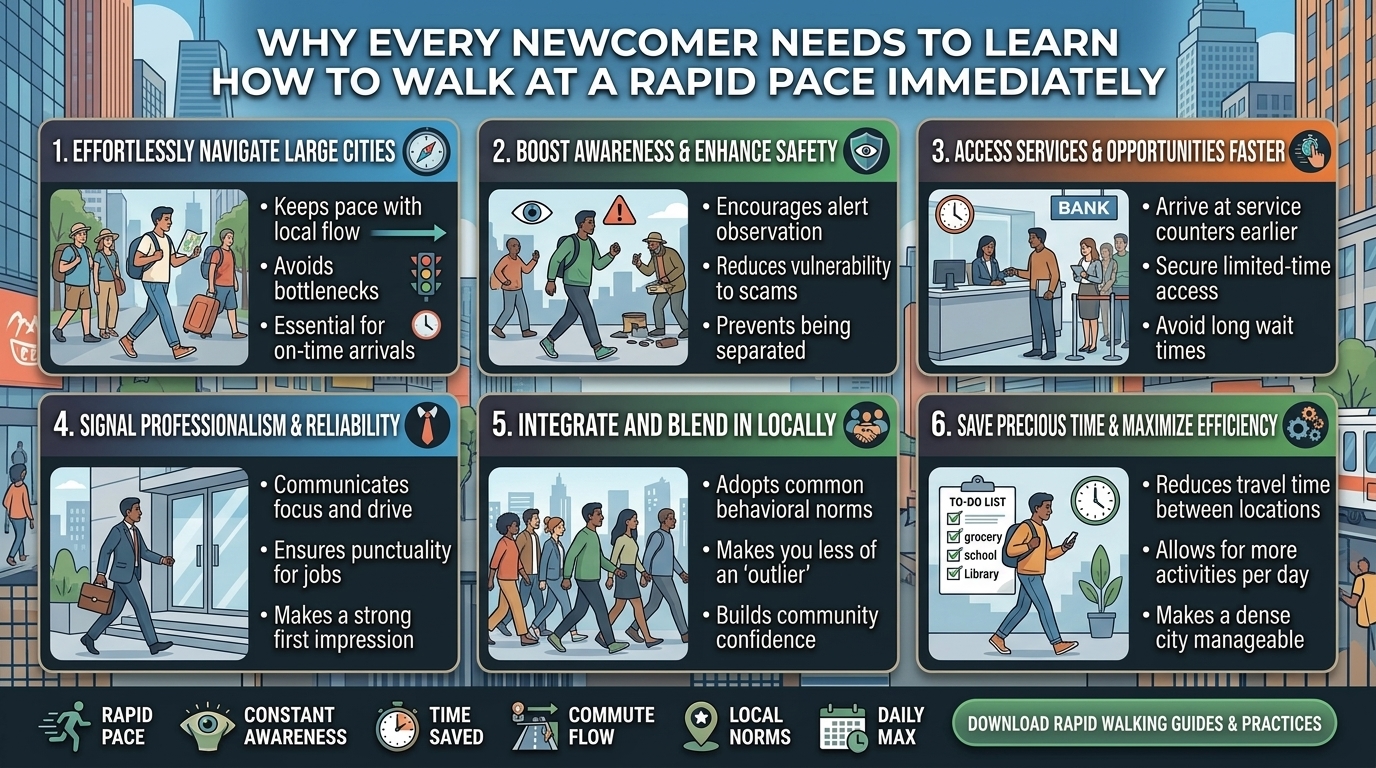
Stepping off a plane or train into a bustling metropolis like New York, San Francisco, or Washington, D.C., introduces you to an immediate cultural shock. Beyond the towering skyscrapers, diverse food scenes, and fast-moving job markets, you will notice one hyper-apparent phenomenon on day one: everyone is walking at an absolute sprint.
To the uninitiated newcomer, this aggressive tempo feels jarring, rude, and unnecessarily stressful. However, adopting a rapid stride is not merely a quirky local habit—it is a core survival skill. Whether you are navigating the packed pavements of Manhattan, traversing San Francisco’s steep hills, or rushing to catch a cross-town connection, learning how to walk fast immediately changes your trajectory from a struggling outsider to an integrated local.
1. The Psychology and Culture of Urban Velocity
Why do metropolitan residents move with such intense urgency? The answer lies at the intersection of urban sociology, economics, and sheer spatial necessity.
- The Pacing Paradox: In densely populated environments, pedestrian infrastructure functions like a massive, organic transit grid. When thousands of people share narrow corridors, moving slowly disrupts the equilibrium.
- The Economic Value of Time: Urban productivity research consistently demonstrates that the economic output of a city directly influences its psychological pace. Higher productivity raises the value of time, manifesting as a faster tempo in daily life.
- Sidewalk Etiquette: In fast-paced cities, stopping abruptly in the middle of a pedestrian thoroughfare to check a smartphone map is the ultimate social faux pas. It creates a human traffic jam and draws immediate, vocal frustration from commuters behind you.
2. Top Tips for Accelerating Your Urban Commute
Transitioning from a casual stroll to a high-speed stride requires physical adjustment and spatial awareness. Use these practical tips to bridge the gap:
+-----------------------------------+---------------------------------------------------+
| Strategy                          | Implementation Focus                              |
+-----------------------------------+---------------------------------------------------+
| Ditch the Phone Screen            | Map your route before stepping outside.           |
| Honor the Passing Lanes           | Keep right on stairs, escalators, and walks.|
| Shorten and Quickening Your Stride| Increase cadence rather than over-extending legs.  |
| Respect the Crosswalk Window      | Match light cycles; do not dawdle mid-street.     |
+-----------------------------------+---------------------------------------------------+
- Map Before You Move: Never expose your phone in the middle of a bustling crowd. Plan your directions indoors or duck quietly into a storefront vestibule to orient yourself.
- Embrace the Right-Hand Rule: Just like driving on a highway, standard pedestrian flow relies on keeping to the right. Slower walkers, tourists, and window-shoppers belong on the far right edge; fast commuters utilize the left lanes to pass.
- Master Peripheral Awareness: Train your eyes to scan 10 to 15 feet ahead rather than staring down at your shoes. This allows you to anticipate pedestrian gaps, weave smoothly around slow groups, and maintain momentum.
3. The Surprising Health Benefits of a Rapid Pace
Beyond helping you fit in socially and professional efficiency, picking up your walking speed yields extraordinary physiological rewards backed by modern science.
- Cardiovascular Resilience: Brisk walking elevates your heart rate into an optimal conditioning zone, strengthening the cardiovascular system, lowering resting blood pressure, and reducing cholesterol.
- Longevity and Reduced Mortality: Extensive public health studies indicate that individuals who incorporate regular fast walking into their daily routines experience a significantly lowered risk of heart disease, metabolic disorders, and overall mortality.
- Metabolic Efficiency: Walking at a brisk clip burns substantially more calories per minute, regulates blood sugar spikes after meals, and builds lower-body endurance without requiring high-impact joint stress.
4. Frequently Asked Questions (FAQ)
1. Why do people in major cities walk so fast?
High population density, high-stakes career environments, and strict public transit schedules force urbanites to optimize every minute, turning fast walking into an automatic habit.
2. Is walking fast considered rude?
Not within the local culture. What outsiders interpret as “rudeness” is actually efficient navigation; stopping abruptly or wandering aimlessly blocks the flow of traffic and inconveniences dozens of people.
3. How can I check my map safely without blocking traffic?
Step completely out of the main pedestrian stream—such as against a building wall, inside a foyer, or off to the side of the sidewalk—before pulling out your device.
4. What is the ideal speed for a “brisk” urban walk?
A true brisk walking pace typically measures around 100 steps per minute or roughly 3 miles per hour, where your heart rate increases and you can talk comfortably without being able to sing.
5. What should I do if I accidentally block someone on the sidewalk?
A quick, polite nod or saying “excuse me” while stepping smoothly to the right resolves the interaction instantly.
6. Does fast walking replace traditional workouts?
For many urban commuters, daily walking miles easily fulfill or exceed the weekly aerobic guidelines recommended by health organizations, promoting long-term metabolic health.
7. How long does it take to adapt to a fast urban pace?
Most newcomers notice their bodies naturally adjusting and matching local rhythms within approximately three to six months of daily city commuting.
8. Are there specific etiquette rules for subway stations and escalators?
Yes. Always stand on the right side of escalators and moving walkways so that hurried commuters can walk up or pass freely on the left.
9. Will walking fast cause foot or joint pain?
It can initially if your body isn’t conditioned. Transition smoothly by investing in supportive footwear with proper cushioning rather than altering your gait drastically overnight.
10. How does walking speed impact professional life?
Punctuality is deeply valued in competitive job markets; moving swiftly ensures you hit your transit connections on time and meet the rapid professional pace expected in major business hubs.
Conclusion
Adapting to a rapid walking pace is your official initiation into fast-paced metropolitan life. It bridges the gap between feeling like an overwhelmed newcomer and operating as a seasoned local who moves with purpose, efficiency, and confidence. Embrace the tempo, protect your stride, and let the rhythm of the city carry you forward.
Why do New Yorkers walk so fast?
A short visual breakdown illustrating the cultural and environmental factors that drive fast-paced walking habits in major metropolitan areas.