There is a distinct, collective hum that defines modern urban existence. Whether you are navigating the relentless sirens of Manhattan, the gridlocked horns of Los Angeles, the fast-paced pedestrian corridors of San Francisco, or the dense concrete pulses of major hubs across Texas, Washington, and New York, city life operates at a staggering velocity.
Cities are engines of culture, commerce, and connection. Yet, beneath their vibrant surface lies an invisible, compounding cost: sensory overload.
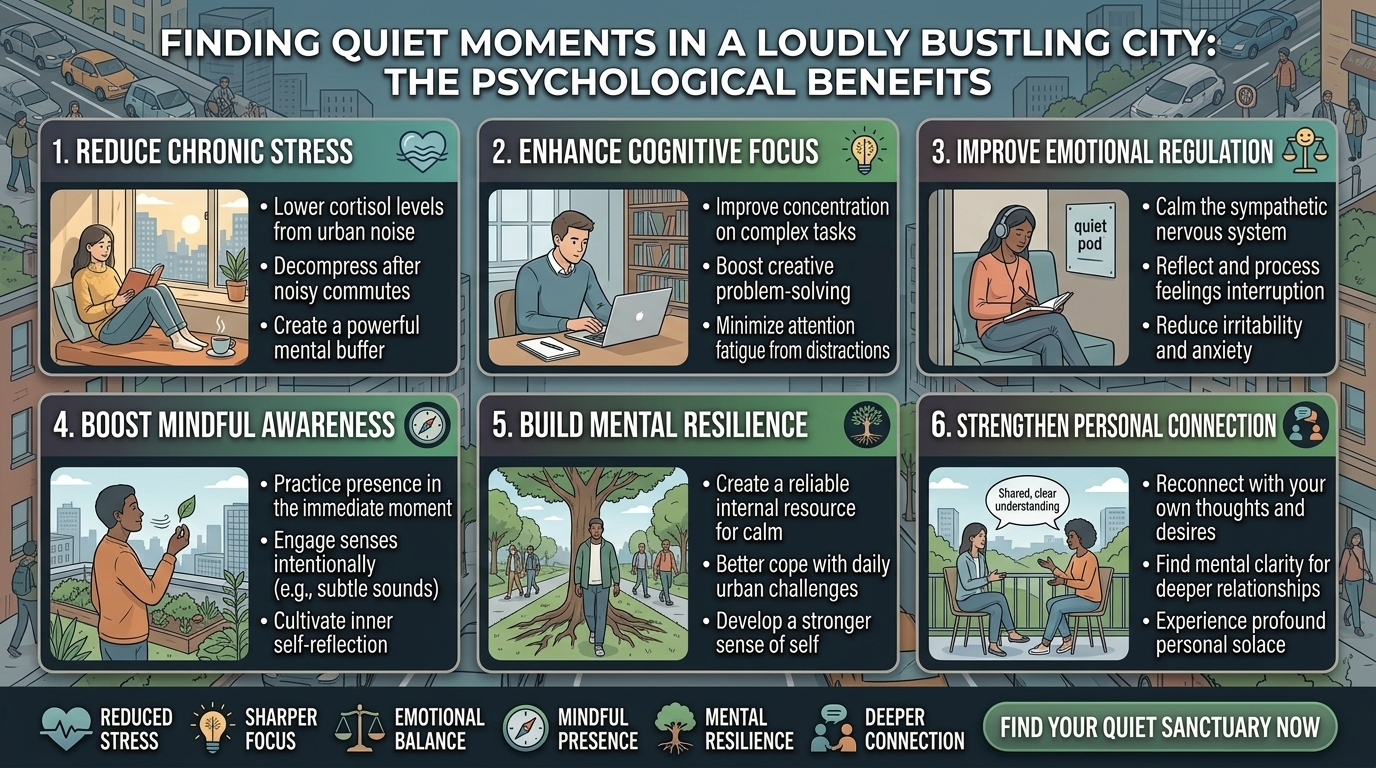
Constant exposure to traffic, flashing lights, overlapping conversations, and the high-stakes pressure of career and social survival trap our nervous systems in a chronic state of low-grade alert. In environments defined by noise, finding true stillness feels like a radical act. But carving out quiet moments amid the chaos is not merely a luxury or a wellness trend—it is a vital psychological necessity.
This guide explores the deep psychological science behind urban quiet spaces, examines how silence repairs our overstimulated minds, and provides actionable tips for protecting your mental peace in the heart of the concrete jungle.
1. The Neurobiology of Noise: Why Cities Exhaust Us
To understand why quiet moments are so psychologically restorative, we first need to look at what persistent urban stimuli do to the human brain.
The Sympathetic Nervous System Overdrive
Human beings evolved in environments where sudden sounds or movements signaled potential threats—a rustling bush, an approaching predator. When you live in a bustling city, your brain processes hundreds of micro-threats every hour: car horns, shouting voices, screeching subway brakes, and rushing crowds.
This triggers your sympathetic nervous system, releasing cortisol and adrenaline. While these hormones keep you alert enough to dodge traffic or catch a train, chronic activation leads to:
- Sensory Fatigue: Your brain’s filter mechanism breaks down, making every minor sound feel irritating or invasive.
- Decision Fatigue: Processing high volumes of visual and auditory data drains the prefrontal cortex, leaving you mentally depleted by midday.
- Irritability and Anxiety: Prolonged cortisol spikes correlate directly with elevated baseline anxiety, emotional reactivity, and feelings of isolation.
2. Psychological Benefits of Urban Quiet Moments
When you intentionally step away from the crowd—whether by sitting in a pocket park, stepping into a cathedral, or wearing noise-canceling headphones in a quiet corner of a public library—your brain experiences an immediate structural and chemical shift.
[Urban Chaos & Sensory Overload]
         │
         ▼ (Intentional Pause / Quiet Moment)
[Reduction of Cortisol & Lowered Heart Rate]
         │
         ▼
[Attention Restoration & Emotional Regulation]
A. Attention Restoration Theory (ART)
Coined by environmental psychologists Rachel and Stephen Kaplan, Attention Restoration Theory suggests that urban environments demand “directed attention”—the intense, effortful focus required to navigate traffic, dodge pedestrians, and work under deadlines. This depletes our cognitive reserves.
Quiet spaces—especially those featuring natural elements like trees, water features, or open sky—engage “soft fascination.” This effortless form of attention allows the prefrontal cortex to rest, repair, and replenish its cognitive capacity.
B. Constructive Internal Reflection and Self-Identity
In a loud city, external stimuli dictate where your attention goes. When you find silence, the external noise fades, making room for constructive internal reflection.
- Your brain shifts default-mode network processing inward.
- You gain the mental clarity required to process complex emotions, evaluate personal goals, and recall memories.
- Silence offers a vital boundary between who you are and what the city demands of you.
C. Lowered Blood Pressure and Physiological Coherence
The psychological and the physiological are deeply intertwined. Studies show that acoustic quietness directly impacts physical markers of stress. Escaping urban noise lowers resting heart rates, stabilizes blood pressure, and reduces muscle tension, creating a feedback loop of calm that stabilizes mood and emotional resilience.
3. Practical Strategies: How to Find and Protect Quiet in a Busy City
You do not need to move to a remote cabin in the woods to experience the benefits of silence. Urban sanctuaries exist all around you if you know how to look.
- Map Your Urban Oases: Every major metropolis has hidden quiet zones. Look for botanical gardens, historic courtyards, interior atriums of public buildings, rooftop terraces, and quiet reading rooms in public libraries.
- Practice “Micro-Silences” During Commutes: Turn off podcasts or music for one leg of your commute. Let your mind wander without digital input to reset your baseline attention span.
- Establish Acoustic Boundaries at Home: If your apartment faces a loud street, invest in heavy blackout curtains, sound-absorbing rugs, white noise machines, or double-pane windows to create a psychological refuge where your nervous system can fully drop its guard.
- Embrace Digital Silences: Turn your phone to “Do Not Disturb” during your quiet intervals. The ping of a notification is an artificial city noise that pulls your mind right back into the grid.
4. Frequently Asked Questions (FAQ)
Q1: Why do I feel restless or anxious the first few times I try to sit in absolute quiet?
A: This is entirely normal. When you are accustomed to chronic urban stimulation, your brain mistakes quietness for a lack of safety or becomes overwhelmed by the sudden absence of distraction. Over time, your nervous system adapts and learns to crave this restorative stillness.
Q2: Can white noise or ambient music substitute for actual quiet moments?
A: White noise and ambient sounds can effectively mask disruptive urban frequencies and help with focus or sleep. However, true psychological restoration is maximized when your brain processes natural soundscapes (like rustling leaves or wind) or complete silence, which gives auditory processing centers a total break.
Q3: How long do I need to sit in quiet to experience psychological benefits?
A: Research suggests that even micro-breaks of 10 to 15 minutes of uninterrupted quiet can significantly lower cortisol levels, restore attention spans, and reset emotional equilibrium.
Q4: Is city noise physically harmful, or is it just annoying?
A: Clinical research confirms that persistent urban noise is physically harmful. Chronic exposure to high decibel levels correlates with elevated risks of hypertension, sleep disruption, cardiovascular strain, and prolonged psychological distress.
Q5: How can I find quiet spaces in dense urban centers like New York or San Francisco?
A: Look for privately owned public spaces (POPS), rooftop gardens, places of worship (which are often open to the public for quiet contemplation), and cemetery grounds, which are historically maintained as peaceful urban parks.
Q6: Does looking at nature in the city help if it’s still noisy?
A: Yes, visual exposure to green spaces acts as a partial buffer against stress, but combining visual nature with an acoustically quiet environment yields the most powerful psychological recovery.
Q7: Why does mental fatigue from city life make people irritable?
A: When your brain’s attentional control network is exhausted from filtering out urban stimuli, you have fewer cognitive resources left for emotional regulation, making minor inconveniences feel much more frustrating.
Q8: Can quiet time improve productivity at work?
A: Absolutely. Stepping away for intentional quiet periods reduces context-switching fatigue and cognitive overload, allowing you to return to complex tasks with sharper focus and better problem-solving skills.
Q9: How do I protect my quiet time from social or professional obligations?
A: Treat your quiet intervals with the same respect you would give an urgent meeting. Schedule them into your calendar, communicate your boundaries clearly to colleagues or family, and view them as essential maintenance for your mental health.
Q10: What is the best time of day to seek out urban quiet?
A: Early morning (before traffic peaks and delivery trucks crowd the streets) or late evening offer the most naturally tranquil windows in major cities. However, midday micro-breaks are vital for breaking up cognitive fatigue.
Conclusion
Living in a bustling metropolis offers unmatched energy, diversity, and opportunity, but it demands a heavy toll on our cognitive and emotional architecture. Seeking out quiet moments amid the roar of the city is not an escape from reality—it is a conscious strategy to preserve your mental health, enhance your creativity, and reclaim your inner peace. By intentionally carving out spaces of stillness, you transform the city from an overwhelming force that drains you into a backdrop for a balanced, mindful life.