We have all experienced the sensation of living somewhere for years while remaining entirely detached from the narrative soil beneath our feet. We walk the same sidewalks to the local coffee shop, drive the same commute past historic storefronts, and check our mailboxes without ever wondering who walked those exact paths a century before us.
In a modern world characterized by transience—where remote work allows us to relocate on a whim and rental markets keep us constantly moving—it is remarkably easy to treat our neighborhoods as little more than temporary storage units for our belongings. Yet, emotional rootedness does not happen automatically just because we sign a lease or buy a deed. True belonging is cultivated through curiosity.
Whether your home base is nestled in the vibrant cultural corridors of New York, the sun-drenched and historically layered neighborhoods of California or San Francisco, the lush, storytelling-rich hills of Washington, or the sprawling, mythic landscape of Texas, discovering local history changes everything.
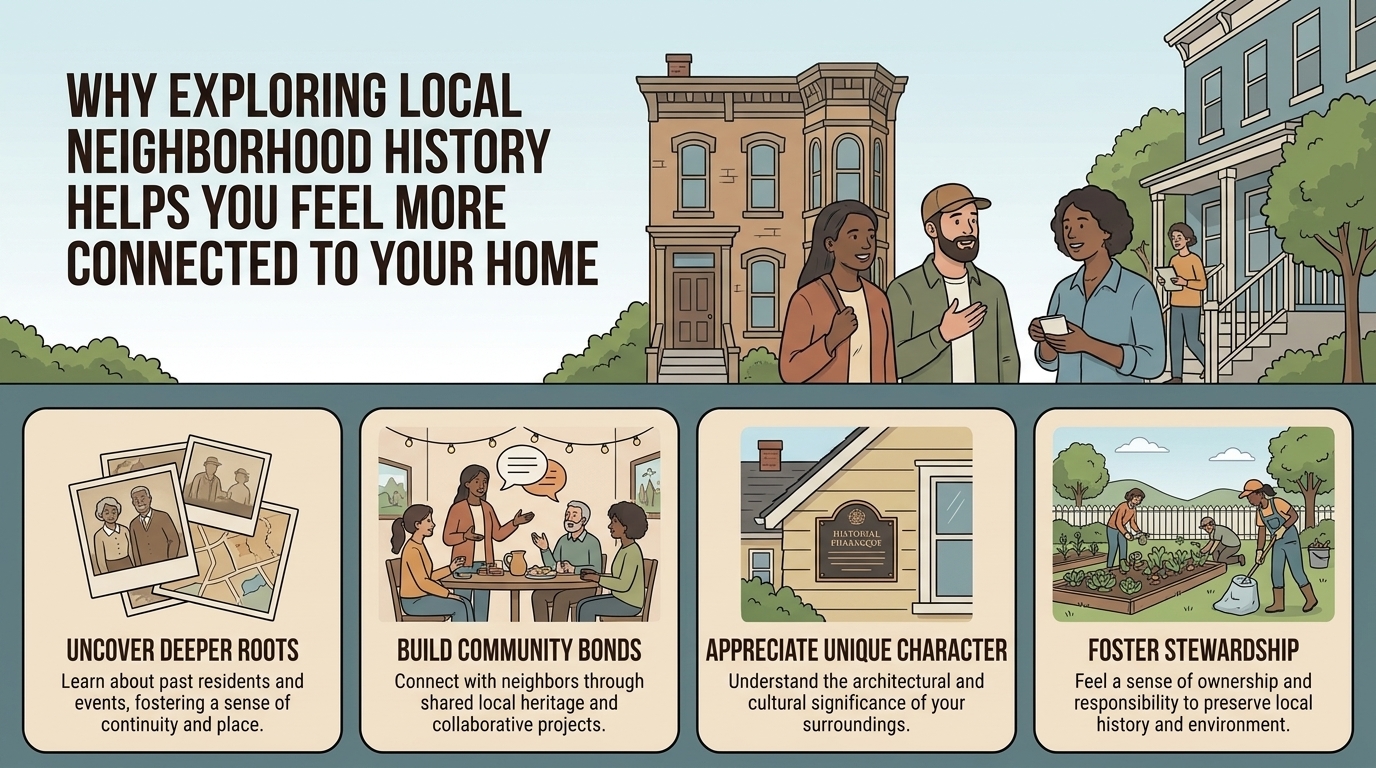
This comprehensive guide explores the psychological, social, and emotional science behind local historical exploration, offering actionable tips to uncover your neighborhood’s past and practical advice for turning where you live into a place you truly belong.
The Psychology of Place: Why We Crave Historical Connection
Human beings are hardwired for narrative. For millennia, our survival depended on understanding our terrain—knowing where the water flowed, who shared the territory, and what tragedies or triumphs occurred on the land we inhabited. Today, urban psychologists refer to this as place attachment: the emotional bond that develops between a person and a specific physical environment.
1. From Anonymous Grid to Living Tapestry
When you walk down an ordinary street without historical context, you see asphalt, concrete, and modern storefronts. When you know the history, those same elements transform into physical archives. An empty vacant lot becomes the site of a legendary 1920s jazz club; an old oak tree becomes a boundary marker from an 1850s homestead; a brick apartment building becomes the former sanctuary for immigrant laborers who built your city’s infrastructure. This shift turns a flat, anonymous environment into a vivid, multi-dimensional story.
2. Combating Modern Alienation and Loneliness
In major hubs across Texas, New York, California, Washington, and San Francisco, fast-paced modern life often breeds a subtle form of rootlessness. We feel like strangers even in our own zip codes. Engaging with local history acts as an anchor. It reminds you that you are part of a continuous generational baton pass, connecting you to a community that stretches far back into the past and extends forward into the future.
Mapping Regional Roots: The Historical Tapestry Across Key Landscapes
Every region tells a distinct historical story shaped by geography, immigration, commerce, and culture. Understanding your region’s overarching history gives you the blueprint for your neighborhood exploration.
1. New York: Layers of Immigrant Dreams and Architectural Evolution
New York City and state are living textbooks of urban evolution.
- The Historical Narrative: From Lenape native trails to Dutch colonial outposts, through waves of European, Caribbean, and Asian immigration, every block in New York reflects the hustle and ambition of people starting over.
- What to Look For: Cast-iron building columns, old tenement stoops, ghost signs painted on brick walls advertising century-old goods, and neighborhood preservation districts that tell stories of labor unions, artistic revolutions, and community resilience.
2. San Francisco & California: Gold Rushes, Counterculture, and Seismic Shifts
California’s history is a dizzying epic of indigenous heritage, Spanish missions, the 1849 Gold Rush, maritime trade, and radical twentieth-century social movements.
- The Historical Narrative: San Francisco and the wider California coast were built on sudden booms and dramatic reinventions. Neighborhoods transformed overnight from sand dunes or agricultural valleys into dense Victorian enclaves.
- What to Look For: Victorian and Edwardian architecture saved from past fires, historic cable car pathways, maritime artifacts embedded in wharf districts, and radical murals documenting civil rights and labor movements.
3. Washington: Timber, Indigenous Heritage, and Frontier Innovation
Washington state boasts a rich tapestry deeply tied to Pacific maritime trade, indigenous Coast Salish history, the timber industry, and early 20th-century progressive reform.
- The Historical Narrative: Neighborhoods in Seattle, Tacoma, and smaller towns were often carved directly out of dense evergreen forests or built atop regraded hills to accommodate the explosive growth of the Pacific Northwest.
- What to Look For: Historic brick industrial warehouses repurposed into modern cultural hubs, early streetcar route layouts that dictate current commercial strips, and public parks honoring indigenous stewardship.
4. Texas: Cattle Trails, Oil Booms, and Cultural Crossroads
Texas history is a massive canvas blending Spanish colonial roots, Mexican heritage, the frontier cattle boom, oil exploration, and modern metropolitan expansion.
- The Historical Narrative: Texas cities grew at the intersection of vast geographic expanses and major trade routes. Neighborhoods often preserve the architecture of old courthouse squares, mid-century ranch expansions, and historic African-American or Tejano cultural enclaves.
- What to Look For: Historic limestone civic buildings, preservation-zoned historic districts with deep roots in music and agriculture, and landmarks honoring the state’s complex multicultural founding.
Step-by-Step Guide: How to Uncover Your Neighborhood’s Hidden Past
You do not need to be a professional archivist or historian to uncover the secrets of your block. Follow this practical, step-by-step framework to begin your local historical investigation:
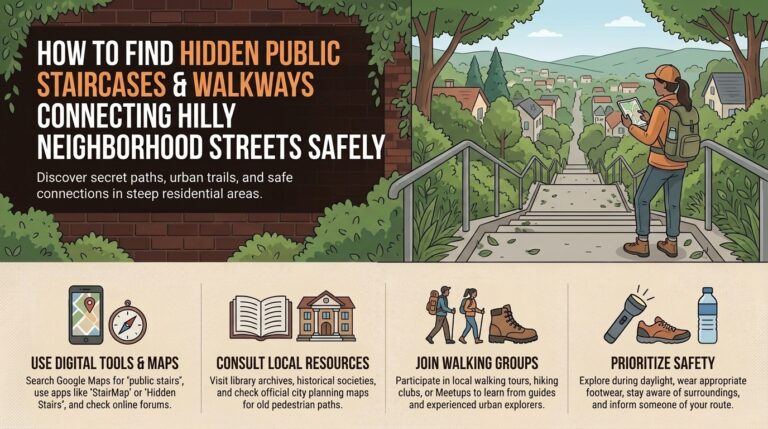
- Consult Historical Maps and Sanborn Fire Insurance Atlases: Websites like the Library of Congress, local university digital archives, and historic map repositories offer incredible bird’s-eye views of your neighborhood from 50, 100, or 150 years ago. You can literally watch buildings appear and vanish.
- Visit Your Local Public Library’s History Room: Almost every municipal library system maintains a local history or special collections room. Ask a librarian for neighborhood clipping files, old local newspapers on microfilm, and neighborhood photo archives.
- Talk to Long-Term Residents: The greatest living archives are your neighbors who have lived on your street for decades. Strike up conversations at local diners, community gardens, or front porches. Ask them: “What was this building before it was a coffee shop?” or “What was life like here twenty years ago?”
- Hunt for Physical Artifacts on Your Walks: Keep your eyes open for cornerstones engraved with construction dates, old iron coal chutes on sidewalks, manhole covers stamped with historic foundry names, and architectural flourishes that hint at a building’s original purpose.
- Explore Local Historical Societies and Walking Tours: Many neighborhoods have dedicated volunteer historical societies or preservation foundations that offer guided architectural and historical walking tours.
Practical Ways to Integrate Local History into Your Daily Life
History shouldn’t just be an academic hobby; it should actively enrich how you experience your everyday routine. Here is how to weave local history into your lifestyle:
1. Rename Your Walking Routes
Instead of walking “down the street to the grocery store,” reframe your walk mentally. You are traversing old farm lanes or walking along the route of a defunct 1910 trolley line. This simple mental shift changes a mundane errand into an act of temporal travel.
2. Create a Neighborhood History Journal
Keep a small notebook or digital log of fascinating facts you discover about your street. Document old photos you find online, note the original architects of significant buildings, and record personal observations about how your neighborhood is evolving today.
3. Support Historic Local Institutions
Patronize businesses, theaters, diners, and independent bookstores that have anchored your neighborhood for generations. When you spend your money at a historic neighborhood fixture, you are actively voting to keep the local narrative alive.
10 Frequently Asked Questions (FAQs)
1. Why is learning local history important if I only plan to live in my neighborhood temporarily?
Even a short-term stay becomes infinitely more engaging when you understand your surroundings. Knowing the history transforms a generic rental experience into an immersive cultural chapter of your life, helping you feel grounded rather than transient.
2. What are the best online resources for finding old photographs of my street?
Excellent digital repositories include the Library of Congress Digital Collections, the Digital Public Library of America (DPLA), local municipal archives, and regional historic preservation groups often found on state library websites.
3. How can I find out who built my specific house or apartment building?
You can visit your local city hall or county recorder’s office to pull property deed histories, or check historic municipal tax assessment photos from the mid-20th century, which often feature cataloged photos of individual residential parcels.
4. Are there apps that provide walking tours based on local history?
Yes. Apps like Detour (where available), GPSmyCity, and various regional historical society apps offer self-guided audio and text walking tours tailored to specific neighborhoods in major cities.
5. What if my neighborhood is entirely modern and suburban? Does it still have history?
Every patch of land has history. Modern suburbs were often built over former agricultural ranches, orchards, indigenous trading paths, or Civil War-era encampments. Researching what existed on your suburban parcel before the subdivision was paved is often a fascinating detective story.
6. How do I start a conversation with long-term residents without being intrusive?
Keep it casual and warm. Strike up conversations while gardening, walking a dog, or waiting in line at a local neighborhood spot. Express genuine appreciation for the neighborhood and ask simple questions like, “How long have you lived around here? Have you seen a lot of changes?”
7. Can exploring local history help me feel safer in my neighborhood?
Yes. Familiarity breeds comfort. When you know the layout, the back alleys, the historic pathways, and the stories of the people who share your community, your neighborhood stops feeling like an intimidating unknown and starts feeling like your territory.
8. What is a “ghost sign” and how do I spot them?
A ghost sign is an old hand-painted advertising sign preserved on the brick exterior of a building, advertising businesses or products that haven’t existed for 50 to 100 years. Look up at the upper-side brick walls of older commercial blocks to spot them.
9. How does historical exploration differ between East Coast and West Coast cities?
East Coast cities (like New York) often feature layered colonial, industrial, and 19th-century immigrant histories with dense brick and stone architecture. West Coast cities (like San Francisco, Seattle, or California/Texas hubs) often reflect late 19th-century expansion, rapid 20th-century economic booms, and unique automobile-era or maritime transformations.
10. Can I get involved in local historic preservation efforts as a newcomer?
Absolutely. Most neighborhood historical societies, preservation trusts, and landmark committees warmly welcome volunteers, researchers, and newcomers who want to help document and protect local heritage.
Conclusion
Home is much more than four walls and a roof; it is the entire ecosystem of stories, struggles, triumphs, and architectural echoes that surround your doorstep. By taking the time to explore your local neighborhood history—whether you live amidst the historic canyons of New York, the scenic hills of San Francisco and California, the evergreen enclaves of Washington, or the vibrant communities of Texas—you cease to be a mere occupant. You become an active participant in your community’s ongoing story.
Step outside today with fresh eyes, look past the modern facade, and discover the rich, living history waiting right outside your door.
What is the most surprising historical fact or hidden landmark you have ever discovered in your neighborhood? Drop a comment below and share your local history discoveries with our community!