How to Find Hidden Public Staircases and Walkways Connecting Hilly Neighborhood Streets Safely
There is a distinct, exhilarating thrill to turning a corner in a dense, bustling city and stumbling upon a quiet, secret world. Tucked between historic homes, hidden beneath lush canopies of weeping figs and towering eucalyptus, and carved into the dramatic topography of America’s hilliest urban landscapes lie hidden public staircases and pedestrian walkways.
Long before cars dominated the American grid, cities were built for human feet. In cities defined by their dramatic elevations—from the legendary hills of San Francisco and the cascading slopes of Seattle, Washington, to the historic brownstone heights of New York, the coastal bluffs of California, and the urban-meets-nature pockets of Texas—public staircases served as the original neighborhood transit infrastructure.
Today, these secret concrete and wooden veins offer urban explorers, fitness enthusiasts, and history lovers a window into a bygone era. More importantly, they provide car-free corridors to explore your city from an entirely new perspective.
This master guide will teach you how to locate these hidden public staircases and walkways, navigate them securely, respect local communities, and turn an ordinary walk into an extraordinary urban adventure.
Why Urban Stair-Walking is the Ultimate City Adventure
If you have never traded the grid-locked sidewalk for a municipal public stairway, you are missing out on the secret dimension of city living.
1. Unlocking Secret Architecture and Views
When civil engineers laid out cities with extreme topography, standard grid systems often failed. Instead of grading massive highways, cities built public right-of-way steps. These paths cut straight through residential blocks, bridging streets that are separated by vertical cliffs. Exploring them grants you access to hidden community gardens, jaw-dropping panoramic lookouts, and stunning architectural marvels invisible from the main roads.
2. A Low-Impact, High-Reward Workout
Stair-climbing is a powerhouse fitness activity. It burns calories twice as fast as brisk walking, builds incredible lower-body strength (targeting your glutes, hamstrings, quads, and calves), and heavily engages your core—all without pounding your joints the way asphalt running might.
3. A Sanctuary from Urban Noise
Stepping onto a hidden public stairway often feels like walking through a portal. Within seconds, the roar of municipal traffic fades, replaced by the rustle of leaves, singing birds, and the quiet rhythm of your own footsteps.
Mapping the Terrain: Where to Find Public Stairways Across Key Regions
Different regions boast unique structural styles, histories, and layouts for their pedestrian stairways. Understanding regional design helps you know what to look for when hunting for stairs.
San Francisco & California: The Mosaic and Bluff Pioneers
San Francisco is famously ranked as one of the hilliest cities in the world, boasting upwards of 300 distinct public stairways.
- What to Expect: Iconic outdoor masterpieces like the 16th Avenue Tiled Steps (a glittering mosaic of sea-to-stars imagery), the historic Lyon Street Steps in Pacific Heights, and the labyrinthine wooden paths of Telegraph Hill. Across broader coastal California, you will find secret beach stairways and cliffside paths hugging the Pacific coastline.
Washington: The Pacific Northwest’s Emerald Stairways
Cities like Seattle feature hundreds of historic public stairways—many built during the early 20th-century streetcar era to connect hillside neighborhoods down to ferry terminals and tram lines.
- What to Expect: Moss-covered concrete steps, handrails framed by giant ferns and Douglas firs, and breathtaking stairways slicing through neighborhoods like Queen Anne, Capitol Hill, and Magnolia.
New York: The Vertical Escapes of Manhattan and Beyond
While Manhattan is known for its grid, areas like Washington Heights, Inwood, Fort Tryon, and parts of Brooklyn (like Brooklyn Heights and Sunset Park) feature steep terrain navigated by historic steps.
- What to Expect: Historic ironwork, stone masonry integrated into retaining walls, and dramatic urban vistas framing riverways and bridges.
Texas: Exploring Urban Bluffs and Hidden Trails
While Texas is globally recognized for its wide-open plains and sprawling flat metros, cities like Austin, San Antonio, and Dallas feature distinct limestone ridges, river bluffs, and hilly park systems.
- What to Expect: While formal municipal concrete street-stairs are less common than in coastal mega-cities, Texas features incredible hidden limestone steps, park pathways, and civic architectural staircases connecting downtown levels to riverwalks and bluff-side neighborhoods.
Step-by-Step Guide: How to Find Hidden Public Staircases Near You
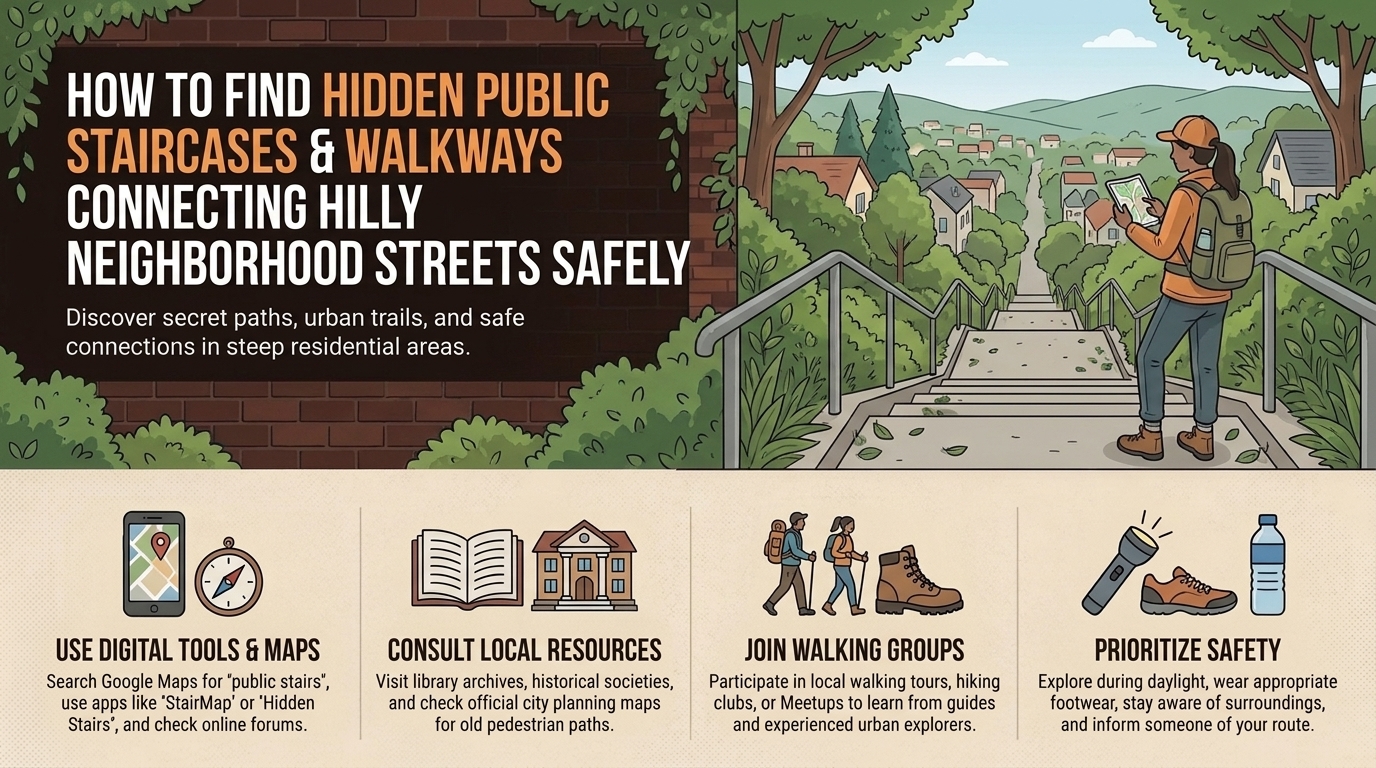
Finding these secret passages requires a blend of digital detective work and old-fashioned boots-on-the-ground exploration. Here is how to map out your local stair routes:
- Consult Specialized Local Guidebooks: Many cities have dedicated “stair-walking bibles.” Classic regional books (such as guides detailing San Francisco’s or Seattle’s stairways) meticulously map out mile-by-mile routes complete with historical anecdotes.
- Scout Satellite Maps in 3D: Open your favorite digital mapping app, switch to satellite view, and look closely at steep residential neighborhoods. Look for thin, pale grey or white lines cutting perpendicularly across blocks where roads take massive hairpin turns or switchbacks.
- Check Municipal GIS and Right-of-Way Maps: Many city departments of transportation (DOT) or public GIS mapping tools feature layers for “Public Pedestrian Easements,” “Municipal Steps,” or “Active Right-of-Ways.”
- Join Local Urban Hiking Communities: Look up regional meetup groups, local Substack blogs, or Reddit communities focused on urban hiking and neighborhood exploration. Local explorers love sharing secret pathways.
- Look for the Clues on the Street: Keep an eye out for small green or white municipal street signs indicating pedestrian-only rights-of-way, yield signs for foot traffic, or unassuming breaks in concrete retaining walls flanked by handrails.
Safety First: Essential Rules for Navigating Hilly Walkways
Because many hidden staircases are tucked away from heavy police patrols or main commercial zones, keeping safety front-of-mind is essential. Follow these golden rules to ensure a secure journey:
1. Master Footwear and Gear Selection
- Traction is Everything: Avoid smooth-soled fashion sneakers. Wear supportive trail shoes or athletic sneakers with deep rubber tread. Old concrete or wooden steps can be slick from morning dew, pine needles, or urban grime.
- Travel Light: Ditch heavy bags. Use a lightweight running vest or a secure cross-body pack to keep your hands free. If you slip, you need your hands unobstructed to catch yourself or grab a handrail.
2. Situational Awareness and Timing
- Go During Daylight: Hidden stairways are best explored during morning or afternoon hours. Exploring unfamiliar, isolated, unlit public stairs after dark significantly increases your risk of tripping or running into safety concerns.
- Mind the Headphone Rule: Keep your music low or use open-ear headphones. You need to hear approaching cyclists, dogs, or environmental sounds.
- Share Your Itinerary: If you are exploring a massive, complex network of hidden stairs alone, drop a pin or share your planned route with a friend or family member.
3. Respect Private Property and Local Etiquette
Many public staircases run directly alongside private homes, backyards, and apartment windows.
- Stay on the Path: Never step off municipal right-of-way paths onto private property lawns or patios.
- Keep the Noise Down: Respect local residents by speaking at a normal conversational volume, especially early in the morning or late in the evening.
- Pack Out What You Bring: Do not litter. Keep these secret community escapes pristine for everyone.
10 Frequently Asked Questions (FAQs)
1. Are public staircases and walkways legally open to everyone?
Yes. Public stairways designated as municipal rights-of-way are public property, open to foot traffic just like standard sidewalks. However, always respect signs marking private driveways or restricted areas.
2. How can I distinguish between a public stairway and a private driveway?
Public stairways typically feature municipal infrastructure such as metal or concrete handrails stamped by the city, official street name signs at the landings, concrete steps integrated into the public utility grid, and absence of “Private Property” or “No Trespassing” signage.
3. What tools or apps are best for finding hidden stairs?
Google Earth’s 3D tilt feature is fantastic for spotting stair cuts visually. Additionally, dedicated local apps, municipal GIS pedestrian maps, and crowd-sourced hiking apps like AllTrails often feature user-submitted urban stair loops.
4. Are urban stair walks safe for children and dogs?
Most stair walks are wonderful for kids and dogs, provided they are comfortable with climbing lots of vertical steps. However, keep dogs securely leashed, as many staircases open directly onto fast-moving street traffic at landings. Check for routes with sturdy handrails if you have smaller children.
5. What should I pack for an urban stair-walking excursion?
Pack light: a reusable water bottle, sunscreen, a fully charged phone, minor first-aid items (like a band-aid for potential blisters), and comfortable athletic clothing suited to the weather.
6. Do I need a special hiking permit to walk urban stairs?
No permits are required whatsoever. Public stairways are part of the city’s standard pedestrian infrastructure, completely free for public use.
7. How do I handle steep descents safely to protect my knees?
Going down stairs puts high eccentric pressure on your knee joints. To protect them, engage your core, keep your knees slightly bent (never lock your joints), take shorter steps, and utilize the handrails if the descent is steep or uneven.
8. What are some of the most famous public staircases in the United States?
Some of the most celebrated include the 16th Avenue Tiled Steps and Lyon Street Steps in San Francisco, the Howe and Blaine Street Stairs in Seattle, the Filbert and Greenwich Street Steps leading to Coit Tower, and the historic step streets of New York City’s outer boroughs.
9. Are public staircases cleared of ice and snow in the winter?
In cities like Seattle or New York, major municipal stairways are prioritized by city departments during winter storms, but minor neighborhood steps may remain icy and unplowed for days. Exercise extreme caution and avoid steep concrete steps during active freezing rain or heavy snow events.
10. Can I use public stairways for an effective cardio workout?
Absolutely. Fitness trainers frequently use public stairways for high-intensity interval training (HIIT), stair repeats, and endurance conditioning. Just be courteous to other pedestrians by stepping aside to let people pass.
Conclusion
Urban exploration isn’t restricted to grand museums or remote wilderness trails. Sometimes, adventure is hiding right above your head, tucked between the residential streets of your own city. By learning how to read the topography, mapping municipal rights-of-way, and prioritizing smart safety habits, you can unlock a secret network of historic staircases and walkways that transform how you experience your urban environment.
Lace up your supportive shoes, step away from the crowded main avenues, and discover the vertical magic waiting on your next neighborhood walk!
What is your favorite hidden staircase or urban walkway in your city? Have you ever stumbled upon a secret view that took your breath away? Drop a comment below and share your local trail secrets with our community!