How to Layer Your Clothing Effectively to Stay Warm During Freezing Winter Blizzards
Welcome back to nyattitude.com, your definitive digital guide for metropolitan resilience, high-performance comfort, and style longevity. Whether you are bracing for bone-chilling polar vortexes sweeping down through New York City and Washington, navigating freezing alpine drafts in San Francisco and Seattle, or confronting rare, fierce cold snaps across Texas and California, winter weather demands absolute respect.
When a full-scale winter blizzard hits, dropping temperatures below freezing and unleashing howling, sub-zero wind chills, throwing on a random assortment of thick sweaters won’t save you. Real warmth during extreme weather is not about wearing heavy, bulky clothing—it is a precise science. It is about mastering the multi-zone three-layer system.
If you want to stay completely warm, dry, and mobile while the elements rage outside, this comprehensive master guide breaks down how to layer your clothing effectively during freezing winter blizzards.
Phase 1: The Golden Rule of Blizzard Survival — The Three-Layer System
Ask any polar explorer, high-altitude mountaineer, or urban commuter who has survived historic nor’easters, and they will tell you the same thing: moisture management is your primary barrier against hypothermia.
When you rush to catch a subway or shovel your car out of a snowbank, your body perspires. If that sweat gets trapped against your skin, it cools rapidly, stealing your body heat up to 25 times faster than dry air. To prevent this, your outfit must be engineered around three distinct, cooperating layers.
Phase 2: Breakdown of the Three Core Layers
1. The Base Layer (The Second Skin)
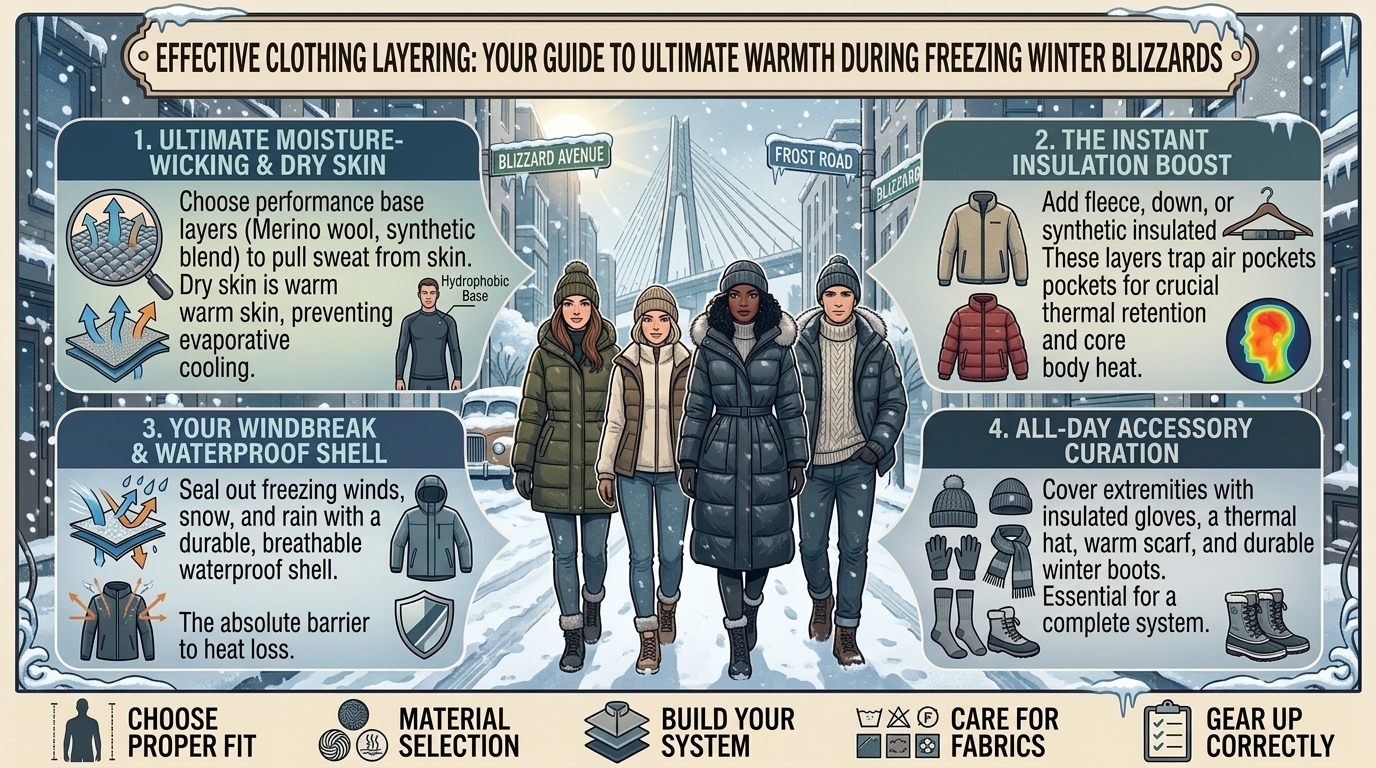
- The Purpose: Moisture management. This layer sits directly against your skin, pulling sweat away through wicking fibers to keep you completely dry.
- What to Wear: 100% fine-gauge merino wool or high-performance synthetic materials (like polyester or polypropylene blends).
- The Cardinal Sin: Never wear cotton as a base layer. Cotton absorbs moisture, holds it against your skin like a wet sponge, and freezes solid in blizzard conditions.
- Fit Check: It should fit snugly against your body without cutting off circulation, trapping a thin layer of warmed air.
2. The Mid Layer (The Insulation Engine)
- The Purpose: Heat retention. This layer traps the heat generated by your body and creates a thermal buffer against the biting exterior cold.
- What to Wear: High-loft polyester fleece, a heavy-duty wool sweater, or a compressible down/synthetic puffer jacket.
- Pro-Tip: If conditions are damp or heavy wet snow is falling, choose synthetic insulation (like PrimaLoft) over natural down. Synthetic insulation retains its thermal properties even if it gets slightly damp, whereas wet down collapses and loses all warmth.
3. The Outer Layer / Shell (The Weather Shield)
- The Purpose: Defense against wind and precipitation. Even the best thermal sweater will fail instantly if bitter wind cuts right through it.
- What to Wear: A truly waterproof, windproof, and breathable shell jacket (such as GORE-TEX or equivalent technical laminates) with sealed seams.
- Fit Check: Ensure your outer shell is roomy enough to fit over your mid layer without compressing the insulation. Trapped dead air space is what keeps you warm!
Comparative Matrix: The Blizzard Layering System
| Layer Type | Primary Function | Ideal Fabrics / Materials | Critical Warning |
| Base Layer | Wicks sweat away; keeps skin dry | Merino wool, silk, high-tech synthetics | Avoid cotton completely; it retains moisture and chills you |
| Mid Layer | Traps body heat and insulates | Heavy fleece, wool, down, synthetic puffers | Do not wear it too tight; air pockets are required for warmth |
| Outer Layer | Blocks wind, sleet, and driving snow | Waterproof/windproof breathable shell | Must feature breathable vents to let body vapor escape |
Phase 3: Protecting Your Extremities During Extreme Cold
Your body instinctively pulls blood flow toward your vital core organs during freezing temperatures, leaving your fingers, toes, ears, and nose vulnerable to frostbite. Do not neglect your extremities:
- Head and Neck: Up to 30% of body heat can escape through an unprotected head. Wear a windproof, fleece-lined beanie that covers your ears. Pair it with a thermal fleece neck gaiter or wool scarf to seal the gap between your jacket collar and chin.
- Hands: Fingers lose heat fast. For severe blizzards, mittens are always warmer than gloves because they allow your fingers to share body heat. Pair a thin merino glove liner inside a waterproof, insulated outer mitt.
- Feet: Wear moisture-wicking wool socks paired with thick thermal wool socks. Ensure your winter boots are fully waterproof, feature rubber traction soles, and have enough room wiggle your toes—tight shoes restrict blood circulation and cause feet to freeze instantly.
Frequently Asked Questions (FAQ)
1. Why is cotton dangerous to wear during a winter blizzard?
Cotton absorbs sweat and melted snow like a sponge. Because it cannot wick moisture away, it stays wet against your skin, rapidly draining your body heat and increasing the risk of hypothermia.
2. Should my base layer fit skin-tight?
It should fit close to your body to effectively capture sweat, but it does not need to be painfully tight. A snug fit ensures efficient moisture transfer.
3. Can I wear multiple heavy sweaters instead of technical layers?
Wearing one giant heavy sweater leaves you with zero temperature regulation. If you step indoors or heat up while walking, you will sweat, overheat, and have no way to shed a single manageable layer without freezing.
4. What is windchill, and why does my outer shell need to be windproof?
Windchill strips away the microscopic layer of warm air trapped around your body. A windproof outer shell stops convective heat loss entirely, making a moderate temperature feel significantly warmer.
5. How do I prevent my glasses from fogging up when I wear a face mask in the cold?
Ensure your base layer or face gaiter creates a tight seal across the bridge of your nose, or choose masks with moisture-venting panels to redirect exhaled breath downward.
6. Are down jackets good for wet blizzard conditions?
Natural down is unmatched for dry, sub-zero cold, but if heavy wet snow or sleet is falling, down loses its loft when wet. Synthetic insulation is safer for damp winter storms.
7. How do I keep my feet warm if I have to stand still in the snow?
Wear insulated boots with removable wool felt liners, add thermal insoles, and ensure your boots aren’t laced too tightly, which restricts warm blood circulation to your toes.
8. Is it possible to over-layer for cold weather?
Yes! If you put on so many tight layers that you compress your insulating garments, you crush the “dead air space” required to trap heat. Furthermore, overheating causes heavy sweating, which chills you later.
9. What should I pack in my bag during a severe winter storm commute?
Always carry an extra pair of dry wool socks, a compact umbrella or emergency poncho, a portable phone charger, and high-calorie snacks in case your transit gets delayed.
10. Where can I find more winter survival guides and lifestyle tips?
Keep your browser bookmarked right here at nyattitude.com for ongoing dispatches on weather preparedness, metropolitan style, and urban winter living!
Conclusion
Facing down a freezing winter blizzard doesn’t have to be a miserable experience. By moving away from bulky guesswork and adopting the scientific three-layer system—anchored by a moisture-wicking base layer, an insulating mid layer, and a impenetrable waterproof shell—you take absolute control of your comfort and safety. Dress with intention, protect your extremities, and brave the winter elements with unwavering confidence and attitude.
What weather preparedness guide or seasonal style topic should nyattitude.com explore next? Drop your thoughts in the comments below!