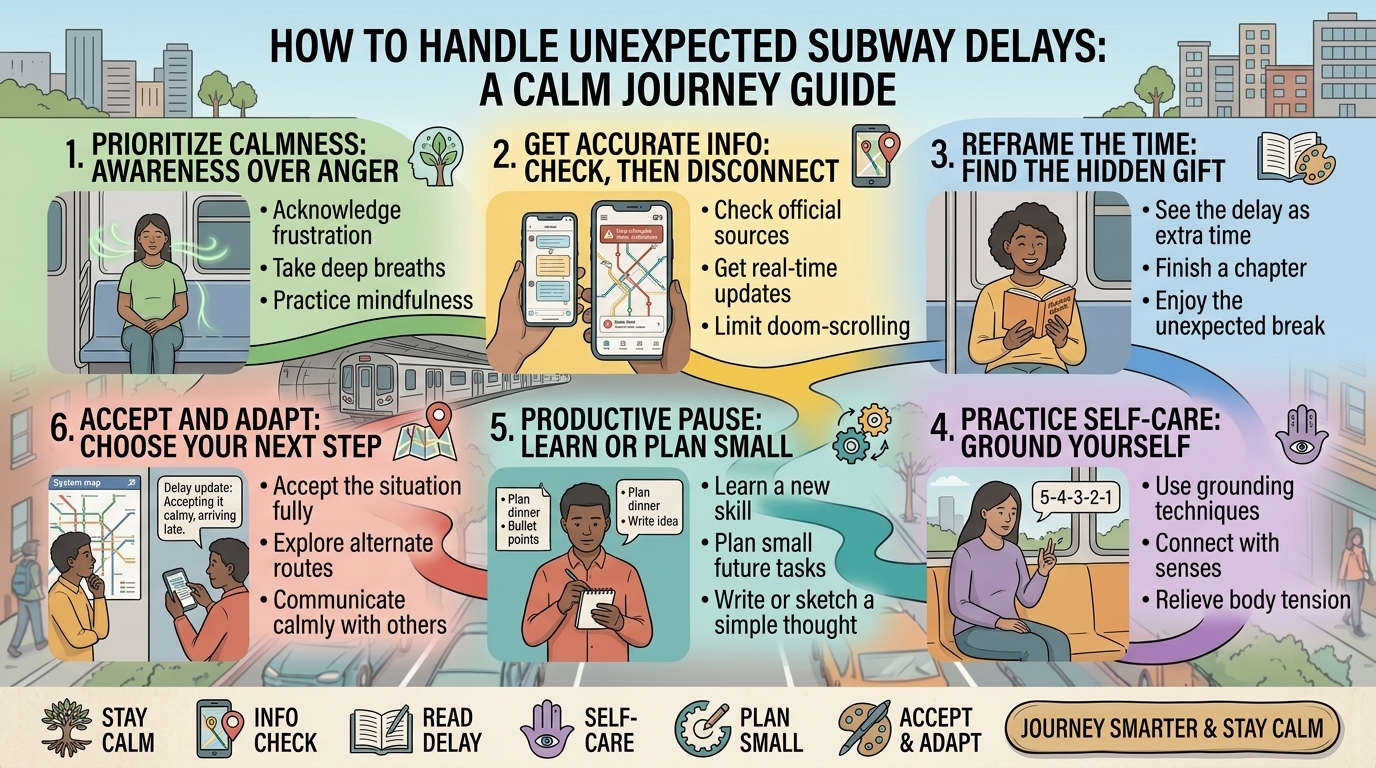
You check your watch, step onto the platform, swipe your transit card or tap your phone via contactless payment, and wait for the familiar rumble of the approaching train. Then, the announcement echoes through the station speaker: “We are experiencing southbound delays due to signal trouble…”
For millions of urban residents navigating transit networks across major metropolitan areas—from the subterranean mazes of New York and San Francisco to bustling global transit hubs—unexpected subway delays are an inevitable rite of passage. A sudden stoppage doesn’t just alter your arrival time; it triggers an immediate spike in cortisol, derails your morning focus, and threatens to cast a dark cloud over your entire day.
However, your commute does not have to dictate your mood. By mastering psychological reframing, developing proactive transit habits, and building tactical response plans, you can take back control of your schedule. This comprehensive guide explores actionable tips and expert strategies to handle unexpected subway delays with total poise.
Part 1: The Psychology of Transit Frustration
Why do subway delays feel so uniquely infuriating compared to other minor life inconveniences? The answer lies in loss of control.
When you sit in traffic, you can often see the congestion or choose an alternate side street. When you are trapped underground in a metal tube or stuck behind a yellow line on a crowded platform, agency vanishes. You are entirely at the mercy of dispatchers, track mechanics, and aging infrastructure.
Recognizing this psychological trap is the first step to neutralizing it. When a delay hits, your brain interprets the unexpected standstill as a threat to your safety, productivity, or social standing. Acknowledging that frustration is a natural physical reaction—rather than letting it spiral into ruined-day syndrome—allows you to consciously pivot from panic to problem-solving.
Part 2: Proactive Pre-Trip Habits to Mitigate Transit Shock
The best way to handle a delay is to outsmart it before you even leave your front door. Elite commuters treat transit reliability as a moving target, building resilience straight into their daily routines.
1. Build the “Buffer Zone” Into Your Schedule
The single biggest catalyst for transit-induced rage is the dreaded “just-in-time” arrival fallacy—leaving the house with just enough minutes to make it to work or an appointment if everything runs at 100% efficiency.
- The Rule of 15: Always add a 15-minute buffer to your travel expectations. If your brain believes you have to be somewhere at 9:00 AM, train yourself to aim mentally for 8:45 AM. If a delay eats up 12 minutes, you still arrive calm and unbothered.
2. Leverage Real-Time Multi-Modal Apps
Never rely solely on static station schedules. Utilize modern transit apps that provide live service alerts, crowd-sourced delay updates, and predictive arrival times. Checking your transit line’s status while eating breakfast gives you the foresight to pivot to a bus route, rideshare, or alternative train line before you walk down the stairs into a blocked station.
Part 3: Tactical Real-Time Management: What to Do When Stuck Underground
When the train comes to a sudden halt between stations or crawls at a snail’s pace, your immediate actions dictate your stress levels for the next hour. Follow this crisis-management checklist:
[Train Halts Unexpectedly]
       │
       ├──> 1. Breathe: Reset your nervous system (Box Breathing)
       ├──> 2. Assess: Check transit apps for estimated duration
       ├──> 3. Communicate: Text your boss/host early and honestly
       └──> 4. Pivot: Decide whether to wait it out or exit at the next platform
Step 1: Regulate Your Nervous System Instantly
Physical tension breeds mental panic. When a delay strikes, consciously drop your shoulders away from your ears and unclench your jaw. Practice tactical breathing (such as inhaling for 4 seconds, holding for 4, and exhaling for 4) to lower your heart rate and short-circuit the fight-or-flight response.
Step 2: Communicate Early and Transparently
The anxiety of being late often hurts worse than actually being late. If a delay is going to push your arrival past an acceptable threshold, send a brief, proactive message immediately:
“Hi [Name], tracking a major signal delay on my transit line this morning. I’m monitoring the updates and will keep you posted on my ETA.”
Most people are understanding of transit anomalies, and lifting the secrecy instantly relieves pressure off your shoulders.
Step 3: Evaluate the “Exit Strategy”
If you have been sitting motionless between stations for more than ten minutes with no conductor update, look at your options. Can you safely wait? Is there a transfer station coming up where you can switch to a functioning express line, a parallel bus route, or a bike-share option? Always weigh the devil you know (waiting it out) against the devil you don’t (scrambling above ground).
Part 4: Mental Reframing: Turning Dead Time Into Bonus Time
The most effective way to protect your day from a transit delay is to completely redefine what that stalled time means to you. Instead of viewing it as stolen time, treat it as uninterrupted bonus time.
- The Audio Escape: Keep a curated playlist of calming instrumental music, an engaging fiction audiobook, or an educational podcast downloaded offline on your phone. Plugging in your headphones creates an instant sensory barrier between yourself and the groaning crowd around you.
- Micro-Productivity or Mental Rest: Use the time to clear out low-stakes smartphone admin tasks (like deleting old screenshots or organizing your notes app), or use it as guilt-free permission to zone out and stare blankly out the window. Not every waking second needs to be optimized; sometimes, forced stillness is a rare gift.
Frequently Asked Questions (FAQ)
1. What is the best way to check for real-time subway delays before heading out?
Always check official transit operator apps, municipal service status web pages, or crowd-sourced apps like Moovit or Google Maps before leaving your home or office. Social media platforms (such as X/Twitter updates from local transit agencies) also provide rapid, real-time community reports.
2. How do I politely handle a panic attack or claustrophobia while trapped on a delayed train?
If you feel overwhelmed by a crowded, stationary car, try to move toward the center of the car where ventilation is often better, focus heavily on slow deep breathing, and remind yourself that the delay is temporary. If the train reaches a platform, step out onto the open station landing for fresh air, even if you have to wait for the next train.
3. Should I notify my workplace every single time my train is delayed?
Not necessarily. If the delay is minor (under 10–15 minutes) and won’t impact your immediate commitments, it’s usually not worth mentioning. However, if it impacts a crucial morning meeting or client call, communicate early with a realistic revised ETA.
4. Are certain days of the week or times more prone to severe subway delays?
Yes. Older transit systems experience higher frequencies of mechanical breakdowns and signal failures during peak rush hours due to intense volume. Furthermore, weekends are notoriously prone to scheduled track maintenance, route changes, and shuttle bus replacements. Always check weekend advisory boards ahead of time.
5. What alternative transport backups should I keep ready in my toolkit?
It is wise to map out secondary options along your daily commute corridor. Keep your digital wallet loaded for contactless payments, know the local bus lines that run parallel to your train tracks, and ensure you have local rideshare or bike-share apps set up and logged in for emergency overrides.
6. How can I stop a transit delay from ruining my mood for the rest of the workday?
Practice “mental compartmentalization.” When you finally step out of the station, consciously take a deep breath, roll your shoulders, and tell yourself: “The commute is over. The workday starts now.” Treat stepping through your destination’s doors as a hard boundary line.
7. Is it worth arguing with transit station staff about a delay?
No. Station booth attendants and conductors have very little direct control over system-wide signal failures, power outages, or track obstructions. Directing frustration at front-line workers only heightens stress for everyone; channeling that energy into finding an alternative route is far more productive.
8. How much buffer time should I realistically add to important morning appointments?
For critical events—such as job interviews, medical procedures, or major client presentations—you should aim to arrive in the neighborhood at least 30 to 45 minutes early. Use a nearby coffee shop or park to review your notes rather than risking a late arrival due to a mid-route transit stoppage.
9. What should I do if my phone battery dies during a delayed commute?
This is a commuter nightmare scenario. To prevent it, keep a portable power bank and charging cable in your everyday bag. If your battery does die, look for station map displays, ask transit staff for directional help, or look for public charging kiosks if available in modern stations.
10. Can listening to music actually help reduce commuter anxiety?
Absolutely. Studies show that listening to familiar, soothing music or structured audio content significantly lowers heart rates and distracts the brain from environmental stressors, making cramped or delayed spaces feel drastically more manageable.
Conclusion
Unexpected subway delays are an annoying, recurring friction point of modern urban life, but they do not have to dictate your emotional state or sabotage your productivity. By building smart schedule buffers, utilizing real-time digital transit tools, keeping calm under pressure, and reframing unexpected downtime into a moment for personal pause, you can master your commute instead of letting it master you.
What is your go-to strategy for surviving a nightmare transit delay, or what’s the longest you’ve ever been stuck underground? Let us know in the comments below!