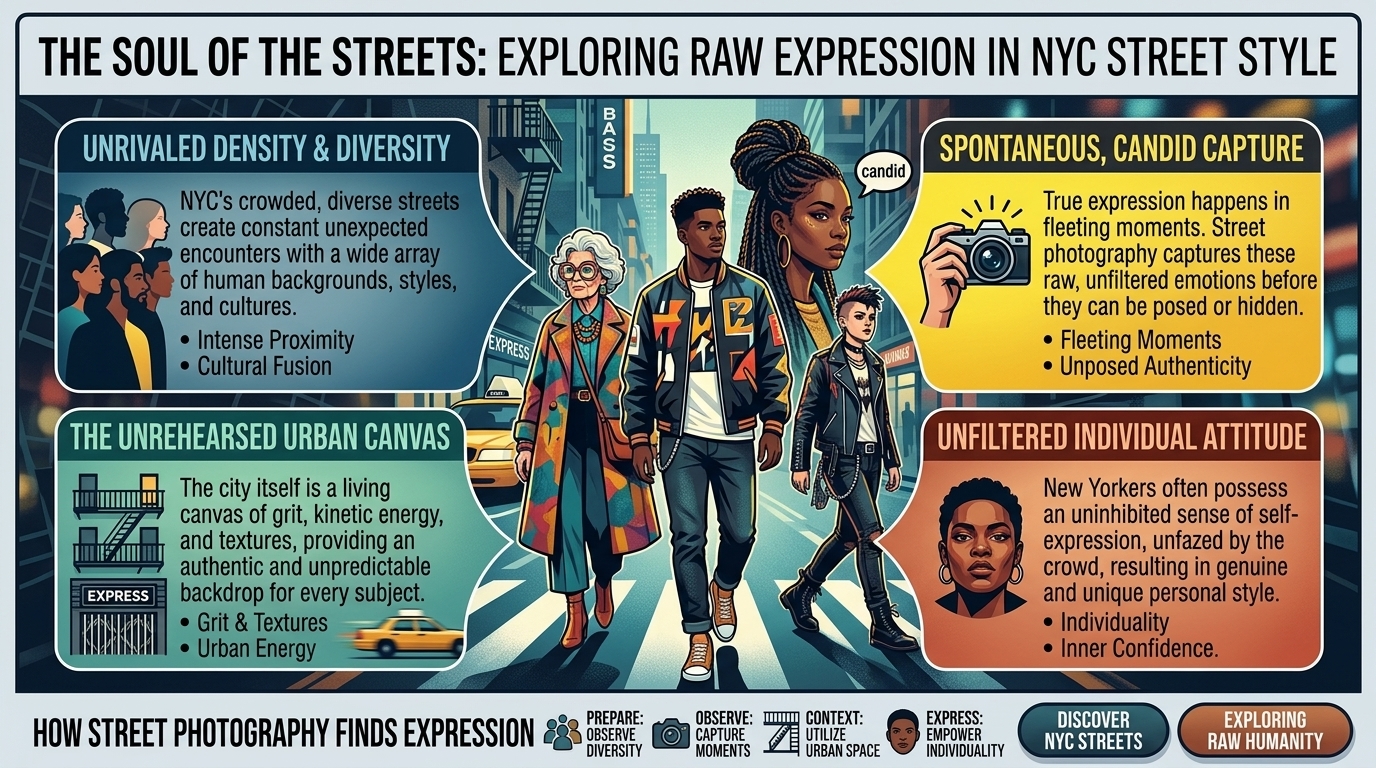
Why Street Style Photography in New York City Captures Raw Authentic Human Expression
Welcome back to nyattitude.com, your definitive digital authority on urban culture, metropolitan aesthetics, and the beating heart of modern street style. When you walk down the kinetic avenues of New York City—whether dodging yellow cabs in Midtown, navigating the art-infused sidewalks of SoHo, or catching the twilight breeze along the Brooklyn waterfront—you are not just witnessing a city; you are witnessing a living, breathing canvas.
In an era dominated by hyper-curated social media grids, algorithm-driven feeds, and polished, studio-lit fashion campaigns, street style photography in New York City stands apart as something radically different. It is unscripted, chaotic, and fiercely alive. It captures raw, authentic human expression in its purest form.
Why does New York hold a monopoly on this raw visual energy? How do street photographers manage to freeze split-second moments of human identity against a backdrop of concrete and steel? Let’s dive deep into the ultimate master guide examining why NYC street style photography reigns supreme.
Phase 1: The Unique DNA of New York City Street Culture
To understand why street photography hits differently in New York, you must first understand the city’s unique socio-cultural ecosystem. New York is a global magnet for individualists, dreamers, artists, and hustlers.
1. The Melting Pot of Identity
In suburban or rural settings, fashion often conforms to regional consensus. In New York, consensus does not exist. A corporate executive from Wall Street, a vintage-obsessed art student from the East Village, a punk rocker from Brooklyn, and a high-fashion model off-duty from a Manhattan runway all cross paths at the exact same pedestrian crosswalk. This collision of contrasting subcultures creates a visual narrative that cannot be artificially manufactured in a studio.
2. The Architecture as an Emotional Catalyst
New York’s physical infrastructure—soaring skyscrapers, steam-vented asphalt, rusted iron fire escapes, and grid-locked traffic—creates a dramatic, high-contrast environment. The architecture acts as a character in the frame, framing human emotion and body language against a grand scale that humbles the individual while amplifying their personal style statement.
Phase 2: Why Street Style Photography Equals Raw Authenticity
Studio fashion photography is about control: lighting is metered to the millimeter, hair is shellacked into place, and expressions are directed. Street photography, by contrast, thrives on surrender. Here is why it captures genuine human expression:
1. The Decisive Moment in Motion
Legendary street photographers talk about “the decisive moment”—that microscopic fraction of a second when physical elements align to reveal a deeper truth about a person. On New York sidewalks, people are moving with purpose. Their stride, the way they adjust a trench coat against a sudden gust of wind, or a sideways glance at a passing bus reveals psychological depth that a static studio pose can never replicate.
2. Fashion as Armor and Autobiography
In New York, clothing is rarely worn just for physical warmth or basic modesty; it is worn as armor, declaration, and autobiography. When someone steps onto a New York City subway platform wearing a vintage thrifted fur coat paired with beat-up sneakers, they are broadcasting their internal state to the world. Street photography preserves that personal manifesto before it gets washed away by routine.
3. The Absence of Performance Anxiety (Initially)
While subjects in modern street style often spot the camera lens, the candid nature of urban transit means many candid frames catch people lost in their thoughts—drinking a morning iced coffee, listening to a playlist on headphones, or laughing mid-conversation. This unguarded vulnerability is the gold standard of authentic human expression.
Phase 3: Essential Elements That Make an NYC Street Shot Masterpiece
If you are an aspiring photographer or an aficionado studying street style archives, certain visual elements consistently elevate a New York street photo from a simple snapshot to a work of art:
1. Environmental Storytelling
A great street photograph doesn’t just show an outfit; it tells a micro-story about the environment. A splash of neon light reflecting off a rain-slicked pavement in Times Square or a streak of autumn leaves blowing through Washington Square Park roots the subject directly into the geographic soul of the city.
2. Capturing Micro-Expressions
Look closely at award-winning street shots. It is rarely a blank, mannequin-like stare. It is a smirk, a look of fierce determination, an upturned chin bracing against the winter chill, or genuine amusement at a street performer. These micro-expressions shatter the illusion of perfection, showing real humanity.
Comparative Matrix: Studio Fashion vs. NYC Street Style Photography
| Metric | Studio Fashion Photography | New York Street Style Photography |
| Control Level | 100% control over lighting, set, and posing | Zero control; completely fluid and unpredictable |
| Wardrobe | Pre-selected samples loaned by major brands | Personal wardrobe curated through lived experience |
| Emotional Tone | Polished, aspirational, often distant | Raw, authentic, energetic, and relatable |
| Setting | Sterile white backdrop or artificial soundstage | Living urban ecosystem (Manhattan, Brooklyn, etc.) |
| Primary Goal | Commercial product conversion | Cultural documentation and human storytelling |
Pro-Tips for Capturing Authentic Street Style in the City
- Anticipate Rather Than Chase: Instead of running after fast-moving pedestrians, find a visually compelling backdrop—a subway exit, a classic brownstone stoop, or a bustling crosswalk—set your focus, and wait for the right subject to step into your frame naturally.
- Respect the Hustle: New Yorkers are notoriously busy. If you approach someone for a dedicated street style portrait, be respectful, quick, and polite. A simple compliment (“I love how you styled that jacket”) goes a long way in securing an authentic smile.
- Embrace “Flawed” Technicals: Don’t stress excessively over pixel-perfect sharpness. A slightly motion-blurred stride or dramatic grain captured during a moody twilight hour often communicates the raw energy of New York much better than a clinical, over-sharpened digital file.
Frequently Asked Questions (FAQ)
1. What makes New York City different from other fashion capitals for street photography?
New York’s grid system, relentless pedestrian pace, and diverse cultural mix create a constant, high-speed collision of subcultures that you don’t find in slower-paced or more uniform urban centers.
2. Is street photography legal in public spaces in New York?
Yes. Under United States law, photographing people in public spaces where there is no reasonable expectation of privacy (such as sidewalks, parks, and public plazas) is protected under the First Amendment as a form of artistic expression.
3. How do street photographers handle subjects who object to being photographed?
Professional street photographers practice situational awareness and empathy. If someone clearly signals discomfort, waves off the camera, or asks not to be photographed, ethical street photographers immediately delete the frame and respect their boundaries.
4. What camera gear is best for candid street style photography?
Compact, lightweight mirrorless cameras paired with versatile prime lenses (such as a 35mm or 50mm focal length) are favored because they allow photographers to move quickly and blend into crowds without intimidating subjects.
5. Why do people care so much about street style fashion?
Street style represents democratization in fashion. Instead of what billionaires and elite designers dictate on a runway, street style shows what real people actually wear, style, and innovate in everyday life.
6. Can I do street style photography with a smartphone?
Absolutely! Modern smartphone cameras feature incredible low-light capabilities, fast shutter speeds, and discreet profiles, making them the ultimate stealth tool for capturing candid urban moments.
7. How has social media changed New York street photography?
Platforms like Instagram and TikTok have turned street style into a global phenomenon, transforming everyday commuters into viral style icons overnight, though it has also led to more performative posing on certain high-traffic corners.
8. What are the best neighborhoods in NYC for street style photography?
SoHo, the Lower East Side, DUMBO in Brooklyn, Greenwich Village, and the areas surrounding major fashion week venues (like Lincoln Center or Tribeca) are absolute hotspots.
9. How do I overcome the fear of photographing strangers in public?
Start by shooting from a distance or focusing on architectural elements and hands/shoes rather than full-face portraits. Over time, confidence builds, and you realize most people are too busy with their own lives to notice a camera.
10. Where can I find more urban style galleries and street photography features?
Keep your browser bookmarked right here at nyattitude.com for ongoing dispatches on New York street culture, fashion week highlights, and visual storytelling!
Conclusion
Street style photography in New York City is far more than just taking pictures of nice clothes; it is an ongoing archive of human resilience, creativity, and identity. By stripping away studio lighting and artificial pretense, the concrete canyons of Manhattan and Brooklyn reveal the raw, unscripted beauty of real people living out loud. Grab your camera or your phone, step out onto the pavement, and start observing the masterpiece happening all around you.
What neighborhood feature or urban style topic should nyattitude.com explore next? Drop your thoughts in the comments below!