Have you ever noticed how slipping into a soft, monochromatic charcoal hoodie feels like wrapping yourself in an invisible shield, while stepping out in a vibrant cobalt blazer or sunflower-yellow dress shifts how you carry yourself?
This isn’t just an aesthetic coincidence. What we put on our bodies triggers a powerful psychological, neurological, and physiological chain reaction.
At NYAttitude (nyattitude.com)—whether you’re navigating the sleek streets of New York, embracing the tech-forward energy of San Francisco, soaking up the coastal sun of California, soaking in the creative buzz of Texas, or walking through rainy afternoon commutes in Washington—fashion is more than just fabric. It is an intentional tool for internal calibration.
In this deep dive into enclothed cognition and the psychology of color, you will discover the science behind how your wardrobe affects your mind, why bright hues spark real neurochemical responses, and how you can harness the “Dopamine Dressing” movement to elevate your confidence, energy, and mood instantly.
1. What Is the Psychology of Clothing? (Enclothed Cognition Explained)
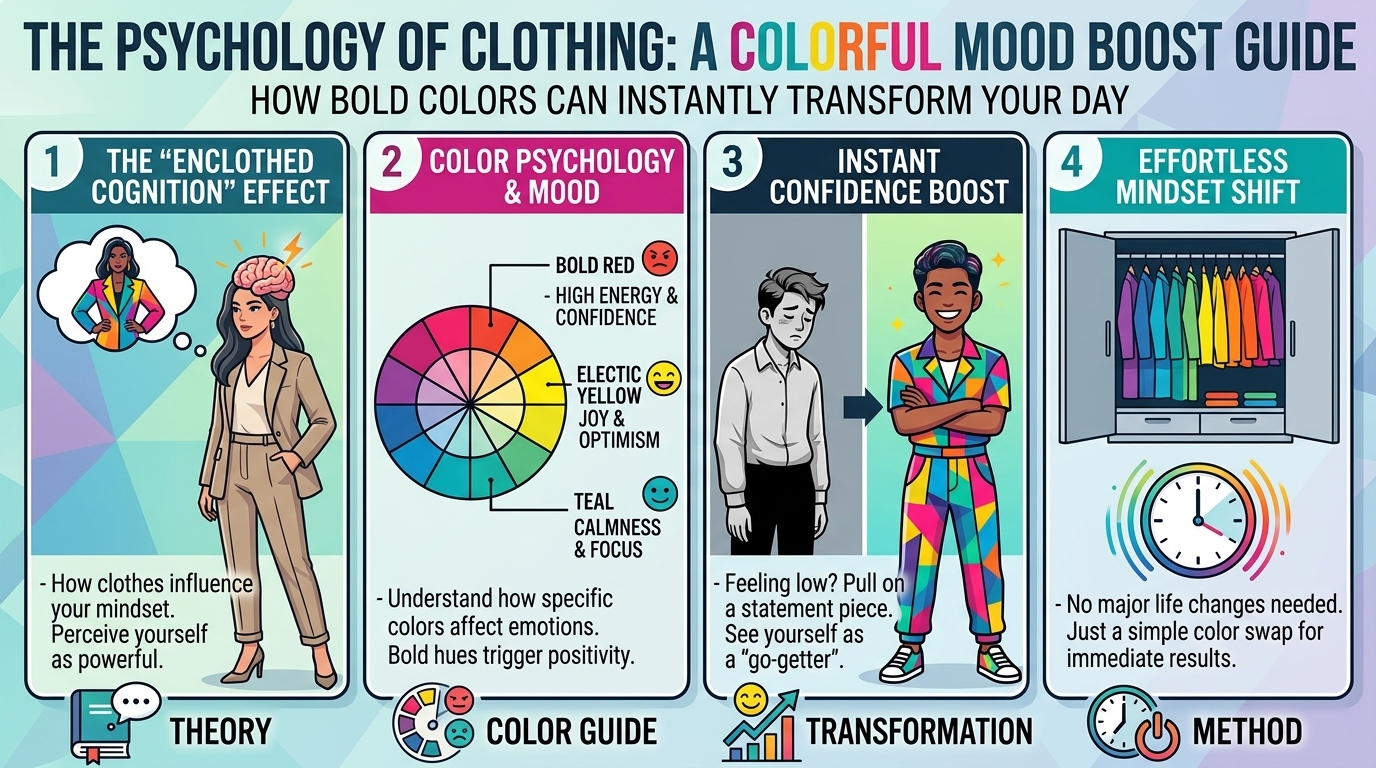
In 2012, Hajo Adam and Adam D. Galinsky published a landmark study in the Journal of Experimental Social Psychology coining the term “Enclothed Cognition.” Their research proved that the clothes we wear trigger dynamic shifts in our psychological processes, attention spans, and self-perceptions.
Enclothed cognition relies on two distinct factors:
- The Symbolic Meaning of the Clothing: What your brain consciously and unconsciously associates with the garment (e.g., power, warmth, authority, fun, relaxation).
- The Physical Experience of Wearing It: How the fabric, cut, weight, and color interact with your body and visual field throughout the day.
                     THE ENCLOTHED COGNITION LOOP

    ┌──────────────────────────────────────────────────────────┐
    │ 1. VISUAL & SENSORY INPUT                                │
    │    You wear a bold garment (e.g., Saturated Red Blazer). │
    └────────────────────────────┬─────────────────────────────┘
                                 │
                 ┌───────────────┴───────────────┐
                 ▼                               ▼
     [ INTERNAL NEUROCHEMISTRY ]     [ EXTERNAL SOCIAL SIGNALS ]
     • Brain processes warm hue      • Others perceive confidence &
       wavelengths.              approachability.
     • Triggers dopamine &           • Positive visual feedback loop
       heightened arousal.       (compliments, engaging eye contact).
                 │                               │
                 └───────────────┬───────────────┘
                                 ▼
    ┌──────────────────────────────────────────────────────────┐
    │ 3. PSYCHOLOGICAL SHIFT                                   │
    │    Increased self-efficacy, mood elevation, and poise.   │
    └──────────────────────────────────────────────────────────┘
When you put on clothes associated with high energy or confidence, your brain adopts those qualities. What you wear acts as a continuous non-verbal biofeedback mechanism.
2. Dopamine Dressing: The Science of Color and Neurochemistry
The phrase Dopamine Dressing has evolved from a social media trend into a recognized practical area of behavioral style psychology. At its core, dopamine dressing is the practice of intentionally choosing clothing—specifically saturated colors, dynamic textures, and joyful prints—to activate the brain’s reward pathways and lift your mood.
How Light Wavelengths Affect the Brain
Color is fundamentally visual light traveling at varying wavelengths:
- Long Wavelengths (Reds, Oranges, Yellows): Stimulate the central nervous system, slightly increasing heart rate and triggering alertness and motivation.
- Short Wavelengths (Blues, Cool Greens, Purples): Lower autonomic arousal, encouraging calm, lowered stress responses, and focused clarity.
                   CHROMATIC SPECTRUM & NEURO-EFFECTS

    HIGH ENERGY / STIMULATION              CALM / BALANCE / FOCUS
    ◄──────────────────────────────────────────────────────────►
    [ RED ]       [ ORANGE ]     [ YELLOW ]     [ GREEN ]     [ BLUE ]
    Long Wave     Long Wave      Mid-Long       Mid Wave      Short Wave

    • Motivation  • Playfulness  • Optimism     • Harmony     • Tranquility
    • Confidence  • Creativity   • Mental Clarity • Grounding  • Serenity
When your visual field is constantly exposed to a bright color you are wearing (such as looking down at your sleeves or seeing your reflection throughout the day), your brain repeatedly processes these visual inputs. This continuous exposure sparks subtle, positive shifts in emotional state.
3. The Color Palette Power Map: Hues and Their Psychological Triggers
Not all bold colors impact the human mind in the same way. Below is a breakdown of primary color spectrums and their direct emotional triggers:
| Color Family | Associated Psychological Impact | Best Worn When You Need… |
| Electric Red / Crimson | Heightened arousal, dominance, physical confidence, attraction. | Public speaking, negotiations, overcoming lethargy. |
| Sunflower Yellow | Sunshine stimulus, mental clarity, optimism, social openness. | Creative brainstorming, overcast/rainy days, breaking social anxiety. |
| Tangerine / Bright Orange | Playfulness, warmth, spontaneous energy, enthusiasm. | Weekend gatherings, athletic activities, launching new projects. |
| Cobalt / Electric Blue | High-level trust, calm authority, clear communication, peace. | Important job interviews, high-stress business meetings. |
| Emerald & Lime Green | Rejuvenation, cognitive restoration, stress reduction, harmony. | Recovering from burnout, long travel days, strategic planning. |
| Magenta & Vibrant Pink | Unapologetic self-expression, joy, compassion, playfulness. | Social outings, breaking out of a routine, boosting self-esteem. |
4. 5 Actionable Tips to Integrate Bold Colors Into Your Daily Wardrobe
If your current wardrobe consists primarily of black, grey, navy, and beige, making the jump to high-saturation colors can feel intimidating. Here is a step-by-step strategy for introducing mood-boosting hues smoothly.
Step 1: Start With the “20% Rule” (Accessories First)
You don’t need to wear a head-to-toe monochromatic neon suit to reap the psychological benefits. Start by incorporating a 20% pop of bold color:
- A bright orange or cobalt blue beanie or scarf.
- Vibrant statement sneakers paired with an otherwise neutral outfit.
- A saturated leather handbag, belt, or watch band.
Step 2: Utilize “Color Sandwiching”
Color sandwiching is a popular styling technique used by creative directors across San Francisco and New York. Match the color of your top-layer accessory (like a scarf, hat, or jacket) with your footwear, while keeping the middle layer (pants/skirt) neutral. This creates visual balance without feeling overwhelming.
Step 3: Match Color to Your Daily Emotional Needs
Instead of asking “What looks good today?”, reframe your morning routine by asking: “How do I want to feel today?”
- Feeling drained? Reach for yellow or orange.
- Feeling anxious or overstimulated? Reach for emerald green or soft blue.
- Feeling invisible or unassertive? Reach for deep crimson or magenta.
Step 4: Pay Attention to Fabric Texture and Saturation
A silk magenta top reflects light completely differently than a chunky knit magenta sweater. If vivid colors feel too sharp for your personality, opt for natural, matte fabrics like linen, brushed cotton, or wool. These materials soften bright pigments while retaining their mood-lifting qualities.
Step 5: Curate Your “Attitude Uniforms”
Identify 3 to 4 fail-safe outfits that make you feel invincible. When you experience high-stress mornings or low-energy days, remove the mental load of decision-making by grabbing a pre-curated outfit designed to boost your confidence.
Frequently Asked Questions (FAQ)
Q1: Can wearing bright colors actually cure clinical depression or severe anxiety?
No. Dopamine dressing and color psychology are self-care tools for mood regulation and emotional expression, not substitutes for professional mental health treatment or medical therapy. They offer a gentle, daily way to boost your energy and self-perception.
Q2: What if I naturally feel more comfortable and safe wearing all black?
Black carries its own psychological power: authority, sophistication, mystery, and physical protection. If all-black is your baseline, you don’t have to abandon it. Try adding a single high-contrast, saturated item—like red socks, a colorful lining in a jacket, or vibrant jewelry—to gain the visual benefits of dopamine dressing while maintaining your signature style.
Q3: How does geographic climate (e.g., Texas heat vs. rainy Washington weather) affect color choice?
Climate influences how our eyes process ambient light. Bright sunlight in Texas and California naturally complements high-saturation warm tones (corals, yellows, terracottas). In gloomier, overcast climates like Seattle or Washington state, wearing vibrant, warm colors acts as a counterweight to grey skies, injecting visual warmth into your environment.
Q4: How do I know which bold colors complement my skin tone?
Look at the undertones of your skin:
- Cool Undertones (blue/pink veins): Crisp cobalt blue, emerald green, ruby red, and true magenta.
- Warm Undertones (greenish veins): Mustard yellow, tangerine, warm coral, olive, and brick red.
- Neutral Undertones: You can easily pull off colors from both spectrums.
Q5: Can dopamine dressing work in conservative corporate office environments?
Yes! You can maintain a professional image while incorporating mood-boosting hues. Opt for deep, rich jewel tones—such as rich burgundy, royal blue, or deep forest green—or use bright colors on inner linings, socks, pocket squares, or silk scarves.
Q6: What is the difference between “Enclothed Cognition” and traditional Color Psychology?
Color psychology focuses specifically on how human emotions and behaviors react to different visual pigments. Enclothed cognition expands on this by combining the symbolic meaning of color with the physical feeling, fit, and personal identity tied to wearing the garment.
Q7: Why do some people feel overwhelmed or self-conscious when wearing bright colors?
If you are used to blending in, wearing high-contrast colors draws visual attention, which can trigger mild social anxiety. The key is to start small (with accessories or home loungewear) and build tolerance gradually as your confidence grows.
Q8: Does texture matter as much as color when it comes to mood-boosting clothing?
Yes! Tactile input is just as important to the brain as visual input. Soft cashmeres, smooth silks, and cozy fleeces release calming sensory signals, while structured fabrics like leather and denim can boost your feeling of poise and readiness.
Q9: Why do bright clothes seem to attract more positive social interactions?
Bright, warm colors make you appear open, energetic, and approachable. When you wear striking colors, people are more likely to smile, make eye contact, or offer compliments, creating a positive social feedback loop that further lifts your mood.
Q10: How can I build a bold, mood-boosting wardrobe on a budget?
You don’t need to replace your entire closet. Focus on thrift shopping for unique vintage statement pieces, swapping items with friends, or simply pairing a few bright accessories with the neutral basics you already own.
Conclusion: Wear Your Attitude with Purpose
Your clothes are not just passive items hanging in a closet—they are an active interface between your mind and the outside world. By understanding the psychology of clothing, you gain a practical daily tool for emotional regulation, confidence building, and authentic self-expression.
Whether you’re dressing for a high-stakes board meeting in San Francisco, an art gallery opening in New York, a casual weekend in Austin, or a coffee run in Seattle, don’t leave your mood to chance. Step into your wardrobe with clear intention, embrace the power of color, and express your true NYAttitude (nyattitude.com) to the world every single day.