When planning a journey through some of America’s most dynamic and visually striking regions—from the glittering bays of San Francisco and the sprawling coastlines of California to the misty marine waterways of Washington state, the historic harbors of New York, and the sweeping aquatic borders of Texas—travelers often make the same expensive mistake. They shell out small fortunes for commercial tour buses, enclosed charter boats, or congested private excursions, fighting crowds for a mediocre view through smudged glass.
Yet, hidden in plain sight across these very regions sits one of the greatest travel hacks on earth: the public commuter and utility ferry.
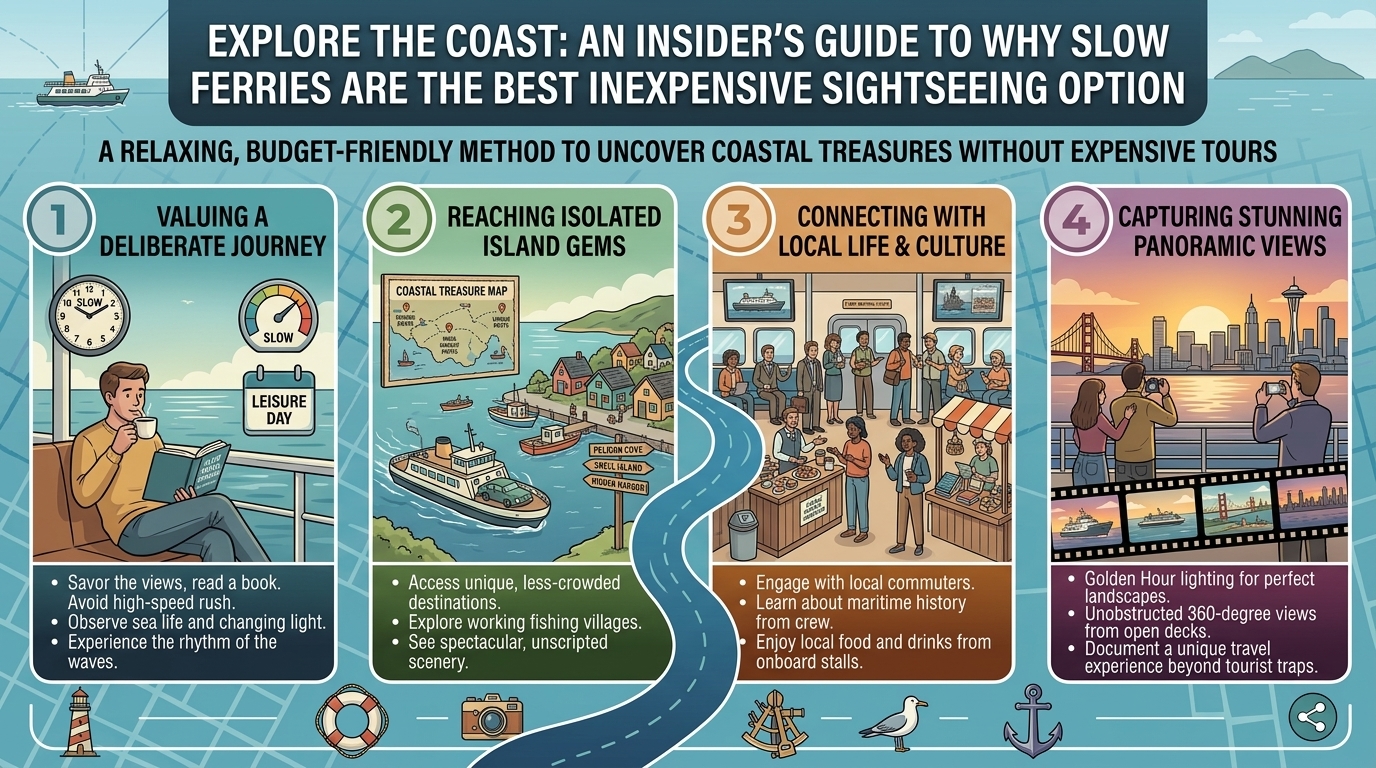
Operating primarily as working transit lines for locals, these vessels double as world-class scenic cruises. For the price of a standard subway or bus fare—and sometimes entirely for free—a slow ferry ride offers unhindered outdoor viewing decks, fresh sea air, and a front-row seat to architectural and natural wonders. If you want to maximize your travel budget while experiencing a destination like a true insider, here is your definitive guide to why a slow ferry ride beats every other sightseeing option available.
1. The Economics of Sightseeing: Luxury Views on a Public Budget
Modern tourism has become notoriously transactional. A standard harbor cruise in a major metropolitan hub can easily cost anywhere from $40 to over $100 per person. Multiply that by a family or a group of friends, and a simple afternoon on the water transforms into an expensive ordeal.
- Fraction of the Cost: Public ferries operate on subsidized municipal or regional transit budgets. Whether you are riding iconic routes in New York or the San Francisco Bay, tickets cost a fraction of commercial alternatives—or, in legendary cases like the Staten Island Ferry, cost precisely zero dollars.
- No Tourist Traps on Board: Because these boats are designed for everyday commuters, students, and local workers, you will not find high-pressure sales pitches for overpriced souvenirs, mandatory tip envelopes for announcers, or congested captive-audience pricing. You pay for transit, and the view comes entirely free.
2. Unmatched Perspective: Seeing Iconic Landmarks from the Water
Cities built around major bodies of water derive their entire identity from their maritime approaches. Approaching a skyline from land gives you a restricted, two-dimensional angle; approaching it from the water reveals its true grand scale.
- New York Harbor: Taking a transit run across New York waters places you eye-to-eye with the Statue of Liberty, Ellis Island, and the soaring canyon walls of the Lower Manhattan financial district. Instead of peering through a crowded glass window on a tour ship, you stand on an open-air upper deck with the wind in your face.
- The San Francisco Bay: Routes connecting San Francisco to Sausalito, Larkspur, or Oakland glide past Alcatraz Island,Angel Island, and beneath the towering spans of the Golden Gate Bridge. The shifting play of marine fog and afternoon sun creates a constantly changing cinematic backdrop that no land-based tour can replicate.
- Washington State & Texas: In the Pacific Northwest, Washington State Ferries weave through misty fjords, island chains, and evergreen-lined channels framed by snow-capped peaks. Down in Texas, historic coastal routes like the Galveston-Port Bolivar ferry offer salty breezes, swooping pelicans, and a front-row view of bustling ship channels without costing a single dime.
3. The Psychology of Slow Travel: Decompressing on the Water
In an era of hyper-accelerated itineraries, taking a slow ferry forces you to pause. There is no rush, no traffic gridlock to navigate, and no parking meters to feed while you are on the water.
- Embracing Drift Time: Sociologists and travel writers often champion “drift time”—unstructured moments where you let transportation dictate a peaceful pace. Standing at the stern of a moving ferry, watching the churning white wake dissolve into the blue-gray horizon, provides an instant mental reset.
- Authentic Local Culture: On a public ferry, you are immersed in the real rhythm of the city. You sit alongside graphic designers heading to remote offices, students with backpacks, and neighborhood elders running errands. It is an authentic cultural cross-section that tourist-centric cruises entirely sanitize away.
4. Pro-Tips for Maximizing Your Ferry Sightseeing Experience
To transform a standard public transit ride into an unforgettable excursion, keep these insider strategies in mind:
- Master the Windward Side: On round-trip routes, figure out which side of the boat faces the primary monuments during departure versus return. For instance, on classic New York harbor runs, standing on the starboard side heading out and the port side heading back guarantees optimal landmark viewing.
- Pack Your Own Refreshments: While many larger ferries feature snack bars selling basic coffee and light bites, you are almost always permitted to bring your own travel mug of artisan coffee or a light pastry to enjoy on the outdoor benches.
- Time It for the Golden Hour: Plan your trip to coincide with late afternoon or sunset. Seeing a major urban skyline catch the fiery orange rays of a descending sun from the middle of a calm bay or river is an aesthetic masterpiece.
10 Frequently Asked Questions (FAQs)
1. Are public ferries really completely free in some cities?
Yes! The legendary Staten Island Ferry in New York City is 100% free for all passengers, running 24 hours a day, 7 days a week. Other regional systems charge minimal public transit fares or accept regional transit cards like Clipper or Metro cards at discounted rates.
2. Do I need to book tickets months or weeks in advance?
Never. Because public commuter ferries operate on regular transit schedules, you simply walk up, tap your transit card or buy a standard ticket at the terminal kiosk right before departure.
3. Can I bring my bicycle on board?
Absolutely! Most public ferry systems heavily accommodate cyclists, making it easy to cross a body of water, pedal through scenic coastal towns or island trails on the other side, and ferry back.
4. Are public ferries comfortable for long rides?
While they are designed for commuter utility rather than luxury cruise recliners, most vessels feature heated indoor cabins with bench seating as well as wide-open outdoor observation decks.
5. What is the best time of day to avoid commuter rushes?
To enjoy a peaceful, uncrowded sightseeing experience, avoid weekday rush hours (7:00 AM – 9:00 AM and 4:30 PM – 6:30 PM). Mid-mornings, early afternoons, and weekends offer the most relaxing environment.
6. Can I get seasick on a municipal ferry?
Major commuter ferries are large, heavy, stabilization-equipped vessels built to handle choppy bay and river waters safely. Unless there is a severe coastal storm, the ride is remarkably smooth.
7. What should I wear for an open-deck ferry ride?
Even on warm summer days, wind speeds out on open water create a significant wind-chill factor. Always pack a windbreaker, light jacket, or cozy scarf.
8. How do ferry views compare to helicopter or high-rise observation deck tours?
Observation decks and helicopters offer a bird’s-eye map view, but ferries provide a cinematic, water-level perspective complete with sea spray, architectural scale, and ambient maritime sounds.
9. Are public ferries accessible for travelers with mobility needs?
Yes. Major modern ferry terminals and vessels comply strictly with accessibility regulations, featuring smooth ramps, wide automatic doors, and designated wheelchair seating areas.
10. Where can I find more budget-friendly urban travel guides?
Explore our comprehensive collection of regional lifestyle guides and hidden itineraries right here on nyattitude.com to uncover more affordable ways to explore top destinations.
Conclusion
Sightseeing does not require an inflated budget or a crowded tour group package. By tapping into the network of public and commuter ferries running through major waterways across New York, California, San Francisco, Washington, and Texas, you unlock some of the most spectacular, historic, and breathtaking viewpoints in the world for pennies on the dollar. Skip the expensive cruise ships, grab a spot on the outer deck, and let a slow ferry ride redefine how you experience the city.