Millions of people walk through the concrete canyons of Manhattan every single day. They rush past glass towers, stare down at their phones while navigating crowded subway turnstiles, and march with laser-like focus toward their corporate desks or trendy brunch reservations.
Whether you are a newcomer fresh off a cross-country move from the open expanses of Texas, the sunlit coastal highways of California, the evergreen pine forests of Washington, or the tech-pioneering hills of San Francisco—or a long-term local who thinks they’ve seen it all—Manhattan possesses a staggering optical illusion.
Beneath the hyper-modern surface of steel and digital billboards lies a deeply layered, centuries-old archaeological and historical palimpsest. Most people assume that history in America requires a museum ticket or a trip out of state. In Manhattan, however, world-changing history is hiding entirely in plain sight.
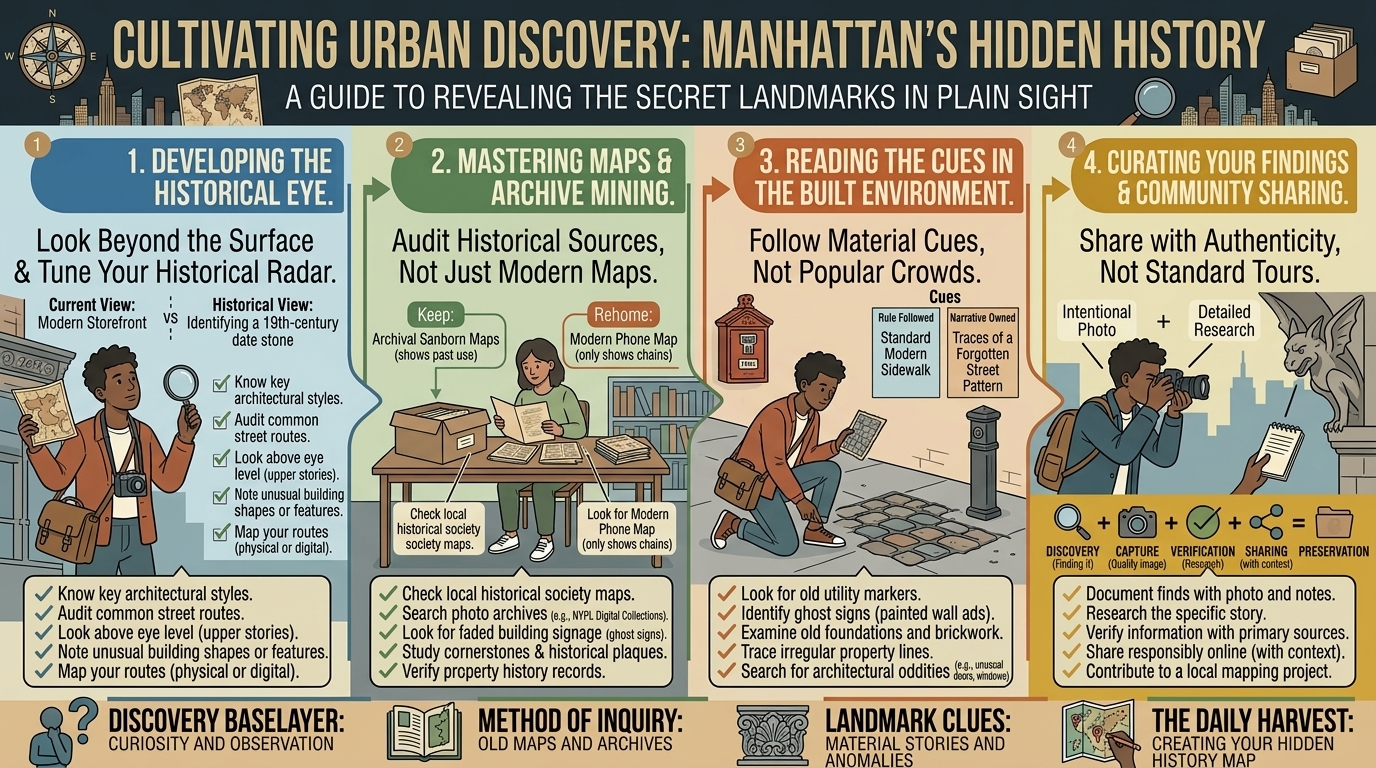
This comprehensive guide reveals how to look past the modern grid, spot the ghosts of New Amsterdam, colonial factions, and Gilded Age titans, and discover secret historical landmarks hidden right beneath your feet.
The Layered Metropolis: Why Manhattan Hides Its History
To understand why Manhattan’s history is so well-concealed, you have to look at how the city evolved. Unlike European capitals that expanded outward or preserved medieval footprints, Manhattan grew upward and aggressively erased its own past.
In 1811, the Commissioners’ Plan imposed a rigid, geometric street grid across the island, paving over streams, leveling hills, and burying old colonial dirt roads. Yet, because space has always been at an absolute premium, history wasn’t destroyed—it was built around, paved over, or integrated into modern infrastructure.
Finding these secret markers requires shifting your perspective from looking forward to looking down, up, and behind.
1. Lower Manhattan: Relics of the 17th-Century Dutch Outpost
Before Manhattan was a global financial titan, it was a modest 17th-century fur-trading post known as New Amsterdam. If you know where to look, physical remnants of this Dutch colonial era still anchor the modern Financial District.
Stone Street’s Original Cobblestones
Tucked just a block away from the roaring chaos of lower Broadway sits Stone Street. Unlike the uniform grid of Manhattan, Stone Street curves organically because it follows an old Native American path and Dutch cow track.
- The Secret: In 1658, it became the very first street in New York to be paved with cobblestones to help merchants cart goods without sinking into the mud. Today, as you sit at an outdoor café table eating dinner over those same uneven stones, you are resting directly on top of 17th-century colonial foot traffic.
The Sidewalk Portal to Old New York
Walk down specific patches of sidewalk in Lower Manhattan, and you will occasionally spot thick structural glass panels built directly into the pavement.
- The Secret: These are not simple skylights for basements. Beneath these glass inserts lie archaeological excavations of old Dutch foundations, cisterns, and wharf structures from the 1600s, preserved like ancient fossils beneath modern pedestrian boots.
2. Architectural Ghosts: Skybridges and Forgotten Infrastructure
As Manhattan industrialized in the late 19th and early 20th centuries, private institutions engineered ingenious, eccentric private structures that still connect buildings high above street level.
The Staple Street Skybridge (Tribeca)
If you wander down a quiet, picturesque alleyway between Duane and Jay Streets in Tribeca, you will look up and see a charming, neo-Renaissance cast-iron bridge connecting two brick buildings three stories above the ground.
- The Secret: Built in 1907, this skybridge originally connected the historic New York Hospital’s House of Relief to its laundry building across the narrow alley. Stamped with a terra-cotta shield bearing the initials “N.Y.H.”, it is a stunning piece of medical history that most tourists completely miss while hunting for trendy coffee shops.
Central Park’s Lamppost Navigational Codes
Central Park is filled with historic monuments, but its most brilliant hidden historical feature is completely functional. If you walk down any path in the park after dark, look closely at the base of the cast-iron gas lamps.
- The Secret: Each lamppost features a four-digit identification number stamped into the metal base. The first two or three numbers tell you the nearest cross-street running along the park’s perimeter. The final digit tells you whether you are closer to the East side (even numbers) or West side (odd numbers)! Nineteenth-century park designers installed this secret coordinate system so lost visitors could find their way out before GPS existed.
3. Uptown Sanctuaries: Tracing the Revolutionary and Gilded Ages
While Downtown holds the colonial roots, Upper Manhattan preserves the sweeping country estates, Revolutionary War battlefields, and Gilded Age remnants that feel entirely detached from the city below.
Sylvan Terrace and the Morris-Jumel Mansion
If you travel up to Washington Heights and step onto Sylvan Terrace (running between West 160th and 161st streets), you will feel like you walked through a time portal.
- The Secret: Lined with identical, wooden, high-stoop row houses painted in vibrant pastel colors, this cobblestone block looks like a quiet 19th-century country lane. At the end of the block sits the Morris-Jumel Mansion (built in 1765), the oldest surviving house in Manhattan. It served as George Washington’s temporary military headquarters during the Revolutionary War and later housed Aaron Burr’s eccentric widow.
10 Frequently Asked Questions (FAQs)
1. Are these secret historical landmarks completely free to visit?
Yes! The vast majority of hidden historical sites—such as Stone Street, Sylvan Terrace, sidewalk archaeological viewports, and Central Park’s lamppost codes—are completely public outdoor spaces that cost nothing to explore.
2. How can I learn more about the archaeological digs underneath Manhattan?
Organizations like the NYC Landmarks Preservation Commission and local historical societies (such as the Gotham Center for New York City History) regularly publish archaeological maps and historical walking guides online.
3. Can the public go inside the Staple Street Skybridge in Tribeca?
No. The skybridge is now part of a privately owned residential property (having sold for tens of millions of dollars), but it is entirely visible from the public street below for photography and architecture enthusiasts.
4. Are there guided historical walking tours that specialize in hidden NYC spots?
Absolutely. Independent groups like the Bowery Boys Walks and various architectural foundation tours specialize in unearthing lesser-known historic narratives that standard commercial tour buses skip.
5. What is the oldest standing building in all of Manhattan?
The Morris-Jumel Mansion in Washington Heights, built in 1765 as a Palladian villa for British loyalist Colonel Roger Morris, holds the title as Manhattan’s oldest surviving residential structure.
6. Why are there so many cobblestone streets remaining in Lower Manhattan?
Streets like Stone Street and sections of the Seaport were paved with ballast stones brought over in the holds of European ships. They were preserved beneath layers of asphalt for centuries and later excavated and restored to honor the city’s maritime heritage.
7. How do Central Park’s lamppost codes actually work?
Look at the base of any lamp: if the digits read 8502, you are near 85th Street, and the 2 indicates you are closer to the East side of the park. It is an ingenious 19th-century navigational tool that still works today!
8. Are there any hidden underground historical sites you can visit?
While most underground sites (like the famous abandoned City Hall subway station or Track 61 under the Waldorf Astoria) are closed to casual drop-in visitors for security reasons, organizations like the New York Transit Museum occasionally host specialized, lottery-based tours.
9. How can I distinguish between a true historical landmark and a modern replica in NYC?
Look for official bronze plaques installed by the New York City Landmarks Preservation Commission or the National Register of Historic Places, which verify the architectural authenticity and date of the structure.
10. Why is discovering these hidden landmarks so rewarding for New Yorkers?
Because Manhattan moves at such a breakneck speed, uncovering these hidden historical layers grounds you. It reminds you that you are walking through a living, breathing theater of human history where millions of stories came before yours.
Conclusion
Discovering secret historical landmarks hidden in plain sight across Manhattan is an exercise in mindfulness, curiosity, and urban exploration. When you stop treating the city as a simple backdrop for daily life and start viewing it as an open-air historical museum, your entire relationship with New York transforms. From 17th-century Dutch cobblestones and 19th-century skybridges to secret coordinate codes carved into park lamps, the past is always right beside you.
Slow down your stride, open your eyes to the details, and discover more urban exploration guides, architectural histories, and lifestyle tips right here at nyattitude.com to help you master life in the greatest city on earth!