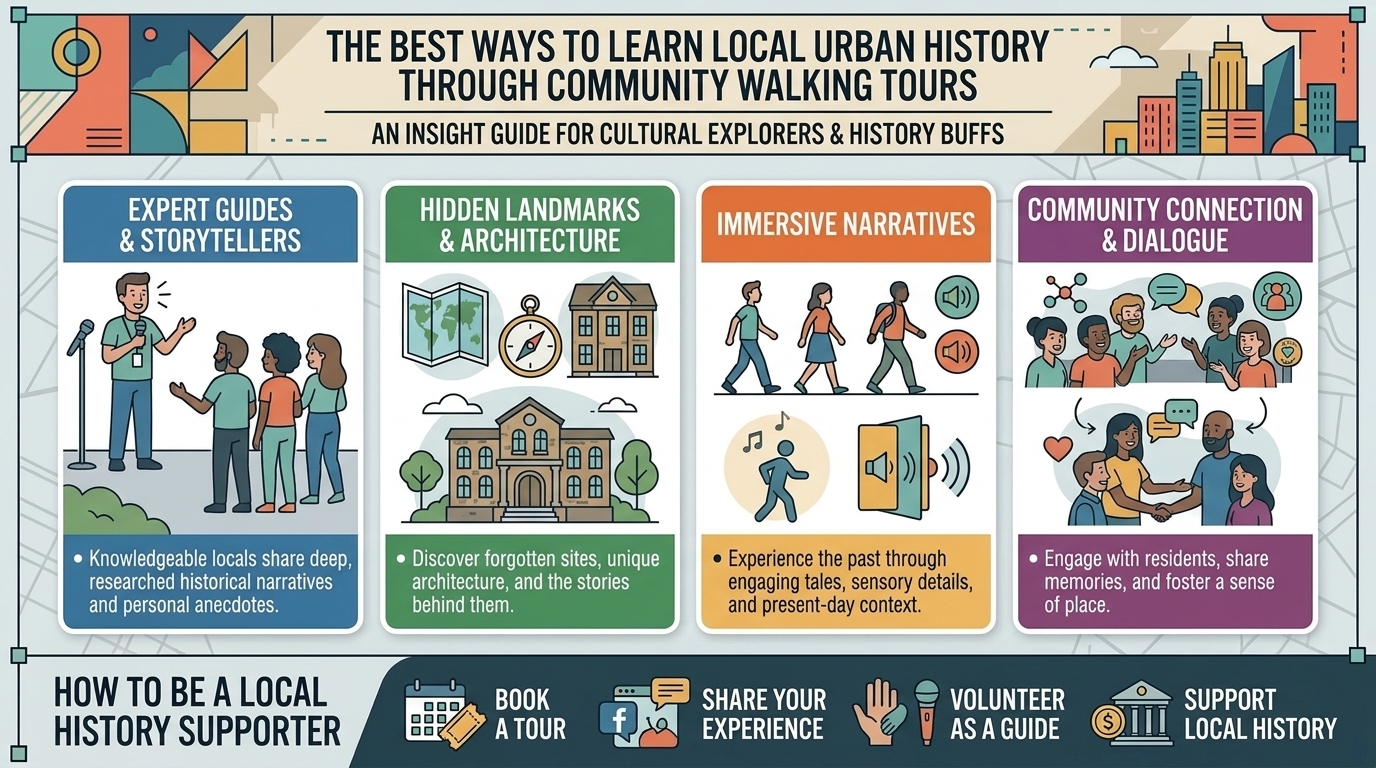
There is a profound difference between traveling through a city and truly experiencing it. When you fly down a highway or peer through the window of a tour bus, cities blur into generic stretches of glass, concrete, and corporate storefronts. But when you slow down and travel on foot, the urban fabric shifts. Pavement turns into pages of a history book; an old brick facade reveals decades of architectural evolution; and a quiet alleyway whispers stories of the generations who walked there before you.
For residents and travelers alike across dynamic urban hubs like New York, San Francisco, Washington D.C., Seattle (Washington), Austin (Texas), and beyond, community walking tours offer an unmatched portal into the soul of a place. Far from standard tourist checklists, these neighborhood-level explorations connect us to the roots of our communities.
Whether you are looking to curate your own self-guided historical stroll, get involved with a local historical society, or transform how you understand metropolitan landscapes, this comprehensive guide explores the best ways to immerse yourself in local urban history through community walking tours.
1. Why Urban Walking Tours Are the Ultimate Historical Classroom
Traditional textbooks offer macro-level summaries—dates, treaties, and sweeping economic shifts. Community walking tours, however, deliver micro-history: the intimate, grounded stories of everyday people, grassroots movements, neighborhood transformations, and architectural quirks that formal textbooks often overlook.
- Tactile Engagement: Touching a weathered brownstone in Brooklyn, feeling the maritime breeze along the San Francisco Embarcadero, or noticing the iron ring bolts on old Texas mercantile buildings engages all your senses, anchoring historical facts in physical reality.
- Neighborhood-Scale Context: Cities are not monoliths; they are amalgams of distinct neighborhoods, each with its own cultural DNA. Walking allows you to witness the sudden transitions between ethnic enclaves, industrial zones, and historic districts.
- Democratic Storytelling: Modern community walks increasingly highlight marginalized voices—immigrant laborers, indigenous populations, civil rights activists, and artists—ensuring that local history reflects a complete, multi-faceted narrative.
2. Choosing Your Historical Lens (Finding Your Niche)
Before hitting the pavement, it helps to focus your exploration. Urban history is vast, and trying to digest an entire city’s timeline in a single afternoon leads to cognitive overload. Instead, select a specific thematic lens:
Architectural Evolution
Focus on how building styles mirror economic booms and busts. Look for traces of Victorian Italianate, Beaux-Arts, Art Deco, or mid-century brutalism. Notice how old industrial warehouses transitioned into modern lofts in places like SoHo in New York or SOMA in San Francisco.
Labor, Industry, and Immigration
Trace the footsteps of the waves of immigrants who built the city’s economic foundation. Explore old union halls, ethnic settlement houses, early marketplaces, and tenement districts that tell stories of struggle, community building, and cultural preservation.
Radical Movements and Civil Rights
Uncover the street corners where history was shaped by protests, strikes, and social justice organizing. From abolitionist safe houses in Washington D.C. to labor strike sites in the Pacific Northwest, these tours map the evolution of democracy at the grassroots level.
3. Best Practices for Designing or Joining a Community Walk
Whether you are joining an organized community-led heritage walk or mapping out your own urban expedition, these strategic tips will maximize your historical discovery:
- Utilize Primary Sources and Sanborn Maps: If you are planning your own route, look up historical fire insurance maps (like Sanborn maps), old city directories, and digital municipal archives. They reveal building footprints that no longer exist and name businesses from a century ago.
- Walk the Route at the Same Time of Day: Urban dynamics change dramatically between a quiet Sunday morning and a chaotic Tuesday rush hour. Test your route beforehand to gauge foot traffic, noise levels, and safety.
- Incorporate Digital Heritage Collections: Leverage mobile apps, digital archives, and geolocation tools that overlay historical photographs onto modern streetscapes. Seeing a 1920s streetcar line superimposed over a contemporary bike lane bridges past and present instantly.
- Engage Local Keepers of Knowledge: Befriend local historical societies, neighborhood librarians, and long-standing business owners. They hold oral histories and anecdotes that you will never find on a standard internet search.
4. Top Urban Hubs for Historical Walking Culture
Urban walking culture thrives uniquely across distinct American landscapes:
- New York City: Famous for micro-neighborhood stratification. A walk through the Lower East Side shifts seamlessly from German to Jewish, Italian, and Hispanic immigrant histories within three blocks.
- San Francisco: Characterized by dramatic topography and rapid eras of transformation—from the Gold Rush tent cities and the 1906 earthquake aftermath to the 1960s counterculture movements in Haight-Ashbury.
- Washington D.C.: Beyond the monumental core, neighborhoods like Anacostia, U Street (once known as “Black Broadway”), and Dupont Circle hold dense layers of political, cultural, and architectural history.
- Texas & Washington State: Emerging metropolitan powerhouses where western expansion, maritime trade, indigenous displacement, and tech booms have rapidly reshaped the urban grid, leaving fascinating historical palimpsests just beneath the surface.
5. Frequently Asked Questions (FAQ)
1. How long should a historical community walking tour be?
An ideal walking tour lasts between 1.5 to 2 hours and covers roughly 1.5 to 2 miles. This duration keeps participants engaged without causing physical fatigue or information overload.
2. Are self-guided or guided walking tours better?
Both have merits. Guided tours offer curated expertise, humor, and interactive storytelling. Self-guided walks provide complete flexibility, allowing you to linger at spots that capture your personal interest.
3. How can I find authentic, community-led walking tours?
Look beyond commercial tour bus companies. Check local historical societies, community preservation groups, university public history departments, and non-profit neighborhood alliances.
4. What should I bring on an urban historical walking tour?
Wear broken-in, supportive walking shoes, dress in weather-appropriate layers, and carry a water bottle, a notebook or smartphone for capturing details, and a portable phone charger if you are using digital maps.
5. How do I start researching the history of my own specific street?
Start at your local public library’s local history or genealogy room. Municipal tax assessor records, historical newspaper databases, and oral history archives are also golden vaults of information.
6. Can walking tours help with sustainable tourism?
Yes! Walking tours have zero carbon footprint, distribute economic tourism dollars directly to local neighborhood small businesses, and reduce overcrowding at mainstream mega-landmarks.
7. How do I keep children or teenagers engaged on a history walk?
Turn the walk into an active discovery challenge. Look for architectural oddities, old ghost signs (fading painted advertisements), historical plaques, or use scavenger-hunt style apps.
8. What is a “ghost sign” and why are they important?
Ghost signs are old hand-painted advertising signs preserved on the brick sides of buildings. They serve as open-air time capsules, revealing long-gone local industries, products, and past consumer habits.
9. How do I handle accessibility considerations on a historical tour?
When planning or choosing a route, check for curb cuts, smooth paving (avoiding overly rough historic cobblestones where possible), minimal steep inclines, and nearby resting benches or public restrooms.
10. Why is community-based history more accurate than mainstream history?
Community history focuses on “history from the bottom up.” By centering ordinary residents, minority communities, and everyday labor, it avoids elite bias and captures the true lived reality of an era.
Conclusion
Community walking tours do much more than pass the time on a weekend afternoon—they anchor us to our surroundings. By exploring urban history on foot, we cultivate a deeper sense of place, empathy for past generations, and an active appreciation for the architectural and cultural evolution of our cities. Whether you are wandering through the historic canyons of New York, the coastal hills of San Francisco, or vibrant neighborhoods across Texas and Washington, every step reveals a story waiting to be heard. Lace up your shoes, step outside, and let the pavement guide you into the past.
What is your favorite historical neighborhood or city to explore on foot, and what is the most surprising hidden story you’ve ever uncovered there?