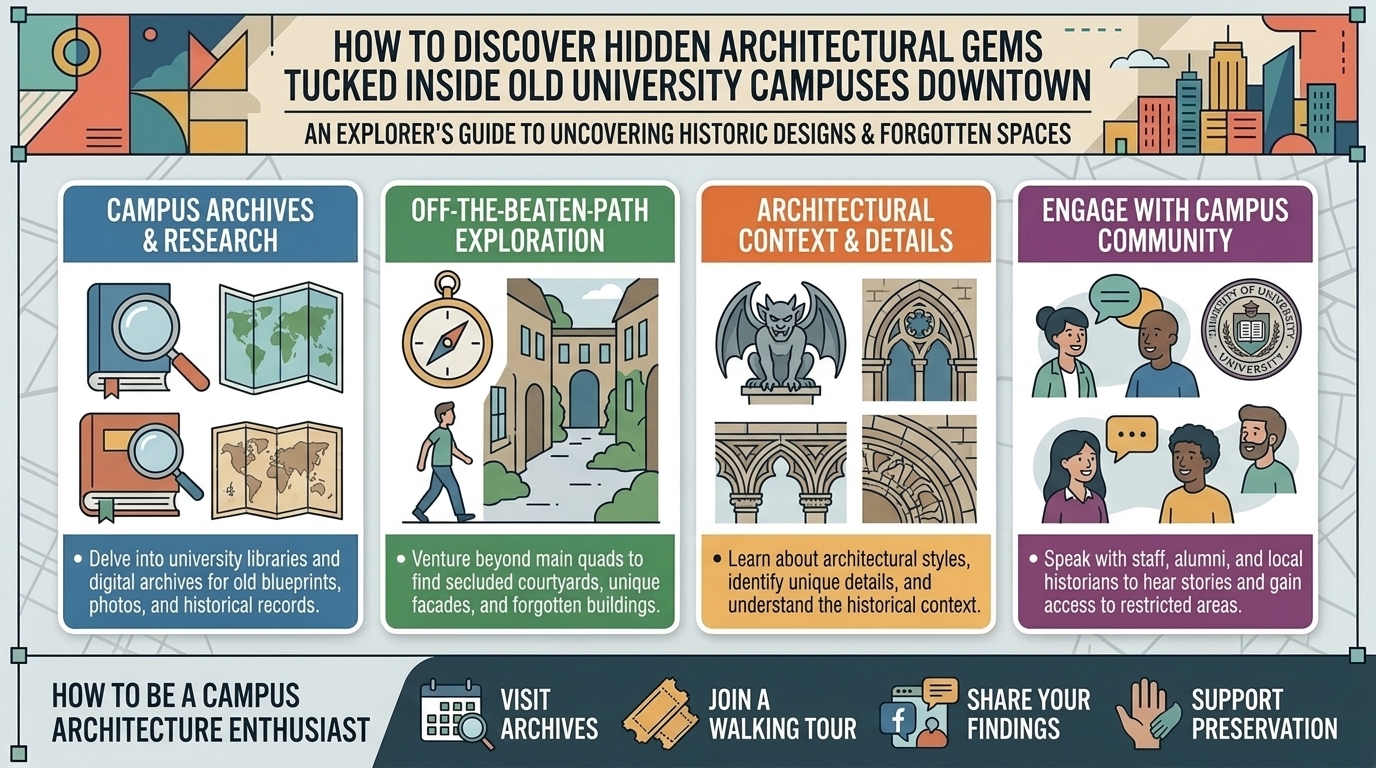
How to Discover Hidden Architectural Gems Tucked Inside Old University Campuses Downtown
Introduction: The Secret Urban Sanctuaries of Higher Education
When travelers, photographers, and history buffs think of metropolitan exploration, their minds naturally gravitate toward bustling commercial strips, historic downtown plazas, towering skyscrapers, and well-trodden tourist corridors. Yet, nestled right in the pulsing hearts of some of America’s most dynamic metropolitan landscapes—from the sun-drenched coast of California to the rainy sophistication of Washington state, the historic grit of New York, the sprawling ambition of Texas, and the foggy hills of San Francisco—lie secluded urban sanctuaries: historic downtown university campuses.
These institutions of higher education are much more than clusters of lecture halls and research laboratories. They function as living architectural time capsules. Over decades and centuries, as modern city grids expanded aggressively around them, these campuses retreated inward, creating walled gardens, cloistered courtyards, subterranean libraries, and forgotten rooftop terraces.
For the urban explorer, the seeker of quiet beauty, and the architectural enthusiast, stepping past the wrought-iron gates of a downtown university campus is like stepping through a portal into another era. This comprehensive guide will teach you how to master the art of uncovering the hidden architectural treasures tucked away within America’s most iconic metropolitan university grounds, with a special focus on key cultural hubs.
1. The Anatomy of Downtown Campus Architecture: Why History Hides in Plain Sight
To find hidden architectural gems, you first need to understand how downtown campuses evolve. Unlike sprawling suburban campuses designed around wide-open green spaces and rolling lawns, urban campuses are victims—and beneficiaries—of spatial compression.
The Vertical and Inward Expansion Model
When urban universities run out of horizontal space, they grow upward or inward. This dynamic forces architects to tuck precious design features into unexpected places:
- Internal Courtyards: Block-square urban campuses often conceal magnificent Italianate, Gothic, or Neoclassical courtyards behind austere, utilitarian street-facing facades.
- Subterranean Spaces: Space constraints drive libraries, rare book archives, and student unions underground, occasionally revealing stunning skylit atriums, vaulted brick ceilings, and brutalist subterranean masterworks.
- Adaptive Reuse: Historic urban manufacturing plants, former municipal buildings, and old carriage houses are frequently swallowed by expanding universities and converted into cutting-edge academic spaces while retaining historic brickwork, cast-iron columns, and vaulted timber beams.
2. Regional Spotlights: Architectural Hunting Grounds in Key Hubs
To help jumpstart your urban architectural expeditions, let’s look at how distinct regional aesthetics manifest in prominent metropolitan settings across the United States.
New York: Vertical Gothic and Cast-Iron Elegance
In a city defined by steel and glass canyons, New York’s downtown campuses—such as New York University (NYU) around Washington Square Park or The New School—feature a dramatic juxtaposition of old brownstones, Romanesque Revival brickwork, and hyper-modern vertical integration. Look beyond the standard building fronts to find private internal gardens, historic faculty clubs featuring handcrafted wood-carved moldings, and early 20th-century libraries tucked above bustling city streets.
Texas: Monumental Scale and Regional Adaptation
Texas cities pride themselves on grandeur. Downtown-adjacent and urban-feeling flagships like the University of Texas at Austin (with its iconic Paul Cret-designed campus master plan and the majestic UT Tower) showcase a unique blend of classical monumentality and regional detailing. Keep an eye out for carved limestone motifs depicting local flora, handcrafted terra-cotta tiles, and shaded loggias designed to combat the fierce southern sun.
California & San Francisco: Spanish Colonial Revival Meets Fog-Kissed Modernism
California’s urban campuses weave Spanish Colonial Revival, Mission Revival, and cutting-edge modernist architecture into dense metropolitan tapestries. In San Francisco and surrounding urban centers, look for hidden interior patios lined with vibrant hand-painted ceramic tiles, wrought-iron balconies overlooking quiet eucalyptus groves, and mid-century brutalist concrete structures that frame breathtaking views of the bay and the urban skyline.
Washington: Pacific Northwest Craftsman and Collegiate Gothic
In Washington’s urban academic environments, architecture responds intimately to the moody, organic landscape of the Pacific Northwest. Historic brick and sandstone buildings are often wrapped in lush, native ferns and towering evergreens, concealing stunning wood-beam assembly halls, stained-glass study rooms reminiscent of medieval European guilds, and innovative sustainable structures that merge indoor and outdoor spaces.
3. Step-by-Step Methodology: How to Discover Hidden Gems Like a Pro
Uncovering secret architectural marvels requires a mix of detective work, spatial awareness, and respectful exploration. Follow this proven framework to plan your next architectural treasure hunt:
Step One: Study Historic Sanborn Maps and Campus Master Plans
Before visiting, consult digital archives, university libraries, or historic Sanborn fire insurance maps. These documents reveal how a campus footprint grew over time. Look for older structures that have been entirely surrounded or engulfed by newer, mid-century or postmodern additions. Often, the historic core of a building is preserved safely on the inside, shielded from modern street view.
Step Two: Look Up, Look Down, and Look Within
Urban architecture hides in plain sight because human eyes naturally scan horizontally at street level.
- Look Up: Notice the rooflines, terra-cotta friezes, gargoyles, parapets, and copper-clad dormers that you can only see by standing across the street or looking down from an adjacent campus library window.
- Look Down: Sidewalk vault lights (glass prisms set into concrete to illuminate sub-basements), historic stone threshold plates, and sunken garden stairwells often lead to architectural surprises.
- Look Within: Open-access public zones like university art galleries, architectural school exhibition halls, rare book reading rooms, and interfaith chapels are typically open to the general public during daytime hours.
Step Three: Befriend Architectural Details and Materials
Train your eye to spot stylistic transition points. When a limestone Gothic arch abruptly meets a sleek international-style glass curtain wall, it indicates an intersection of eras. Explore these transitional thresholds—they are frequently where campus architects exercised their most creative adaptive reuse strategies.
4. Essential Tips for Ethical and Smooth Urban Exploration
- Respect Academic Boundaries: Remember that these are active learning environments. While exterior courtyards and public-facing lobbies are usually welcoming, respect signs marked “Authorized Personnel Only” or “Classrooms in Session.”
- Visit During Off-Peak Hours: Weekends, early mornings, or semester breaks (like mid-summer or winter intercession) provide the ultimate quiet environment for photography, sketching, and uninterrupted architectural observation.
- Connect with Local Historians: Many campus libraries offer self-guided architectural walking tour pamphlets or digital audio guides packed with historical context you won’t find on standard tourist maps.
5. Frequently Asked Questions (FAQ)
1. Are downtown university campuses legally open to the general public?
Most public and private university grounds are considered semi-public spaces during daylight hours, allowing visitors to walk through courtyards and public quads. However, specific interior buildings, libraries, and residence halls may require a student or faculty ID card for entry.
2. What is the best time of day to photograph campus architecture?
The “golden hour”—the hour right after sunrise and right before sunset—provides dramatic, oblique lighting that accentuates textures like carved stone, brickwork, and intricate metal railings. Early mornings on weekends are also ideal because pedestrian traffic is at an absolute minimum.
3. How can I find architectural maps specific to urban campuses?
Check the university’s official website for a “Visitor Center” or “Campus Planning” section. Many institutions publish dedicated self-guided historical walking tour maps that highlight architectural milestones and landmark buildings.
4. Is photography allowed inside historic university buildings?
In most public areas, lobbies, and libraries, casual photography for personal use is completely fine. However, flash photography and tripods may be restricted in rare book rooms, art galleries, or quiet study zones. Always look for signage or ask a security desk attendant.
5. What architectural styles are most commonly found in older urban American campuses?
The most prevalent styles include Collegiate Gothic, Neoclassical, Romanesque Revival, Spanish Colonial Revival, and mid-century Modernism/Brutalism, depending on the geographic region and the decade of the campus’s primary expansion.
6. Can I join organized architectural tours of these campuses?
Yes! Many university alumni associations, local historical societies, and organizations like the American Institute of Architects (AIA) local chapters regularly host guided architectural walking tours of historic urban campuses.
7. What should I do if a building I want to see is locked?
If a historic interior is locked, try visiting the university’s architecture or art library. These departments often occupy the institution’s most visually stunning or historically significant buildings and are more accessible to visitors.
8. How do I spot a “hidden” building that isn’t on the main map?
Look for narrow alleyways, pedestrian bridges connecting two massive structures, or recessed courtyards. Urban campuses frequently build interior infill structures that can only be reached by walking through the lobby of an outer building.
9. Are there apps or digital tools that help locate urban architectural gems?
Yes, applications like field_guide platforms, interactive campus map systems, and architectural history mapping projects (such as SAH Archipedia) offer geotagged information on historic and hidden campus structures.
10. Why are old university campuses worth exploring compared to standard downtown historic sites?
Unlike commercial downtown buildings that undergo constant commercial remodeling, university buildings are historically preserved with greater academic reverence, meaning original millwork, stained glass, and masonry details often survive intact for centuries.
Conclusion: Unlocking Your City’s Academic Heart
The urban university campus is a magnificent paradox: it is a bustling engine of future innovation wrapped entirely in the rich fabric of the past. By venturing beyond the commercial glare of the downtown grid and stepping onto these historic grounds, you open yourself up to a world of hidden cloisters, stunning masonry, quiet courtyards, and brilliant architectural engineering.
Whether you are exploring the coastal sophistication of California and Washington, the historic depth of New York, the bold scale of Texas, or the distinct topography of San Francisco, the secret architectural history of your city is waiting just behind the campus gates. Grab your camera, lace up your comfortable walking shoes, and start discovering the hidden masterpieces tucked away in plain sight.