In an era dominated by hyper-speed digital communication, high-resolution smartphone cameras, and instant social media uploads, the ancient art of sketching has undergone a profound renaissance. There is something intensely meditative about slowing down your perception, looking closely at structural masonry, ironwork, and molding, and translating three-dimensional urban spaces onto a two-dimensional page through ink, graphite, or watercolor.
Across America’s most historically rich and visually stunning regions—from the cobblestone nooks of New York and the Victorian-laced hills of San Francisco, to the sunlit civic plazas of Texas, California, and Washington—historic public squares serve as open-air art studios. These downtown hubs are living museums where architectural styles collide: neoclassical columns stand beside Beaux-Arts facades, Spanish-colonial archways meet modern corporate glass, and century-old brickwork tells the foundational story of the city.
If you are looking to disconnect from the digital noise, sharpen your observational skills, and connect deeply with the urban fabric, this comprehensive guide will teach you everything you need to know about spending a quiet morning sketching architecture in historic downtown public squares.
1. The Therapeutic and Creative Power of Urban Sketching
Urban sketching is far more than just producing a picture; it is an active meditation. When you sit down in a public square with a sketchbook, your relationship with your environment shifts fundamentally:
- Hyper-Focused Observation: When taking a photo, your brain registers a scene in milliseconds. When sketching, you must analyze how a cornice projects, how shadows fall across window panes, and the exact proportions of a pediment, forcing your brain into a state of deep, relaxed flow.
- Cultural Immersion: Sitting still in a public square for two hours allows you to absorb the rhythm of the city. You hear the morning chatter of commuters, smell fresh bakery coffee, and watch the changing morning light dance across historic monuments.
- Low-Pressure Creativity: You do not need to be a professional fine artist to sketch. The goal is personal expression and architectural appreciation, not perfection. Every crooked line or imperfect perspective is a unique record of your morning.
2. Regional Architectural Landscapes: Where to Sketch Coast to Coast
Different regions boast distinct architectural heritages that shape what you will see and draw in their downtown squares.
New York and San Francisco: Historic Density and Victorian Charm
- New York: Lower Manhattan and early borough civic squares (such as Foley Square or Bowling Green) offer a masterclass in monumental masonry, towering neoclassical federal buildings, and intricate cast-iron details. The morning light cuts sharply between skyscrapers, creating dramatic chiaroscuro contrasts on historical stone facades.
- San Francisco: Historic plazas near the Embarcadero, Jackson Square, or Alamo Square feature an eclectic mix of Victorian Italianate row houses, maritime brick warehouses, and grand civic structures. The crisp morning fog rolling over the bay provides a soft, atmospheric, diffused light that is unmatched for watercolor washes.
Texas, California, and Washington: Spanish Heritage, Modernism, and Frontier Grandeur
- Texas: Downtown public squares—often centered around historic county courthouses in cities like Austin, San Antonio, or Fort Worth—feature magnificent Romanesque Revival, Victorian, and art-deco stone courthouses surrounded by wide-open plazas. The morning sun casts long, warm amber tones over limestone and red brick.
- California: Southern and Central California plazas often incorporate Spanish Colonial Revival and Mission-style architecture, featuring white stucco walls, red tile roofs, arched colonnades, and lush courtyard palms that frame beautiful framing compositions.
- Washington: In the Pacific Northwest, downtown squares in Seattle and historic towns combine turn-of-the-century brick mercantile buildings with Scandinavian-influenced modernism, framed by lush evergreen backdrops and dramatic morning cloudscapes.
3. Essential Gear Checklist for Downtown Sketching
Traveling light and efficiently is the secret to a stress-free morning of outdoor sketching. You want a setup that fits easily into a backpack or tote bag.
| Gear Category | Recommended Items | Why You Need It |
| Sketchbooks | Mixed media or watercolor paper (140lb/300gsm), cold-press texture, size A5 or 5×8 inches. | Withstands light watercolor washes and ink bleeding without warping. |
| Drawing Tools | Waterproof micro-pigment pens (e.g., Pigma Micron 01/05), graphite pencils (2B/4B), or a water-brush pen. | Waterproof ink allows you to paint watercolors over lines without smudging. |
| Color (Optional) | Pocket watercolor pan set (12 to 24 colors) with a mixing palette lid. | Adds vibrant local color to brickwork, sky, and foliage quickly. |
| Comfort & Support | Lightweight camp stool, portable clip-board, handkerchief, and wet wipes. | Ensures you aren’t dependent on finding a vacant public bench. |
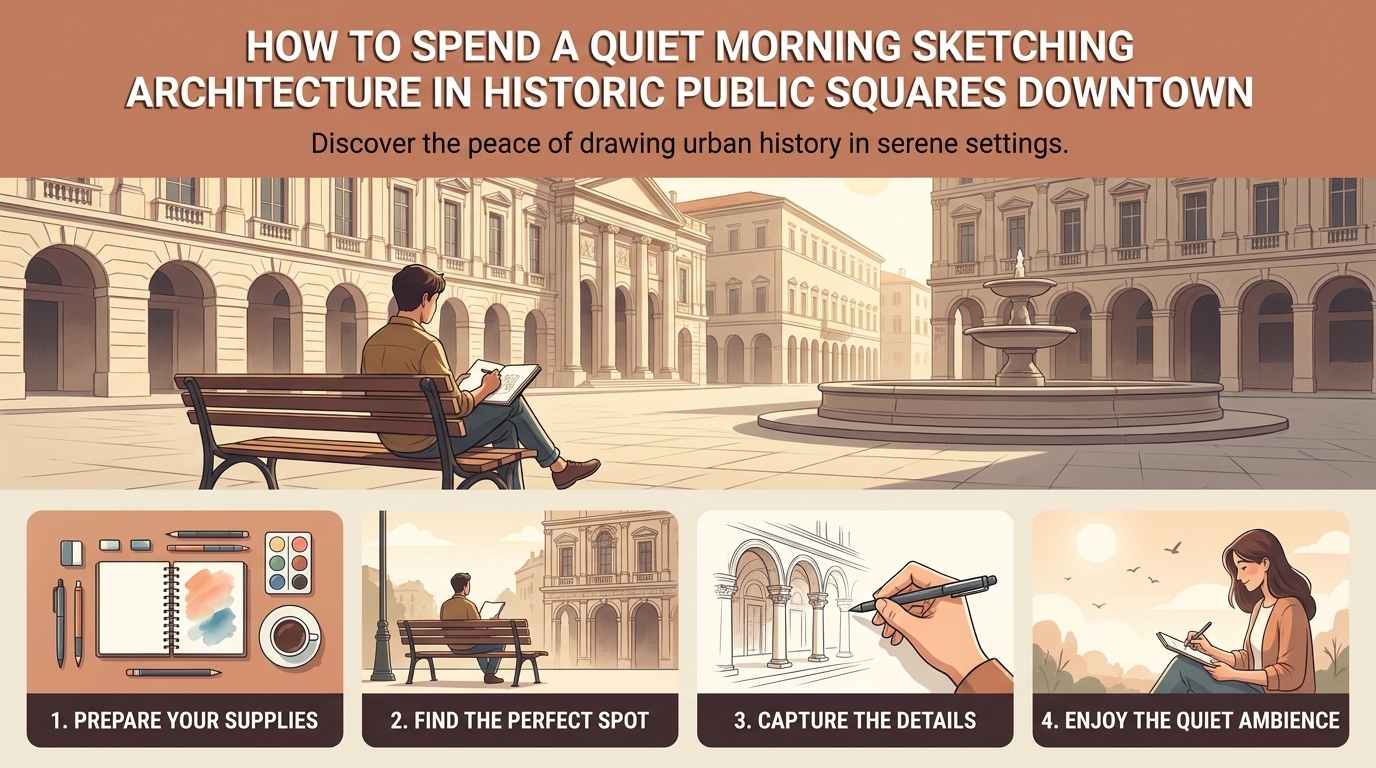
4. Step-by-Step Guide: How to Structure Your Morning Sketching Session
To make the most of a quiet morning, follow this field-tested timeline designed to maximize focus and lighting:
- The Golden Hour Arrival (7:30 AM – 8:15 AM): Arrive before the downtown rush hour peaks. Morning light creates long, striking shadows that emphasize architectural depth, cornices, and window recesses.
- Site Selection and Reconnaissance: Walk a full circle around the square before settling down. Look for strong compositional framing—such as framing a historic building between two trees or positioning yourself across from an arched colonnade.
- Establish Your Vantage Point: Find a stable, comfortable bench, step edge, or set up your portable stool. Ensure you are out of the direct path of morning foot traffic so you can draw without feeling crowded.
- Thumbnail Sketch (5 Minutes): Before committing to the final page, do a tiny 2-inch thumbnail sketch to block out major shapes, horizons, and focal points. This prevents proportion errors later.
- The Line Work & Detail Phase: Start with light pencil guidelines, then reinforce key structural lines with waterproof ink. Focus on architectural rhythm—repeating windows, columns, and rooflines.
- Wash and Wrap-Up: Apply light watercolor washes or cross-hatching shadows. Date your sketch, note the location and weather, and pack up your gear as the square wakes up for the midday hustle.
5. Ten Frequently Asked Questions (FAQ)
1. Do I need to be a professional artist to sketch in public squares?
Not at all! Urban sketching is for everyone, from absolute beginners to professional architects. The focus is on the experience of observing and recording the environment, not on producing a gallery-ready masterpiece.
2. What is the best time of day for architectural sketching?
Early morning (roughly 7:30 AM to 10:30 AM) is widely considered the best window. The lighting is dramatic and low, crowds are minimal, and temperatures are comfortable before the midday heat.
3. Will people bother me while I am sketching in downtown squares?
Occasionally, curious onlookers or children may walk up to ask what you are drawing or admire your work. Most urban sketchers find this to be a warm, friendly interaction, but wearing headphones or earplugs is a great way to signal that you are in deep focus.
4. What paper weight is best for outdoor watercolor sketching?
Look for watercolor sketchbooks with paper rated at least 140lb (300gsm). Lighter paper will buckle and pill when wet, making it frustrating to work with outdoors.
5. How do I deal with perspective distortion when drawing tall buildings?
Start by anchoring the vertical center line of your chosen building facade. Use your pencil held at arm’s length to measure angles and proportions relative to your eye level. Remember: sketches do not need to be mathematically drafted; expressive perspective adds charm!
6. Are public squares free to access for artists?
Yes. Historic public squares, downtown plazas, and civic parks are public property, meaning you are completely free to sit, stand, and draw without paying any fees or securing permits.
7. What are the best cities for architectural sketching in the US?
Cities with rich historical layers and preserved downtown cores—such as New York, San Francisco, Austin, Seattle, and Boston—offer incredible variety ranging from Victorian homes to towering neoclassical civic halls.
8. Can I sketch using my digital tablet instead of paper?
Absolutely! Many modern urban sketchers use iPads with apps like Procreate or Concepts. Just be sure to use a matte screen protector to reduce outdoor glare and bring a portable power bank.
9. What should I do if my hands shake or my lines are messy?
Embrace the “messy lines”! Spontaneous, slightly shaky lines give urban sketches life and energy. Perfect straight lines can look sterile; organic imperfections give hand-drawn art its unique soul.
10. Where can I find more inspiration for exploring city culture and arts?
Keep exploring specialized lifestyle and culture resources like nyattitude.com, where we celebrate the hidden creative gems, architecture, and local heritage of America’s most dynamic urban centers.
Conclusion
Spending a quiet morning sketching architecture in a historic downtown public square is a transformative way to experience a city. By slowing down your pace and translating stone, glass, and steel onto paper, you move from being a passive tourist to an active participant in local culture. Whether you find your inspiration in the grand plazas of New York and San Francisco or the sun-warmed courtyards of Texas, California, and Washington, grabbing a sketchbook and heading outdoors is your ticket to seeing the world with fresh eyes.
Ready to discover more creative urban guides, local historical spots, and cultural deep dives? Continue exploring nyattitude.com to inspire your next city adventure!