Living and working in a major metropolis is an exhilarating pursuit. Whether you are chasing career breakthroughs in the fast-paced financial towers of New York, launching a disruptive startup in the venture-backed ecosystem of San Francisco, building creative momentum across California, navigating political and policy corridors in Washington, or riding the massive economic expansion in Texas, the urban dream promises scale, visibility, and endless opportunity.
However, there is an unwritten, often unspoken tax exacted on everyone who enters the urban arena: rejection.
In high-density environments where competition is fierce and the volume of talent is immense, rejection is not a rare anomaly; it is an everyday atmospheric condition. From missed venture capital pitches and unreturned creative inquiries to apartment rejections and lost job offers, the city tests your psychological resilience at every turn. This comprehensive guide explores the deep psychological reality of facing rejection in the concrete jungle, breaking down how the urban environment amplifies setbacks, and offering actionable strategies to bounce back stronger, wiser, and entirely unshakeable.
1. The Psychology of Rejection in High-Density Urban Environments
Why does rejection in a major metropolitan center feel uniquely heavy, visceral, and personal? Psychological research into urban stress reveals that density and social comparison play massive roles in how we process setbacks.
- The Hyper-Visibility Effect: In small towns, setbacks can often remain private. In high-stakes cities like New York, San Francisco, or Austin, everything feels hyper-visible. When a project fails or a job search stalls, it can feel as though the entire metropolis is watching your defeat.
- Proximity to Success: Cities concentrate wealth, prestige, and achievement into tight geographic corridors. Walking past high-end corporate headquarters, elite art galleries, or successful peer storefronts daily creates an environment of constant social comparison, amplifying the sting of personal rejection.
- The “Zero-Sum” Illusion: Dense urban markets can trick the human brain into believing that resources, roles, and accolades are strictly limited—that another person’s victory or acceptance means your permanent exclusion.
2. Regional Landscapes of Pressure: Rejection Coast-to-Coast
Different metropolitan regions cultivate distinct professional cultures, meaning the flavor of rejection varies depending on where you plant your flag.
New York and San Francisco: The Crucible of Velocity and Innovation
- New York: Rejection in New York is notoriously swift, unfiltered, and direct. Whether in media, finance, or the arts, doors close quickly. The psychological challenge in NYC is developing an armor of thick skin without letting the city’s relentless speed harden your empathy or crush your creative spirit.
- San Francisco: Rejection in the Bay Area is frequently tied to venture capital, tech disruption, and institutional validation. Hearing “no” from investors or tech accelerators can feel like an existential verdict on your intellectual vision. The key is separating product-market friction from personal self-worth.
Texas, California, and Washington: Growth, Adaptation, and Resilience
- California: Beyond San Francisco, California’s diverse hubs—from Los Angeles to San Diego—foster industries like entertainment and biotech where rejection is an hourly occurrence. Cultivating resilience here means adopting the fluid, wave-riding adaptability of the coast.
- Texas: In booming metropolitan centers like Austin, Dallas, and Houston, economic expansion brings fierce competition. Texas resilience is rooted in grit, reinvention, and a forward-looking entrepreneurial optimism that treats temporary failure as mere calibration.
- Washington: In the Pacific Northwest, professional setbacks often intersect with complex institutional and policy-driven environments. Success here requires patience, intellectual stamina, and long-term strategic persistence.
3. The Neurobiology of Rejection: What Happens Inside the Brain?
When you receive a harsh rejection email or face a public professional setback, your brain processes the experience through the exact same neural pathways that handle physical pain.
- The Anterior Cingulate Cortex: Functional MRI studies show that social rejection lights up the anterior cingulate cortex—the same brain region that registers physical trauma. This explains why a career rejection can literally make your chest ache or your stomach drop.
- The Amygdala Hijack: Rejection triggers a primitive “fight-or-flight” response, flooding your system with cortisol and adrenaline. In this state, the prefrontal cortex (responsible for rational long-term planning) goes offline, leading to catastrophic thinking (“I’ll never succeed here”).
- The Antidote—Cognitive Reappraisal: Consciously interrupting this chemical cascade through deliberate reframing allows you to switch your brain back from emotional panic to objective, analytical problem-solving.
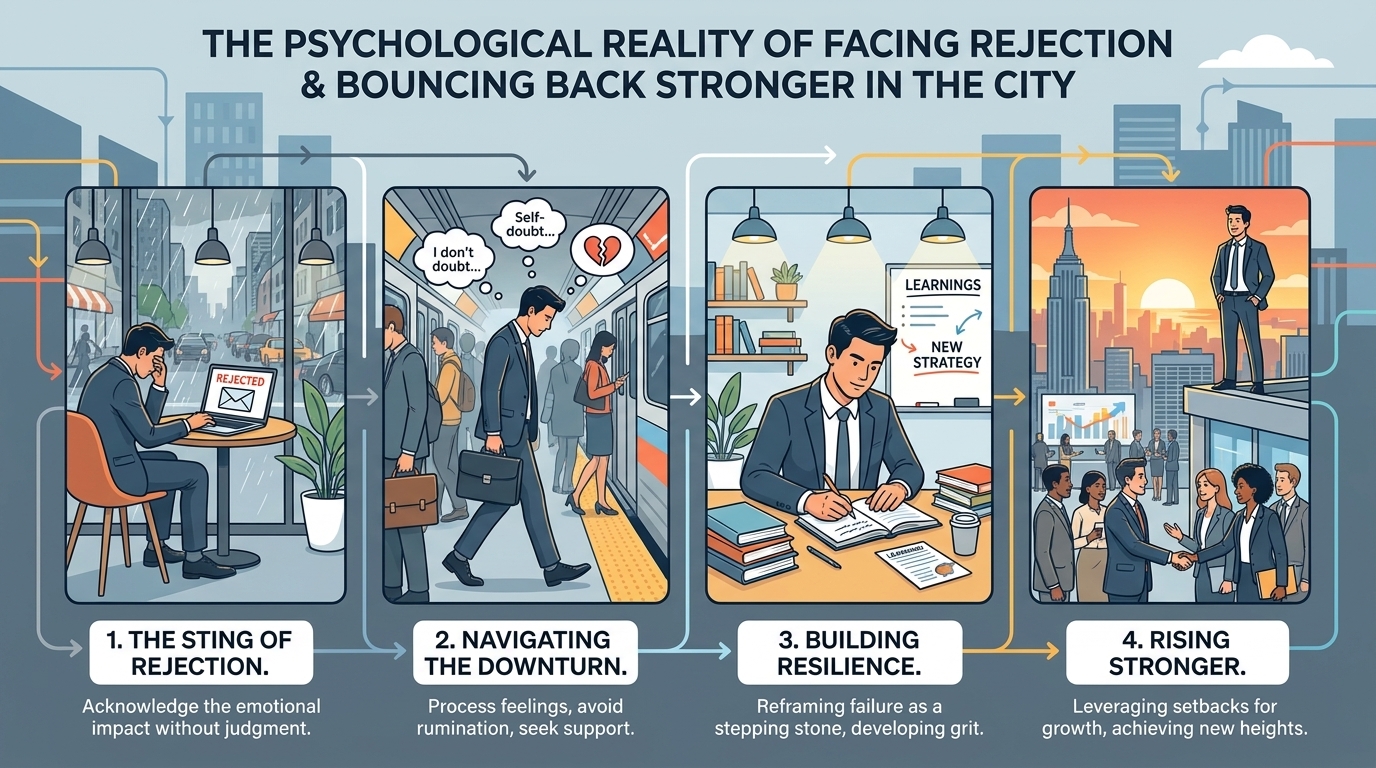
4. Step-by-Step Blueprint for Bouncing Back Stronger
Bouncing back in the city is not about pretending rejection doesn’t hurt; it is about building a systematic recovery protocol. Use this step-by-step framework when a major setback hits:
| Recovery Stage | Actionable Strategy | Psychological Benefit |
| 1. The 24-Hour Decompression | Allow yourself to feel the emotional sting fully without toxic positivity. Cry, vent to a trusted friend, or step away from work entirely. | Prevents emotional suppression, which often leads to prolonged burnout or anxiety. |
| 2. The Objective Audit | After 24 hours, review the rejection objectively. Separate feedback on your work or pitch from your fundamental character. | Transforms a vague emotional defeat into precise, actionable data points for improvement. |
| 3. Reclaiming Agency | Immediately identify one small, controllable action you can take (e.g., updating a resume, pitching a new contact, refining a prototype). | Breaks the paralysis of helplessness and reactivates your internal locus of control. |
| 4. Leveraging Urban Community | Reach out to local peers, mentors, or support circles who understand the unique pressure of the city. | Combats urban isolation and reminds you that every successful person has a graveyard of past rejections. |
5. Ten Frequently Asked Questions (FAQ)
1. Why does rejection feel so much more intense when living in a major city?
High-density environments foster constant social comparison, hyper-visibility, and fast-paced competition, making professional or personal setbacks feel magnified and public.
2. Is it normal to experience physical symptoms after a major career rejection?
Yes. Neuroscientific studies show that emotional rejection activates the same pain-processing regions of the brain as physical injury, causing real physical sensations like fatigue, chest tightness, or nausea.
3. How can I stop taking professional rejections personally?
Practice radical decoupling. Remind yourself that a rejection is a judgment of a specific asset, product, or timing match within a specific market—it is never a verdict on your inherent human worth.
4. What cities in the US have the most competitive rejection cultures?
High-stakes hubs like New York, San Francisco, Los Angeles, and Austin feature intense competitive markets where rejection is a daily reality for ambitious professionals and creatives.
5. How long should I take to grieve a major professional setback?
Give yourself a strict containment window—typically 24 to 48 hours for processing emotions—before pivoting deliberately into analytical review and forward momentum.
6. Can rejection actually make a person more successful long-term?
Absolutely. Psychological resilience and “antifragility” are forged through resistance. Rejection weeds out ineffective strategies, sharpens your value proposition, and builds thick-skinned strategic maturity.
7. How do I maintain my confidence after multiple rejections in a row?
Shrink your timeframe. Stop focusing on the overarching grand goal and focus exclusively on winning the next 24 hours through small, disciplined input habits.
8. Should I ask for feedback after being rejected for a job or pitch?
Whenever possible, yes. While not all organizations will respond, polite requests for constructive feedback turn a closed door into a valuable diagnostic tool.
9. How do I combat the feeling of isolation after experiencing a setback in the city?
Seek out localized communities, independent co-working spaces, or peer mastermind groups where professionals openly share their failures, rejections, and comeback stories.
10. Where can I find more resources on mental resilience, urban living, and career strategy?
Keep exploring specialized lifestyle and success hubs like nyattitude.com, where we provide actionable guides and local insights to help you thrive in America’s greatest cities.
Conclusion
Facing rejection in a major metropolis is an unavoidable rite of passage. Whether you are navigating the high-velocity boardrooms of New York, innovating in the competitive tech landscape of San Francisco, or chasing ambitious goals across California, Washington, or Texas, the metric of your success is not whether you avoid closed doors—it is how rapidly and intelligently you respond when they slam shut. By understanding the psychological reality of urban pressure, honoring your emotional recovery, and treating setbacks as vital data, you can transform rejection into the very bedrock of your ultimate success.
Ready to master your mindset, explore local culture, and conquer your next city challenge? Continue browsing nyattitude.com to fuel your journey forward!