Every creator, artist, writer, builder, and visionary knows the intoxicating high of Day One. The notebook is crisp, the software is loaded, the vision is immaculate, and the future masterpiece feels just a few productive weekends away. But creative reality rarely follows a straight line. Weeks turn into months, funding falls through, technical bugs corrupt files, collaborative partnerships fracture, and life’s unpredictable curveballs bring your momentum to a screeching halt.
Across the most dynamic, high-pressure cultural and professional regions in the country—from the relentless pace of New York and the visionary tech-art intersections of San Francisco, to the sprawling creative incubators of California, the bureaucratic policy hurdles of Washington, and the fast-growing artistic hubs of Texas—creatives constantly face the friction of delay.
When your creative projects face constant hurdles and delays, motivation is the first casualty. Relying on raw inspiration or fleeting bursts of enthusiasm is a recipe for abandonment. Maintaining momentum requires shifting away from fragile emotional states and building a robust psychological and tactical framework. This comprehensive guide explores why projects stall, how to protect your creative psyche, and the exact steps you can take to stay motivated when progress feels painfully slow.
1. The Anatomy of Creative Friction: Why Projects Stall
Understanding why hurdles and delays happen can immediately lower your frustration. Creative stagnation is rarely a personal moral failing; it is usually the result of structural friction points inherent in ambitious work.
- The Complexity Creep: As a project evolves, its scope naturally expands. What started as a simple independent film, a localized art installation, or a software utility balloons into a massive undertaking, introducing logistical vulnerabilities.
- External Dependencies: Unlike sketching alone in a room, ambitious projects rely on external cogs—permits from city agencies, fabricators, co-founders, investors, or gallery spaces. When one external cog stops turning, the entire machine locks up.
- Psychological Fatigue: Prolonged uncertainty drains cognitive stamina. When you cannot see an immediate finish line, your brain begins to perceive the project as an open-ended threat, triggering avoidance behaviors and procrastination.
2. Regional Realities: Navigating Delays Coast-to-Coast
Different metropolitan regions present unique structural hurdles that can stall creative momentum, requiring localized mental toolkits to overcome.
New York and San Francisco: Navigating Institutional Red Tape and High Stakes
- New York: In NYC, creative delays are often tied to logistical nightmares—securing performance permits, navigating exorbitant studio rents, or dealing with hyper-competitive gatekeepers. The antidote here is developing ruthless operational patience coupled with aggressive street-smart persistence.
- San Francisco: In the Bay Area, delays frequently stem from scaling bottlenecks, sudden funding shifts, or pivoting technological frameworks. San Francisco resilience demands treating a failed prototype or delayed launch as a standard iteration cycle rather than an existential defeat.
Texas, California, and Washington: Managing Growth, Policy, and Scale
- California: Across broader California, creative projects in film, design, and environmental art often tangle with complex regulatory compliance and shifting economic climates. Maintaining motivation requires a flexible, long-term horizon.
- Texas: In booming Texas hubs like Austin, Dallas, and Houston, rapid municipal growth can create infrastructure bottlenecks and shifting real estate markets for creative spaces. Texas builders rely on gritty self-reliance and community-driven resource pooling to push past stalls.
- Washington: In the Pacific Northwest, creative projects intersecting with public policy, civic design, or environmental initiatives often move at the speed of bureaucratic review. Success in Washington requires mastering the art of parallel processing—working on secondary creative tracks while waiting for institutional approvals.
3. Psychological Reframing: Shifting from Outcome to Process
When a project is delayed for months, tying your self-worth and motivation to the finished outcome is a surefire path to depression and quitting. You must invert your psychological reward system.
- The Process-Oriented Mindset: Instead of celebrating only milestones (e.g., “The book is published” or “The gallery show is open”), celebrate inputs (e.g., “I wrote for 45 minutes today” or “I fixed three bugs in the code base”). Inputs are entirely within your control; outcomes are not.
- Revisiting the “Why”: When hurdles pile up, it is easy to forget why you started. Dust off your original project journal, concept boards, or early notes to reconnect with the core emotion or curiosity that birthed the idea.
- Embracing Fallow Periods: In agriculture, fields must occasionally lie fallow to replenish nutrients. Treat creative delays not as wasted time, but as a necessary incubation period where subconscious synthesis is taking place.
4. Step-by-Step Blueprint: Staying Productive During Major Roadblocks
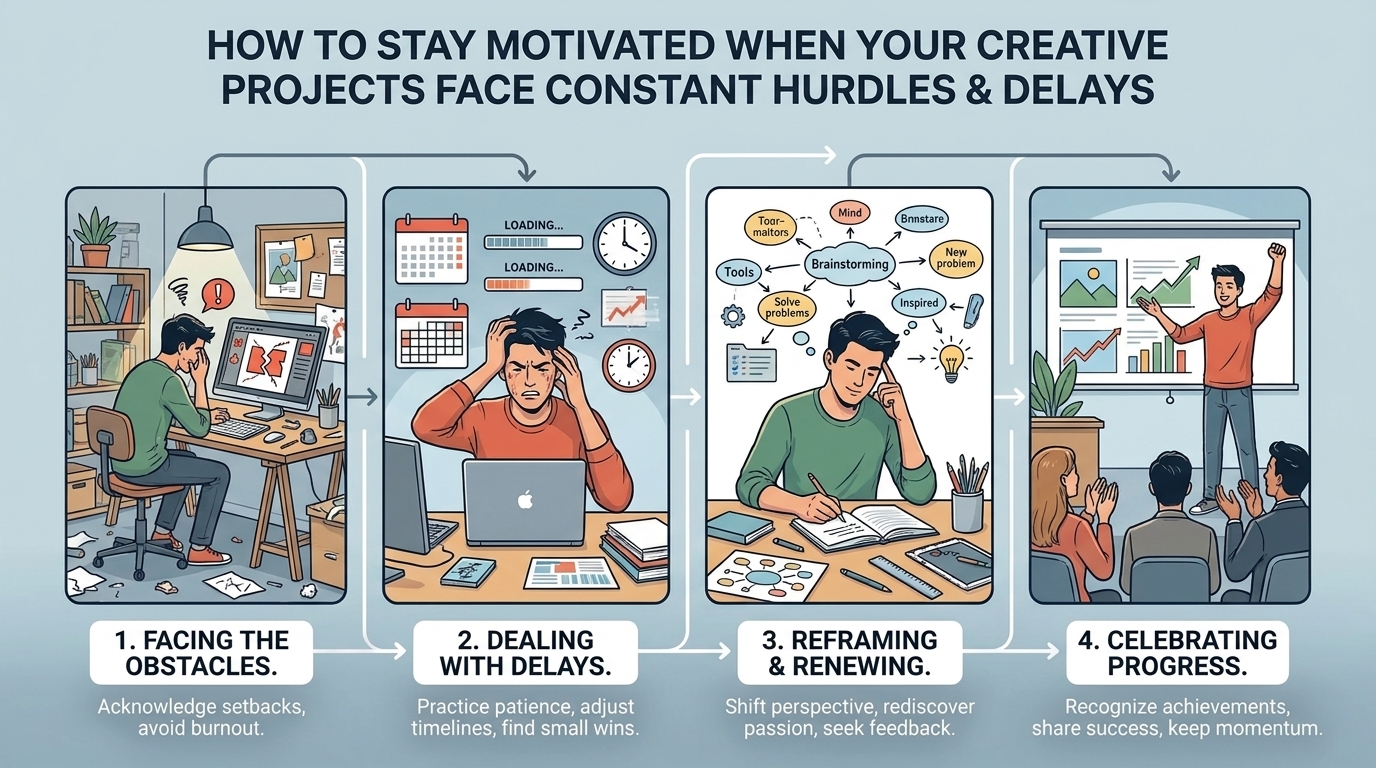
When external hurdles completely halt the forward movement of your primary project, use this step-by-step framework to maintain momentum without burning out:
| Action Step | Description | Creative Benefit |
| 1. Isolate the Bottleneck | Objectively determine whether the delay is internal (skill gap, fatigue) or external (waiting on permits, funding, materials). | Eliminates vague anxiety by pinpointing the exact obstacle that needs solving. |
| 2. Pivot to a Side-Quest | Temporarily redirect your energy to a low-stakes, short-term creative mini-project (e.g., a zine, a quick sketch series, a prototype). | Keeps your creative muscles warm and delivers a quick dopamine hit of completion. |
| 3. Shrink the Scope (MVP) | If a project is stalled due to over-complexity, strip it down to its Minimum Viable Product. Cut features to get it moving again. | Breaks analysis paralysis and forces the project back into motion. |
| 4. Build a Micro-Routine | Commit to just 15 minutes of work on the stalled project daily. Do not try to solve everything at once; simply touch the work. | Prevents the psychological barrier of re-entry from growing larger every day. |
5. Ten Frequently Asked Questions (FAQ)
1. Why do creative projects almost always take longer than expected?
This is known in project management as the “Planning Fallacy.” Humans are notoriously optimistic about estimating time, underestimating external hurdles, technical glitches, and personal burnout cycles.
2. How can I tell the difference between a project that needs a break and one I should abandon?
If a project still sparks your intellectual curiosity and emotional passion after stepping away for two weeks, it is worth saving. If it feels like a hollow obligation driven purely by ego or guilt, it may be time to archive it.
3. What is the best way to handle creative burnout caused by chronic delays?
Step away entirely for a designated period (e.g., one week). Engage in non-creative physical activities, spend time in nature, and completely ban yourself from thinking about the project until your nervous system resets.
4. How do I maintain motivation when nobody else cares about my project?
Intrinsic motivation must be your primary fuel. If you are creating solely for external applause or validation, the first major hurdle will cause you to quit. Create for your own obsession first.
5. Can working on multiple projects at once cure project stagnation?
Yes, provided you do not scatter your energy too thin. Having a primary long-term project alongside a fast-turnaround secondary project allows you to pivot when one hits a bureaucratic wall.
6. What should I do if a collaborator is the source of the project’s delay?
Have an honest, direct conversation. Re-align expectations, establish clear deadlines with milestones, and if necessary, renegotiate roles or outline a legal path to decouple so the project can move forward.
7. How do I overcome the fear that my delayed project will no longer be relevant?
Art and authentic creation are rarely bound strictly by trends. Focus on execution depth and emotional truth; a timelessly well-crafted project will outlast fleeting cultural micro-trends.
8. Is it weak to scale back or simplify a project after hitting a wall?
Not at all. Some of the greatest masterpieces in history were born from severe constraints. Simplification often forces you to strip away fluff and focus on the purest core of your idea.
9. How do accountability partners help when facing constant hurdles?
Sharing your hurdles with a trusted peer or mentor creates gentle external pressure and emotional support, preventing you from isolating yourself in a spiral of frustration.
10. Where can I find more resources on creative mindset and urban artistic survival?
Keep exploring specialized lifestyle and culture hubs like nyattitude.com, where we provide actionable insights, local strategies, and expert guides to help you thrive across America’s greatest cities.
Conclusion
Hurdles and delays are not signs that you should quit; they are the crucible in which durable creative work is forged. Whether you are battling bureaucratic red tape in New York, restructuring tech workflows in San Francisco, or pushing through resource constraints across California, Washington, or Texas, your resilience is your ultimate competitive advantage. By shifting your focus from fragile outcomes to steady daily inputs, shrinking complex scopes, and treating delays as resting phases, you can transform frustration into fuel and bring your most ambitious creative visions to life.
Ready to master your creative workflow, explore local arts culture, and conquer your next project? Continue browsing nyattitude.com to inspire your journey forward!