You step out of the subway station or away from a rideshare service, surrounded by towering glass-and-steel monoliths. You adjust your blazer, check your phone for the hundredth time, and walk through the revolving doors into a gleaming downtown lobby. Minutes later, you are sitting in a sleek conference room or pacing across an open-plan office alongside people whose names you have read in trade journals, whose portfolios you admire, and whose effortless confidence seems almost intimidating.
Then, the quiet, corrosive voice creeps in: “What am I even doing here? They are going to realize I am completely unqualified. I’m just an imposter.”
If you have ever felt this way while working, pitching, or networking in the high-stakes downtown business and creative districts of New York, San Francisco, California, Washington, or Texas, you are far from alone. Imposter syndrome—the persistent inability to internalize your success and the terrifying fear of being exposed as a “fraud”—is the secret tax paid by high achievers.
This comprehensive guide explores the deep psychological mechanics of imposter syndrome, why downtown professional hubs trigger it so intensely, and actionable, battle-tested strategies to overcome it, build unshakable confidence, and thrive among top industry professionals.
1. The Anatomy of Imposter Syndrome in High-Performance Districts
Imposter syndrome was first identified by psychologists Pauline Clance and Suzanne Imes in 1978, originally observed among high-achieving women. Today, we know it affects up to 82% of professionals at some point in their careers, regardless of gender, title, or industry.
When you place yourself in a major downtown metropolitan hub, psychological vulnerabilities are naturally amplified:
- The Proximity Paradox: Downtown corridors concentrate top-tier talent, venture capital, executive leadership, and historic prestige into tight geographic grids. When you sit next to elite performers daily, your brain constantly compares your internal struggles to their curated external highlights.
- The “Fake It Till You Make It” Trap: While cultural advice often tells us to fake confidence, doing so can widen the gap between how you feel inside and how you project yourself outside, fueling the fear that someone will pull back the curtain and expose you.
- High-Stakes Environments: Downtown industries—whether finance in Manhattan, tech in San Francisco, defense and policy in Washington, energy and real estate in Texas, or entertainment and biotech across California—carry massive financial and operational consequences. Higher stakes naturally trigger higher anxiety.
2. Regional Landscapes of Pressure: Coast-to-Coast Imposter Triggers
Different metropolitan regions cultivate distinct professional cultures, meaning imposter syndrome often wears a different mask depending on where your office is located:
New York and San Francisco: The Crucible of Velocity and Elite Pedigree
- New York: In NYC, imposter syndrome is often tied to institutional pedigree—ivy-league degrees, elite corporate boards, and razor-sharp verbal sparring. The city moves so fast that you feel you have to justify your seat at the table every single hour.
- San Francisco: In the Bay Area, imposter syndrome frequently takes the form of “unicorn culture” anxiety—feeling inadequate if you haven’t founded a venture-backed startup, mastered the latest tech stack, or disrupted an entire industry before age thirty.
Texas, California, and Washington: Scale, Policy, and Creative Output
- California: Across broader California hubs like Los Angeles or San Diego, imposter syndrome intersects with visibility, creative validation, and fast-moving visual industries where everyone feels replaceable by the next wave of talent.
- Texas: In rapidly booming Texas economic centers like Austin, Dallas, and Houston, the pressure comes from explosive growth and high-energy entrepreneurship. Navigating rooms full of ambitious builders can make you question your own scaling velocity.
- Washington: In the Pacific Northwest, imposter syndrome in policy, cloud tech, or environmental science often stems from working alongside world-class intellectual heavyweights where policy decisions impact millions of lives.
3. The Core Types of Imposter Syndrome
Dr. Valerie Young, author of The Secret Thoughts of Successful Women, categorizes imposter syndrome into five distinct behavioral archetypes. Identifying which one you fall into is the first step toward neutralizing it:
| Imposter Archetype | Core Belief | How It Manifests Downtown |
| The Perfectionist | “If it’s not 100% flawless, I am a failure.” | Spending hours agonizing over an email or slide deck because a single typo invalidates your worth. |
| The Expert | “I need to know everything before I speak up.” | Remaining silent in meetings because you haven’t memorized every historical data point on a topic. |
| The Natural Genius | “If I have to work hard at something, I must be incompetent.” | Feeling defeated when a complex downtown project doesn’t come to you instantly on the first try. |
| The Soloist | “Asking for help proves I’m a fraud.” | Suffering in silence on a massive project rather than admitting you need guidance or mentorship. |
| The Superperson | “I must excel at every single role simultaneously.” | Burning out trying to be the best analyst, networker, colleague, and partner all at once. |
4. Step-by-Step Blueprint: Overcoming Imposter Syndrome in the Boardroom
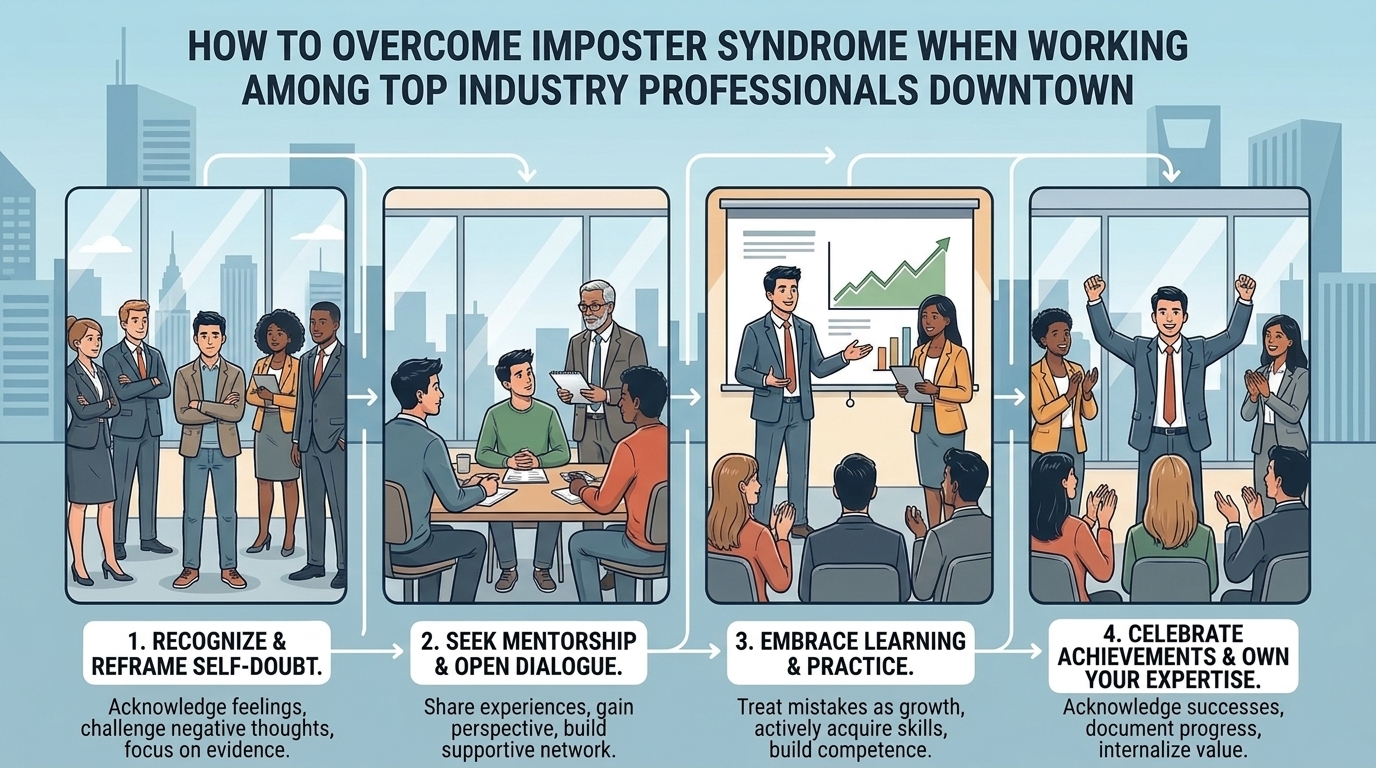
Conquering imposter syndrome requires dismantling cognitive distortions through systematic behavioral shifts. Use this four-step action plan:
- Collect Objective Evidence (The “Reality Folder”): When your brain tells you that you don’t belong, emotional arguments cannot defeat logical data. Keep a digital folder of positive client feedback, performance reviews, solved problems, and thank-you notes from colleagues. Review it whenever self-doubt spikes.
- Shift from “Performing” to “Learning”: Imposter syndrome thrives when you believe your job is to prove you already know everything. Reframe your identity from an “expert who must never fail” to a “curious professional on a continuous learning curve.” Mistakes stop feeling like exposures of fraud and start looking like normal data points.
- Normalize the Vulnerability with Trusted Peers: You would be shocked to discover that the polished executive sitting across from you in the downtown boardroom also battles self-doubt. Build a trusted peer mastermind or venting circle where you can speak honestly about career pressures without fear of professional penalty.
- Separate Feelings from Facts: Remind yourself constantly: “Feeling like an imposter is an uncomfortable emotion, not a factual reality.” You are allowed to feel nervous, unready, or intimidated while simultaneously being deeply competent and qualified for your role.
5. Ten Frequently Asked Questions (FAQ)
1. What is imposter syndrome?
Imposter syndrome is a psychological pattern where an individual doubts their skills, talents, or accomplishments and has a persistent internalized fear of being exposed as a “fraud,” despite clear evidence of their competence.
2. Do top industry executives and leaders experience imposter syndrome?
Yes, absolutely. High-profile leaders, award-winning artists, CEOs, and scientists frequently report struggling with imposter syndrome. In fact, the higher you climb, the more complex the rooms get, which can trigger new waves of self-doubt.
3. Why does working downtown in major cities trigger imposter syndrome so intensely?
Downtown districts concentrate high-stakes corporate environments, elite talent pools, wealth, and intense competition, creating an ecosystem where social comparison and performance pressure are maximized.
4. Is imposter syndrome a diagnosed mental illness?
No. Imposter syndrome is not classified as a psychiatric disorder in the DSM-5; rather, it is recognized as a powerful psychological phenomenon driven by perfectionism, social context, and internal pressure.
5. How can I stop comparing myself to coworkers who seem effortlessly brilliant?
Remember that you are comparing your behind-the-scenes internal struggle to everyone else’s carefully curated highlight reel. Everyone has blind spots, failures, and anxieties that they hide behind a professional exterior.
6. Can imposter syndrome ever be a positive thing?
In small doses, a mild form of imposter syndrome can keep you humble, hungry, and committed to continuous learning. However, left unmanaged, chronic imposter syndrome leads to severe burnout, anxiety, and self-sabotage.
7. What should I say to myself when an imposter attack hits before a major presentation?
Acknowledge the physical anxiety (“My heart is racing because this matters”), separate it from your competence (“Feeling nervous doesn’t mean I am unprepared”), and focus entirely on delivering value to your audience.
8. How do I ask for help downtown without looking incompetent?
Frame your request around optimization rather than rescue. Instead of saying “I don’t know what I’m doing,” try saying “I want to ensure this aligns perfectly with our strategic goals; can we review this section together?”
9. How long does it take to overcome imposter syndrome?
Overcoming imposter syndrome is not a one-time fix; it is a lifelong practice of unlearning perfectionism and retraining your brain to internalize your achievements. With consistent self-awareness, its grip weakens significantly over time.
10. Where can I find more resources on career mindset, professional growth, and urban success?
Keep exploring specialized lifestyle, career, and culture hubs like nyattitude.com, where we provide actionable insights, local strategies, and expert guides to help you thrive across America’s greatest cities.
Conclusion
Working among top industry professionals downtown is a testament to your capability, drive, and hard work—even if your brain tries to convince you otherwise. Whether you are navigating the high-pressure towers of New York, innovating in the tech corridors of San Francisco, building your career across California, shaping policy in Washington, or scaling ventures in Texas, you earned your seat at the table. By understanding the mechanics of imposter syndrome, gathering objective proof of your competence, and shifting from perfectionism to continuous learning, you can quiet the internal critic and step into your professional power with absolute confidence.
Ready to master your career mindset, explore local culture, and conquer your next downtown challenge? Continue browsing nyattitude.com to inspire your journey forward!