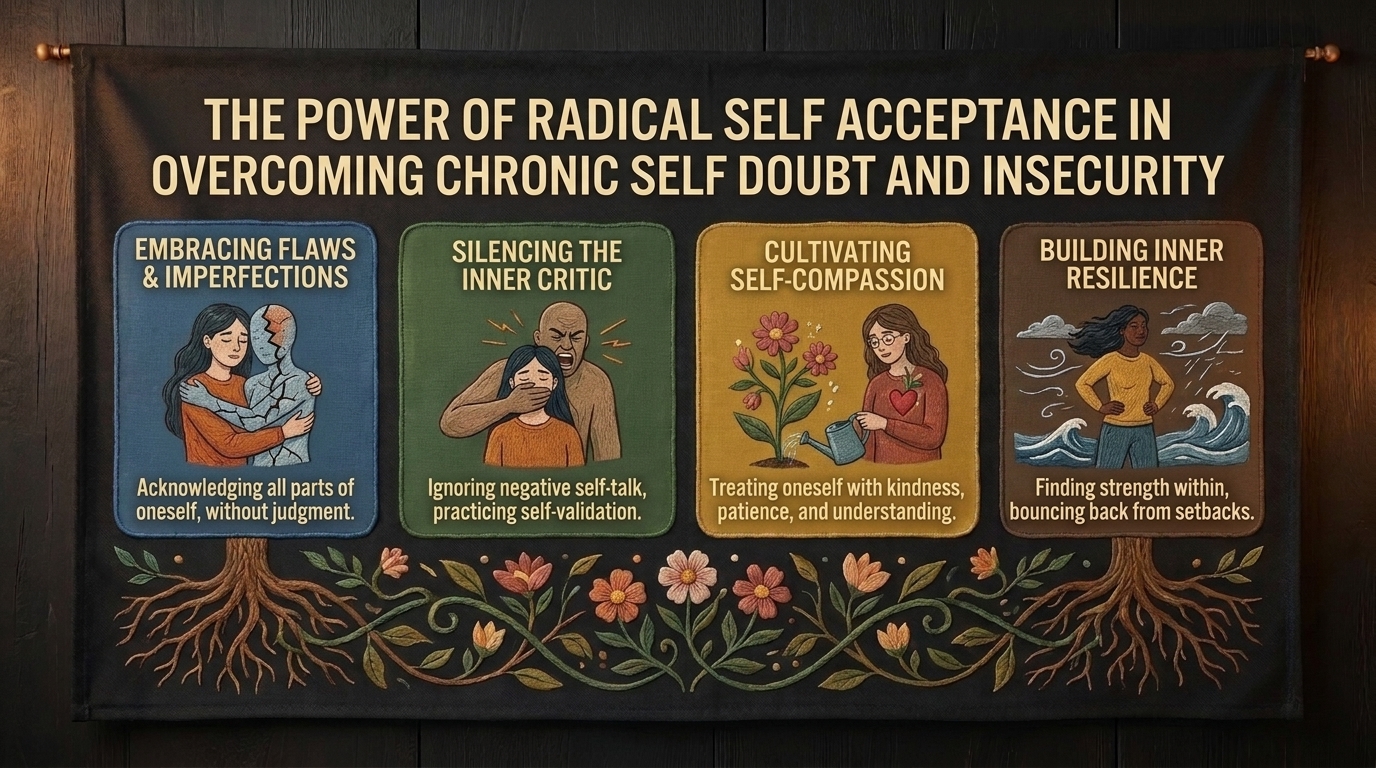
The Power of Radical Self-Acceptance in Overcoming Chronic Self-Doubt and Insecurity
Introduction
In an era defined by relentless digital metrics, curated social media perfection, and hyper-competitive corporate environments, chronic self-doubt and insecurity have become the quiet epidemics of modern life. Whether you are navigating the high-stakes financial trading floors of New York, scaling a venture capital-backed startup in San Francisco, building community-centric enterprises across Texas, spearheading technological innovation in Washington, or balancing creative culture throughout California, the internal pressure to perform, achieve, and measure up can be crushing.
Most traditional self-improvement advice tells us to push harder, fix our flaws, build unshakeable confidence, and forcefully silence our inner critic. Yet, fighting your insecurities head-on often creates a vicious psychological loop: the harder you fight your doubts, the more energy you give them.
There is a profound, paradigm-shifting alternative that offers true psychological liberation: Radical Self-Acceptance.
Rooted in ancient mindfulness traditions and modern psychotherapeutic frameworks such as Acceptance and Commitment Therapy (ACT) and Dialectical Behavior Therapy (DBT), radical self-acceptance is the conscious choice to embrace all parts of yourself—your flaws, past mistakes, limitations, and vulnerabilities—without judgment or conditions.
For ambitious professionals, creators, and entrepreneurs engaging with platforms like nyattitude.com, understanding and applying radical self-acceptance is the foundational bedrock for overcoming chronic self-doubt, eliminating impostor syndrome, and unlocking authentic, sustainable personal and professional power.
This comprehensive guide explores the psychology of self-doubt, the core principles of radical self-acceptance, step-by-step frameworks for rewiring your inner dialogue, regional reflections across major U.S. hubs, actionable transformation tips, and answers to the most frequently asked questions.
1. The Anatomy of Chronic Self-Doubt and Insecurity
To conquer self-doubt, we must first understand its evolutionary and psychological origins. Self-doubt is not a personal failure; it is a glitch in our biological operating system.
The Evolutionary Roots of Insecurity
Human beings are wired for tribal belonging. For our ancestors, rejection from the tribe meant physical danger and isolation. Consequently, our brains developed an innate mechanism—often called the negativity bias—to constantly monitor our behavior, social status, and shortcomings to ensure we fit in and avoid criticism.
In modern society, this ancient survival mechanism misfires. Instead of scanning for physical predators, our brains scan for social rejection, professional inadequacy, and comparative failure.
The Trap of Conditional Self-Worth
Most high-achieving individuals build their self-worth on conditional foundations: “I am valuable only if I hit my quarterly revenue goals,” “I am lovable only if I never make mistakes,” or “I am successful only if others praise my work.”
When self-worth is conditional, self-doubt is guaranteed. Every external setback, delayed project, or critical review feels like a catastrophic threat to your core identity, fueling chronic anxiety and impostor syndrome.
2. What is Radical Self-Acceptance?
Popularized in psychological literature by thought leaders like Tara Brach and Carl Rogers, radical self-acceptance is the total cessation of the war against your own human experience.
Acceptance vs. Resignation
A common misconception is that radical self-acceptance means complacency, settling for mediocrity, or giving up on personal growth. This is entirely false.
- Resignation says: “I am flawed, lazy, or anxious, so why bother trying to change?”
- Radical Self-Acceptance says: “Right now, in this exact moment, I am experiencing anxiety, fear, or inadequacy. That is my reality. I accept it fully without self-hatred, and from this honest baseline, I can choose how to grow.”
You cannot transform a part of yourself that you refuse to acknowledge. Acceptance clears away the blinding fog of shame, allowing you to see your situation objectively and move forward with clarity.
3. The Five Core Pillars of Radical Self-Acceptance
Practicing radical self-acceptance requires shifting your internal posture across five fundamental dimensions:
1. Unconditional Presence with Emotional Reality
Instead of numbing, distracting yourself from, or fighting painful emotions like inadequacy, fear, or grief, radical self-acceptance invites you to pause, breathe, and name the feeling with kindness. “Here is fear. Here is vulnerability. It is okay that I feel this way.”
2. Dropping the Perfectionist Illusion
Perfectionism is not a pursuit of excellence; it is a heavy psychological armor worn to protect against the fear of being deemed unworthy. Radical self-acceptance recognizes that making mistakes, feeling confused, and experiencing failure are universal prerequisites of the human learning curve.
3. Decoupling Worth from Performance
Shifting your identity from a “human doing” to a “human being” is vital. Your intrinsic value as a person remains constant regardless of whether you land a multi-million-dollar deal in New York, launch a viral product in San Francisco, or experience a temporary professional setback.
4. Forgiving Your Past Self
Chronic self-doubt is frequently fueled by past regrets—choices you wish you hadn’t made, relationships that dissolved, or financial mistakes. Radical self-acceptance requires offering radical forgiveness to your past self, recognizing that you made the best decisions you could at the time with the awareness and emotional tools you possessed.
5. Compassionate Boundary Setting
Accepting yourself also means accepting your physical, emotional, and cognitive limitations. Pushing yourself past the point of severe burnout does not prove your strength; it proves a lack of self-respect. Radical self-acceptance empowers you to set firm boundaries without guilt.
4. Regional Realities: Navigating Insecurity Across Major U.S. Hubs
The pressures that trigger chronic self-doubt and impostor syndrome take on distinct cultural flavors across the diverse economic centers connected to nyattitude.com:
- New York: In the high-velocity worlds of finance, media, and corporate law, self-doubt often manifests as the fear of being exposed as an “outsider” or falling behind the relentless pace of Manhattan success. Radical self-acceptance here provides an essential internal anchor, separating personal identity from external prestige and market volatility.
- San Francisco: Surrounded by hyper-achieving tech founders, venture capitalists, and engineering prodigies, professionals in the Bay Area frequently battle intense impostor syndrome. Radical self-acceptance encourages innovators to view failure as iterative data rather than a referendum on their personal intelligence or worth.
- Texas: Spanning thriving hubs like Austin, Dallas, and Houston, Texas culture values rapid growth, hospitality, and entrepreneurial drive. Balancing ambitious expansion with self-acceptance helps local business owners avoid the trap of constant comparison and lifestyle inflation.
- Washington: Anchored by government policy, defense, and Pacific Northwest innovation, Washington professionals navigate complex institutional expectations. Radical self-acceptance helps leaders maintain authenticity, moral clarity, and emotional resilience under intense public and political scrutiny.
- California (Southern & Broader): Balancing wellness culture with creative entertainment industries, California places immense value on image and self-actualization. Radical self-acceptance cuts through the superficial pressure of aesthetic perfectionism, promoting authentic emotional health and holistic well-being.
5. Step-by-Step Framework: Overcoming Self-Doubt Through Acceptance
Transforming deep-seated self-doubt into self-acceptance is a deliberate journey. Follow this step-by-step framework to rewire your internal landscape:
Step 1: Catch and Name Your Inner Critic
Your inner critic speaks in automatic, negative generalizations (“I’m not smart enough for this room,” “I always mess things up”). For one week, keep an “Inner Critic Journal.” Every time you notice a wave of self-doubt, write down the exact thought without judgment. Naming the thought creates cognitive distance between you and the thought.
Step 2: Investigate with Compassion
Ask yourself: Where did this belief come from? Is it an objective truth, or is it an outdated fear response from a past experience? Treat your insecurity not as an enemy to be destroyed, but as a frightened part of your psyche that needs understanding.
Step 3: Practice the RAIN Technique
Popularized in mindfulness psychology, the RAIN framework provides a powerful roadmap for processing self-doubt in real-time:
- Recognize what is happening.
- Accept the experience just as it is.
- Investigate with interest and care.
- Nurture with self-compassion.
Step 4: Reframe Self-Talk into Mentor-Talk
When self-doubt strikes, ask yourself: “What would I say to my best friend or a beloved mentee if they were in this exact situation?” We are almost universally kinder and more objective toward others than we are toward ourselves. Apply that same compassionate wisdom inward.
Step 5: Take Action Despite Doubt
Radical self-acceptance does not mean waiting until all self-doubt disappears before you take action. In fact, waiting for absolute certainty is a trap. Accept that you feel nervous, unqualified, or uncertain, and take the courageous step forward anyway. Confidence follows action, not the other way around.
6. Actionable Tips to Cultivate Radical Self-Acceptance Daily
Incorporate these tactical habits into your daily routine to reinforce self-acceptance and dismantle chronic insecurity:
- Audit Your Digital Environment: Unfollow social media accounts, influencers, or digital platforms that trigger feelings of inadequacy, comparison, or “not-enoughess.” Curate a digital feed that inspires and grounds you.
- Implement a “Wins and Lessons” Journal: Instead of focusing exclusively on your shortcomings, write down three things you handled well each day, alongside one mistake or setback, reframed not as a failure, but as a valuable lesson learned.
- Practice Physical Grounding: When acute anxiety or insecurity triggers a racing heart or shallow breathing, use somatic grounding (such as the 5-4-3-2-1 sensory method or box breathing) to return your nervous system to the present moment.
- Speak Your Truth Aloud: Share your insecurities with a trusted partner, therapist, or close friend. Insecurity thrives in secrecy; when brought out into the open and met with empathy, its power evaporates instantly.
- Ditch the Comparison Trap: Remind yourself that you are comparing your behind-the-scenes reality (doubts, messy struggles, fatigue) with everyone else’s highlight reel.
- Celebrate Progress Over Perfection: Acknowledge micro-improvements in your mindset. Transforming lifelong mental habits takes time; celebrate every moment you catch your inner critic and choose self-compassion instead.
7. Ten Frequently Asked Questions (FAQs)
1. What is the difference between radical self-acceptance and self-esteem?
Self-esteem is often conditional—it fluctuates based on your latest achievement, praise, or external validation. Radical self-acceptance is unconditional. It is the steady, unshakeable acknowledgment of your inherent worth as a human being, regardless of whether you succeed or fail.
2. Doesn’t self-acceptance lead to laziness and a lack of ambition?
No. Research in organizational psychology shows that self-compassion and self-acceptance actually boost resilience, reduce the paralyzing fear of failure, and encourage greater risk-taking. When you are not terrified of making mistakes, you are far more willing to innovate and pursue ambitious goals.
3. How can I stop comparing myself to high-achieving peers?
Start by recognizing that comparison is a distorted optical illusion. You only see the outward success of others, not their internal turmoil. Ground your self-worth in your personal values, unique journey, and individual strengths rather than external benchmarks.
4. What is impostor syndrome, and how does radical self-acceptance cure it?
Impostor syndrome is the persistent inability to believe your success is deserved, accompanied by the fear of being exposed as a “fraud.” Radical self-acceptance cures it by dismantling the belief that you need to be infallible to be legitimate. It allows you to say: “I am still learning, I belong in this room, and my contributions are valuable.”
5. Can radical self-acceptance help with physical insecurity and body image issues?
Yes. Body insecurity often stems from internalizing unrealistic cultural standards. Radical self-acceptance teaches you to appreciate your body for what it does (its strength, resilience, and health) rather than obsessing solely over how it looks under societal microscopes.
6. How do I practice self-acceptance when I have made a major professional mistake?
Isolate the error from your identity. Acknowledge the mistake objectively, accept responsibility, formulate a corrective action plan, and forgive yourself. Remind yourself that a single professional misstep does not make you an incompetent person.
7. How long does it take to overcome chronic self-doubt using this approach?
Rewiring neural pathways formed over decades takes consistent, intentional practice. While you may experience immediate relief from acute anxiety upon accepting your feelings, lasting transformation typically unfolds over several months of daily mindfulness and self-compassion work.
8. What should I do when my inner critic is exceptionally loud?
Pause immediately. Do not try to fight or argue with the inner critic. Instead, label it (“Ah, there is my inner critic trying to protect me again”), take three deep breaths, and consciously pivot your focus to what is within your immediate control.
9. Is radical self-acceptance a form of spiritual bypassing?
True radical self-acceptance is the exact opposite of spiritual bypassing (using positive affirmations to mask deep emotional pain). It requires deep emotional courage to look at your darkest insecurities, painful past, and raw vulnerabilities dead in the eye and say, “I accept that this is part of my story.”
10. How does regional culture impact our struggle with self-doubt?
Competitive metropolitan hubs like New York, San Francisco, and Washington place immense social capital on professional titles, status, and output. Recognizing these external cultural pressures helps you decouple your internal self-worth from regional status games.
Conclusion
Chronic self-doubt and insecurity are heavy burdens to carry, but they do not have to define your life, your career, or your relationships. By abandoning the exhausting war against your own flaws and embracing the liberating power of radical self-acceptance, you unlock an unshakeable internal baseline of peace and resilience.
Whether you are building a visionary enterprise across Texas, New York, California, Washington, or San Francisco, remember that your truest power does not come from perfection—it comes from the courage to show up fully, authentically, and compassionately as your real self.
What is one area of your life where you can replace self-criticism with radical self-acceptance today?