How to Cook Comforting Meals in a Tiny Apartment Kitchen with Limited Counter Space
Introduction
There is a distinct psychological shift that happens when you step into a compact urban apartment kitchen. For millions of residents navigating the high-density real estate corridors of New York, San Francisco, California urban centers, Washington D.C., and bustling Texas metropolitan hubs, the kitchen is rarely a sprawling culinary playground. Instead, it is often a micro-footprint galley: a two-burner stove, a mini-fridge, a single small basin sink, and a sliver of counter space barely wide enough to fit a cutting board.
For aspiring home cooks and comfort food lovers, this spatial limitation frequently breeds intimidation. The common misconception is that making deeply nourishing, soulful, from-scratch comfort meals—like braised short ribs, homemade pan-seared gnocchi, roasted root vegetables, or slow-simmered chicken soup—requires commercial counter space, an island workspace, and an arsenal of specialized appliances.
This is entirely false.
Culinary excellence is born from technique, resourcefulness, and spatial efficiency, not square footage. Professional ship galleys, food trucks, and Michelin-starred prep stations operate in spaces smaller than most apartment kitchens every single day. By mastering the art of “mise en place” (everything in its place), optimizing vertical storage, choosing multi-functional cookware, and adopting tactical workflow strategies, you can turn a cramped kitchenette into a powerhouse of comfort cooking.
This comprehensive guide explores the psychology of compact cooking, essential gear for tight footprints, spatial organization tactics, step-by-step workflows for cooking complex comfort meals, regional perspectives across major culinary hubs, and a definitive breakdown of answers to common apartment cooking questions.
Part 1: The Philosophy of Compact Culinary Efficiency
To conquer a tiny kitchen, you must first reframe how you view space. Space is not a fixed barrier; it is a flexible resource governed by choreography and timing.
1. The Myth of the Culinary Super-Station
Commercial cooking shows have conditioned home cooks to believe they need vast marble islands, six-burner ranges, and separate prep, cook, and wash stations. In reality, working in a large kitchen often encourages bad habits: clutter accumulation, disorganized ingredient sprawl, and inefficient movement.
A tiny kitchen forces you to be disciplined. When every square inch counts, you eliminate redundant tools, clean as you go, and focus entirely on the task at hand. Cooking becomes a focused, meditative dance rather than a chaotic sprawl.
2. Spatial Compression and Workflow Choreography
In a micro-kitchen, you cannot afford to walk back and forth across the room. Everything must be within arm’s reach. Your workflow is divided into three compressed zones:
- The Vertical Zone: Walls, backsplashes, and cabinet undersides used for hanging and magnetic storage.
- The Active Zone: The tiny strip of counter between your sink and stove where all prep happens.
- The Staging Zone: Stovetop burners, oven cavities, and temporary holding surfaces (like the top of the microwave or a cutting board placed directly over the sink basin).
Part 2: Essential Gear and Multi-Functional Equipment for Tiny Kitchens
In a spacious kitchen, clutter is forgiven. In a tiny kitchen, every single item must justify its existence by performing at least two or three different functions.
[ MULTI-FUNCTIONAL APARTMENT KITCHEN ARSENAL ]
               │
               ├── 1. The Over-the-Sink Cutting Board (Instantly doubles counter surface)
               ├── 2. Cast Iron Skillet / Dutch Oven (Sears, bakes, stews, goes from stove to oven)
               ├── 3. Magnetic Knife Strip (Clears drawer clutter, keeps tools accessible)
               └── 4. Immersion Blender (Replaces bulky countertop food processors and blenders)
1. The Over-the-Sink Cutting Board
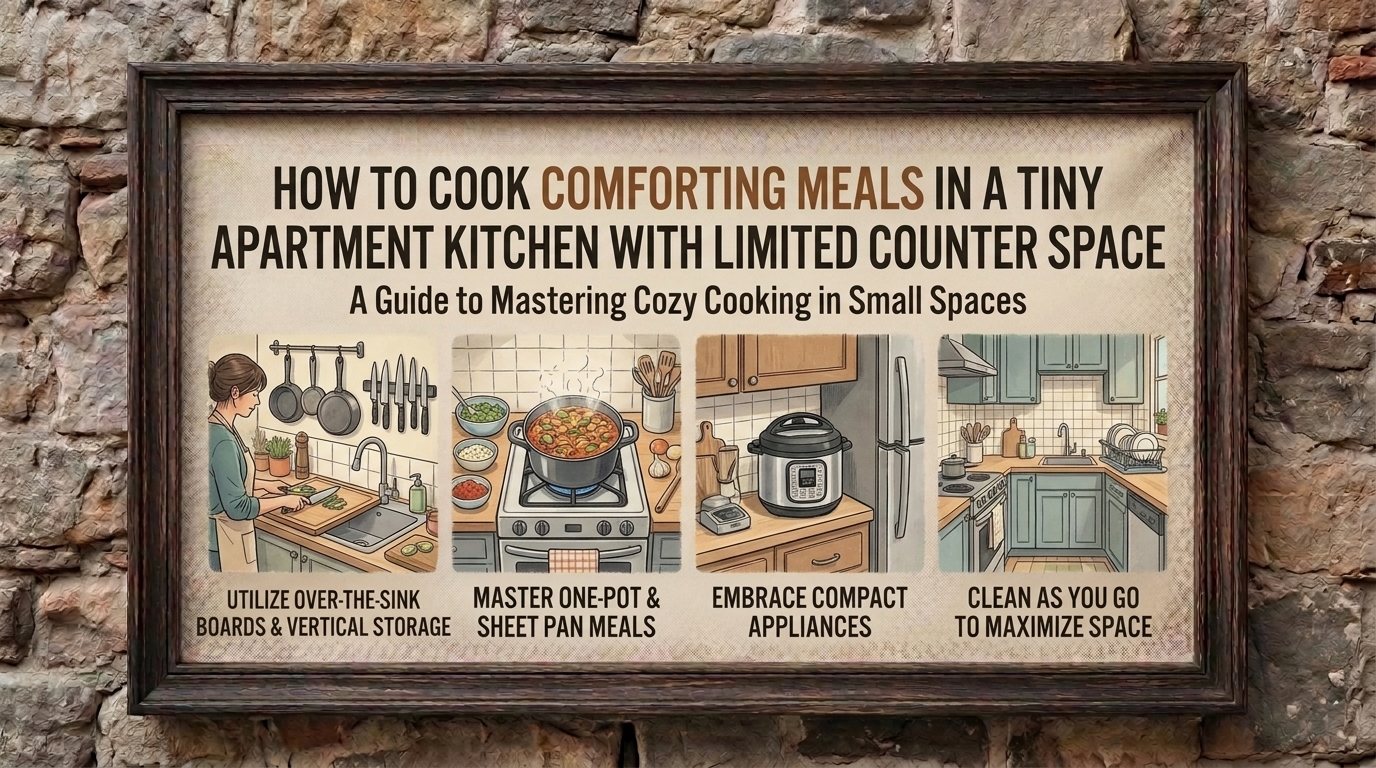
This is the single greatest space-saving hack for apartment kitchens. By placing a heavy wooden or composite cutting board directly over your sink basin, you instantly convert dead, unusable air space into a stable prep station. You can chop vegetables right over the drain, sweep scraps directly down the disposal, and wipe down your workspace in seconds.
2. The Heavy Cast Iron Skillet or Dutch Oven
Instead of owning a dozen specialized pans, invest in two heavy workhorses: a 10-inch seasoned cast iron skillet and a 4-quart enameled Dutch oven.
- Why they excel: A Dutch oven can sear meat on the stovetop, braise it in the oven, deep-fry chicken, bake artisan sourdough bread, and boil pasta. It eliminates the need for separate roasting pans, stockpots, and fry pans.
3. The Immersion Blender
Full-sized countertop blenders and food processors occupy prime real estate and are a nightmare to clean in tiny sinks. An immersion (stick) blender with a whisk attachment takes up minimal drawer space while effortlessly pureeing hot soups right in the pot, whipping cream, and emulsifying dressings.
Part 3: Actionable Tips to Maximize Counter Space and Storage
Implementing physical and organizational modifications can double your functional workspace overnight.
1. Master the “Clean As You Go” Discipline
In a large kitchen, you can let dirty bowls pile up on the counter while dinner cooks. In a tiny kitchen, two mixing bowls will completely shut down your operation.
- Actionable step: Fill your sink basin with hot, soapy water before you start cooking. As soon as you finish using a knife, measuring cup, or prep bowl, wash it immediately and set it on a compact drying mat. Your workspace remains clear from ignition to plating.
2. Utilize Vertical Real Estate
When horizontal counter space is exhausted, look up.
- Actionable step: Install a magnetic knife strip on the wall to clear your drawers. Use command hooks or under-cabinet racks to hang mugs, measuring spoons, and small pots. Mount a tension rod inside cabinets or under the sink to organize baking sheets and cutting boards vertically like books on a shelf.
3. Use the Stovetop as Extended Prep Space
When the burners are cold, your stovetop is flat, heat-resistant counter space.
- Actionable step: Invest in a custom-fit wooden stove cover (noodle board) or place a large, sturdy cutting board directly over your electric or gas burners. This creates an instant staging area for assembling ingredients before the heat gets turned on.
4. Downsize Your Ingredient Footprint
Buying bulk economy-sized spice jars and giant oil jugs will overwhelm a micro-kitchen.
- Actionable step: Decant dry goods, grains, and frequently used spices into uniform, stackable glass jars or magnetic tins that attach to the side of your refrigerator. Buy spices in smaller quantities from bulk bins so they stay fresh and don’t clutter your cabinets.
5. Prep in Tiny Vessels (“Pinch Bowls”)
Professional kitchens use dozens of small stainless steel bowls (* ramekins*) to hold prepped ingredients.
- Actionable step: Instead of scattering chopped onions, minced garlic, and diced carrots across your limited counter on paper plates, use small, stackable glass bowls or even coffee mugs to hold your prepped ingredients. Stack them neatly in a single small tower until it’s time to toss them into the pan.
Part 4: Regional Perspectives: Apartment Cooking Across Major Hubs
The reality of micro-kitchen cooking varies across major American metropolitan areas, shaped by local real estate, architectural history, and regional comfort food traditions:
- New York: Characterized by pre-war walkups with notoriously tiny, windowless galley kitchens or hallway kitchenettes. New Yorkers master the art of one-pot comfort meals (like hearty lentil soups, classic marinara sauces, and stovetop braises) that require minimal cleanup and single-burner mastery.
- San Francisco & California: High-density Victorian conversions and modern downtown micro-studios feature compact kitchens paired with incredible access to hyper-fresh farmers market produce. Cooks here leverage fresh herbs, citrus, and quick-searing techniques to create vibrant, comforting California-style dishes without heavy equipment.
- Washington: Compact row-house apartments near Capitol Hill require efficient meal prep for busy professionals. Washington cooks often rely on slow cookers or Dutch ovens that can bubble away unattended while managing high-stress policy schedules.
- Texas: Even in sprawling Texas cities like Austin, Dallas, and Houston, urban loft and downtown apartment dwellers face tight kitchen footprints. Texas apartment cooks master compact sheet-pan meals and single-skillet cast-iron techniques to deliver bold, comforting flavors (like chili, fajita skillets, and cornbread) without losing their cool.
Part 5: Step-by-Step Workflow: Cooking a Complex Comfort Meal in a Tiny Kitchen
Let’s walk through a real-world example: How to cook a classic, comforting Coq au Vin (braised chicken in red wine with mushrooms and bacon) in a 4×4-foot kitchen counter setup.
[ THE COMPACT COOKING WORKFLOW ]
       │
       ├── Phase 1: Vertical Setup (Magnetic spices, over-the-sink prep board)
       ├── Phase 2: Staged Mise en Place (Stackable pinch bowls for garlic, bacon, herbs)
       ├── Phase 3: Single-Pot Execution (Dutch oven does searing, browning, and braising)
       ├── Phase 4: Clean-As-You-Go (Wash prep bowls while chicken simmers in oven)
       └── Phase 5: One-Bowl Plating (Serve directly into a cozy bowl, zero counter chaos)
- Phase 1: The Setup: Place your over-the-sink cutting board across the basin. Pull out your single 4-quart Dutch oven and set it on the front burner. Mount your chef’s knife on the magnetic strip.
- Phase 2: The Staged Prep: Chop your bacon, mushrooms, carrots, and onions. Place each prepped item into small stackable bowls, stacking them neatly to the side of your cutting board.
- Phase 3: The Single-Pot Searing: Turn on the burner. Brown the bacon directly in the Dutch oven, remove it, sear the chicken thighs in the rendered fat, and set them aside on a single small plate.
- Phase 4: The Braise & Clean: Toss the aromatics and wine into the Dutch oven, return the chicken, cover with the lid, and transfer the whole pot into your apartment oven to braise for 45 minutes. While it braises, wash your cutting board, knife, and prep bowls immediately. Your counter is now 100% clean while dinner cooks itself.
- Phase 5: The Plating: Ladle the rich, comforting stew directly into a wide bowl. Enjoy your meal without looking at a mountain of dirty dishes.
Part 6: 10 Frequently Asked Questions (FAQs)
1. How do I cook a large holiday meal or dinner party in a tiny apartment kitchen?
Planning and timing are your secret weapons. Prep all your vegetables, marinate meats, and chop ingredients 24 hours in advance and store them in stackable containers in your mini-fridge. Utilize staggered cooking: roast vegetables in the oven first, tent them with foil to keep warm, and then use the stovetop for gravy or searing proteins right before serving.
2. What are the best appliances to own if I have zero counter space?
Stick to multi-functional units that can be stored away in a cabinet when not in use: a 4-quart enameled Dutch oven, an immersion blender with a whisk attachment, and a compact digital kitchen scale (which eliminates the need for bulky measuring cup sets). Avoid single-use gadgets like unit-tasker blenders or bread makers.
3. How do I manage strong cooking odors and smoke in a small apartment without proper ventilation?
Many older apartment kitchens lack range hoods that vent outdoors. To combat smoke and odors: always use a high-smoke-point oil (like avocado oil instead of extra virgin olive oil) for high-heat searing, place a small fan near your window pointing outward to create cross-ventilation, and keep your bathroom exhaust fan running to pull air through the apartment.
4. Can I bake bread or pastries in a tiny apartment kitchen?
Yes! You do not need a commercial double oven. A standard apartment oven paired with a heavy cast-iron Dutch oven allows you to bake world-class artisan sourdough or no-knead crusty breads using trapped steam. For rolling out dough, use the dining table or your clean stovetop if counter space is completely non-existent.
5. How do I prevent my tiny kitchen from feeling cluttered and overwhelming?
Adopt a strict “one in, one out” rule for kitchen gadgets. Keep counters completely clear except for one or two daily essentials (like a coffee grinder). Store lesser-used appliances inside lower cabinets or bedroom closets if kitchen cabinetry is limited.
6. What is the best way to wash dishes efficiently when you have a single tiny sink basin?
Do not let dirty dishes sit in the sink blocking your workspace. Keep a compact dish drying rack next to the sink or use an over-the-sink roll-up drying mat. Wash items immediately after use in batches (e.g., wash prep tools while water heats; wash pots right after plating).
7. How do I store pantry staples like flour, sugar, and rice in a small space?
Decant dry goods into square or rectangular airtight containers (square containers maximize cabinet space much better than round bags or jars). Utilize the backs of pantry doors with over-the-door wire shelving racks to store oils, vinegars, and canned goods.
8. Is it possible to make rich, slow-simmered comfort foods on a two-burner stove?
Absolutely. Two burners are more than enough for 90% of home cooking. You can simmer a massive pot of stock or chili on the back burner while searing meat or boiling pasta on the front burner. For slow cooking, your oven acts as your reliable secondary heat chamber.
9. What should I do if my apartment kitchen has zero drawer space?
Utilize magnetic wall strips for knives and metal utensils, hang a ceiling or wall rack for pots and pans, install floating shelves for ceramic mixing bowls, and use rolling utility carts tucked beside the refrigerator to house pantry items and small appliances.
10. Why is cooking in a tiny kitchen actually a rewarding culinary skill?
Cooking in a micro-kitchen teaches you supreme spatial awareness, knife efficiency, timing discipline, and minimalist mindfulness. It strips away the distractions of modern commercial excess and focuses your attention purely on what matters: transforming simple, honest ingredients into a delicious, comforting meal.
Conclusion
Cooking comforting meals in a tiny apartment kitchen with limited counter space is not a compromise—it is an art form. Whether you are operating out of a historic walk-up in New York, a micro-studio in San Francisco, a row house in Washington, or a loft in Texas, your square footage does not dictate your culinary capability.
By embracing multi-functional cookware, mastering vertical storage, practicing disciplined “clean as you go” habits, and streamlining your workflow, you can turn the smallest kitchenette into a sanctuary of warmth, flavor, and comfort. Clear your cutting board, embrace the challenge, and cook something wonderful today.