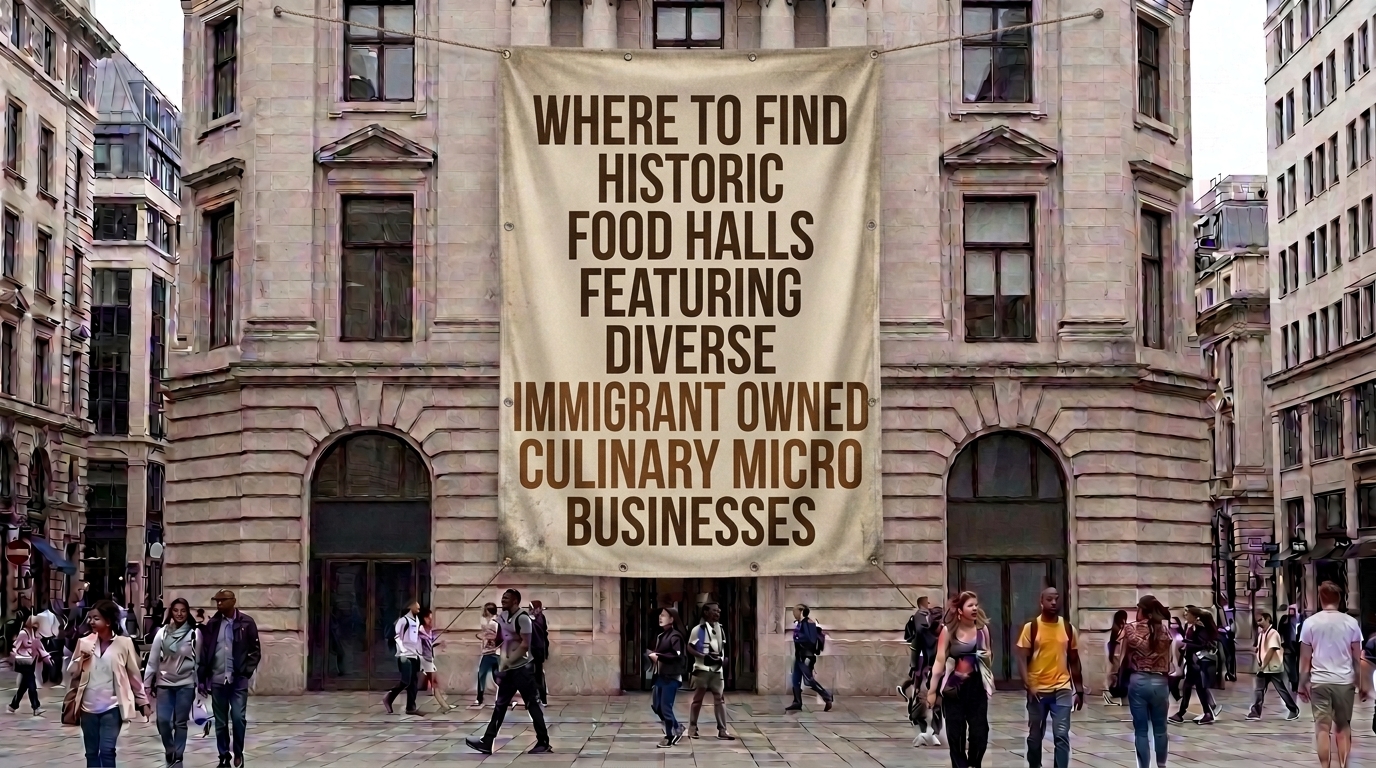
Where to Find Historic Food Halls Featuring Diverse Immigrant-Owned Culinary Micro-Businesses
Food halls are far more than modern architectural trends or corporate dining spaces. Across the United States, historic food halls, repurposed urban markets, and community-focused food incubators serve as vital cultural engines. They preserve regional architecture while providing low-barrier entry points for immigrant-owned micro-businesses, refugee entrepreneurs, and first-generation culinary artists.
From century-old citrus packing facilities transformed into multi-ethnic food bazaars to municipal marketplaces designed specifically to nurture women-owned culinary ventures, these dynamic spaces connect diners directly with authentic food traditions from around the globe.
The Intersection of Architectural Preservation and Culinary Entrepreneurship
Historic markets have long served as primary economic hubs for newly arrived communities. In the late 19th and early 20th centuries, street vendors, bakers, and grocers gathered under central roofs to build livelihoods and share ancestral recipes. Today, adaptive reuse projects have revitalized these aging structures, combining heritage architecture with economic incubator models.
- Low Capital Barriers: Opening a traditional brick-and-mortar restaurant requires massive upfront capital. Food hall stalls drastically reduce overhead, allowing micro-entrepreneurs to test concepts, build brand loyalty, and scale sustainably.
- Incubator Support Systems: Non-profit and municipal operators often provide business literacy, permitting guidance, marketing, and commercial kitchen access alongside stall space.
- Cultural Preservation through Gastronomy: These markets allow immigrant families to preserve living heritage, passing regional recipes and techniques to new generations while feeding diverse local crowds.
Essential Historic Food Halls Across Key US Regions
| Market Name & City | Historic Building Origin | Cultural & Immigrant Business Focus | Standout Micro-Business Specialties |
| La Cocina Municipal Marketplace (San Francisco, CA) | Repurposed Tenderloin urban space | First women-led food hall, focus on low-income, immigrant, and minority-owned micro-eateries | Senegalese yassa, Algerian couscous, Salvadoran pupusas |
| Ferry Building Marketplace (San Francisco, CA) | 1898 Beaux-Arts transit terminal | Blend of historic bay vendors, artisan producers, and immigrant-owned specialty bakeries | Artisanal dim sum, Filipino pastries, Vietnamese coffee |
| Essex Market (New York City, NY) | 1940s Mayor LaGuardia pushcart vendor relief market | Historic Lower East Side incubator supporting generational immigrant grocers and food stalls | Dominican sancocho, Japanese street food, Jewish delicacies |
| Chelsea Market (New York City, NY) | 1890s Nabisco factory complex | Multi-cultural micro-vendors operating alongside artisan food purveyors | Middle Eastern halva, Mexican tacos, hand-pulled noodles |
| Pike Place Market (Seattle, WA) | Opened in 1907, continuously operating public market | Deep history of Asian-American farmer stalls, immigrant bakeries, and seafood counters | Hmong produce stalls, Russian piroshky, Filipino cuisine |
| Anaheim Packing House (Anaheim, CA) | 1919 Sunkist citrus packing warehouse | Restored landmark housing diverse, multi-generational global food stalls | Indian street snacks, Vietnamese pho, Mexican aguas frescas |
| Grand Central Market (Los Angeles, CA) | 1917 Homer Laughlin Building basement | L.A.’s oldest operating food hall featuring classic Hispanic, Asian, and Middle Eastern stalls | Salvadoran pupusas, traditional carnitas, Thai noodle bars |
| Harvest Market / Market Square (Houston & San Antonio, TX) | Historic downtown trading squares and central halls | Focus on Tejano, Afro-Caribbean, Central American, and Vietnamese micro-vendors | Vietnamese-Cajun crawfish, Salvadoran tamales, Mexican pan dulce |
Regional Spotlights: Where History Meets Diversity
1. California: Bay Area & Southern California Landmarks
California’s agricultural and maritime history is reflected directly in its food markets. San Francisco’s La Cocina Municipal Marketplace in the Tenderloin district represents a groundbreaking model: a non-profit incubator designed specifically to transition immigrant women and women of color into successful restaurateurs. Nearby, the Ferry Building Marketplace highlights historic West Coast maritime transport while offering artisan food stalls. In Southern California, the Anaheim Packing House showcases 1910s Spanish Colonial Revival architecture transformed into a vibrant hub for global micro-eateries.
2. New York: Legacy Markets of the East Coast
New York City’s market history was built on managing pushcart commerce in immigrant neighborhoods. Essex Market on the Lower East Side was established in the 1940s to move immigrant vendors indoors. Today, its modern facility continues that legacy by protecting affordable stalls for long-time Dominican, Jewish, and East Asian vendors. Meanwhile, the historic Chelsea Market occupies the former Nabisco complex, merging industrial heritage with international food stalls serving everything from taco counters to Middle Eastern bakeries.
3. Washington: Seattle’s Waterfront Tradition
Pike Place Market in Seattle is one of the oldest continuously operating public markets in the United States. Established in 1907 to connect consumers directly with local farmers, it played a pivotal historical role for Japanese and Hmong immigrant farmers, as well as Filipino, Scandinavian, and Italian merchants. Walking through its multi-level wooden arcades reveals family-run bakery counters, spice shops, and specialty food stalls that have operated for decades.
4. Texas: Cross-Border and Global Fusion
Texas historic markets, particularly in cities like Houston, San Antonio, and Dallas, highlight the state’s unique position as a cultural crossroads. Historic market spaces feature micro-businesses blending traditional Mexican culinary heritage with newer waves of Vietnamese, Central American, and Nigerian influences. This produces famous cross-cultural staples like Tex-Mex pastries, Salvadoran pupusas, and Vietnamese-Cajun seafood options.
Practical Guide: How to Ethically Explore and Support Food Hall Micro-Businesses
Supporting culinary micro-businesses involves mindful consumption that maximizes the impact of your visit:
1.Research the Market’s Operational Model:Identify non-profit or municipal incubator platforms.
Look for markets partnered with non-profits (like La Cocina or local urban development projects). These models ensure stall fees remain accessible and revenue stays directly with the micro-entrepreneurs.
2.Order Beyond the Anchor Tenants:Avoid sticking exclusively to recognizable staple dishes.
While large, famous stalls attract crowds, seek out smaller corner counters run by first-generation owners. Try regional specialties that are rarely found on standard restaurant menus.
3.Use Cash or Direct Digital Payments:Pay via preferred local payment options.
Credit card processing fees hit micro-businesses with tight margins particularly hard. Using cash or preferred local digital options helps owners keep a larger portion of each sale.
4.Share Authentic Word-of-Mouth Recommendations:Help small businesses overcome marketing budgets.
Micro-businesses rarely have dedicated marketing budgets. Tagging specific vendor stalls, leaving detailed positive reviews on local directories, and sharing dish recommendations online drives vital organic foot traffic.
Frequently Asked Questions (FAQ)
1. What defines a “historic” food hall compared to a modern food court?
A historic food hall is housed within an architecturally significant or historic building (such as old train depots, packing houses, or municipal pushcart markets) and focuses on local, independent vendors rather than national fast-food chains.
2. How do food halls support immigrant micro-business owners?
They provide shared kitchen infrastructure, lower upfront real estate costs, flexible lease terms, and built-in foot traffic. Many also offer business training and language access programs.
3. What is a food incubator, and how does it function inside a market?
A food incubator is an organization that provides affordable commercial kitchen space, business technical assistance, and retail opportunities to help early-stage food entrepreneurs launch and scale.
4. Are food hall micro-vendors suitable for travelers with dietary restrictions?
Yes. Because food halls host dozens of distinct stalls under one roof, visitors can easily find diverse vegan, vegetarian, halal, kosher, or gluten-free options rooted in traditional global cuisines.
5. How do historic food halls impact local neighborhood preservation?
Adaptive reuse prevents historic structures from demolition, revitalizes urban corridors, creates local jobs, and keeps community wealth within the neighborhood.
6. Which city has the oldest public market in the United States?
While several cities claim early markets, Seattle’s Pike Place Market (1907) and Los Angeles’ Grand Central Market (1917) are among the most famous continuously operating historic food markets on the West Coast.
7. Can micro-businesses in food halls eventually open brick-and-mortar restaurants?
Yes. Food halls frequently serve as stepping stones. Many successful graduates from programs like La Cocina go on to launch independent full-service restaurants.
8. What is the best time of day to visit popular historic food halls?
Visiting on weekday mornings or early afternoons (between 10:00 AM and 11:30 AM, or 2:00 PM and 4:00 PM) allows you to avoid peak lunch crowds and chat directly with stall owners.
9. Are these markets accessible for family and group travel?
Food halls are ideal for groups because everyone can order from different cultural stalls while sharing common seating areas, catering to diverse tastes seamlessly.
10. How can developers balance commercial profitability with supporting low-income vendors?
Through public-private partnerships, historical tax credits, and sliding-scale rent structures that subsidize incubator spaces using revenue from anchor bar or event tenants.
Visiting historic food halls is one of the most rewarding ways to experience a city’s living history and cultural diversity. By seeking out immigrant-owned micro-businesses tucked inside these repurposed architectural landmarks, travelers and locals alike can enjoy authentic global flavors while actively investing in community-led economic equity.