Why Taking the Time to Observe Everyday City Life Is a Form of Meditation
Introduction: Finding Stillness in the Epicenter of Noise
When we think of meditation, our minds naturally drift to serene, isolated imagery: a silent mountaintop monastery in Tibet, a deserted white-sand beach at dawn, or a dark, incense-filled room where the only sound is the rhythmic inhalation and exhalation of breath. We are conditioned to believe that inner peace requires the total elimination of stimulus. We pack our bags, flee the concrete grid, and seek refuge in nature, convinced that the city is the ultimate enemy of mindfulness.
Yet, for millions of urbanites navigating the high-octane rhythms of metropolitan landscapes across Texas, New York, California, Washington, and San Francisco, escaping to the wilderness is an occasional luxury, not a daily lifestyle. Life happens where we live, work, and move: amidst the blaring taxi horns of Manhattan, the breezy tech-fueled corridors of San Francisco, the sun-baked avenues of Austin and Dallas, the maritime rush of Seattle, and the sprawling intersections of Los Angeles.
What if the secret to profound mindfulness isn’t running away from the chaos, but learning how to sit right in the middle of it?
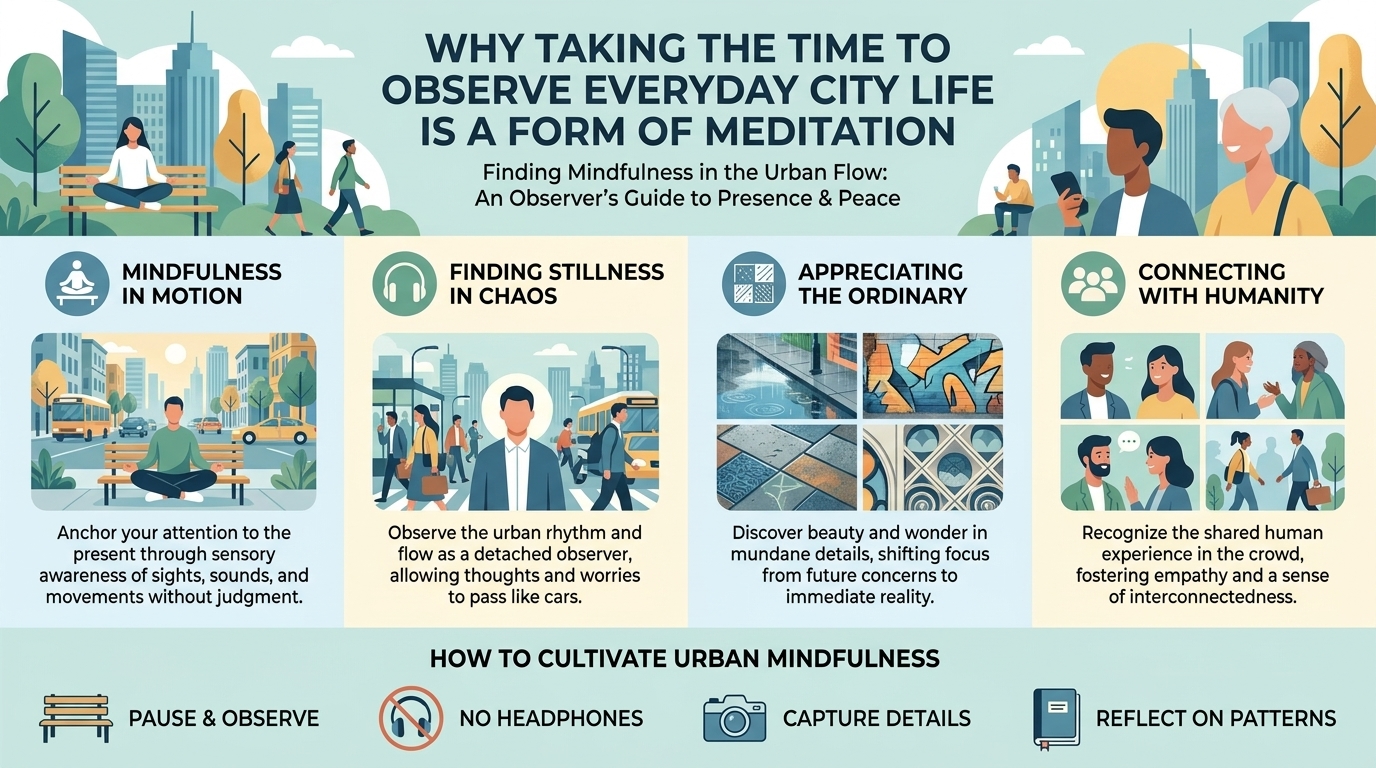
Welcome to the meditative art of urban observation—the practice of treating everyday city life as a living, breathing mandala. By intentionally slowing down to watch the theater of the streets, you transform the overwhelming noise of the metropolis into a powerful anchor for presence, emotional regulation, and deep self-awareness.
1. The Psychology of Urban Witnessing: Flâneurship Meets Mindfulness
To understand why observing city life is deeply therapeutic, we must look at both ancient contemplative traditions and modern environmental psychology.
The Evolution of the Urban Observer
In 19th-century French literature, the concept of the flâneur emerged—an observant, aimless stroller who absorbed the sights, sounds, and rhythms of the city without being consumed by its frantic pace. Modern urban mindfulness takes this classic concept a step further. Instead of walking just to see, you walk—or sit—to witness.
When you step outside in a bustling metropolis like San Francisco or New York, your brain is typically bombarded by millions of data points: traffic lights, digital billboards, commuter chatter, sirens, and flashing screens. Normally, your brain’s amygdala treats this as a survival threat, triggering low-grade chronic stress or mental fatigue known as “directed attention fatigue.”
Reversing Mental Fatigue Through Soft Fascination
Environmental psychologists refer to the concept of “Soft Fascination.” Unlike staring at a computer screen or driving through dense highway traffic (which requires hard, exhausting focus), observing the gentle, unpredictable flow of everyday urban life—a courier locking a bicycle, a vendor arranging fruit at an open-air market, leaves swirling around a street corner—engages your attention effortlessly. It allows the over-stimulated analytical brain to rest while keeping you firmly anchored in the present moment.
2. Regional Rhythms: How Different Metropolises Shape the Meditative Lens
Every major cultural hub possesses its own distinct cadence, offering unique emotional textures for the mindful observer.
New York: The Symphony of Accelerated Presence
New York City moves at a velocity that forces a choice: you either let it crush your inner peace, or you use its relentless energy as a moving meditation. Sitting on a bench in Union Square or leaning against a brownstone stoop in Brooklyn allows you to watch a multi-cultural mosaic unfold. The sheer density of humanity acts as a mirror for your own thoughts, teaching you how to watch mental phenomena pass by like yellow cabs rushing down an avenue.
San Francisco & California: Fog, Light, and Slow Elevation
On the West Coast, urban meditation takes on a different sensory palette. In San Francisco, watching the fog roll over the tiled rooftops of the Mission District or observing the quiet ritual of commuters waiting for a cable car invites a softer, more contemplative rhythm. In Southern California or sprawling Texas metropolises, the interplay of harsh sunlight, deep shadows, and wide-open urban plazas encourages you to notice the geometry of human movement against monumental architecture.
Washington: The Balance of Monumental Scale and Human Detail
In Washington D.C., the juxtaposition is striking: massive neoclassical government structures standing alongside intimate, tree-lined neighborhood squares. Observing everyday life here—protesters, politicians, tourists, and locals sharing the same urban ecosystem—reminds the observer of the grand, intersecting narratives of human society.
3. Step-by-Step Guide: How to Practice Urban Meditation
You do not need an hour of silent solitude in a remote studio to practice this. You can turn your everyday commute, lunch break, or afternoon stroll into a mindfulness retreat. Here is a step-by-step framework to master urban observation:
Step 1: Establish Your Anchor Point
Find a stationary vantage point where you can blend into the background without blocking foot traffic. Excellent spots include:
- A corner table at a street-facing café with large glass windows.
- A public park bench facing a busy pedestrian walkway.
- The upper deck of an outdoor transit system or a ferry crossing the bay.
Step 2: Drop Out of Judgment, Into Description
When we look at people, our minds immediately categorize them: “They look rushed,” “That person looks unhappy,” “I like their jacket.” Mindful observation requires shifting from evaluation to pure sensory description. Notice shapes, colors, gaits, and textures without attaching moral judgments or personal narratives to them. Notice the rhythm of footsteps hitting concrete. Notice how light reflects off sunglasses and skyscraper windows.
Step 3: Practice “People-Watching” as Compassion (Metta Practice)
As you watch strangers pass by, silently extend a wish for their well-being. Recognize that everyone you see is carrying their own invisible universe of joys, anxieties, deadlines, and dreams. This simple mental shift instantly transforms passive staring into active empathy and connection, dissolving the loneliness that often accompanies crowded city living.
Step 4: Anchor in Your Physical Body
While your eyes track the motion of the city, keep your awareness anchored in your physical body. Feel your feet resting firmly on the sidewalk. Notice the rise and fall of your chest. Feel the cool urban breeze against your skin. This dual awareness—outward observation combined with inward grounding—prevents you from getting sucked into the frantic pace of what you are watching.
4. Essential Tips for Cultivating Sustainable Urban Mindfulness
- Leave the Headphones Behind: While listening to a podcast or playlist is a great way to pass time, it builds an acoustic wall between you and your environment. Try walking or sitting in total acoustic silence for just 15 minutes a day.
- Vary Your Geography: Explore different neighborhoods—from industrial warehouse districts to bustling commercial high streets—to see how architecture, class, and culture alter the rhythm of everyday street life.
- Keep an Urban Journal: Jot down brief vignettes, striking visual contrasts, or poetic observations at the end of your day. This deepens your retention and trains your brain to look for beauty in ordinary moments.
- Embrace Weather Variations: Don’t limit your observation to sunny days. Watching a city transform during a sudden downpour, a thick morning fog, or the eerie glow of neon lights at dusk offers entirely new dimensions of visual poetry.
5. Frequently Asked Questions (FAQ)
1. Isn’t watching people in public considered rude or intrusive?
There is a distinct difference between invasive staring and mindful observation. Mindful observation is panoramic, soft-focused, and non-judgmental. You are looking at the collective tapestry of the street rather than locking eyes or invading anyone’s personal privacy.
2. How is urban observation different from traditional meditation?
Traditional meditation (like Vipassana or Zazen) typically directs attention inward toward the breath, body, or a mantra. Urban observation is a form of mindful external awareness, teaching you to maintain a calm, centered inner stillness while processing external chaos.
3. Can I practice this while walking, or do I have to sit still?
Both! “Walking meditation” (* kinhin* in Zen traditions) is an ancient practice. Walking slowly and deliberately through a crowded downtown street while maintaining total awareness of your surroundings is an advanced and deeply rewarding practice.
4. What if the noise and commotion of the city trigger my anxiety?
If you feel overwhelmed, start in low-stimulus urban environments—such as a quiet campus quad, a botanical garden within city limits, or a neighborhood side street during early morning hours—before working your way up to busier commercial hubs.
5. How long should an urban meditation session last?
Even five to ten minutes of intentional, distraction-free observation during a lunch break or morning commute can reset your nervous system and lower your cortisol levels.
6. Do I need any special gear or preparation?
None at all. Just comfortable walking shoes, weather-appropriate clothing, and a willingness to put your smartphone away in your pocket.
7. Why is this practice particularly powerful in major cultural hubs like New York or San Francisco?
High-density cities feature immense cultural diversity, rapid architectural shifts, and vibrant human interactions. This provides a vastly richer, more dynamic canvas for observing human behavior than quiet suburban environments.
8. Can urban observation improve my creativity?
Yes! Writers, photographers, designers, and entrepreneurs often use urban observation to spark creative breakthroughs. Watching how real people interact with their environment unlocks fresh perspectives and novel ideas.
9. What is the best time of day for this practice?
Early morning (just as the city wakes up and businesses unlock their doors) and dusk (when commuters transition toward home and the city lights flicker on) offer the most dramatic lighting and emotional shifts.
10. How does this help with modern digital burnout?
Staring at screens all day traps our brains in high-frequency stress loops. Shifting your gaze to physical, real-world human movement restores our connection to the physical world, reminding us that life exists far beyond digital feeds.
Conclusion: Reclaiming the City as Your Sanctuary
We often view our metropolitan environments as concrete jungles designed to test our endurance, drain our energy, and rush us toward burnout. But when you change the lens through which you view the city, the entire landscape transforms.
The crowded subway platform, the bustling coffee shop patio, the sunlit street corner in Texas, or the foggy sidewalk in San Francisco are no longer sources of friction—they become a vast, living classroom of human existence. By taking the time to pause, watch, and breathe amidst the everyday theater of city life, you reclaim your peace of mind where you least expect it: right in the beating heart of the world.