Welcome back to nyattitude.com, your definitive digital authority on fast-lane urban living, metropolitan lifestyle mastery, and the uncompromising preparedness required to thrive across America’s most dynamic hubs. Whether you are sprinting between corporate appointments in Manhattan, managing a hybrid tech schedule across San Francisco and California, navigating unpredictable weather corridors in Washington D.C., or transition-commuting across sprawling Texas metropolitan centers, one accessory unites every urban dweller: the everyday tote bag.
In a walking city, your tote bag is not just a fashion statement or a casual accessory; it is your mobile survival kit. When you step out of your apartment at 8:00 AM and don’t return until 10:00 PM—spanning a morning commute, back-to-back meetings, a midday networking lunch, a sudden afternoon rain squall, an impromptu dinner, and an evening transit ride home—your day’s success depends entirely on what you packed inside that single piece of canvas or leather.
Pack too little, and you will find yourself vulnerable to dead phone batteries, sudden downpours, headaches, and unexpected expenses. Pack too much, and your shoulder will ache from carrying a literal brick.
What are the non-negotiable items every smart urbanite needs in their everyday carry? This comprehensive, highly informative guide explores the anatomy of the ultimate urban tote, tactical gear checklists, organization frameworks, a 10-point FAQ section, and a master blueprint to help you conquer the concrete jungle prepared for anything.
Part 1: The Anatomy of the Ultimate Urban Tote Bag
Before loading up your gear, you have to ensure your container is actually up to the architectural and physical demands of urban life.
1. Structure, Durability, and Material Science
A flimsy cotton promotional tote bag will tear at the seams the moment you toss in a laptop, a water bottle, and a heavy book.
- The Material Standard: Look for heavyweight materials like heavy-duty waxed canvas, thick vegetable-tanned leather, or tightly woven ballistic nylon. These fabrics resist moisture, handle friction against subway turnstiles, and maintain their structural integrity.
- Strap Engineering: Long handles are necessary if you are wearing a thick winter coat, but they must be reinforced with heavy X-stitch box stitching where they attach to the bag body to prevent strap failure under heavy daily loads.
2. Internal Organization vs. The Black Hole Effect
A traditional open tote can quickly transform into a chaotic black hole where keys, AirPods, and lip balm vanish to the bottom. To combat this, master the modular pouch system. Rather than letting items loose in the main cavity, group your gear into smaller zippered pouches (tech pouch, cosmetic/wellness pouch, utility pouch). This allows you to transfer your entire survival kit from one bag to another in seconds.
Part 2: The Core Survival Checklist (What to Pack Daily)
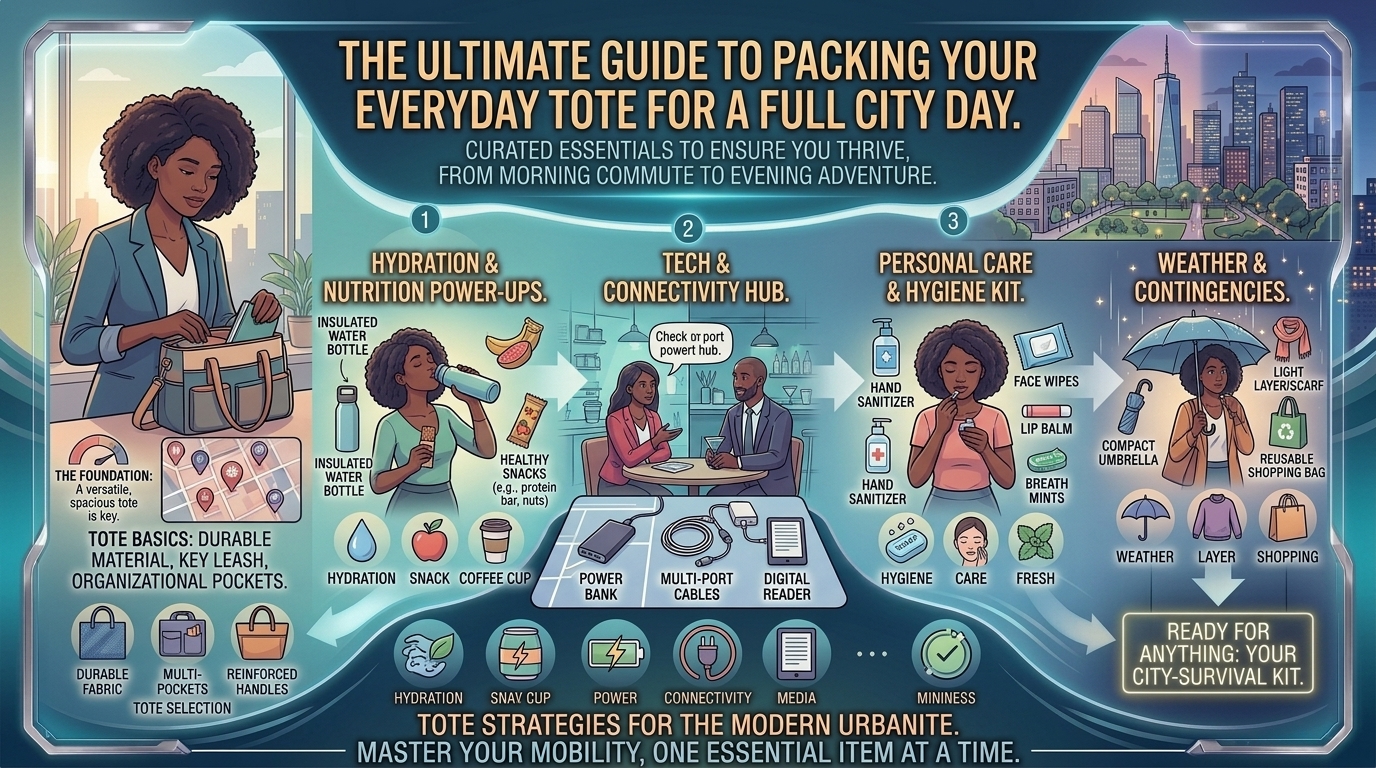
Divide your daily tote contents into four strategic functional categories to ensure you are ready for any urban emergency.
1. Technology and Power (Keeping the Digital Lifeline Alive)
In a modern metropolis, your smartphone is your transit pass, map, wallet, and communication lifeline. Running out of battery is not an inconvenience; it is a logistical emergency.
- Slim Power Bank & Cords: Pack a compact, high-capacity portable power bank along with a durable braided charging cable.
- Wired Earbuds / Backup Audio: Even if you love wireless AirPods, keep a cheap pair of wired earbuds tucked away. If your Bluetooth dies or interference cuts out on the subway, you’ll still have reliable audio or phone-call capability.
2. Weather Defense (Conquering Microclimates)
As explored in our urban style guides, city weather changes on a dime. Your tote must account for the elements.
- Compact Windproof Umbrella: Skip the flimsy dollar-store umbrellas that invert at the first gust of wind. Invest in a heavy-duty, compact, wind-resistant travel umbrella.
- Packable Shell or Layer: A lightweight, foldable rain shell or a compressed merino wool scarf takes up minimal space but saves you from freezing during temperature drops.
3. Personal Wellness and Grooming (The 12-Hour Freshness Kit)
Long days out in the city expose you to pollution, dust, stress, and fatigue. Keep your personal maintenance kit compact and efficient:
- Hydration: A lightweight, reusable insulated water bottle. Dehydration accelerates urban exhaustion and headaches.
- Health & First Aid: Travel pack of tissues, hand sanitizer, breath mints, eye drops (essential for subway dust and screen strain), and a small blister-bandage pack for sudden shoe chafing.
- Fuel: A clean, high-protein snack (like raw almonds or a high-end protein bar) to prevent midday blood sugar crashes when meetings run long.
4. Security and Administrative Essentials
- The Physical Backup: Always keep a physical transit card or emergency cash ($20 bill tucked away in a hidden zipper pocket). Digital Apple Pay is fantastic until your phone battery dies or a payment terminal glitches at the turnstile.
- Reusable Grocery / Market Pouch: Fold up a ultra-light nylon reusable bag (like a Baggu). You never know when you’ll need to stop at a fresh market or pick up groceries on your way home.
Part 3: Ergonomics and Weight Distribution (Protecting Your Spine)
Carrying a heavy tote bag improperly on one shoulder for years can lead to asymmetrical muscle strain, neck tension, and chronic posture issues. Protect your physical health with these ergonomic rules:
1. The Weight Audit Rule
Every Friday afternoon, empty your tote bag completely. You will be shocked by how much digital debris, crumpled receipts, empty wrappers, and redundant items have accumulated during the week. Reset to a clean baseline.
2. Strategic Placement of Weight
Place heavy items (like your laptop, battery pack, and water bottle) at the bottom center of the bag directly against your hip line, rather than higher up or leaning to one side. This keeps your center of gravity stable while walking and minimizes shoulder torque.
Part 4: Frequently Asked Questions (FAQ)
1. What is the best material for an everyday urban tote bag?
Heavyweight waxed canvas or full-grain leather are the gold standards. They offer superior water resistance, structural durability, and age gracefully through years of daily city wear and tear.
2. How do I stop my tote bag from turning into a messy black hole?
Use modular internal organization pouches. Group your tech accessories in one small pouch, cosmetics in another, and keys/wallet in a zippered side pocket. This eliminates digging around blindly on a crowded subway.
3. Is a tote bag better than a backpack for city commuting?
It depends on your daily load. Tote bags offer faster access, look sharper for professional and social settings, and fit easily between your legs on crowded trains. Backpacks are better for heavy athletic gear or laptops exceeding 16 inches.
4. How do I protect my laptop inside an open-top tote bag?
Always slide your laptop into a dedicated padded laptop sleeve before placing it into your tote. Open-top totes leave devices vulnerable to sudden impacts or liquid spills if something leaks inside your bag.
5. What emergency items do long-term city residents always keep in their bags?
Experienced urbanites always carry a $20 bill, a backup phone charger, blister bandages, a compact umbrella, and hand sanitizer. These five items solve 90% of sudden city inconveniences.
6. How heavy should my everyday tote bag be?
As a general rule of thumb, your loaded everyday bag should never exceed 10% to 15% of your total body weight to prevent shoulder and spinal strain during long walking commutes.
7. How do I clean and maintain a canvas or leather tote bag?
For canvas, spot-clean stains with mild soap and cold water, and re-wax periodically if it’s waxed canvas. For leather, condition it twice a year with quality leather balm to prevent cracking from urban pollution and sun exposure.
8. Are open-top tote bags safe from pickpockets in crowded transit?
In hyper-dense crowds or tourist hubs, open-top totes present minor security risks. Look for tote bags that feature a secure top zipper or a magnetic snap closure to protect your wallet and phone.
9. How do I keep my water bottle from leaking inside my bag and ruining electronics?
Invest in a 100% leak-proof insulated water bottle (such as Hydro Flask with a locking lid or Klean Kanteen), and always store it upright in a dedicated interior side pocket or sleeve.
10. Can a tote bag transition smoothly from daytime office work to evening social dinners?
Yes. Choosing a minimalist, structured leather or black canvas tote with clean architectural lines ensures it looks just as appropriate at a corporate boardroom meeting as it does at a trendy downtown wine bar.
Conclusion
Surviving a full day out in a fast-paced metropolis requires more than just ambition—it requires tactical preparation. By upgrading to a durable structured tote, mastering modular internal organization, packing essential tech and weather armor, and maintaining proper ergonomic weight distribution, you transform your daily bag into an invincible mobile survival kit. Own your day, stay prepared for anything, and conquer the city on your own terms.
What’s in My Everyday City Tote Bag: Ultimate Urban Carry Guide
Watch this insightful video walkthrough breaking down the ultimate everyday carry items, bag organization hacks, and gear essentials for surviving a full day out in the city.