Welcome to nyattitude.com, your premier digital bridge connecting ambitious urbanites across Texas, New York, California, Washington, and San Francisco.
There is a distinct cinematic buildup that precedes moving to New York City. Whether you are packing up a sun-soaked apartment in San Francisco, leaving behind the wide-open highways of Texas, escaping the misty tech-heavy cadence of Seattle, or making a localized hop from upstate, you think you know what you are getting into. You have seen the skyline in movies. You have romanticized the hustle.
But nothing—absolutely nothing—prepares you for the sensory overload of your actual first week living in New York City.
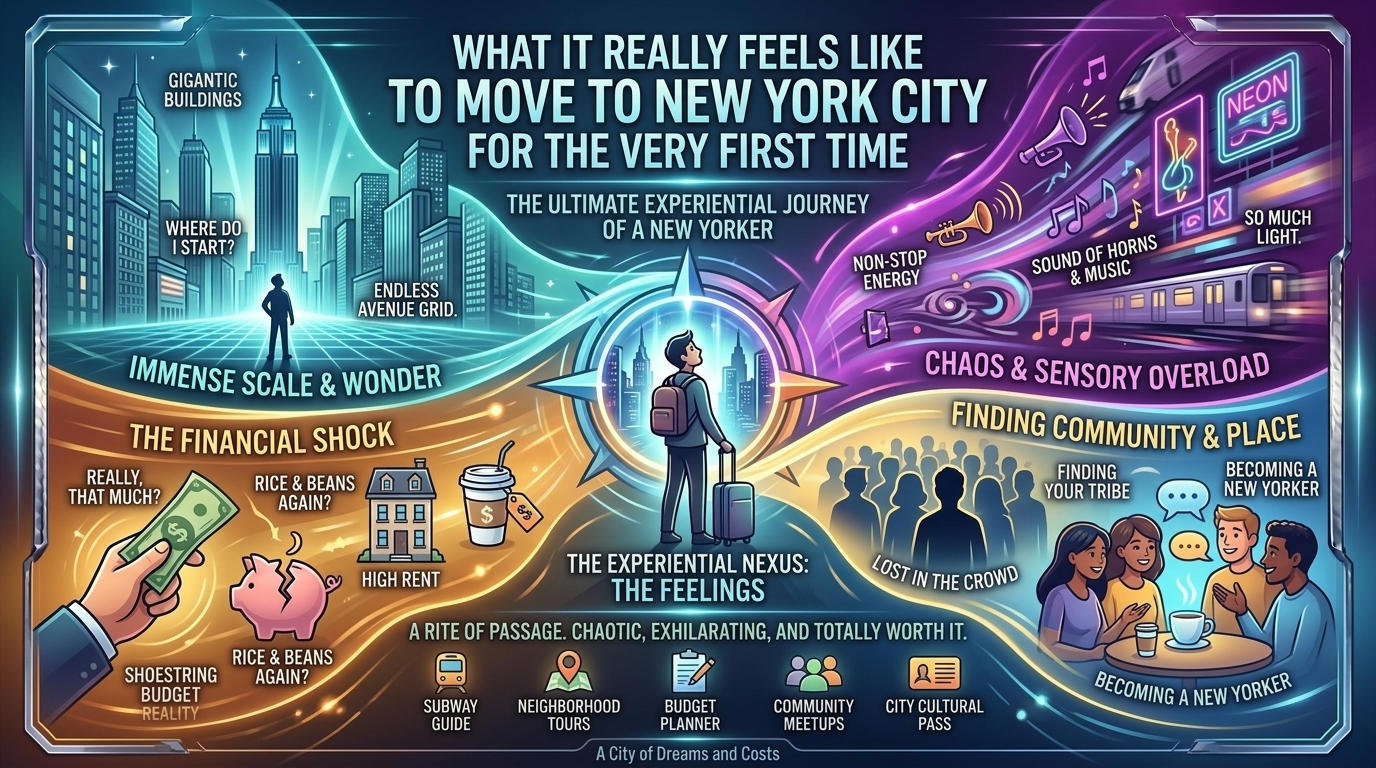
Moving to NYC for the very first time is not merely a geographic relocation; it is a full-scale psychological transformation. It is a collision of the highest highs, the most exhausting lows, and an awakening that changes how you view yourself and the world forever.
1. The Arrival: Sensory Overload and the First-Day Shock
The moment your moving truck or taxi drops you off at your new doorstep, the city announces itself loudly.
Coming from spacious states like Texas or Washington, your brain struggles to process the density. The verticality of the buildings blocks out sections of the sky, casting long geometric shadows. The noise is constant—a symphony of honking yellow cabs, blaring sirens, construction jackhammers, and the overlapping chatter of millions of pedestrians.
- The Scale Shock: Your apartment will likely look smaller than you imagined. Rooms that look cozy on a FaceTime walkthrough suddenly feel intensely compact when your suitcases and boxes are piled inside.
- The Pace: You will immediately notice that everyone around you is walking with absolute purpose. Pedestrians weave past you like water flowing around a rock. Within forty-eight hours, you will find yourself unconsciously speeding up your stride just to keep from being trampled.
2. Navigating the Concrete Labyrinth: Your First Subway Ride
For newcomers, the New York City subway system is an intimidating rite of passage. It is an underground maze of tiled walls, screeching rails, and complex color-coded lines.
+--------------------------------------------------------------------------+
|                     FIRST-TIMER SUBWAY SURVIVAL RULES                    |
+--------------------------------------------------------------------------+
|  1. Know your direction: Check if the train is Uptown or Downtown.       |
|  2. Have your OMNY tap or MetroCard ready BEFORE reaching the turnstile.  |
|  3. Stand to the right on escalators. Walk on the left.    |
+--------------------------------------------------------------------------+
Your first few weeks will involve missing stops, boarding an express train when you needed a local, and staring blankly at route maps while seasoned commuters sigh behind you. Do not take it personally. Getting lost on the subway is a universal New York initiation rite. Once you master the rhythm of the lines, the city unlocks itself to you, transforming from a confusing puzzle into an interconnected web of endless neighborhood possibilities.
3. Redefining Home: Living Small and Loving It
In places like California or Texas, your home is typically your sanctuary—a spacious refuge where you stretch out. In New York, your apartment is essentially a high-end storage unit and sleeping quarters.
New Yorkers quickly adopt a lifestyle of outsourcing their living space:
- Your corner bodega becomes your pantry.
- Your favorite neighborhood coffee shop is your remote office.
- The local park is your oversized backyard.
- The bustling neighborhood pub or restaurant row serves as your living room for entertaining.
Learning to live with less is surprisingly liberating. You stop buying unnecessary material goods because every square inch of physical space carries a high emotional and financial rent value.
4. The Social Shift: High Ambition and Rapid Bonding
One of the most striking emotional aspects of moving to NYC is the intensity of the social fabric. Everyone here is chasing something—an artistic breakthrough, a corporate milestone, a creative reinvention, or simply a fresh start.
- Instant Connections: Because everyone is sharing this intense, high-pressure environment, you can bond with strangers remarkably fast. A conversation sparked at a local coffee shop or laundry mat can turn into a deep friendship.
- Fierce Schedules: Conversely, getting people on your calendar requires military-style precision. New Yorkers are exceptionally busy, and social fatigue is real. Finding your core community takes active effort, patience, and a willingness to step out to events alone.
5. Developing “New York Armor”
You cannot survive your first year in New York with a thin skin. The city forces you to develop what locals call New York armor.
You learn how to maintain laser focus on the sidewalk, gracefully decline street petitioners without breaking stride, and brush off blunt interactions with service workers or landlords. This perceived roughness is rarely personal; it is simply a byproduct of an energetic ecosystem where time is fiercely protected. Beneath that tough exterior, however, you will find an underlying community of deeply kind, fiercely loyal neighbors who will help you carry a heavy couch up a five-story walk-up without hesitation.
10 Frequently Asked Questions (FAQ)
1. How does the reality of moving to NYC compare to what you see in media?
Media often portrays NYC as a glamorous playground of sprawling Manhattan penthouses and effortless romance. The reality is grittier, louder, and smaller-scale, but it is infinitely more authentic, rewarding, and culturally rich.
2. Is it normal to feel lonely during the first month in New York?
Completely normal. The contrast between being surrounded by millions of people and feeling internally isolated can trigger intense waves of homesickness during your first 30 to 60 days.
3. How long does it take for NYC to finally feel like “home”?
Most long-term residents agree that it takes anywhere from 6 months to 2 full years to stop feeling like a tourist and truly adapt to the city’s complex emotional and physical rhythms.
4. What is the biggest physical surprise for first-time movers?
The sheer amount of walking. You will easily log 10,000 to 15,000 steps a day just running ordinary errands, making comfortable walking shoes your most vital wardrobe investment.
5. How do I handle the overwhelming noise at night when trying to sleep?
Invest in a high-quality white noise machine, thick blackout curtains, and comfortable earplugs. Over time, your brain naturally learns to filter out standard street sounds like sirens and distant traffic.
6. Are New Yorkers really as rude as people say they are?
No. New Yorkers are direct, fast-moving, and intolerant of wasted time, which outsiders often misinterpret as rudeness. In an emergency or when asking for directions, locals are usually remarkably helpful.
7. What should I pack or bring when moving into my first NYC apartment?
Pack light. Prioritize multi-functional furniture, space-saving organizers, weather-appropriate gear for humid summers and freezing winters, and absolute essentials for your first night.
8. How do I make friends when I don’t know anyone in the city?
Join run clubs, community volunteering groups, alumni associations, creative co-working spaces, or neighborhood hobby meetups. Consistently showing up to the same local spots is key.
9. What is the hardest adjustment coming from a car-centric state like Texas or California?
Giving up personal vehicular freedom. Transitioning to carrying your groceries home by hand or navigating public transit in the rain requires a major mindset adjustment.
10. How do I know if New York is actually right for me?
If you find yourself energized rather than broken down by the daily chaos, if you love discovering hidden corners of the metropolis, and if the city’s high highs outweigh its frustrating lows, then New York has successfully claimed you.
Conclusion
Moving to New York City for the very first time is an emotional rollercoaster unlike any other experience in modern life. It tests your resilience, shrinks your physical footprint, stretches your financial boundaries, and magnifies your personal ambitions. Yet, for all its grit and friction, it rewards you with an unmatched level of cultural vibrance, independence, and personal growth. Whether you came from San Francisco, Seattle, Austin, or anywhere beyond, surviving your initial chapter means you possess the grit to carve out your own unique space in the capital of the world. Welcome to New York—take a deep breath, lace up your walking shoes, and dive in.
Are you preparing for your first big move to New York City from Texas, California, Washington, or San Francisco, and what aspect of the transition makes you the most nervous?