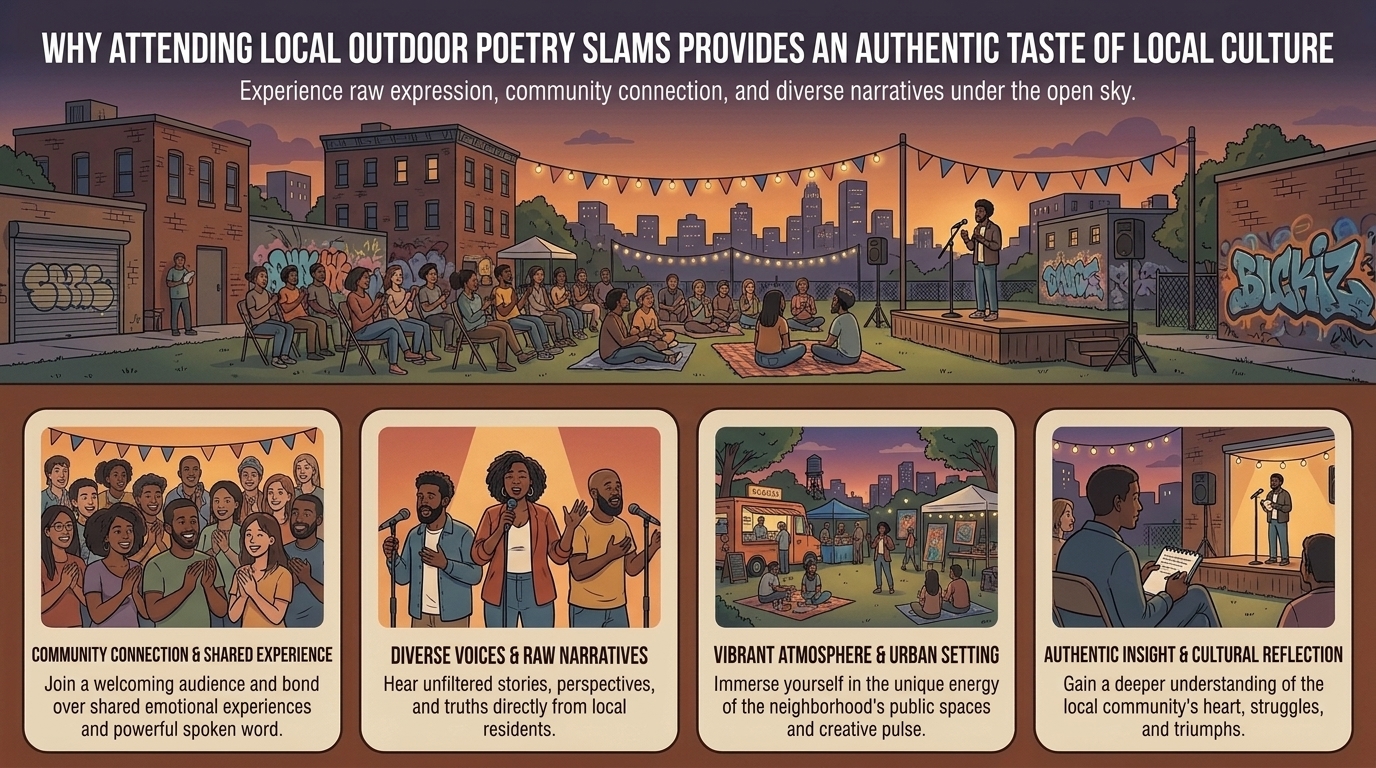
Culture cannot always be found tucked neatly behind the glass panes of downtown museums or listed on the curated brochures of corporate tourism boards. True culture—raw, pulsating, and unfiltered—lives on city park steps, under the amber glow of string lights in community gardens, on coastal boardwalks, and within the chaotic, beautiful open-air circles of local outdoor poetry slams.
From the sun-soaked public plazas of California and the foggy, maritime hills of San Francisco, to the historic stoops of New York, the sprawling creative enclaves of Washington, and the vibrant street-level artistic hubs of Texas, regional identity is spoken aloud. It is breathed into microphones, echoed against concrete walls, and shared among strangers sitting side-by-side on lawn chairs, picnic blankets, and curbs.
For travelers, culture-seekers, and modern urbanites alike, attending a local outdoor poetry slam offers a rare portal into the heartbeat of a community. Unlike commercialized entertainment venues designed to sanitize and package experiences for mass consumption, an outdoor poetry slam invites you into a direct, unfiltered dialogue with the people who inhabit the city. This comprehensive guide explores why stepping out into the open air to listen to local verse is the ultimate way to taste the authentic culture of America’s most dynamic regions.
1. The Anatomy of an Outdoor Poetry Slam: What Makes It Unique?
To understand why outdoor poetry slams are cultural treasures, one must first understand the format itself. A poetry slam is a competitive art form where poets perform original spoken-word pieces, usually restricted to a strict three-minute time limit. There are no props, no costumes, and no musical accompaniments allowed—just the naked power of the human voice, rhythm, body language, and raw emotion.
When you move this dynamic art form outdoors, the entire atmosphere transforms:
- Organic Acoustics: The sound of a voice competing with city traffic, rustling tree leaves, or distant ocean waves creates an electric, grounded ambiance.
- Fluid Boundaries: Traditional indoor venues have strict door policies and ticket barriers. Outdoor slams in public parks or plazas bleed into the surrounding city, allowing curious passersby, neighborhood locals, and regular commuters to drift into the circle.
- Zero Pretense: Stripped of velvet theater seats and dim, engineered lighting, outdoor venues level the playing field. The millionaire tech worker from San Francisco sits right next to the working-class student from Texas or the long-term resident of New York, sharing the exact same patch of grass.
2. A Window Into Regional Identity: Coast to Coast
Every major region possesses a distinct linguistic rhythm, political climate, and cultural nuance. Outdoor poetry slams act as localized barometers, capturing the zeitgeist of their specific geography.
The Pulse of New York and Washington
In New York, outdoor poetry circles in spots like Washington Square Park or community gardens carry the relentless, breakneck tempo of the metropolis. The verses are sharp, unapologetically fast, and deeply tied to themes of immigration, survival, hustle, and the structural complexities of urban coexistence. Meanwhile, moving down to Washington, the open-air readings often blend civic critique with poetic activism. Set against the backdrop of institutional power, Washington’s outdoor mics provide a platform for federal workers, activists, and local youth to voice dissent, equity, and human rights.
The Vibe of California, San Francisco, and Texas
On the West Coast, the culture shifts toward sensory immersion and philosophical exploration. San Francisco outdoor poetry echoes a deep historical legacy of the Beat Generation and radical free speech. From Golden Gate Park to Mission District corners, poets weave themes of tech displacement, environmentalism, and maritime melancholy into their stanzas. Broadening out to the rest of California, the poetic landscape expands to include Latinx storytelling, surf culture, and the immigrant experience.
Down south in Texas, outdoor slams—frequently found in cities like Austin, Houston, and Dallas—combine southern hospitality with fierce regional pride. Texas poetry often wrestles with vast landscapes, shifting demographics, economic booms, and the juxtaposition of wide-open spaces with modern metropolitan expansion.
3. Why Local Outdoor Poetry Slams Outperform Traditional Tourism
If your goal is to experience the true flavor of a city, traditional tourist traps will often leave you with a homogenized perspective. Here is how outdoor poetry slams offer a superior cultural immersion:
| Traditional Tourism | Local Outdoor Poetry Slams |
| Commercialized, scripted, and catered to visitors. | Rooted entirely in local realities, struggles, and triumphs. |
| Passive observation (museums, monuments, tour buses). | Active community participation and emotional co-presence. |
| Cost-heavy admission fees and ticket lines. | Frequently free or low-cost donations hosted in public spaces. |
| Isolated from everyday neighborhood life. | Deeply embedded in neighborhood parks, plazas, and community centers. |
When you listen to a local poet speak about gentrification in East Austin, the fog rolling over the Golden Gate, or the midnight subway rides in Brooklyn, you are absorbing historical and sociological data wrapped in visceral art. You learn what keeps the city up at night and what makes its people proud.
4. Practical Tips for Attending Your First Outdoor Poetry Slam
If you are ready to dive into the vibrant world of outdoor spoken-word poetry, a little preparation goes a long way. Use these actionable tips to maximize your experience:
- Check Local Event Calendars: Look up local poetry organizations, independent bookstores, and community arts councils in cities like San Francisco, Seattle, New York, or Austin. Platforms like local poetry collectives often post pop-up park schedules on social media.
- Bring Comfortable Seating: Outdoor venues rarely have cushioned seating. Pack a light folding camp chair, a durable picnic blanket, or a cushion to sit comfortably on concrete steps or grass.
- Dress in Layers: Weather—especially in coastal regions like Washington and Northern California—can shift rapidly once the sun dips below the horizon. Always bring a light jacket or sweater.
- Support the Artists and Organizers: Many outdoor slam series operate on donations, tip jars, or merch sales. Buy a chapbook, drop a few dollars into the digital or physical tip jar, and support the local creative economy.
- Participate in Audience Responses: Poetry slams are interactive. Don’t be afraid to snap your fingers, clap, cheer, or groan in empathy. The energy you give back to the circle directly impacts the performance quality.
- Respect the Space: Remember that public parks and outdoor plazas are shared spaces. Pack out whatever trash you bring, respect local noise ordinances, and honor the emotional boundaries of vulnerable performances.
5. Ten Frequently Asked Questions (FAQ)
1. What exactly is a poetry slam?
A poetry slam is a live, competitive poetry performance where poets share original work and are judged on a numerical scale by randomly selected members of the audience.
2. Are outdoor poetry slams free to attend?
Most outdoor community slams held in public parks, plazas, or community gardens are completely free to attend, though donations to support the hosting organizations or featured poets are highly encouraged.
3. Do I need to register or buy tickets in advance?
Generally, no. Because outdoor slams often take place in open public spaces, you can simply show up, find a spot on the grass or a bench, and enjoy the show.
4. Can anyone sign up to perform at an open-air mic?
Yes! Most outdoor slams feature an open-mic portion prior to the main competition. Sign-ups usually happen on-site on a first-come, first-served basis, so arriving early is recommended.
5. What should I bring with me to an outdoor poetry event?
Bring a picnic blanket or portable chair, layered clothing for shifting weather, water, a notebook if you feel inspired to write, and a bit of cash to tip the performers or buy independent poetry books (chapbooks).
6. Are outdoor poetry slams kid-friendly?
It depends on the specific venue and event. While many community-focused afternoon slams are family-friendly, evening slams often feature mature themes, explicit language, and deep emotional confessions intended for adult audiences. Check the event description beforehand.
7. How are the winners chosen at a slam?
Audience members are chosen at random to act as judges. They hold up scorecards ranging from 0 to 10 based on both the writing quality and the performance delivery of the poet.
8. What happens if it rains or bad weather hits?
Outdoor poetry organizers usually have a rain backup plan—either shifting the event indoors to a partner coffee shop, bookstore, or community center, or rescheduling for the next clear evening. Check the organizers’ social media pages for weather updates.
9. Why are outdoor slams considered more “authentic” than indoor theater shows?
Outdoor slams remove corporate gatekeeping and expensive ticket barriers. They take place in the physical neighborhoods they represent, allowing for spontaneous community interaction and a raw, unpolished connection between artist and audience.
10. How can I find local outdoor poetry events in cities like New York, San Francisco, or Texas?
You can search local community calendars, follow regional poetry collectives on Instagram or Facebook, check local independent bookstores, or look for community garden event listings in major urban centers.
Conclusion
Local outdoor poetry slams are far more than just casual weekend entertainment; they are the living, breathing archives of our modern communities. By stepping away from standardized tourist attractions and sitting down on a patch of park grass in Texas, New York, California, Washington, or San Francisco, you open yourself up to an unfiltered cultural exchange.
You hear the triumphs, grievances, and everyday realities of local residents spoken in their truest voices. The next time you travel or want to deepen your connection to your own region, seek out the string lights in the park, listen for the snap of fingers in the evening air, and let an outdoor poetry slam give you an authentic taste of local culture.
Looking for more guides on local culture, hidden urban gems, and authentic travel experiences? Explore the rest of nyattitude.com for your next neighborhood adventure!