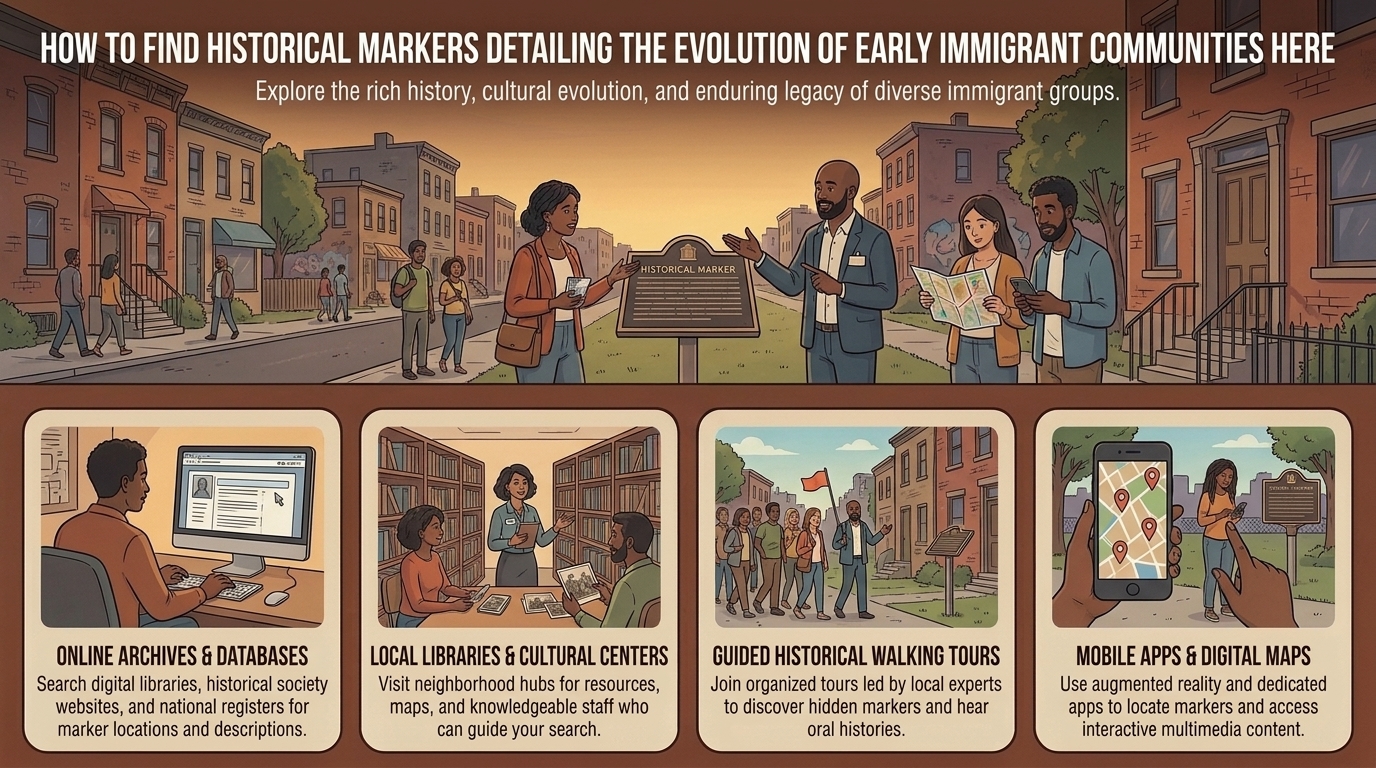
The story of America is, at its core, a mosaic of movement. Long before modern transit crisscrossed the continent, generations of voyagers, laborers, refugees, and dreamers crossed oceans and borders to carve out new lives. They settled in neighborhoods that would eventually grow into the cultural powerhouses we know today. Yet, the physical reminders of these foundational communities—the bronze plaques, cast-iron panels, and stone monoliths embedded in sidewalks and park corners—often slip by unnoticed by the hurried commuter.
From the historic European and Asian enclaves of New York and San Francisco to the borderlands and maritime gateways of Texas, California, and Washington, historical markers act as silent witnesses to the evolution of early immigrant communities. Locating these markers is more than an academic exercise; it is an intimate way to walk through living history, uncovering the struggles, triumphs, cultural fusions, and architectures that built our modern cities.
Whether you are a local resident wanting to understand your block’s heritage or a cultural traveler looking to explore beneath the surface gloss of a region, this comprehensive guide provides the blueprint for finding and interpreting the historical markers that document early immigration.
1. Why Early Immigrant Markers Matter for Local Culture
Historical markers do much more than simply date a building or memorialize a static event. They map the complex social geography of the past. Early immigrant communities rarely settled randomly; they clustered around ports of entry, industrial hubs, and affordable housing stock, creating micro-cultures that eventually altered the broader identity of the state.
- Mapping Cultural Corridors: Markers highlight how neighborhoods shifted from working-class ethnic enclaves into vibrant cultural districts.
- Preserving Lost Architectures: Many markers stand where tenements, social halls, immigrant aid societies, and houses of worship once stood, preserving memories of buildings lost to urban renewal.
- Humanizing Statistics: Reading a plaque dedicated to a specific mutual-aid society in Texas or a historic boarding house in San Francisco transforms macro-level immigration history into deeply human, local stories.
2. Region-by-Region Breakdown: Where Immigration History Lives
Different regions of the United States experienced immigration waves driven by distinct geographical, economic, and political factors. Knowing where to look geographically makes finding the relevant markers much easier.
New York and San Francisco: The Iconic Gateways
As primary historical ports of entry on opposite coasts, New York and San Francisco are dense with immigration markers.
- New York: Look around Lower Manhattan, Ellis Island, the Lower East Side, and early borough outposts. Markers here frequently highlight European immigration waves (Irish, Italian, German, Jewish, Eastern European) alongside early Caribbean and Asian communities. They detail tenement life, labor unions, and settlement houses like the Henry Street Settlement.
- San Francisco: Centered around the Pacific rim, San Francisco’s markers heavily document Asian immigration—most notably through sites connected to the Angel Island Immigration Station legacy—as well as waves of Latin American, Italian, and Basque settlers who shaped the Bay Area’s culinary and social fabric.
Texas, California, and Washington: Borderlands, Pacific Coasts, and Frontier Expansion
- Texas: Texas markers heavily reflect complex Spanish, Mexican, German, Czech, and later Asian and Middle Eastern migrations. Look across historical county seats, the Texas Gulf Coast (such as Galveston, a major historical port of entry), and border towns where Tejano and Mexican roots run deep.
- California: Beyond San Francisco, California’s vast interior valleys and southern expanses feature markers dedicated to Chinese railroad workers, Japanese agricultural pioneers, Filipino farmworkers, and Mexican settlers who transformed the state into an agricultural and technological giant.
- Washington: In the Pacific Northwest, markers across Washington state uncover Scandinavian logging communities, early Japanese and Chinese fishing and canning villages along Puget Sound, and waves of immigrants who built the region’s foundational timber and maritime industries.
3. Top Digital Databases and Tools to Locate Markers
You don’t have to wander blindly down city streets hoping to stumble upon a plaque. A robust network of digital archives and crowdsourced maps allows you to scout historical markers from your home before hitting the pavement.
| Tool / Resource | What It Covers | Best For |
| The Historical Marker Database (HMDB.org) | A searchable, global registry of historical markers with exact GPS coordinates and text transcriptions. | Pinpointing exact marker text and mapping weekend walking tours. |
| State Historical Commission Atlases (e.g., Texas Historical Sites Atlas) | Official state-vetted databases tracking registered historical subject markers and medallions. | Finding official state-sanctioned markers grouped by cultural or ethnic themes. |
| National Register of Historic Places (NRHP) Maps | Interactive federal maps plotting historic districts, buildings, and sites. | Locating entire historic immigrant neighborhoods rather than isolated plaques. |
| The William G. Pomeroy Foundation Map | Focuses heavily on markers tied to historic transportation, canals, and immigrant settlement history. | Discovering community-funded markers that emphasize local ethnic heritage. |
4. Step-by-Step Guide: How to Track Down Obscure Immigrant Markers
If you want to unearth markers that aren’t featured on standard tourist maps, follow this practical workflow:
- Leverage Keyword Filters: When using databases like HMDB or state atlases, use targeted keyword searches such as “Immigrant,” “Mutual Aid,” “Colony,” “Ethnic,” “Refugee,” or specific nationalities (“German,” “Chinese,” “Italian,” “Mexican”) alongside your target city name.
- Consult Local Historical Societies: Municipalities and county historical societies often maintain specialized walking tour pamphlets that commercial apps miss. Check their digital archives for PDF guides on ethnic history.
- Trace Old Transportation Routes: Immigrants settled where they could find work. Look for markers along historical rail lines, mid-19th-century wharf areas, and early industrial districts.
- Use Street View Proactively: Once you find coordinates on a marker database, drop into digital street views to check the physical context—confirming whether the marker is mounted on a surviving historic building, a modern park wall, or a redeveloped plaza.
- Keep an Eye Out for Subsidiary Plaques: Remember that corporate or private buildings often bear secondary plaques detailing the immigrant labor or previous ethnic institutions that once occupied that exact soil.
5. Ten Frequently Asked Questions (FAQ)
1. What is the best website to find historical markers online?
The Historical Marker Database (HMDB.org) is widely considered the most comprehensive, user-generated searchable directory containing thousands of transcribed markers and GPS coordinates across all 50 states.
2. Are historical markers maintained by the federal government?
Not usually. Most markers are erected and maintained by state historical commissions, local municipal governments, county historical societies, or private non-profit foundations.
3. How can I find markers specifically related to immigrant history in Texas?
You can use the Texas Historical Commission’s online Texas Historic Sites Atlas or explore their curated thematic mapping guides, which break down markers by Hispanic, Asian, and African American historical heritage.
4. Do historical markers provide full details about immigrant struggles?
Historically, older markers tended to gloss over systemic hardships. However, modern marker programs (particularly those established over the last two decades) increasingly focus on providing nuanced, accurate depictions of labor exploitation, discrimination, and cultural resilience.
5. Can I contribute new markers I find to public databases?
Yes! Platforms like HMDB allow local history enthusiasts to upload photos, update missing information, and submit newly discovered or unlisted markers to their public registry.
6. How do I find immigrant markers in dense cities like New York or San Francisco?
The best approach is to focus on specific historic neighborhoods—such as Chinatown, the Lower East Side, or North Beach—and cross-reference local walking-tour maps provided by city libraries or preservation alliances.
7. Are there mobile apps available for marker hunting?
While many databases are mobile-optimized for web browsers (like HMDB’s “Near Me” feature), you can also plug coordinates directly into Google Maps or Apple Maps to build a custom walking tour route.
8. What should I do if a historical marker appears missing or damaged?
You can report missing markers through the “Correct This Page” feature on databases like HMDB, and notify the local county historical society so they can assess whether the plaque needs restoration or replacement.
9. Do I need permission to visit historical markers?
Most markers are placed on public property, public sidewalks, parks, or exterior building facades accessible from the street, requiring no special permission to view or photograph.
10. How can I research the history behind a marker once I find it?
Take a photo of the marker text, note the sponsoring organization, and use local library archives, census data, or digitized historical newspapers (such as Chronicling America) to dive deeper into the individuals and groups named on the plaque.
Conclusion
Uncovering the historical markers that detail the evolution of early immigrant communities is an active way to connect with the soul of a city. Whether you are traversing the bustling streets of New York and San Francisco or exploring the rich cultural crossroads of Texas, California, and Washington, these metal and stone markers hold the blueprint of our collective identity. By utilizing digital databases, exploring local archives, and stepping out onto the pavement with curiosity, you give voice to the generations who built the communities we cherish today.
Ready to uncover more hidden histories, local cultural guides, and urban explorations? Continue browsing nyattitude.com to fuel your next journey of discovery!