In the modern professional arena, we live in a culture that relentlessly fetishizes hustle. We wear our exhaustion like a badge of honor, measure productivity in raw hours logged, and treat burnout as a standard initiation rite for anyone chasing elite success. Nowhere is this more pronounced than in America’s most demanding metropolitan epicenters.
Whether you are underwriting multi-million-dollar deals in the financial canyons of New York, shipping disruptive code in the fast-paced tech hubs of San Francisco, scaling ventures across the expansive markets of California, drafting critical policies in the institutional corridors of Washington, or driving rapid economic growth throughout Texas, high-pressure careers demand a heavy toll.
Yet, while most professionals carefully manage their financial capital, their calendars, and their professional networks, they recklessly squander their most finite, precious resource: mental energy.
Mental energy is the cognitive and emotional fuel that powers your focus, creativity, emotional regulation, and decision-making capacity. When your mental energy is depleted, your performance plummets, your relationships strain, and burnout takes hold. This comprehensive guide explores the deep science of mental energy, why high-pressure urban careers drain it so rapidly, and actionable, battle-tested strategies to protect, replenish, and optimize your psychological reserves.
1. The Psychology and Neuroscience of Mental Energy
Unlike physical energy—which typically restores itself after a meal and a good night’s sleep—mental energy is deeply tied to cognitive processing limits, emotional regulation, and neural fatigue.
- Decision Fatigue: Coined by social psychologist Roy Baumeister, decision fatigue explains that the brain’s capacity to make sound choices is a finite resource. Every email answered, meeting navigated, and strategic problem solved depletes your prefrontal cortex. By the end of a high-pressure workday, your ability to make rational choices is severely compromised.
- The Cost of Context Switching: In modern careers, we rarely focus on a single task. We toggle between Slack messages, urgent client calls, spreadsheets, and meetings. Each switch forces your brain to pay a “cognitive switching tax,” draining mental glucose and exhausting your neural pathways.
- Emotional Labor: High-pressure environments require constant emotional regulation—managing difficult stakeholders, masking frustration, projecting unshakeable confidence, and absorbing corporate or creative stress. Emotional labor is one of the fastest routes to cognitive depletion.
2. Regional Landscapes of Pressure: Coast-to-Coast Energy Drains
Different metropolitan regions cultivate distinct professional cultures, meaning the specific threats to your mental energy vary depending on where your career is anchored:
New York and San Francisco: Velocity, Pace, and Constant Connectivity
- New York: The mental energy drain in New York is primarily driven by relentless velocity and auditory-visual density. The city never stops, and the cultural expectation to be “always on” can make disconnecting feel like professional negligence.
- San Francisco: In the Bay Area, mental fatigue often stems from the blurring lines between work and life. In tech-driven cultures, the expectation to obsess over your startup or product 24/7 can lead to chronic cognitive overload and sleep deprivation.
Texas, California, and Washington: Growth, Scale, and Bureaucracy
- California: Across broader California, professionals balancing creative output, entertainment demands, or fast-paced biotech environments often struggle with boundary fatigue in sunlit cultures that promote perpetual motion.
- Texas: In booming Texas economic centers like Austin, Dallas, and Houston, rapid expansion and high-stakes entrepreneurial scaling create an environment where the pressure to out-hustle the competition can quickly lead to exhaustion.
- Washington: In the Pacific Northwest, mental energy is often taxed by complex institutional environments, intense policy analysis, and managing high-stakes stakeholder alignment across government and private sectors.
3. The Core Pillars of Mental Energy Protection
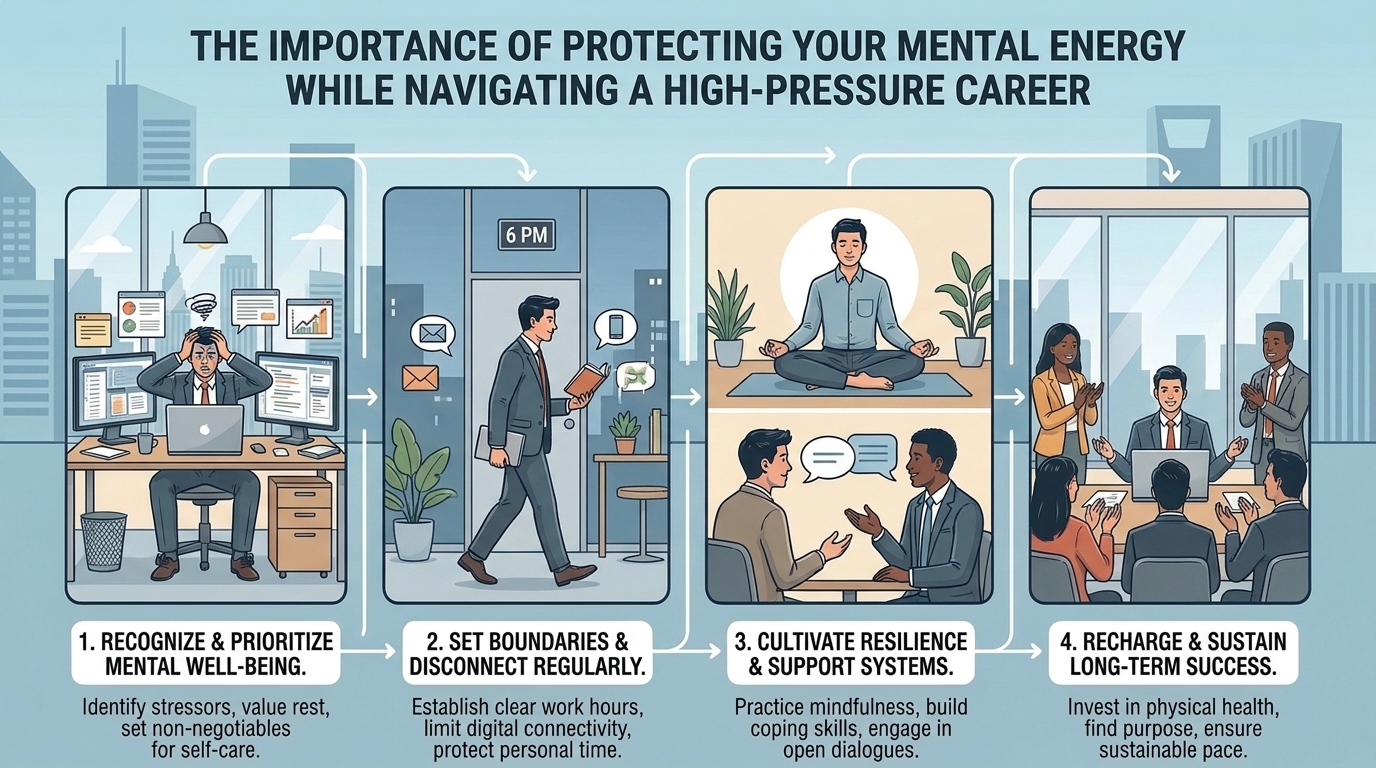
Protecting your mental energy is not about working less; it is about managing your cognitive bandwidth with surgical precision. Implement these core pillars:
| Protection Pillar | Tactical Execution | Professional Benefit |
| Radical Boundary Setting | Establish hard digital and temporal cut-off times (e.g., no work emails after 8:00 PM). | Prevents your nervous system from remaining in a chronic “fight-or-flight” stress loop overnight. |
| Energy Auditing | Track which tasks, meetings, or people drain your energy versus which ones energize you over a two-week period. | Empowers you to delegate, eliminate, or restructure low-value, high-drain commitments. |
| Cognitive Decompression | Schedule mandatory micro-breaks (5–10 minutes every two hours) devoid of screens, scrolling, or input. | Allows the brain’s default mode network to process information and replenish neurotransmitters. |
| Physical Movement Anchors | Integrate rigorous physical exercise, walking meetings, or breathwork into your daily schedule. | Flushes cortisol and adrenaline from your bloodstream, resetting your baseline stress tolerance. |
4. Step-by-Step Blueprint: Designing an Energy-Preserving Daily Routine
To safeguard your cognitive reserves while pursuing an ambitious career, you must structure your day around energy management rather than mere time management. Use this four-step blueprint:
- Protect Peak Cognitive Hours: Identify your biological prime time—the 2 to 3-hour window each day when your mental clarity and focus are at their absolute peak (typically mornings for most people). Reserve this window exclusively for your highest-leverage, most demanding work. Do not check email or attend meetings during this time.
- Implement the “Transition Ritual”: When wrapping up your workday—whether in a downtown office or a home workspace—create a physical or psychological boundary that signals to your brain that work is over. This could be a 20-minute walk, changing clothes, or writing a tomorrow-morning action list so your subconscious can let go.
- Audit Your Calendar Ruthlessly: Treat your calendar like a financial bank account. Decline or shorten meetings that lack a clear agenda or decision-making requirement. Push back against back-to-back scheduling that leaves zero recovery time between deep cognitive demands.
- Prioritize Non-Negotiable Recovery: Sleep, nutrition, and true psychological disconnection are not luxuries; they are the biological prerequisites for high-performance stamina. Treat your recovery time with the exact same rigor you apply to critical business meetings.
5. Ten Frequently Asked Questions (FAQ)
1. What is the difference between physical tiredness and mental energy depletion?
Physical tiredness is a muscular or bodily need for rest, easily cured by sleep and nutrition. Mental energy depletion is cognitive and emotional exhaustion characterized by brain fog, irritability, cynicism, and an inability to focus or make decisions.
2. How can I tell if I am experiencing standard stress or full-blown burnout?
Standard stress usually leaves you feeling overwhelmed with the belief that if you can just get everything done, you will feel better. Burnout is characterized by a deep, chronic numbness, cynicism toward your work, and total emotional exhaustion where rest no longer restores you.
3. Why do high-pressure careers in major cities drain mental energy so quickly?
Major metropolitan hubs concentrate intense competition, fast-paced communication, high financial stakes, and constant social comparison, keeping your nervous system in a heightened state of alertness.
4. How do I set boundaries with a demanding boss or client without hurting my career?
Frame your boundaries around performance and value delivery. Instead of saying “I won’t do that,” try saying “To ensure I deliver the highest possible quality on this project, I need to focus on X priority first.” Most leaders respect clarity and boundary management.
5. What is “decision fatigue” and how can I combat it?
Decision fatigue is the deterioration of the quality of decisions made by an individual after a long session of decision-making. Combat it by automating low-stakes daily choices (such as meal planning or clothing selection) to preserve brain power for critical work.
6. Can introverts and extroverts experience mental energy drain differently?
Yes. While both experience cognitive fatigue, extroverts often recharge their mental energy through social interaction and external stimulation, whereas introverts require solitary quiet time, reading, or low-stimulus environments to restore their reserves.
7. How long does it take to recover from severe mental burnout?
Recovery depends on the severity of the burnout. Mild cognitive fatigue can be resolved with a restful weekend or a digital detox, whereas deep burnout can take anywhere from several weeks to months of intentional lifestyle restructuring and reduced workloads.
8. Is multitasking a myth when it comes to mental energy?
Yes. Human brains cannot truly multitask; we engage in rapid “task-switching.” This constant switching burns through cognitive energy rapidly and increases error rates while giving a false illusion of high productivity.
9. How does physical exercise protect your mental energy?
Rigorous physical activity metabolizes stress hormones like cortisol and adrenaline, stimulates the production of neurotrophic factors that repair neural pathways, and provides a psychological distraction from work-related ruminations.
10. Where can I find more resources on mental resilience, career strategy, and urban lifestyle success?
Keep exploring specialized lifestyle and culture hubs like nyattitude.com, where we provide actionable insights, local strategies, and expert guides to help you thrive sustainably across America’s greatest cities.
Conclusion
Protecting your mental energy is not an act of professional weakness; it is the ultimate competitive advantage. In high-pressure careers across New York, San Francisco, California, Washington, and Texas, the professionals who achieve long-term, sustainable excellence are not those who burn the brightest and fade the fastest. They are the ones who treat their cognitive bandwidth as a prized asset, establishing ruthless boundaries, prioritizing cognitive recovery, and managing their energy with disciplined intention. Safeguard your mind, protect your focus, and build a career that you can sustain and enjoy for decades to come.
Ready to master your mindset, protect your energy, and conquer your career goals sustainably? Continue browsing nyattitude.com to inspire your journey forward!