How to Design a Balanced Lifestyle That Honors Both Your Ambition and Your Rest
Introduction
In the modern economic landscape, ambition is often celebrated as the ultimate virtue. We live in a culture that glorifies the relentless hustle, equating constant output with personal worth and professional success. Whether you are scaling an enterprise in the competitive tech hubs of San Francisco and Seattle (Washington), navigating high-stakes financial districts in New York, or building rapidly expanding ventures across Texas and California, the cultural expectation is clear: never stop pushing.
Yet, this relentless drive comes at a staggering human cost. Burnout, chronic fatigue, fractured relationships, and declining mental health have become the invisible tax of modern ambition. The traditional paradigm forces a false binary choice upon us: either you sacrifice your career goals to prioritize wellness, or you sacrifice your health and well-being on the altar of career success.
There is a superior, sustainable alternative: Designing a balanced lifestyle that equally honors your ambition and your rest.
True high performance is not sustained by working seventy hours a week until your mental and physical reserves are entirely depleted; it is sustained by cyclic energy management, strategic recovery, and deliberate boundaries.
For visionary entrepreneurs, ambitious professionals, and individuals engaging with platforms like nyattitude.com, mastering the architecture of balanced living is the ultimate competitive advantage. This comprehensive guide explores the science of recovery, the psychology of ambition, step-by-step design frameworks, regional navigation across major U.S. markets, actionable tips, and answers to the most frequently asked questions.
1. The False Dichotomy: Ambition Versus Rest
For decades, productivity literature has framed ambition and rest as adversaries locked in eternal combat. According to this narrative, every hour spent resting, sleeping, meditating, or spending time with family is an hour stolen from your ultimate success.
The Science of Ultradian Rhythms
Neuroscience and chronobiology completely debunk this myth. Human energy does not operate on a flat, linear line; it operates on ultradian rhythms—natural biological cycles lasting approximately 90 to 120 minutes during which our bodies move from high-frequency focus to physiological fatigue.
- The Reality: Pushing past these natural fatigue signals without adequate rest leads to diminishing returns. Your cognitive bandwidth narrows, your error rate spikes, and your creative problem-solving capacity plummets. Rest is not the opposite of work; it is the biological fuel that makes high-level work possible.
The Compound Effect of Burnout
When you neglect rest in the name of ambition, you borrow energy from your future self with exorbitant interest. Chronic sleep deprivation and unmanaged stress lead to burnout—a state of emotional, physical, and mental exhaustion that can sideline your career for months or even years. Protecting your rest is the ultimate risk-management strategy for your professional ambitions.
2. The Architecture of Sustainable Ambition
To design a lifestyle that harmonizes ambition and rest, you must shift your perspective from time management to energy management. Time is finite and unchangeable, but your energy can be multiplied, preserved, and restored through intentional design.
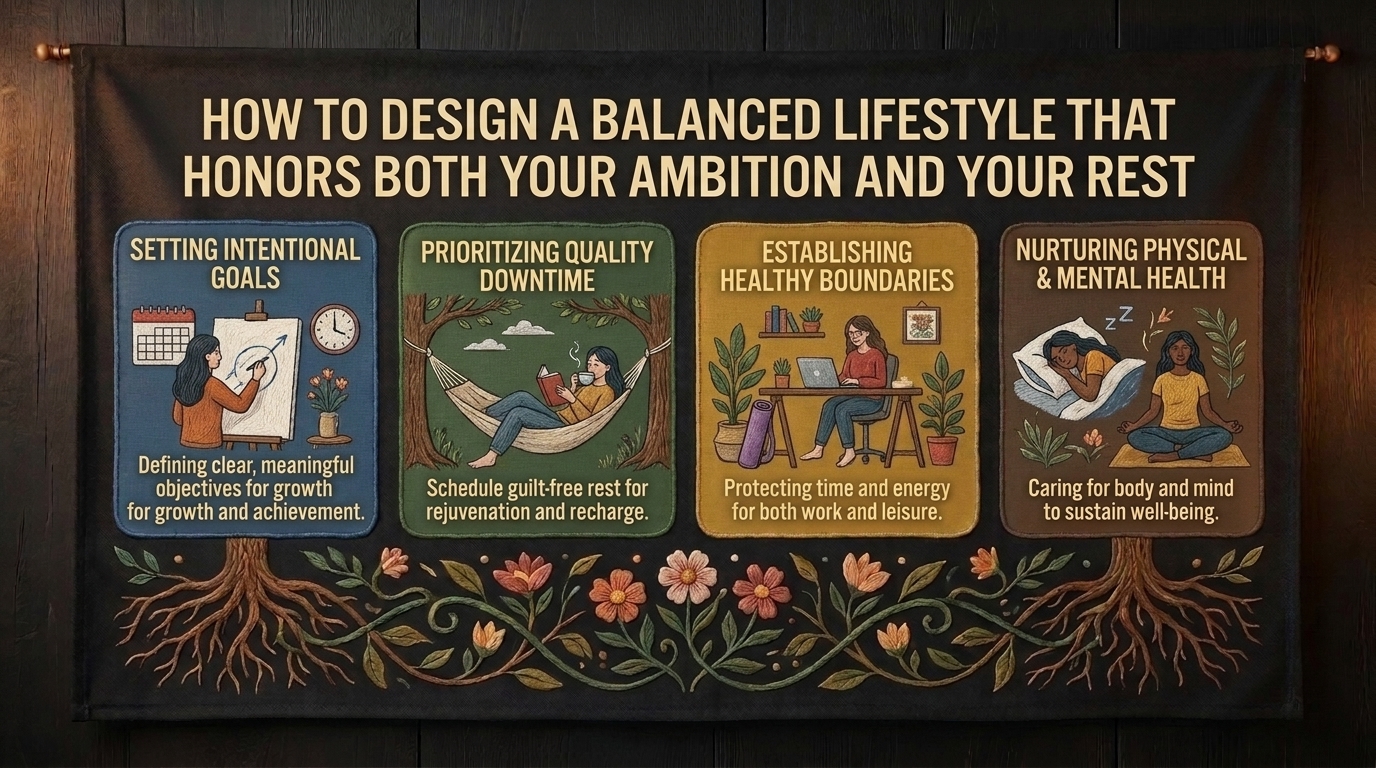
1. Defining Your Core Values
Ambition without a clear anchor point becomes a runaway train. Why are you building your business or chasing your career goals? When your ambition is aligned with your deepest personal values—such as creative freedom, family security, community impact, or intellectual curiosity—you stop chasing arbitrary external metrics and start building a life of authentic fulfillment.
2. Periodization: The Athletic Model of Work
Elite athletes do not sprint year-round; they train in strategic cycles (periodization) alternating heavy exertion with mandatory recovery phases. Knowledge workers and entrepreneurs must adopt this exact model. Design your year, quarter, and week to include intense sprints of focused execution followed by non-negotiable windows of deep recovery.
3. Radical Boundary Setting
Ambition requires saying “yes” to extraordinary opportunities, but rest requires the profound discipline of saying “no.” Protecting your rest means establishing impenetrable boundaries around your personal time, sleep schedule, and digital availability.
3. Regional Dynamics: Balancing Drive Across Major U.S. Ecosystems
The cultural pressure to hustle—and the corresponding necessity to carve out deliberate rest—takes on distinct characteristics across the diverse economic hubs connected to nyattitude.com:
- New York: The unrelenting energy of Manhattan rewards speed, networking, and high-volume output. Designing balance in New York requires treating rest as a non-negotiable corporate appointment, carving out sanctuaries of quietude amidst an urban landscape that never sleeps.
- San Francisco: Surrounded by hyper-ambitious tech cultures where startup hustle is worn like a badge of honor, balancing life in the Bay Area means resisting the glorification of sleep deprivation and embracing wellness, mindfulness, and physical outdoor restoration in nature.
- Texas: Spanning booming urban centers like Austin, Dallas, and Houston, Texas combines ambitious economic expansion with a rich appreciation for personal space, family life, and community connection, providing an ideal canvas for true work-life integration.
- Washington: Anchored by complex public policy, defense, and Pacific Northwest innovation, Washington professionals must consciously balance intense analytical workloads with restorative immersion in the region’s breathtaking natural landscapes.
- California (Southern & Broader): Balancing wellness culture with creative industries, California naturally leans toward holistic living. Balancing ambition here involves aligning high-performance output with mindfulness, physical fitness, and mental well-being.
4. Step-by-Step Framework: Designing Your Balanced Lifestyle
Creating a lifestyle that honors both sides of your personality requires deliberate, structured design. Follow this step-by-step framework to build your custom blueprint:
Step 1: Audit Your Current Energy Leaks
For one week, track not just how you spend your time, but how your energy levels fluctuate throughout the day. Identify your “energy vampires”—tasks, meetings, digital habits, or people that drain your vitality without yielding meaningful professional or personal value.
Step 2: Establish the “Non-Negotiable Rest” Baseline
Before you schedule your work blocks, carve out your recovery anchors in your calendar:
- Sleep Hygiene: Lock in 7 to 8 hours of quality sleep with a fixed wake-up time.
- Micro-Rest: Schedule 10-minute cognitive breaks between heavy work blocks to walk, breathe, or stretch.
- Macro-Rest: Block out one full weekend day (or evening) completely free of professional communication.
Step 3: Implement Deep Work Blocks
Ambition is not about working more hours; it is about driving higher leverage during the hours you do work. Implement 90-minute blocks of uninterrupted “Deep Work” where notifications are disabled, allowing you to accomplish more in two hours than most do in an entire distracted workday.
Step 4: Create Transition Rituals
Working remotely or managing hybrid teams often blurs the line between professional output and personal rest. Create physical or psychological transition rituals—such as a 20-minute walk after work, changing your clothes, or shutting your office door—to signal to your brain that the workday is officially over.
Step 5: Review and Refine Quarterly
Life seasons change. A period of intense professional scaling might require a temporary shift in your energy allocation, followed immediately by a dedicated season of consolidation and rest. Review your lifestyle balance every quarter and adjust your boundaries accordingly.
5. Actionable Tips to Maintain Equilibrium Daily
Incorporate these practical micro-habits into your daily routine to safeguard your rest while fueling your ambition:
- Adopt the “Digital Sunset”: Turn off work-related notifications, close email tabs, and put your phone away at least one hour before bedtime to allow your nervous system to wind down.
- Prioritize Physical Movement: Regular cardiovascular exercise or strength training acts as a powerful bridge between ambition and rest, burning off stress hormones and boosting cognitive clarity.
- Practice the Art of Strategic Delegation: If you are an entrepreneur or manager, recognize that trying to control every minor detail is a trap. Delegate operational tasks to empower others and free up your cognitive bandwidth for high-level strategy.
- Schedule “White Space” in Your Calendar: Do not back-to-back your calendar with meetings. Leave 15-to-30-minute buffers of unstructured time (white space) to think, breathe, and reset between commitments.
- Engage in Analog Hobbies: Balance screen-based professional ambition with tactile, offline creative hobbies (such as reading physical books, cooking, gardening, or painting) that engage different neural pathways.
- Communicate Boundaries Clearly: Be transparent with your colleagues, clients, or team members regarding your availability. Setting clear expectations prevents emergency interruptions during your designated rest periods.
6. Ten Frequently Asked Questions (FAQs)
1. What is the difference between time management and energy management?
Time management focuses on scheduling hours on a calendar, assuming all hours are equal. Energy management focuses on aligning your tasks with your natural biological rhythms, recognizing that high-energy hours yield exponentially greater output and quality than exhausted hours.
2. Can you be highly ambitious while prioritizing 8 hours of sleep?
Absolutely. In fact, elite performers across science, sports, and business universally cite adequate sleep as their secret weapon. Sleep is the brain’s biological cleaning cycle; it consolidates memory, clears metabolic waste, and sharpens executive decision-making.
3. How do I handle the guilt of resting when there is still work to be done?
Reframe rest as an essential professional investment rather than a reward you must “earn.” Ask yourself: Would I expect an elite athlete to run a marathon every single day without rest? Treating rest as mandatory maintenance eliminates the guilt.
4. What are the early warning signs of burnout?
Common warning signs include chronic fatigue, cynicism toward your work, irritability with colleagues or family members, frequent physical ailments (headaches, muscle tension), insomnia, and a noticeable drop in creativity and productivity.
5. How do I maintain balance when working in a high-pressure corporate environment?
Protecting your boundaries requires radical clarity. Focus on ruthless prioritization during work hours, master the art of saying “no” to non-essential commitments, and fiercely guard your evenings and weekends for complete psychological detachment from work.
6. Is work-life balance a myth?
If viewed as a static 50/50 split every single day, work-life balance is indeed a myth. Instead, view it as a dynamic, flowing rhythm—a perpetual balancing act where work and rest ebb and flow across weeks, months, and annual seasons.
7. How does regular rest actually improve professional productivity?
Rest restores cognitive bandwidth, enhances working memory, and triggers the brain’s Default Mode Network, which is responsible for creative insight and complex problem-solving. Well-rested professionals make fewer mistakes and execute tasks faster.
8. How can remote work make lifestyle balance harder to maintain?
Remote work removes the physical separation between home and office, often turning your living space into a 24/7 workplace. Combat this by establishing a dedicated workspace, setting strict working hours, and creating clear transition rituals at the end of the day.
9. How do regional living costs impact our ability to rest?
High-cost metropolitan hubs like New York or San Francisco often trap professionals in a high-expense cycle that demands constant financial hustle. Strategic lifestyle design in these regions involves careful budgeting and financial planning to buy back your time and peace of mind.
10. How long does it take to recover from severe burnout?
True recovery from deep burnout is not a quick weekend fix; it often takes anywhere from three to twelve months of reduced workload, psychological counseling, rigorous sleep hygiene, and profound lifestyle restructuring to fully restore your baseline energy.
Conclusion
Ambition and rest are not conflicting forces; they are the two essential wings of a sustainable, fulfilling life. Without ambition, you stagnate; without rest, you burn out. By mastering the art of energy management, setting unshakeable boundaries, and treating recovery as the catalyst for high performance, you create a life of enduring success.
Whether you are building a groundbreaking enterprise across Texas, New York, California, Washington, or San Francisco, remember that your greatest professional asset is not your computer or your bank account—it is your well-rested, focused, and inspired mind.