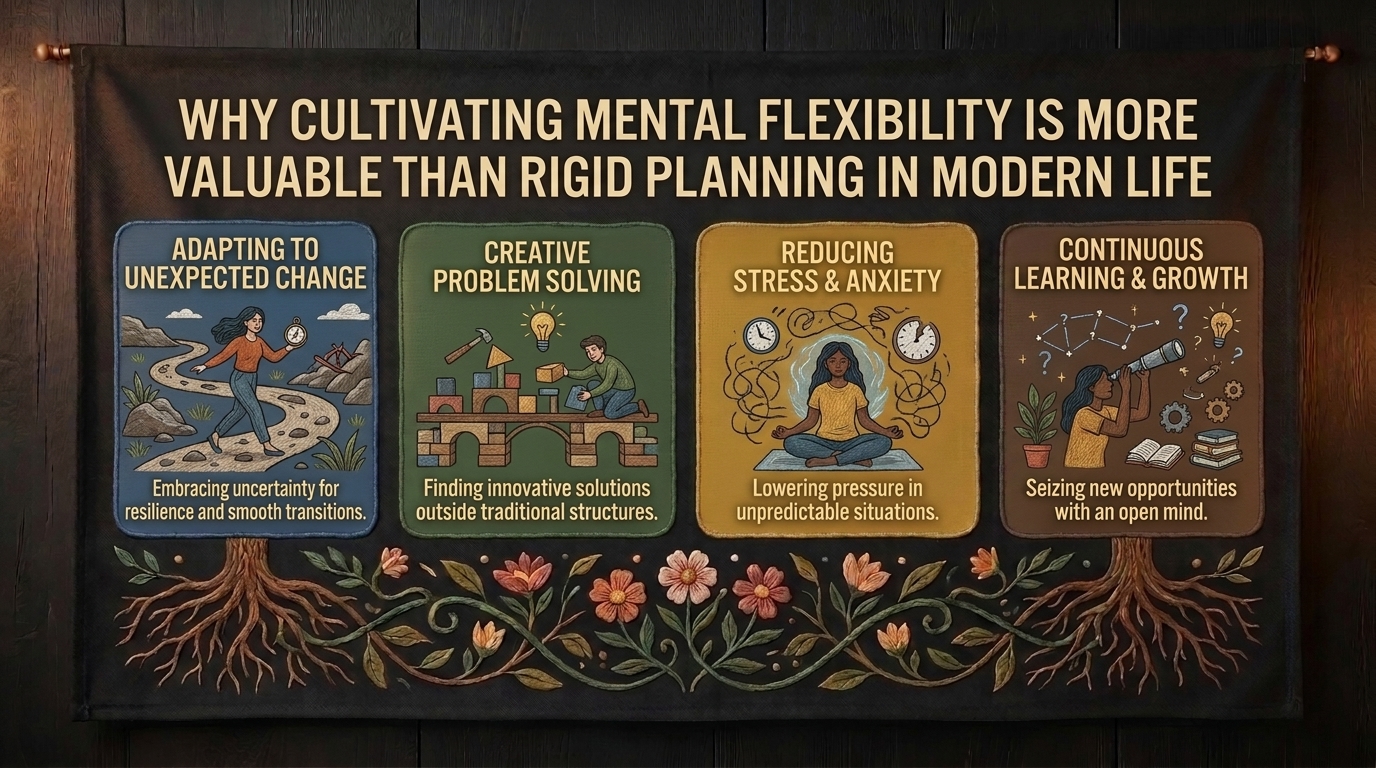
Why Cultivating Mental Flexibility Is More Value Than Rigid Planning in Modern Life
Introduction
We live in an era defined by hyper-acceleration, technological disruption, and perpetual uncertainty. Whether navigating volatile venture ecosystems in San Francisco, managing high-stakes financial environments in New York, scaling emerging enterprises across Texas, adapting to rapid policy and tech shifts in Washington, or driving creative industries throughout California, the traditional playbook for success is undergoing a seismic shift.
For decades, conventional wisdom preached the gospel of rigid planning. We were taught to map out our five-year plans down to the quarter, establish unyielding schedules, and view deviations from the plan as personal or professional failures.
However, rigid planning in a fluid, unpredictable world is a recipe for chronic anxiety, shattered expectations, and strategic obsolescence. When the ground beneath your feet shifts overnight, an unyielding plan snaps under pressure.
The antidote to volatility is not a better, stricter plan—it is mental flexibility.
Also known as cognitive flexibility, this psychological superpower is the capacity to switch between thinking about two different concepts, adapt your behavior to changing environments, view problems from multiple perspectives, and pivot gracefully when circumstances demand it.
For modern entrepreneurs, professionals, and forward-thinking individuals engaging with platforms like nyattitude.com, cultivating mental flexibility is the ultimate competitive advantage. This comprehensive guide explores the neuroscience of adaptability, the hidden traps of rigid planning, step-by-step frameworks for mental agility, regional navigation across major U.S. markets, actionable tips, and answers to the most frequently asked questions.
1. The Fallacy of Rigid Planning in a Complex World
To understand why mental flexibility reigns supreme, we must first examine why rigid planning so frequently fails in modern life.
The Illusion of Control
Human beings possess an innate evolutionary aversion to uncertainty. Our brains crave predictability because predictability feels safe. Rigid planning acts as a psychological comfort blanket, tricking us into believing that we can micro-manage the future and eliminate risk through sheer force of scheduling.
- The Reality: Complex socio-economic, technological, and personal systems are governed by non-linear dynamics. A single global supply chain disruption, an artificial intelligence breakthrough, or a macroeconomic shift can render a meticulously crafted five-year business plan obsolete in a matter of weeks. When you tie your self-worth and operational strategy entirely to a rigid plan, unexpected change feels catastrophic.
The Cost of Sunk Cost Fallacy
Rigid planners often fall prey to the sunk cost fallacy—the tendency to stubbornly continue down a failing path simply because they invested significant time and resources into planning it. Mental flexibility, by contrast, allows you to objectively evaluate real-time data, cut your losses, and pivot without ego getting in the way.
2. The Neuroscience of Mental Flexibility
Mental flexibility is not just a philosophical mindset; it is a neurological capability rooted in the structure and function of the human brain.
The Role of the Prefrontal Cortex
Cognitive flexibility is primarily managed by the prefrontal cortex (PFC), the brain’s executive command center. The PFC is responsible for working memory, abstract thinking, impulse control, and task-switching.
- Neuroplasticity: When you force yourself to break routine, consider alternative viewpoints, or problem-solve under constraints, you stimulate neuroplasticity. You physically strengthen the neural pathways associated with adaptability, making it easier to navigate future disruptions with calm composure.
Moving From Reactivity to Response
Rigid thinkers typically operate from a fear-based, reactive loop controlled by the amygdala. When a plan falls apart, the brain perceives it as a threat, triggering a fight-or-flight response. Mentally flexible individuals activate their prefrontal cortex during crises, transforming a stressful disruption into an interesting intellectual puzzle to be solved.
3. Why Mental Flexibility Beats Rigid Planning Every Time
While planning provides an initial direction, mental flexibility provides the vehicle and the driving skills required to navigate unpaved, ever-changing roads. Here is why flexibility outperforms rigidity:
1. Rapid Exploitation of Emergent Opportunities
Rigid planners are so laser-focused on executing their original roadmap that they frequently miss unexpected opportunities happening right in front of them. Mentally flexible individuals possess peripheral vision; they spot serendipitous shifts, market anomalies, and creative synergies, pivoting instantly to capitalize on them.
2. Built-In Stress and Burnout Resistance
Rigid planners experience high chronic stress because reality constantly violates their expectations. Every minor delay, canceled meeting, or market fluctuation triggers frustration. Flexible thinkers expect friction; they view detours not as roadblocks, but as alternative scenic routes, drastically lowering their cortisol levels and preventing burnout.
3. Enhanced Collaborative Intelligence
Rigid thinkers are often dogmatic, defensive, and dismissive of ideas that contradict their master plan. Flexible thinkers practice intellectual humility. They actively listen, integrate diverse perspectives from team members, partners, or mentors, and synthesize superior solutions that a single rigid mind could never conceive.
4. Regional Realities: Navigating Change Across Major U.S. Hubs
The need for mental flexibility versus rigid planning takes on distinct characteristics across the dynamic economic and cultural landscapes connected to nyattitude.com:
- New York: In the high-velocity worlds of finance, corporate law, and media, market conditions shift by the second. New York professionals must maintain razor-sharp mental flexibility to reallocate capital, adjust strategies, and outmaneuver volatile market tides.
- San Francisco: At the absolute epicenter of technological disruption and startup culture, the mantra is often “fail fast, pivot faster.” Rigid business plans here are quickly replaced by agile methodologies, where mental flexibility is the baseline survival skill for founders and innovators.
- Texas: Spanning thriving entrepreneurial epicenters like Austin, Dallas, and Houston, Texas combines rapid business expansion with diverse industry shifts. Local leaders thrive by blending strategic vision with the agile adaptability required to scale across booming markets.
- Washington: Anchored by public policy, defense contracting, and Pacific Northwest tech, Washington professionals must navigate complex regulatory landscapes where political, legislative, and technological variables change constantly.
- California (Southern & Broader): Balancing entertainment, design, and wellness, California rewards creative fluidity. Mental flexibility here allows artists, entrepreneurs, and creators to reinvent their craft and ride shifting cultural waves with grace.
5. Step-by-Step Framework: Cultivating Mental Flexibility
Mental flexibility is a muscle that can be systematically trained and strengthened. Follow this step-by-step framework to transition from rigid planning to agile adaptability:
Step 1: Shift from “Blueprints” to “Hypotheses”
Instead of treating your plans as absolute blueprints that must be executed flawlessly, treat them as scientific hypotheses. “I believe launching this product feature will increase user retention by 15%.” If data proves otherwise, you haven’t “failed your plan”—you have simply disproven a hypothesis, which allows you to update your model without emotional distress.
Step 2: Practice “Red Teaming” Your Own Ideas
Actively search for flaws in your own plans. Ask yourself: If my primary competitor wanted to destroy this plan, what vulnerabilities would they exploit? What assumptions am I making that could turn out to be completely false? Anticipating disruption makes you immune to surprise.
Step 3: Implement Scenario Planning (Plan A, B, and C)
Planning is not inherently bad; rigid planning is. Instead of making a single rigid plan, practice scenario planning. Map out three distinct paths:
- Plan A: The optimal path if conditions remain stable.
- Plan B: The pivot path if a key resource or market condition shifts.
- Plan C: The emergency survival path if a major disruption occurs. Having pre-calculated alternatives eliminates panic when unexpected changes strike.
Step 4: Cultivate Intellectual Humility
Actively expose yourself to information, podcasts, books, and people that challenge your core assumptions. If you find yourself having an intensely defensive reaction to a dissenting opinion, pause and investigate why. Rigidity often hides behind a wall of fragile ego.
Step 5: Conduct Regular “Pivot Audits”
Every quarter, review your ongoing projects, personal goals, and business strategies. Ask yourself: Are we pursuing this goal because it still makes logical sense, or simply because we’ve been doing it for a long time? Give yourself explicit permission to kill zombie projects and reallocate your energy where it yields the highest current value.
6. Actionable Tips to Build Daily Cognitive Agility
Incorporate these practical micro-habits into your daily routine to train your brain for effortless adaptability:
- Break Your Routine Deliberately: Take a different route to work, rearrange your desk workspace, try a new hobby where you are a complete beginner, or switch your daily workflow hours. Small disruptions train your brain to handle larger unexpected changes comfortably.
- Practice the “Pause and Pivot” Breath: When an unexpected problem arises, do not react instantly out of frustration. Take three deep breaths to quiet your amygdala, then ask: “Given this new reality, what is our most intelligent next move?”
- Journal Alternative Perspectives: When facing a complex professional or personal challenge, write down three entirely different ways to solve it—including one approach you initially consider completely unorthodox or counterintuitive.
- Embrace “Happy Accidents”: When a mistake or unexpected delay ruins your schedule, look for the hidden advantage. Ask: How can I use this unexpected window of time or change of events to my advantage?
- Limit Over-Optimization: Stop trying to optimize every minute of your day with rigid scheduling. Leave unstructured “white space” in your calendar to handle the unpredictable curveballs of daily life without causing a domino effect of stress.
- Seek Out Cross-Disciplinary Learning: Read books or study fields completely outside your primary profession (e.g., if you are a coder, study art history or psychology). Cross-disciplinary exposure builds rich neural networks that supercharge creative problem-solving.
7. Ten Frequently Asked Questions (FAQs)
1. Does cultivating mental flexibility mean I should stop planning altogether?
Not at all. Planning is still vital for setting direction, allocating resources, and clarifying goals. The key distinction is treating your plan as a dynamic, living compass rather than an unyielding, sacred contract. Plan thoroughly, but hold your plans lightly.
2. How does mental flexibility reduce stress and anxiety?
Rigid planners suffer from chronic anxiety because reality constantly threatens their expectations. Flexible thinkers accept that change is the natural state of the world. When disruptions occur, they don’t see them as catastrophes; they see them as normal navigation challenges, neutralizing the fight-or-flight stress response.
3. What is the difference between mental flexibility and chronic indecisiveness?
Mentally flexible people are decisive; they gather real-time data, evaluate alternative paths, and commit fully to a direction. However, if new data proves that direction is wrong, they possess the agility to pivot. Chronic indecisiveness, conversely, stems from fear of commitment and analysis paralysis.
4. How can I become more comfortable with uncertainty?
Start by exposing yourself to small, low-stakes uncertainties (such as visiting a new restaurant without reading reviews or taking an unfamiliar route home). Over time, your nervous system learns that uncertainty does not equal danger, building your overall tolerance for ambiguity.
5. Can mental flexibility improve my leadership and management skills?
Absolutely. Rigid leaders stifle innovation and terrify their teams into hiding mistakes. Mentally flexible leaders create psychological safety, encourage creative problem-solving, pivot corporate strategy smoothly during crises, and earn the deep trust of their teams.
6. What are the common signs of cognitive rigidity?
Common signs include extreme defensiveness when challenged, chronic frustration when plans change, an insistence that “we’ve always done it this way,” intolerance for ambiguity, and an inability to see situations from another person’s perspective.
7. How does neuroplasticity relate to mental flexibility?
Neuroplasticity is the brain’s ability to reorganize itself by forming new neural connections. Every time you consciously practice mental flexibility—such as changing your approach when a strategy fails—you reinforce the neural pathways responsible for cognitive agility.
8. How do fast-paced environments like San Francisco or New York impact our need for flexibility?
Hyper-competitive metropolitan hubs experience rapid market shifts, intense competition, and technological disruption. In these environments, rigid planners are quickly left behind, while mentally flexible professionals pivot rapidly to capture emerging market opportunities.
9. How do I balance having clear long-term goals with being mentally flexible?
Think of your long-term goal as a fixed destination (e.g., reaching a specific mountain peak) and your daily plan as a flexible route. If a landslide blocks your path, you don’t give up on reaching the peak; you remain flexible and choose a different climbing trail.
10. How long does it take to train your brain to become more flexible?
Because you are rewiring ingrained habitual patterns of thought, noticeable improvements in cognitive agility typically emerge within four to eight weeks of consistent mindfulness, scenario planning, and deliberate routine-breaking exercises.
Conclusion
The modern world belongs not to the rigid architects who demand perfection from an imperfect universe, but to the agile navigators who dance with change. While rigid planning offers a comforting illusion of control, mental flexibility provides the true resilience, creativity, and strategic advantage required to thrive.
Whether you are scaling an enterprise across Texas, New York, California, Washington, or San Francisco, remember to set your destination with clarity, hold your plans with lightness, and cultivate the mental agility to turn every unexpected shift into your greatest competitive edge.
What is one rigid plan or routine in your life right now that you can loosen up to make room for greater creativity and adaptability?