How to Practice Self-Care When the City Around You Never Seems to Sleep
Welcome back to nyattitude.com, your definitive digital sanctuary for high-achieving urbanites, relentless professionals, and unapologetic city dwellers. Whether you are navigating the sleepless pulse of Manhattan, managing a high-stakes tech sprint in San Francisco, working late-night corporate hours across sprawling Texas commerce hubs, or keeping pace with the dynamic lifestyles of California and Washington, you know the reality of metropolitan life: the city never sleeps.
When your environment is a 24/7 symphony of flashing sirens, roaring subway lines, humming traffic, glowing skyscraper lights, and a cultural expectation that you should always be “on,” your nervous system pays the price. Constant sensory overload tricks your brain into believing you are perpetually on the front lines, leading to chronic stress, decision fatigue, and deep-seated burnout.
True self-care in a 24-hour metropolis isn’t about escaping to a silent cabin in the woods or spending an entire weekend at a luxury spa. It is about mastering the art of urban sanctuary creation—building micro-boundaries, protecting your peace amidst chaos, and designing tactical self-care routines that fit a fast-paced life.
This comprehensive guide explores the psychology of urban sensory overload, actionable self-care strategies tailored for city living, a 10-point FAQ section, and a concluding blueprint to help you reclaim your well-being.
Part 1: The Neuroscience of the Sleepless City
To understand why practicing self-care is so difficult in a 24/7 city, you first need to understand how your brain reacts to continuous urban stimuli.
1. Sensory Overload and the Amygdala
Humans evolved to experience moments of high alertness followed by long periods of quiet safety. In a 24-hour city like New York or San Francisco, your amygdala (the brain’s threat-detection center) is bombarded with non-stop inputs: sudden loud noises, flashing neon signs, spatial crowding, and cognitive friction.
- Because these stimuli never truly stop, your body remains flooded with baseline levels of cortisol and adrenaline. Over time, this chronic micro-stress impairs sleep quality, drains emotional resilience, and blunts your capacity for joy.
2. The Cultural Pressure of “Always On”
In major metropolitan hubs, productivity is often worn like a badge of honor. When everyone around you is hustling late into the night, resting feels like falling behind. Self-care in this environment requires a radical mental shift: viewing recovery not as a luxury or a reward for working hard, but as a non-negotiable biological maintenance requirement necessary to keep your personal engine running.
Part 2: Building an Urban Sanctuary at Home
When the city outside your window refuses to quiet down, your home must function as an absolute fortress of peace and sensory deprivation.
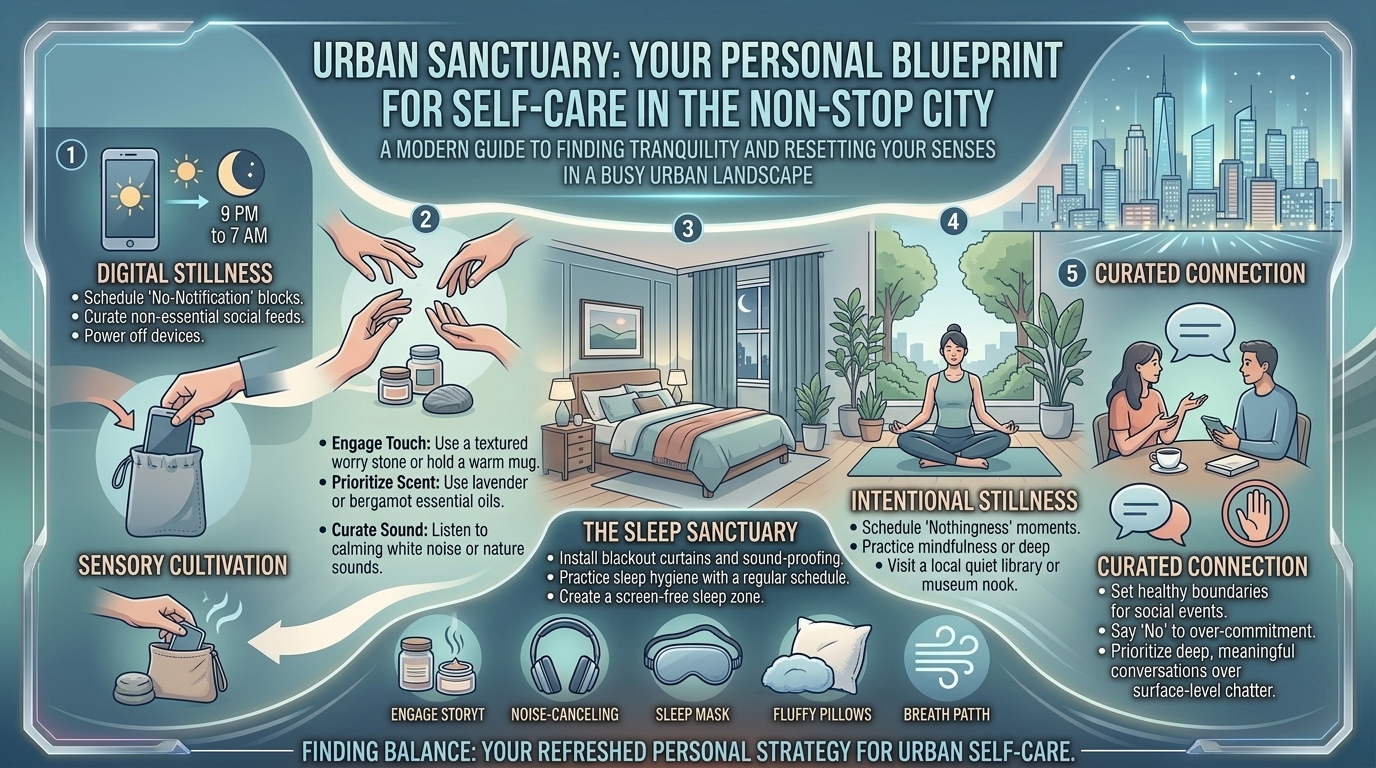
1. Soundproofing Your Space
Ambient street noise is one of the biggest saboteurs of urban rest.
- Acoustic Curtains: Install heavy, multi-layered thermal and acoustic blackout curtains over your windows to muffle street traffic and block artificial neon glow.
- White Noise Engineering: Invest in a high-quality physical fan or a dedicated white noise machine. Layering a consistent, low-frequency sound masks irregular sharp noises (like car alarms or sirens) that trigger micro-awakenings in your sleep cycle.
2. Lighting Control (Circadian Reset)
City dwellers are plagued by “skyglow”—artificial light pouring through windows all night long.
- Swap out bright, harsh overhead lighting for warm, dimmable floor lamps and smart bulbs that automatically shift to amber tones after 8:00 PM.
- Use 100% blackout shades in your bedroom to trick your brain into total darkness, allowing your body to produce melatonin naturally despite the glowing skyline outside.
Part 3: Micro-Self-Care Rituals for the Fast-Paced Day
You do not need a two-hour block of free time to practice self-care. In a high-speed city, integrate these tactical micro-rituals into your daily routine:
1. The Digital Sunset
Set a strict phone curfew at least 45 minutes before sleep. Turn off email notifications, close Slack, and put your phone in grayscale mode or leave it charging in another room. This breaks the cycle of doom-scrolling and allows your over-stimulated brain to wind down.
2. The Somatic Shakeout
When you transition from a frantic workday to your personal evening, your muscles retain physical tension. Spend 2 minutes doing a “somatic shakeout”—gently shaking out your hands, rolling your shoulders, and taking three deep, diaphragm-expanding breaths to discharge built-up physical stress.
3. Sensory Minimalism (The Silent 15)
Carve out 15 minutes during your day—whether during your lunch break or immediately upon getting home—where you sit in absolute silence with zero music, zero podcasts, and zero screens. Give your auditory and visual cortex a complete break from processing data.
Part 4: Strategic Weekend Decompression
When your workweek is high-drive, weekends shouldn’t be filled with endless errands and social obligations. Protect your downtime with intention:
- The JOMO (Joy of Missing Out) Morning: Give yourself permission to sleep in without guilt. Spend Saturday morning drinking coffee slowly in your pajamas before the city’s commercial rush picks up.
- Nature Immersion Trips: Make it a priority to escape the concrete grid at least twice a month. Visit a coastal trail in San Francisco or Washington, hike through regional parks in Texas or California, or spend a quiet afternoon in Central Park or the Brooklyn Botanic Garden. Reconnecting with green spaces and open skies acts as an instant neurological reset.
Part 5: Frequently Asked Questions (FAQ)
1. How can I practice self-care when I only have 10 minutes of free time?
Focus on micro-practices: step away from your desk, close your eyes, do box breathing (inhale for 4 seconds, hold for 4, exhale for 4, hold for 4) for 3 minutes, and drink a full glass of water. Quick physical resets provide immediate nervous system regulation.
2. Why do I feel guilty when I try to rest in a city where everyone is working?
This is a byproduct of urban productivity culture. Remind yourself that burnout benefits no one. Rest is fuel; operating at 80% capacity with a clear mind is far more effective than running at 100% on fumes until you collapse.
3. What is the best way to block out city noise for better sleep?
A combination of double-paned windows (if possible), heavy acoustic curtains, and a reliable white noise machine or box fan is the gold standard for neutralizing unpredictable urban soundscapes.
4. Can self-care be expensive in a major metropolitan area?
Not at all. While spa treatments and boutique fitness classes are popular in cities like New York and San Francisco, true self-care—like setting phone boundaries, taking a quiet walk in a neighborhood park, breathing intentionally, and sleeping an extra hour—is completely free.
5. How do I maintain self-care boundaries with demanding coworkers and bosses?
Communicate your off-hours availability clearly and stick to it. Once your core working hours end, turn off work notifications on your personal phone. Setting respectful boundaries teaches others how to respect your time.
6. What role does nutrition play in urban self-care?
Living a fast-paced urban life often tempts people to rely on takeout, processed foods, and excessive caffeine. Prioritizing simple, nourishing whole foods and staying hydrated counteracts the jittery, inflammatory effects of chronic city stress.
7. How do I handle FOMO (Fear of Missing Out) when staying in for self-care?
Reframe staying in as an active investment in your health rather than a deprivation. Think of your apartment as your private sanctuary, and protect your energy reserves so you can show up fully when you do choose to socialize.
8. Is it possible to meditate in a noisy city environment?
Yes! In fact, urban meditation can be deeply grounding. Instead of fighting the background sounds of traffic or sirens, acknowledge them as part of your environment, let them pass through your awareness like clouds, and anchor your focus entirely on your breath.
9. How do I know if I am suffering from urban burnout?
Signs of urban burnout include chronic fatigue even after sleeping, irritability, brain fog, cynicism toward your work, headaches, and a feeling of being constantly overwhelmed by minor inconveniences.
10. How can I start a self-care routine when my schedule is completely chaotic?
Start small. Pick just one non-negotiable habit—such as no screens for the first 30 minutes of your morning or a 15-minute tech-free evening walk—and master that before adding more elements to your routine.
Conclusion
Practicing self-care when the city around you never sleeps requires deliberate intention, fierce boundary-setting, and a commitment to protecting your mental peace. By soundproofing your home sanctuary, implementing daily micro-rituals, stepping away from the digital noise, and occasionally escaping the concrete grid, you can thrive in America’s most dynamic metropolitan hubs without sacrificing your well-being. Protect your energy, master your rhythm, and conquer the city on your own terms.
How to Practice Mindfulness and Self-Care in a Busy City
Watch this insightful video exploration for practical tips on managing sensory overload, creating urban quiet zones, and prioritizing mental health in fast-paced metropolitan environments.