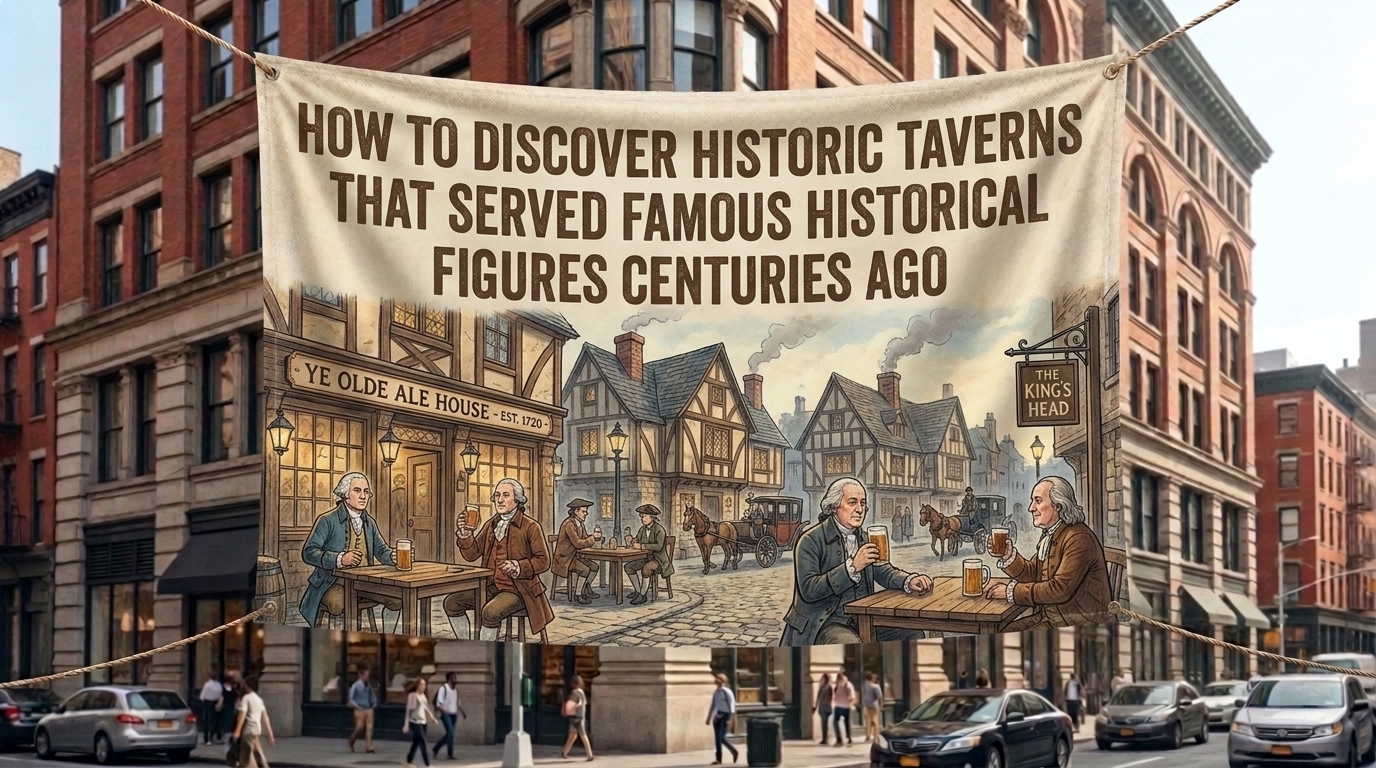
To establish nyattitude.com as a powerhouse domain in historical travel, heritage tourism, and cultural storytelling, this guide bridges regional history across Texas, New York, California, Washington D.C., and San Francisco. Designed to engage readers and perform effectively for search engines, it targets key search terms including historic taverns, heritage pubs, Founding Fathers bars, and historic watering holes in America.
How to Discover Historic Taverns That Served Famous Historical Figures Centuries Ago
Drinking establishment history is, in many ways, the unvarnished history of nations. Long before boardrooms, press rooms, or official halls of state existed, taverns served as the primary nexus for political conspiracy, literary genius, military strategy, and cultural revolution.
Whether walking in the footsteps of George Washington in New York, sharing the favorite haunts of Doc Holliday and Wyatt Earp in Texas, retracing the Gold Rush footprints of Mark Twain in San Francisco, or stepping inside the historic venues of Washington D.C. and California, discovering authentic historic taverns requires more than a simple maps search. It demands a structured methodology to separate true historic treasures from modern themed bars.
Here is your comprehensive manual for locating, verifying, and experiencing America’s most storied historical taverns.
1. Defining “Authentic” Historic Taverns Across Key Regions
Before planning a trip, it helps to understand how historic taverns evolved across different regions of the United States.
       [Colonial & Early Republic Era]                 [Western Frontier & Maritime Expansion]
    ┌───────────────────────────────────┐            ┌─────────────────────────────────────────┐
    │  New York & Washington D.C.       │            │  Texas, San Francisco, & California     │
    ├───────────────────────────────────┤            ├─────────────────────────────────────────┤
    │ • Revolutionary War Strategy      │            │ • Gold Rush & Barbary Coast Saloons     │
    │ • Founding Fathers & Presidents   │   ──────►  │ • Cattle Barons, Outlaws, & Writers     │
    │ • Original Post-Road Inns         │            │ • Prohibition Speakeasy Hideouts        │
    └───────────────────────────────────┘            └─────────────────────────────────────────┘
New York: The Revolutionary Engine
In 18th-century New York, taverns were civic infrastructure. They doubled as courthouses, post offices, and battle headquarters.
- Famous Example: Fraunces Tavern (Lower Manhattan) – Built in 1719, this establishment served as George Washington’s tactical headquarters and hosted his emotional 1783 farewell address to his officers at the end of the Revolutionary War.
- Literary & Cultural Landmarks: McSorley’s Old Ale House (East Village) – Continuous service since the mid-19th century hosted Abraham Lincoln, Ulysses S. Grant, and Peter Cooper.
Washington D.C.: The Seat of Presidential Power
The nation’s capital and its surrounding historical corridors retain watering holes where legislative history was negotiated over whiskey and ale.
- Famous Example: Old Ebbitt Grill / Gadsby’s Tavern (DC Metro Area) – Frequented by George Washington, Thomas Jefferson, John Adams, and James Madison, hosting official banquets and political debate.
San Francisco: Gold Rush, Maritime, and Literary Lore
San Francisco’s tavern scene emerged from the chaotic Gold Rush of 1849 and the infamous Barbary Coast era.
- Famous Example: The Saloon (North Beach) – Established in 1861, it survived both the massive 1906 earthquake and fire, serving as a historic refuge for local maritime workers, writers, and artists.
- Literary Haunts: Comstock Saloon & Vesuvio Cafe – Historic spaces near Chinatown and North Beach where Beat generation figures like Jack Kerouac and Allen Ginsberg gathered.
California: Mission Trails & Victorian Saloons
Beyond San Francisco, California’s historical saloons reflect Spanish colonial roots, early statehood, and late-19th-century luxury.
- Famous Example: The Palace Hotel Tap Room (San Francisco/Bay Area) & The Mission Inn (Riverside) – Hosted U.S. Presidents including William Howard Taft, Theodore Roosevelt, and Richard Nixon.
Texas: Outlaws, Cattle Barons, and Republic Leaders
Texas taverns and saloons reflect the Republic era, the Old West, and booming 19th-century trade routes.
- Famous Example: The Menger Bar (San Antonio) – Opened in 1859 adjacent to the Alamo. It is famous as the spot where Teddy Roosevelt recruited his legendary “Rough Riders” in 1898.
- Outlaw History: The Scholz Garten (Austin) – The oldest continuously operating tavern in Texas (est. 1866), frequented by state governors, civil rights leaders, and historic legends.
2. Comprehensive Comparison of Famous Historic Taverns
| Tavern Name | Location | Est. Year | Famous Historical Figures | Key Historical Significance |
| Fraunces Tavern | New York, NY | 1719 | George Washington, Alexander Hamilton, John Jay | Washington’s Revolutionary HQ; Farewell Address to officers in 1783. |
| McSorley’s Old Ale House | New York, NY | 1854 | Abraham Lincoln, Theodore Roosevelt, John Sloan | Oldest Irish saloon in NYC; maintained sawdust floors and WWI relics. |
| Old Ebbitt Grill | Washington, D.C. | 1856 | McKinley, Grant, Cleveland, Theodore Roosevelt | Washington’s oldest saloon; historic hub for political dealmaking. |
| The Saloon | San Francisco, CA | 1861 | Mark Twain, Local Barbary Coast figures | Oldest continuously operating bar in SF; survived the 1906 Earthquake. |
| The Menger Bar | San Antonio, TX | 1859 | Teddy Roosevelt, Sam Houston, Robert E. Lee | Recruiting hub for the Rough Riders; historic site near the Alamo. |
| Scholz Garten | Austin, TX | 1866 | Texas Governors, Civil Rights Leaders, University Founders | Oldest continuously operating tavern in Texas; historic cultural hub. |
| Heinold’s First and Last Chance | Oakland, CA (SF Bay) | 1883 | Jack London, Robert Louis Stevenson | Built from whaling ship timbers; inspired Jack London’s writing. |
3. Step-by-Step Guide: How to Research and Discover Authentic Historic Taverns
Finding true historic taverns requires cross-referencing archives, architectural records, and local history.
- Verify National and State Historic Registers
- Cross-reference venues with the National Register of Historic Places (NRHP) or local municipal landmark boards.
- Look for official plaque numbers from organizations like the Sons of the Revolution or State Historical Commissions.
- Examine Architectural Integrity
- Authentic venues retain original architectural elements: post-and-beam timbers, low hand-carved ceilings, early bar-rails, or original hearths.
- Check Primary Sources and Local Archives
- Consult city historical societies (e.g., the New-York Historical Society, Texas State Historical Association, or California Historical Society) to verify if historical figures actually visited.
- Identify “Continuous Operation” vs. “Reconstructed”
- Continuous Operation: The venue operated in the same physical structure without stopping (e.g., McSorley’s or The Saloon).
- Reconstructed/Restored: The site was rebuilt on original foundations following historic blueprints (e.g., City Tavern in Philadelphia or Fraunces Tavern’s 1904 restoration).
- Utilize Niche Historical Travel Mapping Tools
- Map your route using specialized databases like the Library of Congress Historic American Buildings Survey (HABS) alongside regional historical travel guides.
4. Practical Travel & Etiquette Tips for Historic Tavern Hunters
- Plan Off-Peak Visits: Visit between 2:00 PM and 4:00 PM on weekdays. Bartenders at historic establishments are living historians; they have time to talk history when the room isn’t crowded.
- Order Period-Appropriate Drinks: Sip drinks that match the era. Try Madeira wine, dark ales, or classic rum punches for 18th-century colonial bars, or an Old Fashioned or straight rye whiskey for 19th-century Western saloons.
- Respect the Artifacts: Many historic bars display un-glassed museum-quality pieces—such as McSorley’s historic wishbones or 19th-century bar mirrors. Avoid touching fragile historical displays.
- Combine with Walking Tours: Pair tavern visits with broader heritage walks (e.g., pairing Fraunces Tavern with NYC’s Wall Street historic trail, or The Saloon with San Francisco’s Barbary Coast Trail).
5. Top 10 Frequently Asked Questions (FAQ)
Q1: What is officially the oldest operating tavern in the United States?
A: The White Horse Tavern in Newport, Rhode Island, established in 1673, is widely recognized as the oldest operating tavern building in the United States.
Q2: Did George Washington really drink at Fraunces Tavern in New York?
A: Yes. Fraunces Tavern served as Washington’s headquarters during parts of the Revolution, and he held his famous 1783 farewell dinner to his officers in its Long Room.
Q3: Where can I find historic Old West saloons in Texas?
A: San Antonio’s Menger Bar (1859) and Austin’s Scholz Garten (1866) are two prime, fully operational historic venues in Texas.
Q4: Which historic tavern in San Francisco survived the famous 1906 Earthquake?
A: The Saloon in North Beach, established in 1861, survived both the earthquake and subsequent firestorms, making it San Francisco’s oldest continuously operating bar.
Q5: How can I tell if a historic tavern is authentic or just a modern copy?
A: Look for official listings on the National Register of Historic Places, local historical markers, or documented land titles from municipal historical societies.
Q6: Are historic taverns family-friendly for daytime dining?
A: Most historic taverns function as full-service restaurants during lunch and early dinner hours, welcoming families before transitioning to night-time pub environments.
Q7: What drinks did historical figures typically consume in 18th-century taverns?
A: Popular drinks included Madeira wine, ale, cider, flip (rum, beer, and sugar heated with a red-hot iron), and traditional rum punches.
Q8: Where did politicians gather in Washington D.C. during the 19th century?
A: Old Ebbitt Grill (est. 1856) and nearby venues like Gadsby’s Tavern in Alexandria, VA, were primary gathering spots for American presidents and lawmakers.
Q9: Can you rent out historic taverns for private historical events?
A: Yes, many venues—including Fraunces Tavern in NYC and Gadsby’s Tavern—offer private event room rentals for gatherings and corporate events.
Q10: Are there famous historic literary bars in California?
A: Yes. Heinold’s First and Last Chance in Oakland was a favorite of Jack London, while San Francisco’s Vesuvio Cafe served as a major center for Beat Generation writers.
Conclusion
Discovering historic taverns allows you to experience history firsthand, walking through the same doors and sitting at the same bars as notable historical figures. From the Revolutionary meeting rooms of New York and political haunts of Washington D.C. to the frontier saloons of Texas and the Gold Rush coastal establishments of San Francisco and California, these watering holes remain living testaments to the past.
By using historical registries, seeking out authentic architectural details, and asking the right questions, your travel itinerary transforms from standard sightseeing into an engaging journey through living history.