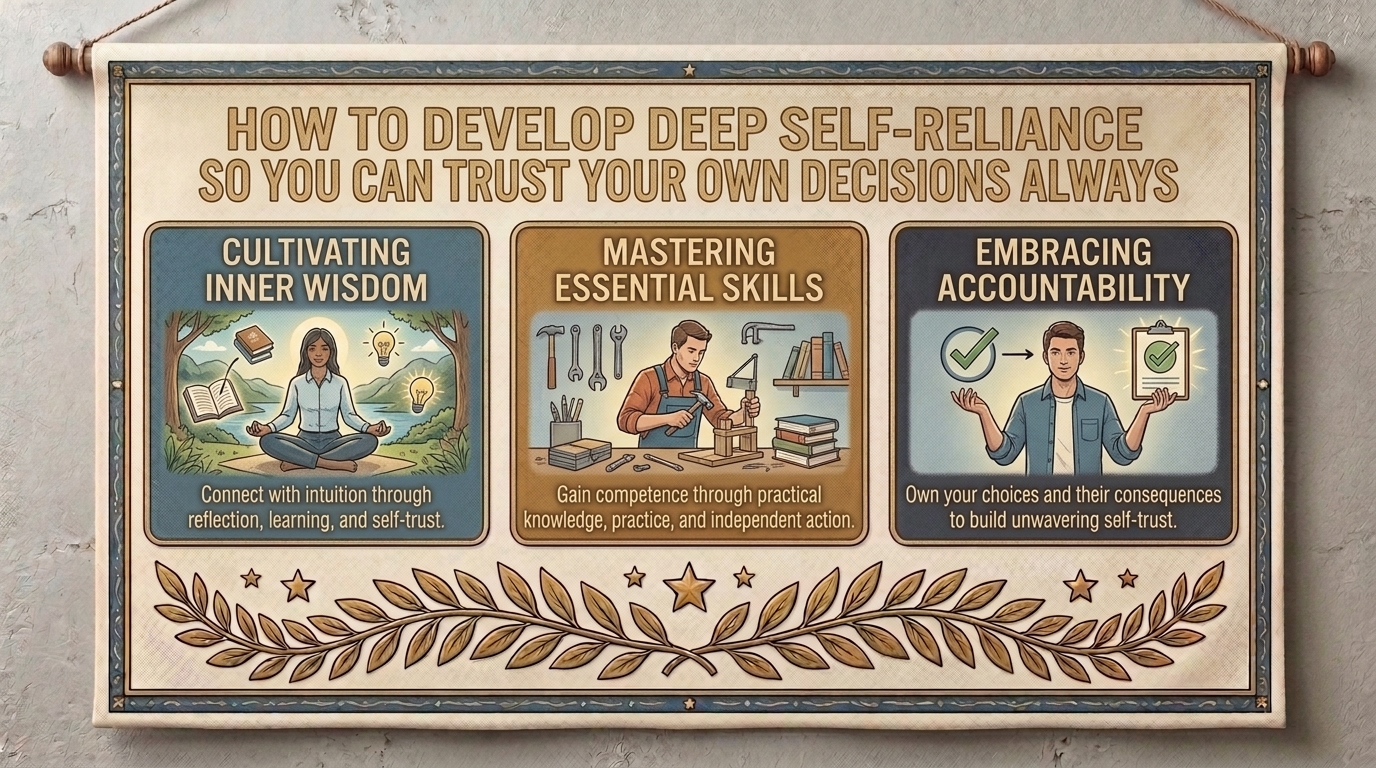
In an era defined by endless information, constant connectivity, and competing expert opinions, trusting your own judgment has never been harder—or more essential. Whether you are navigating high-stakes financial markets in New York, scaling an ambitious venture in San Francisco or across the broader California tech corridor, evaluating shifting legislative and policy landscapes in Washington, or driving rapid, competitive growth in Texas, you are constantly bombarded by external noise.
Every day, advice, data feeds, peer opinions, and societal expectations demand your attention. When things go wrong, it is easy to point fingers outward, but when pivotal career, business, or life choices loom, the ultimate burden rests entirely on your shoulders. Many high-achieving professionals find themselves paralyzed by decision fatigue and chronic second-guessing simply because they have outsourced their internal compass to external validators.
True success, sustainable confidence, and inner peace stem from deep self-reliance. Developing this trait does not mean operating in isolation or ignoring expert counsel; rather, it is the ability to gather data, listen to your intuition, weigh risks, and make firm decisions that you can stand behind—regardless of whether the outcome is an immediate triumph or a valuable lesson.
This comprehensive guide explores the psychological foundations of autonomy, the hidden traps of external validation, actionable frameworks for independent decision-making, and practical daily habits to help you build unshakeable trust in your own mind.
Part 1: Deconstructing Self-Reliance vs. Hyper-Independence
Before building self-reliance, it is vital to distinguish it from its often-misunderstood counterpart: hyper-independence.
1. The Trap of Hyper-Independence
Hyper-independence is a trauma response or defense mechanism rooted in the belief that “I cannot trust anyone; I have to do everything myself.” Hyper-independent individuals refuse help, shun mentorship, and shoulder unsustainable burdens, mistaking isolation for strength. This approach leads straight to chronic stress and burnout.
2. The Power of Mature Self-Reliance
Mature self-reliance, conversely, is an internal security framework. It acknowledges your capacity to handle outcomes, process failures, and direct your own path while remaining open to collaboration, feedback, and learning.
- Dependent Mindset: Needs constant external reassurance, approval, and permission before taking action.
- Self-Reliant Mindset: Evaluates external advice objectively, consults trusted mentors, but ultimately retains full ownership of the final choice.
When you are deeply self-reliant, you stop asking, “What do others think I should do?” and start asking, “Based on first principles, reality, and my core values, what is the right move?”
Part 2: The Psychology of Decision Paralysis and Doubt
Why do intelligent professionals struggle so much to trust their own decisions? Several psychological barriers undermine self-trust:
- Analysis Paralysis: The presence of too much information creates cognitive overload. Instead of clarifying choices, endless research deepens confusion.
- Fear of Accountability: If you follow someone else’s advice and fail, you can blame them. If you make a choice entirely on your own and it fails, you must face yourself. This fear of sole accountability drives people toward chronic indecision.
- The Validation Loop: Social media, corporate hierarchies, and peer groups condition us to seek likes, promotions, and nods of approval. Over time, external validation replaces internal conviction as the metric of success.
Part 3: The 4-Part Framework for Unshakeable Decision-Making
To build self-reliance, you need a repeatable, objective system for making choices. Running your dilemmas through a structured framework eliminates emotional panic and builds long-term confidence in your judgment.
[ Complex Decision / Dilemma ]
              │
              ▼
   1. First-Principles Audit ────► Strip away external noise and opinions.
              │
              ▼
   2. Risk & Inversion Analysis ─► Define the worst-case scenario and survivability.
              │
              ▼
   3. Gut & Data Synthesis ──────► Combine hard metrics with intuitive alignment.
              │
              ▼
   4. Absolute Ownership ────────► Commit fully, accepting 100% responsibility.
1. The First-Principles Audit
Strip away what your peers are doing, what industry trends dictate, and what social expectations demand. Break the problem down to its foundational truths. Ask: “What are the undeniable facts here, independent of anyone else’s opinion?”
2. Inversion Analysis
Popularized by mathematician Carl Jacobi and championed by investors like Charlie Munger, inversion requires looking at problems backward. Instead of asking, “How do I succeed?” ask, “What guarantees failure?” By identifying and eliminating catastrophic paths, the correct path forward often reveals itself naturally.
3. The 10-10-10 Rule
Coined by strategist Suzy Welch, this mental model forces you to evaluate a choice across three distinct time horizons:
- How will you feel about this decision 10 minutes from now?
- How will you feel about it 10 months from now?
- How will it impact your life 10 years from now? This exercise instantly separates temporary emotional discomfort from long-term strategic value.
4. Absolute Ownership Commitment
Once you make a choice, banish second-guessing. Treat every decision as an experiment where there are no mistakes—only data. When you accept total accountability for the outcome, you build a powerful psychological feedback loop that strengthens self-trust over time.
Part 4: Regional Contexts: Cultivating Autonomy Across Major Economic Hubs
The pressure to conform to external standards varies depending on your geographic and professional ecosystem. Tailoring your approach to your local business environment strengthens your independence:
- New York: In fast-moving corporate, financial, and media hubs, herd mentality and consensus-seeking can be seductive. Self-reliance here means looking past short-term market hype and trusting your long-term analytical thesis.
- San Francisco & California: Innovation ecosystems reward contrarian thinking, yet tech culture often breeds echo chambers and trend-chasing. Self-reliance involves building products or strategies based on genuine human utility rather than chasing venture capital fads.
- Washington: Public policy and government relations environments are dominated by stakeholder politics, lobbying, and consensus-building. True independence here means maintaining ethical clarity and strategic vision amidst intense partisan pressure.
- Texas: Known for independent-minded entrepreneurs and pragmatic business cultures, Texas rewards decisive execution. Cultivating self-reliance here aligns naturally with a decentralized, results-oriented operating style.
Part 5: Actionable Tips to Build Deep Self-Reliance Daily
Self-reliance is built through micro-habits practiced consistently over time. Integrate these five strategies into your daily routine to train your brain to trust itself:
1. Practice “Micro-Decisions” Without Consulting Others
When facing low-stakes choices—such as what project management tool to use, how to structure your daily schedule, or where to dine—make the decision immediately on your own without polling your colleagues or friends. Flexing this mental muscle builds confidence for bigger choices.
2. Maintain a Decision Journal
Memory is notoriously biased; we tend to remember our brilliant choices and forget our doubts.
- Actionable step: Keep a journal where you record major decisions, your core rationale at the time, and your expected outcomes. Reviewing this log monthly or quarterly proves to your subconscious mind that your judgment is reliable and improves with practice.
3. Conduct a “Validation Fast”
For one week, consciously refrain from asking for anyone else’s opinion on a project or goal you are working on. Force yourself to sit with your own ideas, execute them, and evaluate the results independently.
4. Separate Discomfort from Wrongness
When you make an independent choice that goes against conventional wisdom, it usually triggers anxiety and self-doubt. Most people mistake this normal physiological discomfort for proof that their decision was wrong. Learn to recognize anxiety as the price of admission for autonomy.
5. Reframe “Failures” as Calibrated Feedback
If you make a decision that yields a negative outcome, do not collapse into self-blame or declare yourself incompetent. Analyze the variables objectively: “What did this data teach me? How will I adjust my model for the next iteration?”
Part 6: 10 Frequently Asked Questions (FAQs)
1. Does developing self-reliance mean I should never ask for advice or mentorship?
Not at all. Self-reliant individuals actively seek out brilliant mentors and expert advice, but they use outside counsel as data inputs rather than commands. The final synthesis and ultimate responsibility always rest with them.
2. How do I stop second-guessing myself after making a major decision?
Second-guessing stems from a fear of imperfection. Remind yourself that every decision is made with imperfect information. Once the die is cast, shift 100% of your energy into execution rather than rumination.
3. What if I make a massive mistake because I trusted my own judgment?
Mistakes are the tuition fee for mastery. A wrong decision analyzed objectively provides more educational value than a lifetime of blindly following safe, conventional advice.
4. How can I build self-reliance if I have spent my entire life seeking approval from parents or bosses?
Start small. Begin by making minor lifestyle or professional choices without seeking validation. Gradually increase the stakes as your internal tolerance for independent accountability expands.
5. Is self-reliance the same as stubbornness?
No. Stubbornness is clinging to a choice despite overwhelming evidence that it is failing. Self-reliance is the courage to make a choice, evaluate its results objectively, and pivot intelligently if the data demands it.
6. How does self-reliance help prevent professional burnout?
When you rely entirely on external validation, your well-being is at the mercy of other people’s opinions, moods, and fluctuating metrics. Self-reliance anchors your self-worth internally, insulating you from external chaos.
7. How do I handle criticism or backlash when my independent decision goes against the crowd?
Understand that pioneering ideas or non-conforming choices almost always invite friction. If your foundational logic is sound, view criticism as external noise rather than an indictment of your character.
8. How long does it take to truly trust your own decisions?
While you will notice an immediate shift in clarity after your first few independent execution cycles, building deep, unshakeable self-reliance is a lifelong practice that strengthens over years of navigated challenges.
9. What role does intuition play in self-reliant decision-making?
Intuition is not magic; it is pattern recognition processed subconsciously based on your cumulative life and professional experience. Self-reliant leaders learn to balance rigorous data analysis with tuned intuitive instincts.
10. How can leaders encourage self-reliance within their teams?
Leaders foster team self-reliance by granting psychological safety, encouraging autonomous problem-solving, and treating mistakes as learning opportunities rather than punishable offenses.
Conclusion
Trusting your own decisions always is not a mystical state of infallible perfection; it is a deep, quiet confidence born from accountability, resilience, and first-principles thinking.
Whether you are building a venture in California, navigating corporate growth in New York, shaping policy in Washington, or scaling operations in Texas, external noise will never disappear. By stripping away outside pressure, running your choices through a rigorous framework, and treating every outcome as valuable data, you forge an internal compass that no market shift or critic can dislodge. Master self-reliance, and you master your own trajectory.