Every professional, regardless of their sector, eventually hits a wall built not by personal shortcomings, but by macro-level forces. Whether you are navigating shifting regulatory landscapes in Washington, economic volatility in New York and San Francisco, rapid technological disruption in California, or evolving operational demands in Texas, systemic challenges can feel insurmountable.
When your chosen industry field faces structural roadblocks—such as market contractions, technological automation rendering traditional roles obsolete, supply chain breakdowns, or sweeping legislative shifts—maintaining a sense of hope can feel like an act of naive defiance. Yet, optimism in the face of systemic adversity is not about wearing rose-colored glasses or ignoring harsh realities. Instead, strategic optimism is a cognitive framework and a tactical resilience tool. It fuels persistence, safeguards mental well-being, and positions you to spot structural openings where others only see dead ends.
This comprehensive guide explores the anatomy of systemic industry challenges, psychological frameworks for safeguarding your mindset, actionable professional strategies to pivot effectively, and structural ways to future-proof your career.
Part 1: Deconstructing Systemic Challenges vs. Personal Setbacks
To maintain optimism, you must first change how you label adversity.
The Locus of Control Shift
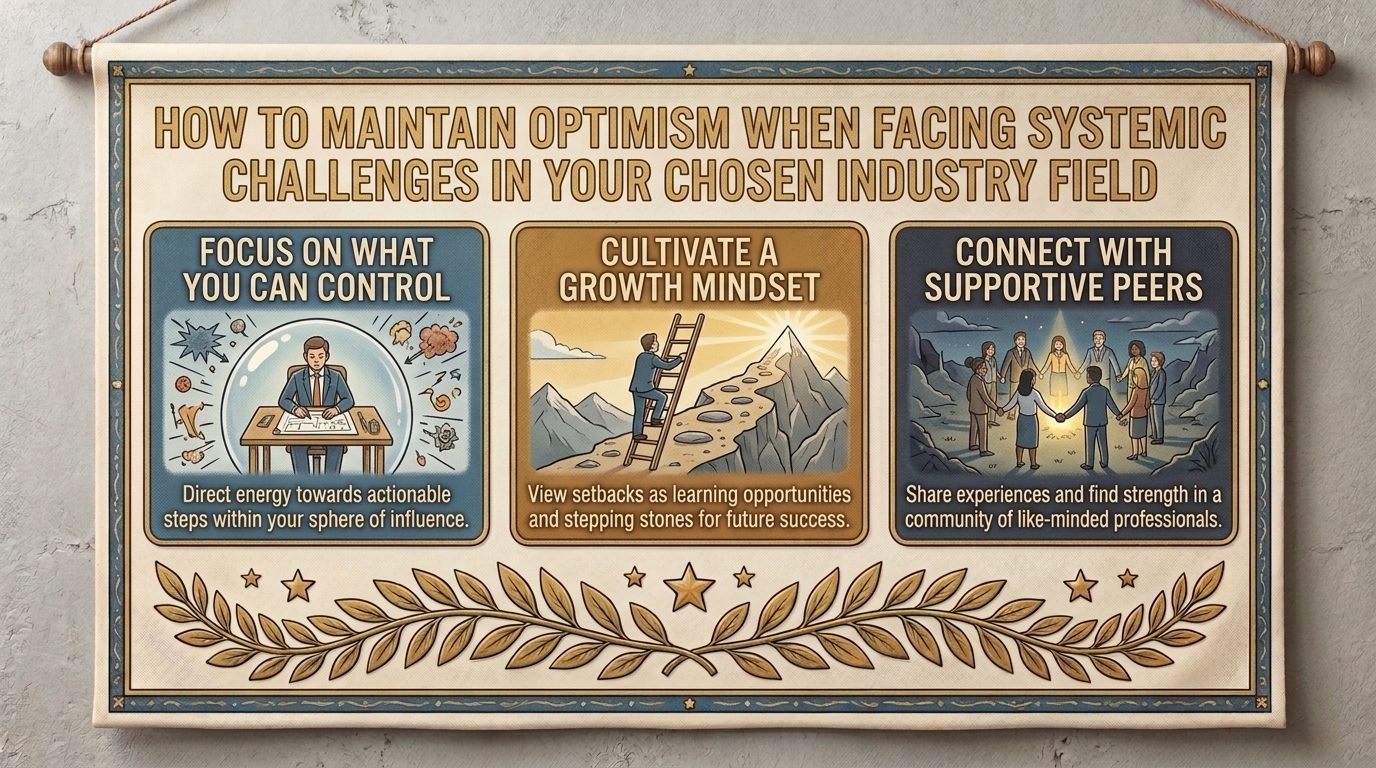
In psychology, the locus of control refers to an individual’s belief about whether the outcomes of their actions are contingent on what they do (internal locus) versus events outside their personal control (external locus). Systemic challenges—such as macroeconomic downturns, industry-wide budget freezes, or sweeping federal policy overhauls—sit firmly in the external column.
When professionals fail to separate personal performance from systemic friction, burnout follows. If your sales numbers drop because an entire regional market is contracting due to legislative changes, blaming your individual competency damages your professional self-esteem.
- Personal Setbacks: Involve variables under your direct influence (e.g., missed skill sets, poor time management, communication errors). These require direct behavioral correction.
- Systemic Challenges: Involve macro-level friction (e.g., regulatory bottlenecks, structural market shifts, capital droughts). These require strategic navigation, collective resilience, and adaptation rather than self-blame.
By recognizing that systemic headwinds are structural weather patterns rather than personal thunderstorms, you free up the psychological bandwidth needed to adapt.
Part 2: The Psychology of Strategic Optimism
Optimism is often misunderstood as a passive personality trait. In professional contexts, however, it is an active discipline.
1. Learned Optimism vs. Toxic Positivity
Psychologist Martin Seligman popularized the concept of “learned optimism,” which posits that individuals can unlearn pessimistic explanatory styles by changing how they interpret defeats.
- Pessimistic style: Views setbacks as permanent (“This industry is permanently broken”), pervasive (“Everything about my career is failing”), and personal (“It’s entirely my fault”).
- Optimistic style: Views setbacks as temporary (“This is a cyclical market correction”), specific (“This particular revenue channel is blocked, but product development is thriving”), and external/modifiable (“The macro environment is challenging, but I can adjust my strategy”).
Toxic positivity, conversely, demands the suppression of legitimate negative emotions like frustration, anger, or anxiety. Strategic optimism makes space for grief and frustration while refusing to let those emotions dictate long-term strategy.
2. Reframing the Narrative
When an industry undergoes structural upheaval, the narrative dictates your emotional response. Instead of framing a market downturn as the “death of an industry,” strategic optimists frame it as the “great reallocation.” Every major structural shift clears out obsolete methodologies and creates vacuums for innovative solutions.
Part 3: Actionable Strategies to Maintain Optimism In Your Career
Optimism without action is merely wishful thinking. To sustain morale during prolonged systemic stress, integrate these five tactical shifts into your professional routine.
Strategy 1: Build a Micro-Community of Resilient Peers
Isolation accelerates professional burnout. When your broader industry is panicking, surrounding yourself with chronic pessimists will drain your operational energy.
- Actionable step: Curate a “peer advisory board” of 3 to 5 forward-thinking professionals within or adjacent to your field. Use these touchpoints not to vent endlessly about macro conditions, but to share tactical workarounds, pivot stories, and emerging opportunities.
Strategy 2: Shrink Your Time Horizons
When multi-year industry forecasts look grim, looking too far ahead induces paralysis.
- Actionable step: Compress your operational focus. If 5-year plans are rendered obsolete by changing regulations or market disruptions, shift to 90-day execution sprints. Focus entirely on what can be stabilized, learned, or optimized within the current quarter.
Strategy 3: Diversify Your Professional Ecosystem
Depending entirely on one company, one revenue stream, or one narrow job description during a systemic industry shift is a recipe for chronic anxiety.
- Actionable step: Cross-pollinate your skills. If you are a tech professional, build fluency in regulatory compliance or financial management. If you are in corporate communications or marketing, study data analytics or AI-driven content distribution. Diversification acts as an internal hedge fund for your career stability.
Strategy 4: Audit and Limit Your Macro-Noise Consumption
Constant exposure to doomsday industry headlines triggers chronic cortisol spikes, impairing the prefrontal cortex functions required for creative problem-solving.
- Actionable step: Establish strict information boundaries. Check industry news through curated weekly digests rather than real-time panic feeds. Protect your cognitive environment so you have energy left over to build solutions.
Strategy 5: Keep a “Systemic Win” and Impact Log
Systemic challenges often overshadow incremental progress. When macro forces dominate, you lose sight of your daily agency.
- Actionable step: Maintain a dedicated professional journal tracking micro-victories: a process you improved, a difficult client conversation you navigated successfully, or a new concept you mastered. Reviewing this log proves that your agency remains intact despite external turbulence.
Part 4: Industry-Specific Lenses: Adapting Across Major Economic Hubs
Different regional business ecosystems experience systemic challenges through unique lenses. Tailoring your outlook to your local ecosystem helps ground your optimism in regional realities:
- New York: Financial, media, and corporate sectors often face macroeconomic shifts, high interest rate environments, and rapid automation. Optimism here stems from leveraging New York’s deep capital networks and pivoting toward fintech and digital transformation.
- San Francisco & California: Technology and venture-backed sectors deal with rigorous regulatory scrutiny, shifting funding winters, and cultural shifts in workforce management. Optimism is rooted in California’s enduring history of tech reinvention, sustainability initiatives, and AI-driven breakthroughs.
- Washington: Government relations, defense, aerospace, and public policy fields navigate legislative gridlock, partisan shifts, and compliance overhauls. Optimism relies on understanding policy cycles and positioning yourself as an indispensable bridge between public compliance and private innovation.
- Texas: Energy, logistics, real estate, and corporate relocation hubs experience rapid population influxes paired with infrastructure strain and commodity price volatility. Optimism thrives on Texas’s pro-business climate, economic diversity, and rapid adoption of next-generation energy solutions.
Part 5: 10 Frequently Asked Questions (FAQs)
1. Isn’t optimism just a form of denial when an industry is collapsing?
No. Toxic positivity involves denial, but strategic optimism acknowledges reality head-on. It says, “The current system is failing or changing radically, and that is difficult, but I have the agency to find a workable path forward.”
2. How do I stay optimistic when my income or job security is directly threatened by industry-wide layoffs?
Separate your self-worth from your current corporate container. Focus immediately on inventorying your transferable skills, activating your professional network, and treating your job search or business pivot like a structured project rather than an emotional indictment.
3. What if my colleagues and managers are extremely pessimistic?
Culture flows downward, but peer influence travels laterally. Protect your mindset by limiting negative conversations, seeking mentorship outside your immediate department, and positioning yourself as a solution-oriented team member who focuses on execution.
4. How long does it typically take to adapt when an entire industry undergoes a structural shift?
Macro-level shifts usually unfold over 12 to 36 months. This is why compressing your focus into 90-day execution sprints is vital—it prevents you from feeling overwhelmed by the total timeline of transformation.
5. Can optimism be practiced, or is it purely genetic?
Extensive psychological research confirms that optimism is largely a skill. Through cognitive reframing, gratitude practices, and altering your explanatory style, you can systematically train your brain to spot opportunities amidst adversity.
6. How do I balance being realistic about risks while remaining positive?
Adopt the mindset of a “constructive realist.” Acknowledge every worst-case risk so you can build contingency plans, but choose to invest your daily emotional and physical energy into best-case execution strategies.
7. What role does physical health play in maintaining professional optimism?
Systemic stress manifests physically. Sleep deprivation, poor nutrition, and lack of exercise degrade cognitive regulation, making negative thoughts harder to filter out. Self-care is a professional necessity, not a luxury.
8. How do I explain career gaps or pivots caused by systemic industry downturns to future employers?
Frame systemic disruptions with transparency and commercial insight. Explain how the macro environment forced a market contraction, and highlight how you utilized that transition window to upskill, consult, or pivot into more resilient verticals.
9. When should I decide to pivot out of an industry entirely rather than stay optimistic?
If an industry’s core value proposition has been permanently invalidated by technological or structural changes—and your personal values no longer align with its trajectory—it is time to transition. Optimism should be directed toward your overarching career longevity, not blindly chained to a sinking ship.
10. How can business leaders foster optimism among their teams during systemic crises?
Leaders must practice radical transparency, avoid sugarcoating harsh realities, and grant teams operational autonomy. When employees feel trusted and understand the strategic game plan, optimism naturally replaces panic.
Conclusion
Systemic challenges in your chosen industry field are inevitable chapters in the broader economic story. Whether you are navigating legislative shifts in Washington, market volatility in New York, tech evolution in San Francisco and California, or dynamic expansion in Texas, the external environment will always fluctuate.
Maintaining optimism does not mean waiting for the storm to pass; it means learning how to build and navigate through it. By shifting your locus of control, reframing structural hurdles as periods of reallocation, compressing your time horizons, and leaning on resilient communities, you transform systemic uncertainty into your greatest competitive advantage. Your career is a long-term portfolio—weathering the structural winter is what positions you to capture the spring.