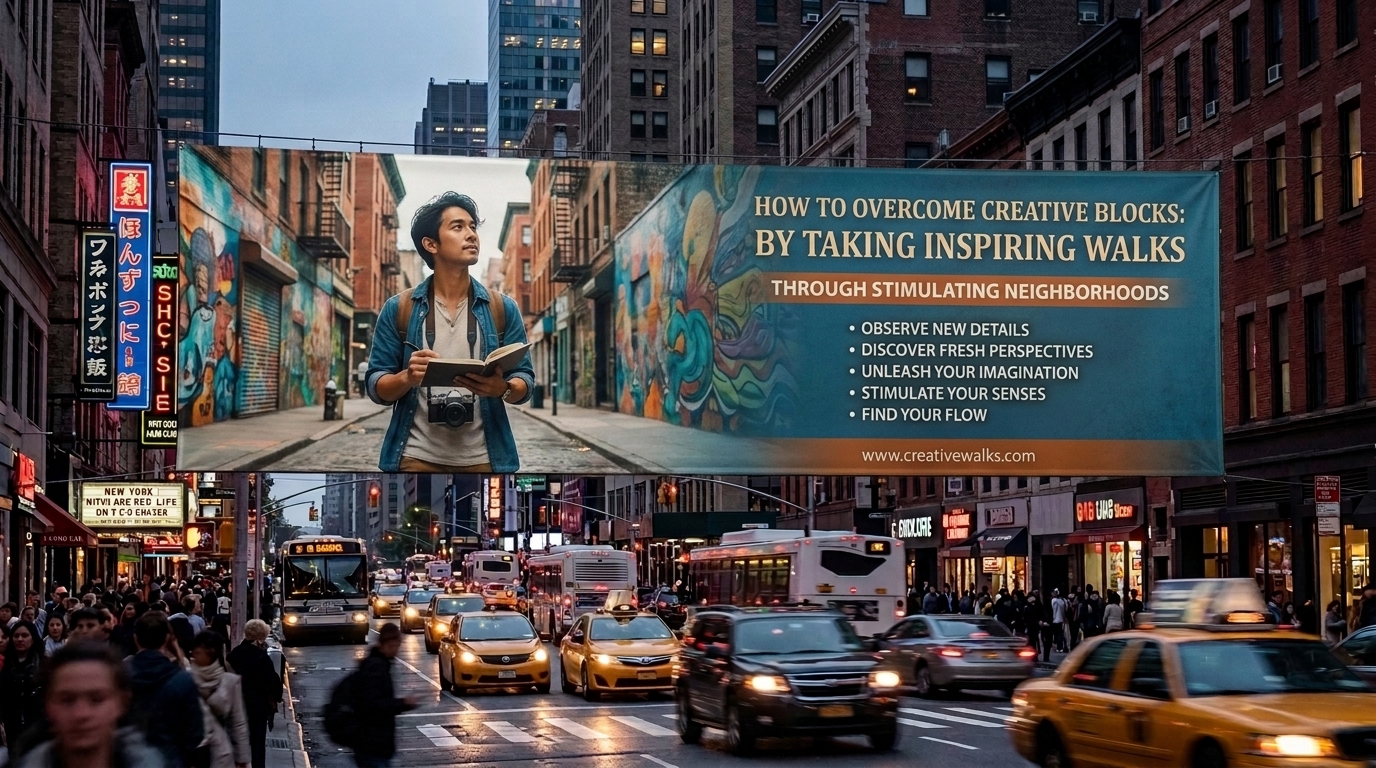
How to Overcome Creative Blocks by Taking Inspiring Walks Through Stimulating Neighborhoods
Creative stagnation is rarely a failure of talent or ambition. More often, it is a symptom of environmental exhaustion. When you spend hours staring at a blinking cursor or an empty canvas inside the same four walls, your brain defaults to familiar neural pathways, repeating the same thought loops without yielding fresh solutions.
For creators, entrepreneurs, writers, and innovators operating in high-demand hubs—from the bustling streets of Manhattan and the steep hills of San Francisco to creative enclaves across Texas, Washington, and California—the remedy for a creative block is often simple: change your inputs.
Sensory-rich neighborhood walks offer an accessible, scientifically validated method for reigniting artistic momentum. By stepping outside and immersing yourself in dynamic urban architecture, vibrant local culture, and diverse visual landscapes, you invite new stimuli that bypass cognitive resistance and unlock lateral thinking.
The Neuroscience of Walking and Creativity
The relationship between physical movement and cognitive breakthroughs is well-documented. Great thinkers throughout history—from Friedrich Nietzsche and Virginia Woolf to Steve Jobs—relied on daily walks to process complex ideas. Modern neuroscience explains why this practice works so effectively.
Physical Movement (Incubation)
       │
       ▼
Increased Cerebral Blood Flow ───► Brain-Derived Neurotrophic Factor (BDNF)
       │
       ▼
Default Mode Network (DMN) Activation ───► Divergent Thinking & Breakthrough Insights
- Increased Cerebral Blood Flow: Walking increases heart rate and blood circulation, sending oxygen and glucose directly to the brain. This physiological boost immediately improves executive function and working memory.
- Activation of the Default Mode Network (DMN): When engaged in a passive, rhythmic activity like walking, your brain shifts away from hyper-focused task execution (controlled by the Central Executive Network) and activates the DMN. The DMN is responsible for daydreaming, memory consolidation, and connecting seemingly unrelated concepts.
- Divergent Thinking Generation: Studies consistently show that walking—whether indoors on a treadmill or outdoors in nature—significantly boosts performance on tests measuring divergent thinking (the ability to generate multiple novel ideas).
- Novelty and Dopamine Release: Exposing your brain to new visual patterns, architectural textures, sounds, and social interactions triggers the release of dopamine. This neurotransmitter is closely linked to curiosity, motivation, and creative pattern recognition.
How Environmental Inputs Reframe Thought Patterns
When experiencing a creative block, your mind is stuck in convergent thinking—trying to force a single correct solution to a problem. Urban exploration breaks this state by providing a constant stream of external variables.
| Sensory Stimulus | Cognitive Mechanism | Creative Outcome |
| Architectural Contrast | Forces spatial awareness and structural observation | Unlocks new perspectives on layout, scale, and balance |
| Ambient Street Sounds | Moderates background noise (~70 dB) | Enhances abstract processing and creative cognition |
| Visual Art & Color | Activates emotional pathways | Triggers associative memory and fresh aesthetic ideas |
| Human Micro-Interactions | Enhances empathy and social observation | Enriches character development, narrative depth, and UX insights |
Curating the Ultimate Inspiring Walk: Step-by-Step
To turn a standard walk into a deliberate session for overcoming creative blocks, structure your outing using this simple framework:
1.Define Your Intent (Without Forcing an Answer):Set the context before stepping outside.
Before leaving your desk, write down the specific creative challenge you are facing in one sentence (e.g., “I need a headline for this campaign,” or “I need to solve this plot hole”). Read it once, then set it aside. Do not actively try to solve it while walking; let your subconscious handle the problem while your conscious mind observes the environment.
2.Select a Neighborhood with High Visual & Cultural Density:Choose environments rich in contrast and history.
Opt for neighborhoods that offer architectural diversity, vibrant street life, public art, or mixed historical and modern elements. High contrast environments stimulate curiosity far more than uniform suburbia or static office parks.
3.Disconnect from Digital Distractions:Eliminate passive consumption to encourage observation.
Put your phone in “Do Not Disturb” mode. Resist the urge to listen to podcasts, audiobooks, or scroll social media. Passive listening occupies the exact cognitive bandwidth required for your mind to wander and generate original associations.
4.Practice ‘Active Observation’ (The Flâneur Approach):Engage deeply with ambient details.
Notice details usually overlooked: the juxtaposition of old brick next to modern steel, signage typography, street art, shadow angles, or snippets of overheard dialogue. Allow yourself to stop and look closer at anything that catches your eye.
5.Capture Thoughts Immediately Upon Return:Document ideas before they fade.
As soon as you return from your walk, sit down with a notebook or blank document for 10 minutes. Write down every idea, word, or visual concept that surfaced—even if it seems unfinished or unrelated to your primary problem.
Stimulating Neighborhood Styles for Creative Exploration
Depending on where you are located, seeking out specific types of urban environments can yield different creative outputs.
1. Historic & Architectural Districts
- Key Features: Cobblestone paths, historic landmarks, intricate masonry, varied facade designs.
- Best For: Structural thinking, narrative design, historical context, and establishing depth.
- Examples: Greenwich Village or Brooklyn Heights (New York), Georgetown (Seattle/Washington), Beacon Hill (Boston), The French Quarter (Texas/New Orleans historic influences).
2. High-Energy Arts & Mural Hubs
- Key Features: Large-scale street murals, independent galleries, boutique shops, vibrant color palettes.
- Best For: Visual inspiration, color exploration, breaking through perfectionism, bold ideas.
- Examples: Mission District or Wynwood-style art pockets in San Francisco and Los Angeles (California), Deep Ellum in Dallas or South Congress in Austin (Texas).
3. Waterfronts & Open Urban Canopies
- Key Features: Expansive views, water movement, open horizons paired with skyline vistas.
- Best For: Strategic long-term planning, big-picture brainstorming, reducing acute anxiety.
- Examples: Waterfront Park along Elliott Bay (Seattle, Washington), The Embarcadero (San Francisco, California), Hudson River Park (New York), Lady Bird Lake Trail (Austin, Texas).
Practical Tips to Maximize Creative Breakthroughs on Foot
To ensure your walks consistently produce creative results, incorporate these micro-strategies into your routine:
- Take an Unfamiliar Route: Novelty is the primary catalyst for dopamine release. Even in your own neighborhood, turn down streets you have never explored before.
- Change Your Pacing: Alternate between a slow, contemplative stroll (to observe small details) and a brisk walk (to boost heart rate and cerebral oxygenation).
- Bring a Small Pocket Notebook: Jotting down quick keywords by hand prevents the distraction of unlocking a smartphone.
- Schedule Walks During Low-Energy Slumps: Use a 20-minute walk to replace the 2:00 PM coffee run. Physical movement clears afternoon brain fog faster than caffeine.
- Walk During Golden Hour: Early morning or late afternoon light creates dramatic shadows and warm tones that completely transform familiar landscapes.
Top 10 Frequently Asked Questions (FAQ)
1. How long should an inspiring walk be to unlock creative thinking?
A walk between 20 to 45 minutes is usually optimal. Research shows that as little as 10 to 15 minutes of light aerobic movement boosts divergent thinking, while 30 minutes provides enough time for the brain to transition into the Default Mode Network.
2. Is walking in a city better for creativity than walking in nature?
Both offer unique cognitive benefits. Nature walks excel at reducing stress, lowering cortisol, and restoring depleted attention. Urban walks provide high-density sensory inputs, cultural friction, and visual diversity that stimulate novel associations. Choose nature for stress recovery, and dynamic urban neighborhoods for conceptual idea generation.
3. What if I get an idea mid-walk and don’t want to forget it?
Use a quick voice memo app or carry a small pocket notebook. Record only key trigger words or phrases so you can immediately return your focus to observing your surroundings.
4. Can I listen to music while walking for creative inspiration?
Instrumental music, ambient tracks, or lo-fi beats without lyrics can enhance the experience without overloading your linguistic processing. Avoid lyric-heavy songs, podcasts, or audiobooks, as they occupy the verbal centers of your brain needed for creative thought synthesis.
5. How does urban walking help with non-visual creative work like coding or writing?
Non-visual creativity relies heavily on pattern recognition, structural logic, and problem-solving. Observing spatial relationships, movement rhythms, and structural organization during a walk helps your brain process structural logic subconsciously.
6. What should I do if my mind keeps dwelling on stress instead of creative ideas?
Shift your focus outward using sensory grounding. Practice the “5-4-3-2-1 technique”: consciously name 5 things you can see around you, 4 textures you can feel, 3 sounds you can hear, 2 scents, and 1 taste. This pulls your brain out of internal rumination and back into active observation.
7. How often should I take creative walks?
Integrating a daily 20-minute walk into your routine yields the best results. Treating walking as a daily operational habit rather than an emergency response to a creative block prevents fatigue before it sets in.
8. What if I live in a quiet, residential neighborhood without major art or architectural hubs?
You don’t need a world-famous art district to find inspiration. Shift your focus to smaller details: notice landscaping choices, shadows cast by trees, home designs, macro-nature elements, or simply take a route you’ve never walked before.
9. Can indoor walking (like on a treadmill) yield the same creative benefits?
Yes. Stanford University studies revealed that walking indoors on a treadmill produced significant increases in divergent thinking compared to sitting. While outdoor environments add beneficial sensory inputs, physical movement itself is the core driver of cognitive enhancement.
10. How do I transition from the walk back into execution mode?
Sit down at your workspace immediately after returning—before checking email or messages. Spend 5 to 10 minutes doing an unedited “brain dump” of every thought, image, or solution that crossed your mind during the walk.
Conclusion
A creative block is not an insurmountable wall; it is simply a signal that your mind requires fresh inputs and physical movement to clear cognitive clutter. By stepping away from your workspace and taking deliberate, observant walks through stimulating neighborhoods—whether in New York, San Francisco, Texas, Washington, or anywhere in between—you leverage your brain’s natural neurobiology to unlock new ideas. The next time you find yourself stuck on a problem, tie your shoes, leave your phone on silent, and let the pavement supply the inspiration you need.