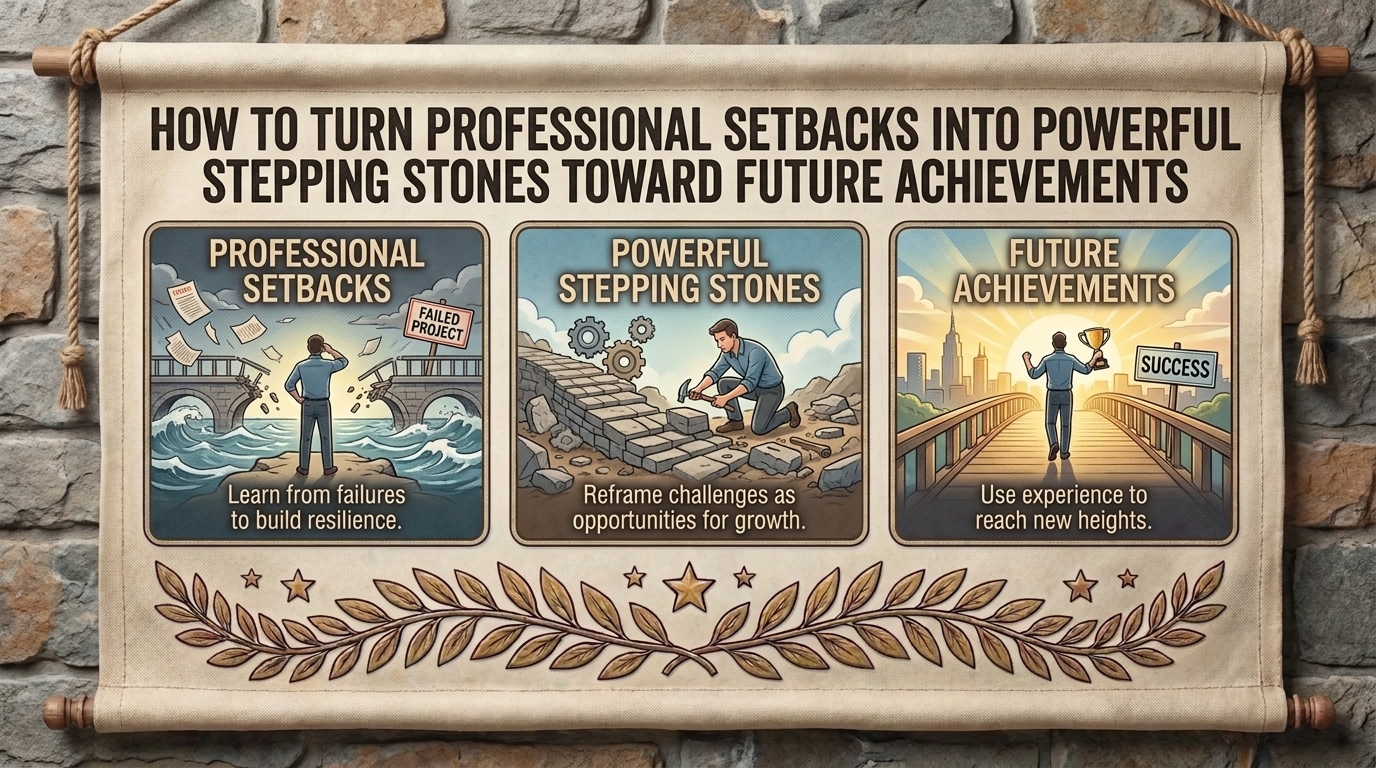
How to Turn Professional Setbacks into Powerful Stepping Stones Toward Future Achievements
Introduction
In the high-stakes theater of modern commerce, failure is rarely advertised, yet it is universally experienced. Whether you are navigating volatile economic shifts in New York, scaling a hyper-growth tech startup in San Francisco or across California, managing complex regulatory and policy landscapes in Washington, or driving rapid, competitive expansion across Texas business hubs, professional setbacks are inevitable waypoints on the road to mastery.
Yet, our professional culture remains profoundly allergic to failure. We celebrate the triumphant product launch, the landmark funding round, the promotion, and the flawless quarterly report, while hiding the botched pitches, the missed revenue targets, the structural layoffs, and the failed ventures in the shadows. This cultural aversion leads professionals to internalize setbacks as personal indictments rather than objective market data.
When a major professional setback strikes—be it a lost client, a stalled project, a denied promotion, or an outright business collapse—it triggers a visceral psychological reaction. How you process, dissect, and leverage that friction dictates the trajectory of your entire career. Turning professional setbacks into powerful stepping stones is not about adopting toxic positivity or pretending a painful loss doesn’t hurt; it is a systematic, data-driven process of cognitive reframing, ruthless post-mortem analysis, and strategic pivoting.
This comprehensive guide explores the psychology of professional resilience, the neurobiology of failure, actionable strategies to extract maximum value from adversity, and a step-by-step framework to transform your lowest professional moments into your greatest competitive advantages.
Part 1: Deconstructing the Psychology of Professional Setbacks
To transform failure into fuel, you must first dismantle how your brain processes professional pain.
1. The Threat Response and Cognitive Narrowing
When a major setback occurs—such as losing a key leadership role or watching a venture fail—the human brain perceives it as a direct threat to survival and status. The amygdala activates, flooding the body with cortisol and adrenaline. This triggers cognitive narrowing, a survival mechanism that limits your ability to see long-term options, creative solutions, or alternative pathways.
During this acute phase, professionals frequently make reactive, fear-based choices: jumping into a misaligned job out of panic, lashing out at colleagues, or withdrawing entirely from networking and growth opportunities. Recognizing this physiological panic response is the first step toward neutralizing it.
2. Fixed Mindset vs. Growth Mindset in Adversity
Stanford psychologist Carol Dweck’s foundational research on mindset explains why two professionals can experience the exact same setback and walk away with entirely different futures:
- The Fixed Mindset Response: Views intelligence, talent, and professional capability as static traits. A setback is interpreted as definitive proof of inadequacy (“I failed this project, therefore I am a failure”). This leads to shame, defensiveness, and avoidance.
- The Growth Mindset Response: Views capability as a muscle that strengthens through resistance. A setback is interpreted as critical feedback (“This approach failed; what variables do I need to upgrade to master this challenge?”). This leads to curiosity, adaptation, and resilience.
By consciously shifting your explanatory style from fixed judgment to growth-oriented curiosity, you transform a painful stop sign into a flashing directional arrow.
Part 2: The 5-Stage Framework for Converting Setbacks Into Momentum
Turning a setback into a stepping stone requires a structured, repeatable methodology. When adversity strikes, take your career through this five-stage processing pipeline:
[ PROFESSIONAL SETBACK OCCURS ]
               │
               ▼
   1. The Emotional Decompression ──► Process grief and neutralize panic.
               │
               ▼
   2. The Clinical Post-Mortem ──────► Analyze objective operational data.
               │
               ▼
   3. The Accountability Audit ──────► Separate internal errors from external noise.
               │
               ▼
   4. The Strategic Pivot ───────────► Redesign your approach using new insights.
               │
               ▼
   5. The Relentless Re-Engagement ──► Execute with upgraded tactical clarity.
Stage 1: The Emotional Decompression
Do not try to spin a fresh failure into a positive lesson immediately. Suppressing initial disappointment, anger, or grief guarantees that those unexpressed emotions will leak out later as cynicism or burnout. Give yourself a strictly time-boxed window (e.g., 48 to 72 hours) to process the emotional impact. Run, lift weights, talk to a trusted mentor, or write it out in a private journal. Once the acute physiological charge clears, move to stage two.
Stage 2: The Clinical Post-Mortem
Borrowing a practice from elite engineering and aviation teams, conduct an objective post-mortem on what went wrong. Strip away ego and emotion.
- What were the initial assumptions?
- At what exact milestone did the trajectory diverge from the plan?
- What early warning signals were ignored? Treat the failure like a clinical researcher examining a lab result: dispassionate, curious, and focused entirely on data.
Stage 3: The Accountability Audit
Divide the failure into two distinct columns: External Variables (macroeconomic downturns, shifting regulatory policies, client budget cuts, partner breaches) and Internal Variables (poor risk assessment, flawed execution, miscommunication, lack of preparation).
- Accept 100% responsibility for the internal variables—this is where your agency lives.
- Acknowledge the external variables without wasting emotional energy resenting them. You cannot control the market weather; you can only upgrade your vessel.
Stage 4: The Strategic Pivot
A setback rarely signals that your overarching career vision is wrong; it usually indicates that your vehicle or methodology requires an upgrade. Use the insights gained from your post-mortem to redesign your strategy. Do you need to acquire a new technical skill? Do you need to diversify your client base or revenue streams? Do you need to recalibrate your risk tolerance?
Stage 5: The Relentless Re-Engagement
Momentum is only created through action. Once the new strategy is mapped out, re-enter the arena quickly. The longer you sit on the sidelines ruminating over a past failure, the heavier the psychological anchor becomes.
Part 3: Actionable Strategies to Build Career Antifragility
Nassim Nicholas Taleb coined the term antifragile to describe things that not only gain from disorder and stress but actually need shocks and volatility to survive and thrive. To bulletproof your career, you must build antifragile professional habits.
1. Diversify Your Professional Portfolio
Depending entirely on one employer, one client, or one narrow job description makes every professional setback an existential crisis.
- Actionable step: Build alternative revenue streams, maintain an active network outside your immediate company, and continuously cross-pollinate your skill sets (e.g., combining technical expertise with financial literacy or public communication).
2. Keep a “Failure Resume”
Inspired by academic researcher Johannes Haushofer, a failure resume is a public or private document cataloging your rejections, failed projects, lost deals, and career missteps alongside the critical lessons each one taught you.
- Actionable step: Write down your past top five professional failures and explicitly list the durable skills or opportunities that directly resulted from them. Reviewing this document desensitizes your brain to the fear of failure.
3. Seek Radical, Unfiltered Feedback
When professionals experience a setback, friends and family often offer soothing platitudes (“You’re amazing, it was their loss!”). While well-intentioned, this coddling robs you of necessary growth data.
- Actionable step: Seek out mentors, former managers, or industry peers who will give you brutally honest, constructive feedback. Ask: “Where did my execution fall short? What blind spots led to this outcome?”
4. Shrink the Feedback Loop
The faster you test ideas, fail, measure the results, and iterate, the more resilient your career becomes.
- Actionable step: Break large career goals down into rapid 30-day execution sprints. Treat missteps not as catastrophic failures, but as fast iterations that bring you closer to product-market fit in your career.
5. Protect Your Physiological Baseline
Stress and failure deplete cognitive reserves. Trying to out-think a major professional setback while sleep-deprived and malnourished leads straight to depressive loops.
- Actionable step: Prioritize rigorous physical recovery—consistent sleep schedules, strenuous physical exercise, and clean nutrition—as foundational operational requirements for navigating career friction.
Part 4: Regional Perspectives: Bouncing Back Across Major Business Hubs
Professional setbacks take on different cultural and operational flavors depending on your geographic and industrial ecosystem:
- New York: In high-speed financial, corporate, and media environments, public missteps can feel magnified. Bouncing back here requires thick skin, immediate focus on deal restitution, and leveraging New York’s vast, highly liquid networks to orchestrate swift career pivots.
- San Francisco & California: The venture capital and technology ecosystems have a uniquely mature relationship with failure—often viewing a failed startup or botched product launch as a badge of operational education. Setbacks here are treated as necessary R&D for your next breakthrough.
- Washington: Public policy, government relations, and defense sectors operate within rigid regulatory and partisan timelines. Setbacks involve stalled legislation or shifting political winds; bouncing back requires mastering long-term policy cycles and building bipartisan institutional trust.
- Texas: Driven by rapid corporate expansion, energy sector dynamics, and entrepreneurial grit, the Texas business climate values pragmatic resilience. Setbacks are met with a “dust yourself off and scale” mentality, favoring direct operational re-engagement over lengthy post-mortems.
Part 5: 10 Frequently Asked Questions (FAQs)
1. Isn’t reframing failure as a “stepping stone” just toxic positivity?
Toxic positivity denies pain and demands immediate fake happiness. Turning a setback into a stepping stone does the exact opposite: it demands brutal honesty, grief, clinical analysis, and hard work. It respects the pain while extracting maximum utility from it.
2. How do I recover my self-confidence after a very public professional failure?
Confidence is not a feeling; it is a byproduct of competence and repeated action. Start by achieving small, private wins (completing a certification, shipping a minor project, organizing your workflow) to rebuild your internal evidence base.
3. How do I explain a massive career setback or termination in future job interviews?
Frame the setback with absolute candor, commercial insight, and zero bitterness. Explain the objective macro or internal variables that contributed to the outcome, and pivot immediately to what specific operational lessons you learned and how you have applied them since.
4. What is the difference between a productive failure and a reckless mistake?
A productive failure happens when you take calculated risks, innovate, or push into uncharted territory and the model breaks. A reckless mistake happens due to gross negligence, lack of preparation, or ethical shortcuts. Productive failures build mastery; reckless mistakes require ethical and behavioral correction.
5. How long should I take to grieve a major career setback before moving forward?
For most major disruptions (layoffs, failed businesses, lost leadership roles), a 48-to-72-hour emotional decompression window is ideal, followed by a structured 1-to-2-week analytical planning phase before aggressive re-engagement.
6. Can a professional setback actually make me more attractive to top employers or investors?
Yes. Seasoned leaders and investors often prefer backing professionals who have survived a major market downturn or business failure over those who have only experienced uninterrupted bull markets. Scar tissue proves you know how to navigate turbulence.
7. How do I prevent the fear of failure from paralyzing my future decisions?
Acknowledge that inaction is a guaranteed failure. When you realize that standing still guarantees irrelevance, taking a calculated risk—even with the possibility of falling—becomes the only rational choice.
8. What role do mentors play when bouncing back from a severe setback?
Mentors provide emotional grounding, objective perspective, and access to unlisted opportunities. When your own cognitive narrowing blinds you to options, a trusted mentor can show you alternative doors you didn’t know existed.
9. How do I handle the stigma or embarrassment of a failed business venture?
Shed the ego. The people whose opinions actually matter—innovators, builders, and leaders—respect execution and risk-taking. Those who mock failure from the sidelines are usually too timid to ever step into the arena themselves.
10. How can leaders cultivate a “safe-to-fail” culture within their teams?
Leaders foster resilient teams by separating honest, innovative missteps from punitive failures. When employees know they can experiment, fail intelligently, and conduct post-mortems without fear of termination, creativity and velocity skyrocket.
Conclusion
Professional setbacks are not the opposite of success; they are the raw materials from which enduring success is forged. Whether you are weathering market contractions in New York, pivoting through tech disruptions in California and San Francisco, navigating policy shifts in Washington, or scaling operations in Texas, friction is the constant companion of growth.
By replacing shame with clinical curiosity, conducting rigorous post-mortems, and re-engaging with disciplined strategy, you strip setbacks of their destructive power. Every professional giant you admire has a graveyard of failed projects behind them. Stop running from your friction, master the art of the pivot, and let your setbacks become the solid foundation upon which your future achievements stand.