Why Pursuing Creative Hobbies Outside of Work Enriches Your Primary Professional Output
Introduction
In modern knowledge-based economies, professionals are frequently told that to reach the pinnacle of their respective fields, they must hyper-specialize. We are encouraged to eat, sleep, and breathe our careers—devoting every waking hour to climbing corporate ladders, scaling startups, mastering programming languages, or analyzing financial portfolios. This relentless dedication is particularly pronounced in high-performance epicenters like New York, San Francisco, Seattle (Washington), bustling economic hubs across Texas, and the creative corridors of California.
However, a dangerous misconception underpins this hustle-culture dogma: the belief that time spent away from work on hobbies, art, crafting, or creative exploration is time wasted.
In reality, neuroscience, organizational psychology, and historical precedent prove the exact opposite. Engaging in creative hobbies outside of your primary profession is not a distraction; it is a vital catalyst that directly enhances your professional output, fosters innovation, prevents burnout, and sharpens cognitive flexibility.
For ambitious creators, entrepreneurs, and professionals engaging with platforms like nyattitude.com, understanding the profound synergy between leisure-time creativity and career excellence is the secret weapon to achieving sustainable, long-term success.
This comprehensive guide explores the cognitive science of hobbies, how creative outlets supercharge workplace performance, regional perspectives across major U.S. markets, actionable tips for balancing passion projects with demanding careers, and answers to the most frequently asked questions on the subject.
1. The Neuroscience of Creativity and Cognitive Spillover
To understand why painting, writing fiction, woodworking, playing an instrument, or pottery makes you a better strategist, coder, executive, or marketer, we must examine what happens inside the brain during leisure-time creativity.
The Default Mode Network (DMN)
When you are intensely focused on a spreadsheet, coding syntax, or a business presentation, your brain relies heavily on the Task-Positive Network (TPN). However, when you step away from work to engage in a relaxing, low-stakes hobby, your brain activates the Default Mode Network (DMN).
- The Synergy: The DMN is the neurological engine behind daydreaming, self-reflection, and creative synthesis. It is the network responsible for the classic “shower epiphany”—those moments when solutions to complex professional problems suddenly click into place precisely because you stopped actively trying to solve them.
Neuroplasticity and Skill Transfer
Creative hobbies force your brain to form new neural pathways. Learning a new chord on a guitar, framing a photograph, or troubleshooting a ceramic glaze requires trial, error, and fine motor coordination. These experiences foster neuroplasticity—the brain’s ability to reorganize itself by forming new neural connections.
- The Result: The cognitive flexibility gained from navigating an artistic medium spills over into professional problem-solving, making you more adaptable when confronting unexpected business challenges.
2. How Creative Hobbies Supercharge Workplace Performance
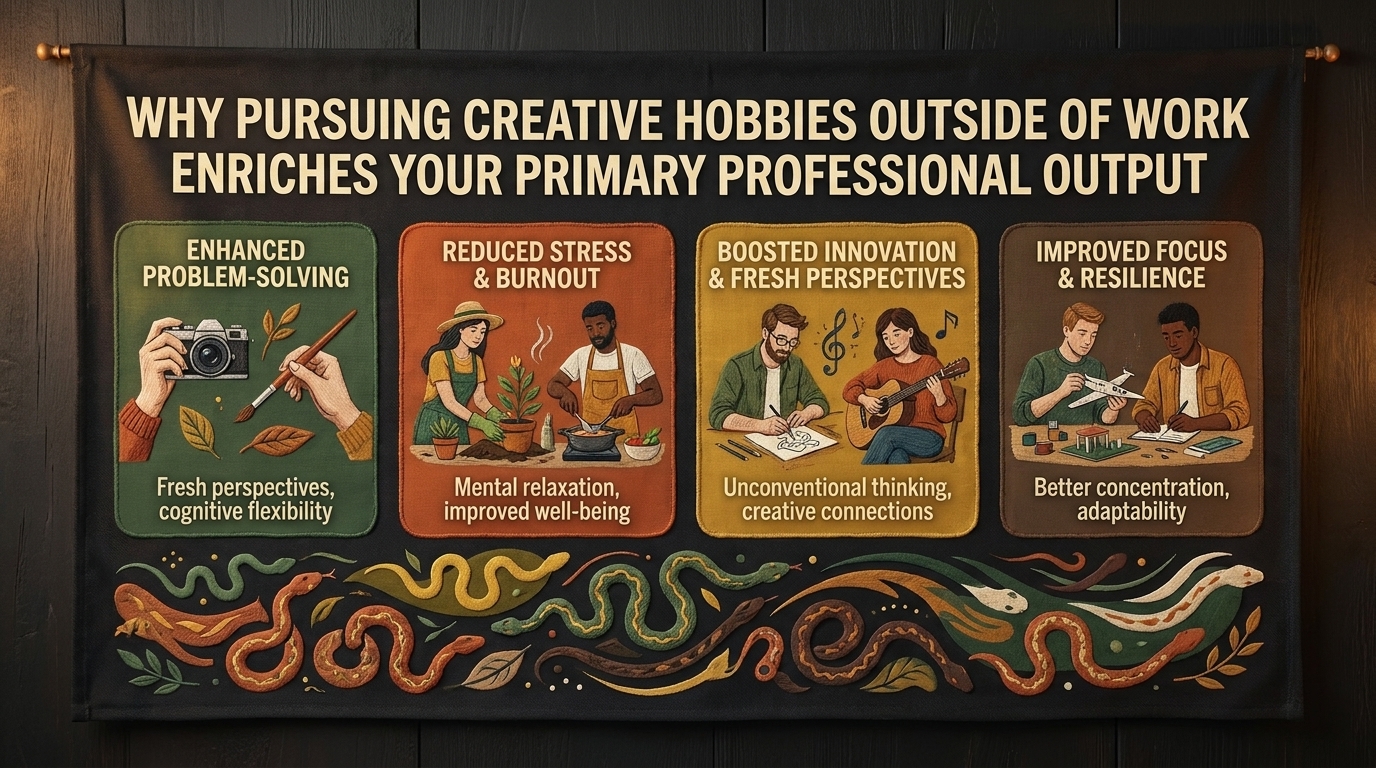
Far from being disconnected from your day job, creative hobbies act as an invisible engine room for professional excellence. Here is how creative outlets directly elevate your career output:
1. Radical Enhancement of Problem-Solving Capabilities
Professionals often get trapped in cognitive ruts, applying the same tired frameworks to recurring problems. Artistic and creative hobbies train you to tolerate ambiguity, embrace happy accidents, and experiment without fear of financial failure. This experimental mindset translates directly into the workplace, allowing you to innovate faster and approach strategic hurdles from unconventional angles.
2. Built-In Burnout Immunity
Chronic work stress narrows our cognitive bandwidth, leading to tunnel vision, cynicism, and diminished output. A meaningful hobby provides psychological detachment from work. When you immerse yourself in an activity where time seems to stand by—a state psychologists call “flow”—your nervous system resets, lowering cortisol levels and restoring emotional reserves.
3. Cultivating Emotional Regulation and Resilience
Creating art or mastering a craft requires patience. A painting goes through an “awkward phase” where it looks terrible before it comes together; a woodworking project requires precision under threat of ruining expensive timber. Navigating these micro-frustrations builds emotional resilience, teaching you how to stay calm, pivot, and persevere during high-stakes professional crises.
4. Expansion of Perspective and Empathy
Creative hobbies—particularly storytelling, theater, photography, or community-based arts—train you to observe the world through alternative lenses. This expanded perspective enhances your empathy, making you a more effective manager, a more persuasive communicator, and a deeply attuned collaborator.
3. Regional Dynamics: Creativity and Industry Across Major U.S. Hubs
The intersection of professional ambition and creative expression looks distinct across the diverse economic and cultural landscapes connected to nyattitude.com:
- New York: Amidst the relentless pace of finance, media, and corporate law in Manhattan, creative hobbies like writing, culinary arts, street photography, or indie music serve as vital grounding mechanisms, offering a sanctuary of self-expression and emotional relief.
- San Francisco: In the epicenter of technology and engineering, hobbies involving physical craftsmanship (such as woodworking, mechanical restoration, or fine arts) provide a tactile, screen-free antidote to digital fatigue, stimulating physical-world problem-solving skills that feed back into tech innovation.
- Texas: Spanning booming innovation hubs in Austin, Dallas, and Houston, Texas professionals blend entrepreneurial drive with vibrant local music, culinary, and outdoor recreational cultures, proving that work-life integration thrives on wide-open spaces and community connection.
- Washington: Balancing high-stakes policy, defense, and Pacific Northwest tech, professionals in Washington often turn to nature-based creative pursuits—such as landscape photography, woodworking, or creative writing—to process complex analytical thoughts through organic mediums.
- California (Southern & Broader): Blending entertainment, design, and wellness, California naturally merges professional work with creative exploration, viewing hobbies not as an escape from work, but as an essential element of holistic human vitality.
4. Actionable Tips: How to Protect and Prioritize Creative Hobbies
In a hyper-busy schedule, finding time for hobbies can feel daunting. Without intentional boundaries, work will naturally expand to consume every available minute. Use these actionable strategies to protect your creative life:
- Schedule Creative Time Like a Board Meeting: Do not wait until you “have free time” to pursue a hobby—free time is rarely found; it must be created. Block out non-negotiable hours in your calendar for your creative outlet.
- Embrace “Bad Art” and Low Stakes: The moment a hobby must generate income or institutional validation, it ceases to be a hobby and becomes a second job. Give yourself permission to be a complete beginner. Stumble, make mistakes, and enjoy the freedom of creation without pressure.
- Build a Dedicated Creative Environment: Whether it is a corner of your desk with a sketchbook, a garage workbench, or a digital music production setup, having a designated space lowers the friction required to start creating.
- Leverage Micro-Moments: If you cannot carve out three hours for painting, spend fifteen minutes sketching during lunch, writing micro-poetry on your commute, or practicing a single chord progression. Consistency trumps duration.
- Protect Your Psychological Boundaries: When your workday ends, shut down your professional communication channels. Signal to your brain that the professional shift is over and the creative exploration has begun.
- Share Your Craft with Community: Join local clubs, online communities, or collaborative workshops. Engaging with fellow enthusiasts provides social accountability, inspiration, and constructive feedback.
5. Ten Frequently Asked Questions (FAQs)
1. What qualifies as a “creative hobby”?
A creative hobby is any discretionary activity that involves active creation, expression, problem-solving, or craftsmanship rather than passive consumption (such as scrolling social media or watching television). Examples include painting, coding personal projects, writing, cooking, gardening, building models, playing music, or ceramics.
2. How can a hobby help me in a non-creative field like finance or law?
Analytical fields rely heavily on pattern recognition, lateral thinking, and stress management. Creative hobbies train your brain to embrace ambiguity, connect disparate ideas, and look at data sets or case files from fresh, imaginative perspectives, making you a sharper and more innovative analyst or attorney.
3. What if I am “not talented” at any creative activities?
Creativity is a muscle, not a fixed genetic trait. Skill in a hobby is entirely irrelevant to its cognitive benefits. The restorative and neurological advantages come from the process of creating, not the commercial quality of the final output. You do not need to sell your art or display it in a gallery for it to enrich your mind.
4. How do I balance a demanding career with maintaining a serious hobby?
Treat your hobby with the same scheduling discipline you apply to professional meetings. Set realistic micro-goals (e.g., writing 200 words a day or practicing an instrument for twenty minutes three times a week) and ruthlessly prune time spent on passive digital consumption.
5. Can my hobby eventually turn into a business?
While some hobbies successfully transition into side hustles or full-time enterprises, be cautious. Monetizing a hobby can introduce financial pressure and performance anxiety, stripping away the very psychological sanctuary that made the hobby restorative in the first place. Many professionals prefer keeping their creative outlets strictly non-commercial.
6. Why is passive entertainment (like watching Netflix) less beneficial than active hobbies?
Passive consumption places the brain in a receptive, low-activity state that can exacerbate mental fatigue. Active creative hobbies engage motor skills, executive decision-making, and emotional expression, actively rewiring neural pathways and providing genuine psychological rejuvenation.
7. How long do I need to spend on a hobby to see professional benefits?
Even short, consistent bursts—such as two or three 30-minute sessions per week—are enough to activate the Default Mode Network, lower stress hormones, and stimulate creative problem-solving capabilities that translate back to your primary work.
8. What are some portable creative hobbies for busy professionals who travel?
Great portable options include sketching in a pocket-sized journal, creative writing on a tablet or notebook, mobile photography, learning a new language through interactive apps, or portable fiber arts like knitting or embroidery.
9. How do I prevent my hobby from causing additional stress?
If your hobby starts feeling like an obligation or another item on your to-do list, pause and recalibrate. Drop expectations of perfection, scale back your commitments, and remember that a hobby exists purely to bring you joy, curiosity, and mental rest.
10. How do regional cultures influence how we view hobbies?
Fast-paced urban centers like New York or San Francisco often breed a hyper-productive mindset where hobbies must be justified or optimized. Embracing hobbies in these environments is a radical act of self-care that re-centers human well-being over relentless commercial output.
Conclusion
The pursuit of creative hobbies outside of work is not an indulgence or a distraction from professional duty; it is the secret bedrock of elite, sustainable professional performance. By stepping away from the daily grind to paint, write, build, play, or design, you give your brain the neurological breathing room it needs to innovate, solve complex problems, and heal from burnout.
Whether you are building a visionary enterprise across Texas, New York, California, Washington, or San Francisco, remember that the richest professional output is born from a well-rounded, deeply stimulated human life. Nurture your curiosity, protect your creative outlets, and watch how your primary work transforms as a result.
What creative hobby do you currently pursue, or which new artistic outlet have you been wanting to explore to refresh your professional mindset?