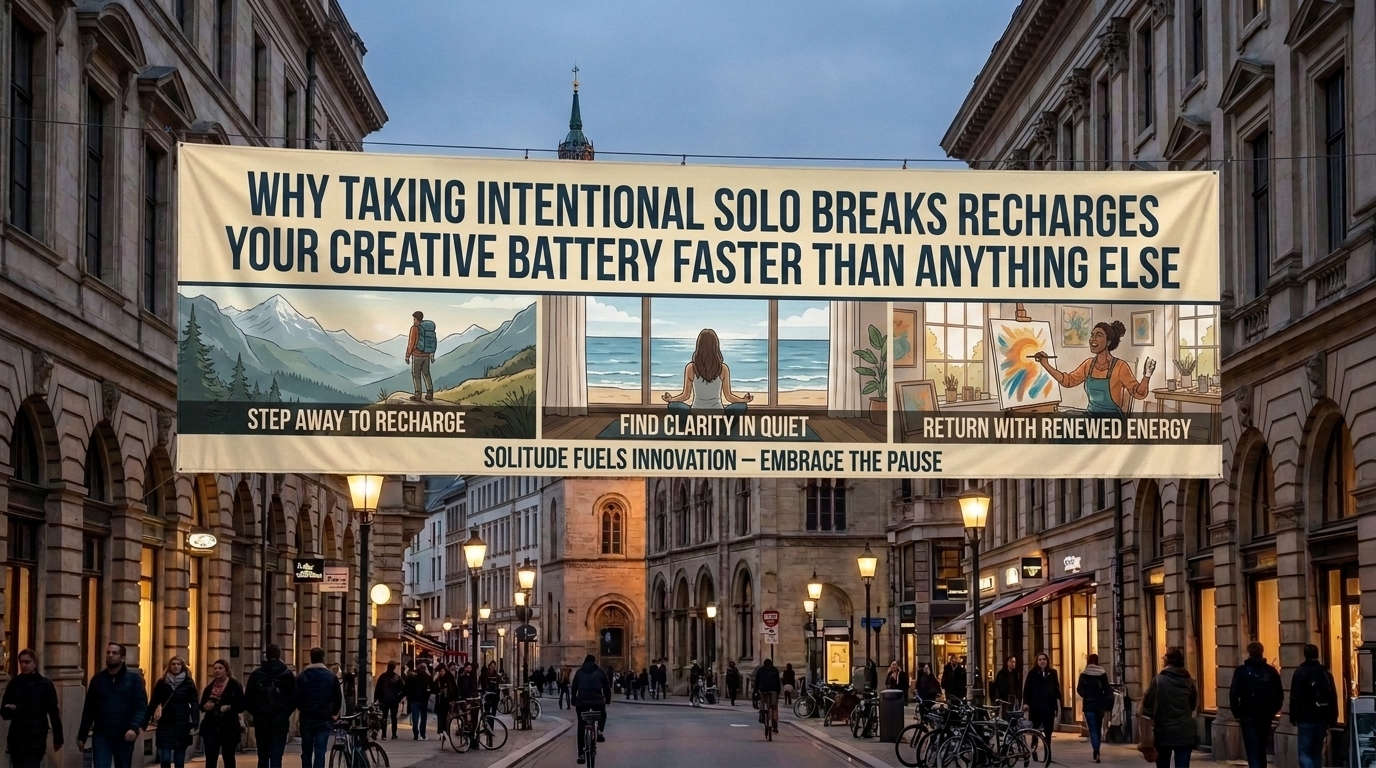
Why Taking Intentional Solo Breaks Recharges Your Creative Battery Faster Than Anything Else
In the high-octane economic and creative epicenters of the modern world—from the relentless financial grid of New York City and the hyper-competitive tech corridors of San Francisco, Silicon Valley, and Seattle, Washington, to the sprawling, fast-growing entrepreneurial hubs of Texas and Southern California—creative professionals operate under continuous cognitive strain.
In these demanding markets, productivity is frequently measured by output velocity, constant connectivity, and immediate responsiveness. However, operating your creative engine at maximum capacity without deliberate recovery leads to a predictable wall: sensory fatigue, decision paralysis, original idea depletion, and profound burnout.
While many attempt to combat mental exhaustion through group vacations, social weekend outings, or passive digital consumption, these activities often fail to restore baseline creative capacity. Group settings require continuous social calibration, emotional regulation, and conversational effort. Passive consumption floods an already exhausted brain with external noise.
The most effective, scientifically backed method for rapid mental recovery is the practice of taking intentional solo breaks.
Stepping away from both professional demands and social expectations creates the psychological safety and cognitive freedom needed for your brain to process accumulated data, reset its attentional capacity, and synthesize original insights.
The Neuroscience of Solo Breaks and Creative Recovery
Understanding why solo solitude accelerates creative recovery requires looking at the brain’s underlying neural networks and cognitive systems.
Continuous Demands & Social Noise ───► Central Executive Network (CEN) Fatigue
                                              │
                              [Intentional Solo Break]
                                              │
                                              ▼
                    Default Mode Network (DMN) Activation
                                              │
                                              ▼
                Cognitive Offloading & Unconscious Synthesis
                                              │
                                              ▼
                    Restored Executive Focus & Breakthrough Ideas
1. The Default Mode Network (DMN) and Unconscious Synthesis
When engaged in goal-oriented tasks, meetings, or problem-solving, your brain relies heavily on the Central Executive Network (CEN). While essential for execution, prolonged CEN activation depletes mental bandwidth.
When you step into an intentional solo break—free from social performance and structured tasks—your brain shifts activation to the Default Mode Network (DMN). The DMN is responsible for:
- Autobiographical memory consolidation
- Emotional processing and self-reflection
- Divergent thinking and connecting disparate, seemingly unrelated concepts
- Conceptual breakthroughs (“eureka” moments)
Without unstructured solo time, the DMN remains suppressed, starving your brain of the exact neural state required for original creative synthesis.
2. Eliminating the Social Calibration Tax
Even during enjoyable social interactions, your brain pays a hidden cognitive tax. You automatically monitor body language, adjust vocal tone, practice active listening, and calibrate your responses. This ongoing social processing prevents your nervous system from shifting into true recovery. Solo breaks eliminate this social calibration tax entirely, allowing your brain to drop into deep, unmonitored rest.
3. Restoring Directed Attention Capacity
Pioneered by psychologists Stephen and Rachel Kaplan, Attention Restoration Theory (ART) demonstrates that directed attention—the focused mental energy required to solve complex problems, write code, design frameworks, or analyze data—is a finite resource. Constant exposure to urban noise, notifications, and social demands drains this reserve. Intentional solitude in quiet or natural environments allows directed attention to recover naturally.
Solo Solitude vs. Common Alternatives
Understanding how intentional solo breaks compare to other common rest methods clarifies why solitude is uniquely effective:
| Rest Method | Social Calibration Required? | Cognitive Input Level | Impact on Creative Battery |
| Intentional Solo Break | None (Complete Autonomy) | Low to Zero (Reflective/Unstructured) | Optimal: Rapid DMN activation and mental reset |
| Social Outings / Group Trips | High (Managing dynamics) | Moderate to High (Active engagement) | Variable: Emotionally fulfilling, but cognitively taxing |
| Passive Screen Time (Scrolling) | Low | Extreme (Information overload) | Negative: Heightens sensory fatigue and anxiety |
| Working Through Breaks | High | Maximum (Sustained focus) | Destructive: Accelerates cognitive exhaustion and burnout |
Types of Intentional Solo Breaks for Maximum Yield
Not all solo breaks need to be multi-day retreats. Incorporating varying durations of solitude into your routine builds a resilient, sustainable creative system.
[Micro-Solitude]  ➜ 10-15 Mins Daily (Breathwork, Quiet Strolls, Screen Free)
[Macro-Solitude]  ➜ 2-4 Hours Weekly (Solo Neighborhood Walks, Gallery Visits)
[Deep Solitude]   ➜ 1-3 Days Quarterly (Solo Retreats, Nature Off-Grid)
1. Daily Micro-Solitude (10 to 30 Minutes)
- Execution: Step away from your desk, leave your phone behind, and go for a quiet walk, sit in a park, or practice structured stillness.
- Goal: Clear immediate task residue and reset focus between deep work blocks.
2. Weekly Macro-Solitude (Half-Day to Full Day)
- Execution: Block out a 3-to-5-hour window on a weekend morning or afternoon. Visit a museum, explore an unfamiliar neighborhood, or spend time in nature completely on your own schedule.
- Goal: Allow the Default Mode Network to run unimpeded, consolidating weekly learnings and solving macro-level creative bottlenecks.
3. Quarterly Deep Solitude (1 to 3 Days)
- Execution: Plan an overnight solo getaway to a quiet location outside your primary urban area—whether heading up-state from New York, escaping to the Texas Hill Country, exploring coastal California, or heading into the forests of Washington.
- Goal: Deep psychological recovery, strategic vision alignment, and full-spectrum creative reset.
Step-by-Step Framework for Planning an Effective Solo Break
To maximize the cognitive yield of your solo time, structure the experience using this actionable framework:
1.Establish a Complete Communication Disconnect:Set firm boundaries with team, clients, and family.
Inform key contacts in advance that you will be offline. Place your devices on “Do Not Disturb” or leave them behind in a secure location. Eliminating the expectation of immediate availability is required to lower nervous system arousal.
2.Eliminate Strict Agendas and To-Do Lists:Remove agendas, rigid schedules, and checklists.
Resist the urge to turn your solo break into another optimization project. Do not set strict itineraries or heavy reading goals. Allow your intuition and curiosity to dictate your movement minute-by-minute.
3.Seek Out Low-Stimulation Environments:Engage in low-cognitive-demand environments.
Choose environments rich in soft fascination—such as parks, waterfronts, quiet art galleries, or rural retreats. Natural elements engage your attention effortlessly, allowing your directed focus to rest and recharge.
4.Carry a Friction-Free Capture Tool:Capture spontaneous insights without forcing output.
Bring a simple physical notebook or index cards. When spontaneous ideas, solutions, or realizations emerge from your subconscious during quiet moments, jot them down quickly and return immediately to your reflective state.
5.Buffer Your Return to Operational Work:Ease back into high-gear work environments gracefully.
Avoid scheduling high-stress meetings or launching major initiatives immediately following a deep solo break. Give yourself a 2-hour buffer window to review your captured notes and synthesize your insights into actionable priorities.
Practical Tips for Overcoming Solitude Guilt
For high-performing creators, entrepreneurs, and executives across competitive hubs like Texas, California, New York, Washington, and San Francisco, stepping away alone often triggers guilt or fear of missing out (FOMO). Use these perspectives to reframe the practice:
- Reframe Solitude as Professional Maintenance: View solo breaks as essential maintenance for your primary asset: your mind. Just as an athlete prioritizes physical recovery to prevent injury, a creative thinker must protect cognitive recovery to sustain elite output.
- Recognize the Cost of Constant Availability: Continuous presence yields diminishing returns. A burnt-out creator operating at 40% capacity produces mediocre work slowly. A recharged creator operating at 100% capacity solves complex problems in a fraction of the time.
- Communicate the ROI to Stakeholders: Frame your solo recovery to partners, teams, or clients in terms of output quality: “Taking this focused time offline ensures I return with the mental clarity needed to solve our biggest strategic challenges.”
- Start Small to Build Comfort: If full-day solitude feels intimidating, build your tolerance incrementally. Start with 30-minute phone-free solo walks and scale up as you experience the mental benefits.
Top 10 Frequently Asked Questions (FAQ)
1. What is the difference between solo breaks and social vacations?
Social vacations prioritize connection, shared experiences, and relationship building, which are valuable but require social calibration and energy. Solo breaks eliminate social expectations entirely, allowing your brain to enter complete cognitive offloading and Default Mode Network processing.
2. How frequently should a creative professional take intentional solo breaks?
A balanced routine includes daily micro-solitude (15–30 minutes), weekly macro-solitude (2–4 hours), and quarterly deep solitude (1–3 days).
3. What should I do if I feel anxious or restless during a solo break?
Restlessness is normal when transitioning away from high-stimulus environments. Engage in light physical movement—such as walking, stretching, or sketching—to help discharge excess physical energy without overloading your mind.
4. Can I use a solo break to consume educational content like books or podcasts?
Heavy consumption forces your brain back into active processing (CEN mode). Limit educational content during recovery breaks. Instead, prioritize unstructured observation, light reflection, or fiction.
5. How does nature enhance the benefits of solo creative breaks?
Nature provides “soft fascination”—visual patterns, open horizons, and ambient natural sounds that hold your attention gently without demanding active processing. Research shows nature exposure lowers cortisol, reduces blood pressure, and restores executive function significantly faster than urban settings.
6. What if my family or partner feels excluded by my desire for solo time?
Communicate clearly that your solo breaks are a tool for mental health, cognitive recovery, and professional performance—not an escape from your personal relationships. Support your partner in taking their own solo breaks as well to create a healthy, reciprocal dynamic.
7. Is solo journaling considered a good activity for a creative break?
Yes. Unstructured solo journaling serves as a powerful cognitive offloading tool. It allows you to dump internal thoughts, process lingering anxieties, and make space for fresh ideas.
8. How do I maintain creative momentum if I can’t afford a solo retreat?
Cost should never be a barrier. Effective solo breaks require time and boundary management, not expensive accommodations. A half-day spent alone in a local library, park, or quiet botanical garden yields significant mental recovery at zero financial cost.
9. Can introverts and extroverts benefit equally from solo breaks?
Yes. While introverts naturally gravitate toward solitude, extroverts also experience cognitive fatigue from continuous task execution and digital stimulation. Both personality types require uninterrupted solo time to restore executive focus and process complex information.
10. Why are solo breaks particularly critical for professionals in hubs like NY, SF, Seattle, or Austin?
High-density, fast-paced metro areas present elevated baseline levels of sensory stimulation, economic pressure, and competitive noise. Intentional solo breaks act as an essential buffer against the constant stimulation endemic to major market centers.
Conclusion
In a world that celebrates continuous connectivity and relentless hustle, the ability to step away alone is a true competitive advantage. Solitude is not an escape from productivity; it is the source from which original thought, deep problem-solving, and sustainable creativity flow. By committing to intentional solo breaks—whether a quiet 20-minute daily walk or a multi-day retreat—professionals across Texas, New York, California, Washington, San Francisco, and beyond can recharge their creative engines, safeguard their mental health, and sustain high-level performance over a lifetime.