There is an electric, magnetic promise that draws millions of people to New York City every single year. Whether you are packing up a modest car in Texas, leaving behind the laid-back coastlines of California, moving down from Washington, or relocating from the tech hubs of San Francisco, the Big Apple represents the ultimate proving ground. It is a city of unmatched creative energy, cultural convergence, and career velocity.
However, the very elements that make New York magnificent also make it deeply unforgiving. The pace is breathless, the cost of living is punishing, and the social infrastructure is entirely built on speed and efficiency. If you arrive in Manhattan, Brooklyn, or Queens expecting gentle hand-holding, slow-paced courtesy, or a world that bends to accommodate your fragile feelings, the city will chew you up and spit you out within a month.
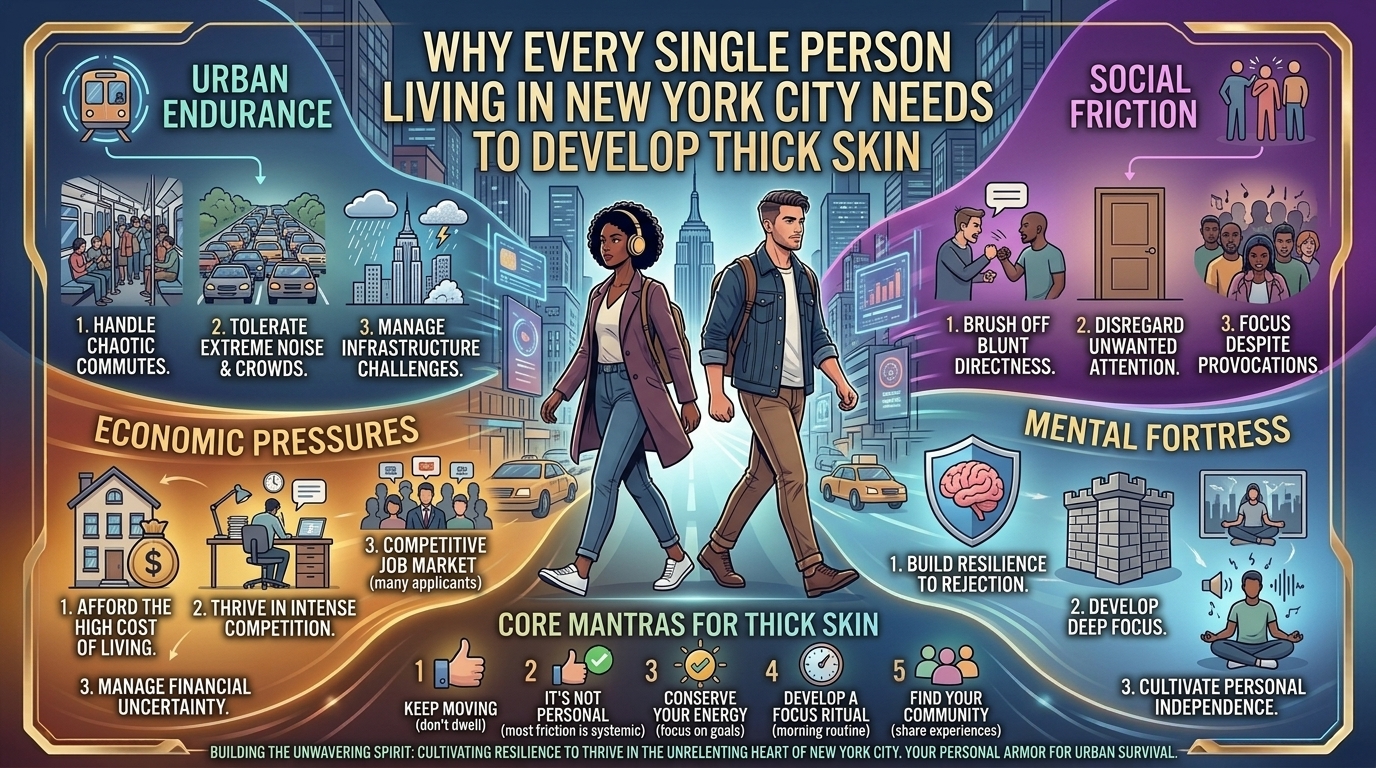
To survive and ultimately thrive in New York City, developing a thick skin is not merely a helpful personality quirk—it is a non-negotiable survival tool.
The New York State of Mind: Why NYC Demands Emotional Armor
Outsiders often mistake New York directness and hustle for outright hostility. When a bodega clerk barks at you to make up your mind, when a subway commuter shoves past you without a polite “excuse me,” or when a landlord coldly rejects your apartment application after you waited three hours in line, it feels personal.
It almost never is.
The Calculus of Density
New York City crams more than eight million people into roughly 300 square miles. To maintain sanity in an environment defined by relentless sensory overload—blaring sirens, crowded sidewalks, flashing lights, and competing demands for attention—residents build an internal psychological filter.
- Mind Your Business Culture: The famous New York “coldness” is actually a polite boundary. Leaving people alone and expecting them to handle their own business is how millions of people manage to live on top of one another without descending into constant chaos.
- Efficiency Over Formality: Time is currency in the Big Apple. People do not mean to be rude when they cut straight to the point; they are simply respecting your time (and theirs) by trimming away conversational fat.
If you take every sharp word, slammed door, or delayed response as a personal attack against your character, you will spend your entire time in NYC exhausted, resentful, and emotionally depleted.
The Cost of Thin Skin in the Big Apple
Having “thin skin” in New York is like walking through a torrential downpour without an umbrella and wondering why you are getting soaked. When you lack emotional resilience, ordinary city inconveniences cascade into major mental health crises.
- Professional Stagnation: The professional landscape in NYC is fiercely competitive. If a creative director tears your portfolio apart, or an investor passes on your startup idea with a blunt “not interested,” a thin-skinned reaction is to take it as proof that you are a failure. A thick-skinned response is to extract the constructive feedback, discard the noise, and pitch the next person an hour later.
- Social Burnout: Dating and friendships in New York can be notoriously transient. People ghost, plans fall through at the last minute because of work emergencies, and schedules are booked weeks in advance. Taking social rejection personally leads to deep, agonizing isolation.
Pillar Strategies: How to Cultivate Thick Skin Without Losing Your Empathy
Developing a thick skin does not mean turning into a cynical, unfeeling jerk. The secret art of the true New Yorker is maintaining an open, warm heart underneath a tough, resilient exterior. Here is how to build that armor safely.
1. Separate Intention from Impact
When someone snaps at you on the subway platform or in line at a deli, remind yourself: This has nothing to do with me. That person might be facing a looming eviction notice, chronic sleep deprivation from neighborhood noise, or a family crisis. By detaching your ego from the random outbursts of strangers, you instantly disarm their negativity.
2. Redefine “Rejection” as Simple Filtering
In a hyper-competitive metropolis, hearing “no” is an everyday occurrence. Whether it’s an apartment lease falling through, a lowball job offer, or a rejected pitch, treat rejections not as a verdict on your worth, but as data points. New York rewards those who treat persistence as a game of numbers.
3. Build a Soft Landing Pad at Home
Your apartment—no matter how small or overpriced—must act as your psychological decompression chamber. When you close your front door, the city stays outside. Surround yourself with items, sounds, and people that ground you, allowing your nervous system to recover from the daily hustle.
10 Frequently Asked Questions (FAQs)
1. Does having thick skin mean I have to accept mistreatment or abuse?
Absolutely not. There is a distinct difference between everyday urban brusqueness (e.g., someone bumping into you or speaking bluntly) and actual harassment or abuse. Thick skin helps you brush off the minor friction of city life so you can reserve your energy to stand up for yourself when boundaries are genuinely crossed.
2. Why do New Yorkers seem so much ruder than people from other parts of the country?
New Yorkers aren’t necessarily rude; they are just efficient and protective of their time and emotional bandwidth. In places like Texas or California, friendly small talk with strangers is standard social etiquette. In NYC, uninvited small talk is often viewed with suspicion because everyone has places to be.
3. How do I stop taking professional criticism personally in a competitive NYC industry?
Separate your identity from your output. Your worth as a human being is not tied to whether a client likes your design, a boss approves your report, or an editor accepts your article. View criticism as a technical tool to sharpen your craft.
4. How long does it typically take to adjust to the intensity of New York City?
Most transplants report that it takes a full year—a complete cycle of all four brutal seasons, scorching summers, and freezing winters—to feel like they have found their footing and developed the emotional armor needed to coast smoothly.
5. What is the best way to handle aggressive panhandlers or street confrontations?
The golden rule of NYC street safety is non-engagement. Do not make prolonged eye contact, do not argue, and do not take verbal provocation to heart. Keep your head up, walk with purpose, and keep moving forward.
6. Is it possible to be a sensitive person and still survive in New York?
Yes, many artists, writers, and deeply empathetic people thrive in NYC, but they usually learn to build strict boundaries. They carve out quiet creative spaces, limit their exposure to over-stimulating environments, and learn when to tune out the noise.
7. How do I deal with landlords, brokers, and service workers who treat me poorly?
Document everything, keep your emotions entirely out of business transactions, and practice calm assertiveness. In NYC real estate and service industries, showing weakness or panic can sometimes invite exploitation; calm confidence commands respect.
8. How do I keep from feeling lonely when everyone around me seems too busy?
Understand that loneliness in New York is a universal shared experience, even among people who have lived there for decades. Building a community takes intentional, repetitive effort—like joining local run clubs, volunteering, or frequenting the same neighborhood cafe.
9. What should I do when a friend or romantic partner in the city suddenly “ghosts” me?
Remind yourself that ghosting is a reflection of the other person’s communication deficit, not your value. New York’s overwhelming optionality causes many people to take the path of least resistance. Let them go without chasing closure.
10. How do I know if the city is genuinely breaking me down versus helping me grow?
If you find yourself constantly irritable, feeling hopeless, or experiencing physical symptoms of chronic stress that do not improve with rest or downtime, it might be time to re-evaluate your boundaries, take a vacation out of state, or seek professional therapy. Growth feels uncomfortable; burnout feels destructive.
Conclusion
Living in New York City is an extraordinary privilege that tests your mettle, expands your worldview, and sharpens your ambition. But it will also test every boundary you have. Developing thick skin does not require you to sacrifice your kindness, your empathy, or your humanity. Instead, it acts as protective armor, allowing you to absorb the inevitable shocks of the urban landscape without letting them derail your dreams.
Arm yourself with resilience, keep your eyes on your goals, and remember that every challenge you weather in the Big Apple makes you unstoppable.