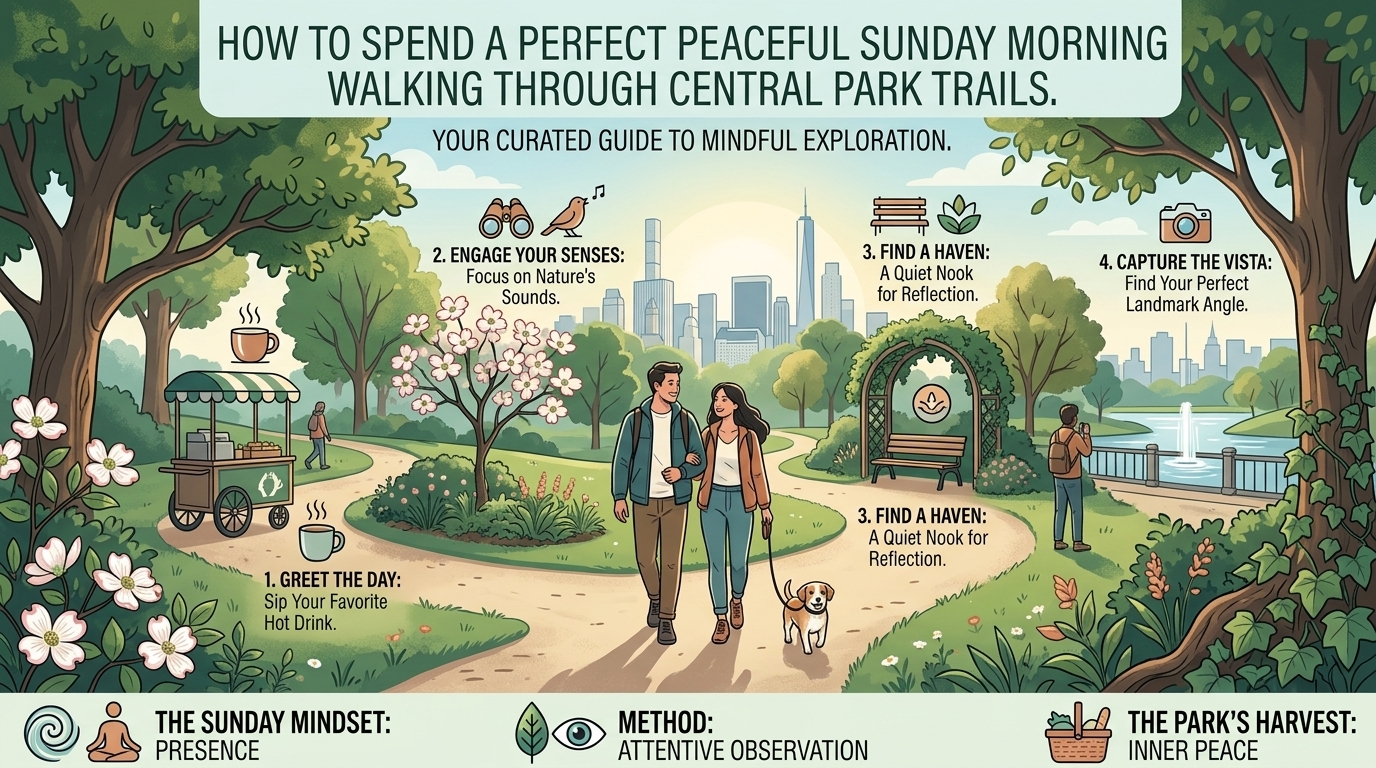
There is a profound, restorative magic that occurs when the frenetic energy of New York City pauses for a few brief hours on a Sunday morning. For transplants and long-term locals who arrived from the expansive horizons of Texas, the sun-drenched coastlines of California, the pine-shrouded valleys of Washington, or the steep tech hills of San Francisco, the sensory intensity of the Big Apple can leave your nervous system craving sanctuary.
While millions of tourists and weekend visitors flock to Central Park’s famous paved loops—navigating swarms of cyclists near Bethesda Fountain, horse-drawn carriages at Grand Army Plaza, and crowded vendors near the Dairy—true New Yorkers know a closely guarded secret. Central Park is not just a manicured Victorian park; it is an 843-acre masterpiece of landscape architecture designed by Frederick Law Olmsted and Calvert Vaux specifically to hide the city from itself.
If you know which hidden gates to enter, which dirt paths to follow, and how to time your steps, you can experience complete, profound rural silence right in the middle of Manhattan. This comprehensive guide details the ultimate blueprint for spending a peaceful, soul-cleansing Sunday morning walking through Central Park’s secret trails and hidden woodlands.
The Philosophy of Sunday Sanctuary: Why Central Park Matters
In environmental psychology, urban dwellers suffer from a chronic deficit of “soft fascination”—the cognitive rest experienced when looking at natural fractals, leaves, rustling canopies, and meandering water features rather than rigid concrete angles and digital screens.
Sunday morning is the singular window of time in New York when the city breathes out. Between 7:30 AM and 10:30 AM, the corporate workers are sleeping in, the nightlife crowds have vanished, and the massive tour buses haven’t yet unloaded their passengers. Walking the park during this golden window provides a psychological reset that anchors you for the week ahead.
Step 1: The Golden Hour Timeline (Timing is Everything)
To experience Central Park in absolute peace, your schedule matters far more than your route.
- The 7:30 AM – 9:00 AM Window: This is the pristine sweet spot. You will share the paths primarily with serious distance runners, dog walkers, and local bird watchers carrying high-powered binoculars in absolute silence.
- The 11:00 AM Cliff: Around 11:00 AM, the character of the park shifts dramatically. Strollers multiply, street performers set up their speakers near the Mall, and the volume level rises. Finish your peaceful trail walk before the midday crowds take over.
Step 2: The Ultimate Peaceful Trail Route (North to South)
Skip the crowded paved south loop. To find true wilderness, you must head above 72nd Street and deep into the park’s rugged northern and central sanctuaries. Here is the ultimate trail itinerary:
1. Enter at the West 81st Street Gate (The Natural History Approach)
Step past the American Museum of Natural History and enter the park heading eastward toward The Ramble.
2. Lose Yourself in The Ramble (Middle Park)
Spanning 38 acres of dense, twisting woodland, The Ramble is a masterpiece of hidden labyrinthine dirt paths, rustic wooden bridges, and secret rocky outcrops.
- The Experience: Because the paths are narrow, unpaved, and heavily shielded by a dense multi-tiered canopy of oak, cherry, and pine trees, the sound of surrounding midtown skyscrapers completely vanishes. You will hear little more than the wind through the leaves and the call of migrating warblers.
- The Azalea Pond & The Gill: Follow the small trickling stream known as The Gill down to Azalea Pond, a legendary hotspot for local bird watchers where turtles sun themselves on mossy logs.
3. Cross Over to the North Woods and The Loch (Upper Park)
If you continue north past 96th Street, you enter a completely different world: The North Woods. This is the largest of the park’s three woodland preserves, encompassing 90 acres of rugged ravine terrain.
- The Ravine: Modeled after the Adirondack mountains, a rushing stream cuts through jagged Manhattan schist rock formations, creating cascading waterfalls like The Loch Waterfall and Glen Span Arch. Sitting on a wooden bench here makes it easy to forget you are standing on top of some of the most expensive real estate on Earth.
Step 3: Packing for Your Urban Wilderness Morning
While you are still in Manhattan, visiting Central Park’s deep trails requires basic preparation to ensure comfort and mindfulness.
- Footwear Matters: Do not wear smooth-soled fashion sneakers or heels. The dirt paths, exposed tree roots, and stone steps of the Ramble and North Woods require sturdy walking shoes or lightweight trail runners, especially if there was morning dew or recent rain.
- Analog Mindfulness: Leave your work phone on Do Not Disturb, or better yet, leave headphones at home. The primary objective of a Sunday trail walk is acoustic detoxification—letting the sounds of nature replace the ambient roar of city traffic.
- Hydration and a Notebook: Pack a reusable water bottle and a small pocket notebook. The quiet solitude of the morning trails often sparks deep creative epiphanies, making it an ideal time to journal.
10 Frequently Asked Questions (FAQs)
1. Are Central Park’s dirt trails safe for a solo walker on Sunday morning?
Yes, absolutely. Sunday mornings between 7:30 AM and 10:00 AM are exceptionally safe because the park is heavily populated by local runners, dog owners, park rangers, and sanitation staff.
2. Where is the quietest spot in all of Central Park?
The North Woods (above 100th Street) and the northern perimeter of the Ramble near the Ladies’ Pavilion offer the highest degree of acoustic isolation from city traffic noise.
3. Can I bring my dog onto the Central Park trails?
Yes, dogs are welcome, but note that off-leash hours in Central Park are restricted to early mornings (before 9:00 AM) and late evenings (after 9:00 PM) in designated areas. Always follow local park signage.
4. Are there public restrooms accessible along the trail routes?
Yes, historic comfort stations are located near major junctions—including near Shakespeare Garden, Belvedere Castle, and the Dana Discovery Center at the Harlem Meer in the north end.
5. What time does Central Park officially open and close?
Central Park is officially open daily from 6:00 AM to 1:00 AM, making early Sunday morning walks completely accessible.
6. Can I go bird watching in Central Park without prior experience?
Definitely! Central Park is one of the top urban bird-watching sites in North America. Local groups and Audubon volunteers often host casual, free morning bird walks on weekends.
7. How do I navigate without getting lost in the Ramble’s twisting paths?
While getting delightfully “lost” is part of the charm, you can easily orient yourself by keeping track of the perimeter landmarks: look for the lake to the south or major transverse roads. Cell service works perfectly fine if you ever need GPS assistance.
8. What is the best season to experience peaceful walks in Central Park?
Every season offers a unique magic: vibrant cherry blossoms in spring, lush green canopies in summer, breathtaking golden foliage in autumn, and profound, snow-muffled silence in winter.
9. Are bicycles permitted on the dirt walking trails of the Ramble?
No. To protect fragile ecology, prevent erosion, and ensure pedestrian safety, bicycles, scooters, and skateboards are strictly prohibited on dirt paths and restricted to the paved park drives.
10. Why is walking Central Park trails considered an essential urban survival skill?
Because intentional immersion in urban nature lowers cortisol, repairs cognitive fatigue caused by the high-speed work week, and restores your mental connection to the physical earth amidst a concrete metropolis.
Conclusion
Spending a peaceful Sunday morning walking through Central Park’s hidden dirt trails and woodland sanctuaries is the ultimate antidote to the relentless velocity of New York City life. By waking up early, venturing away from the paved tourist loops, and losing yourself in the leafy labyrinths of the Ramble and the North Woods, you reclaim your inner peace and transform how you experience the city.