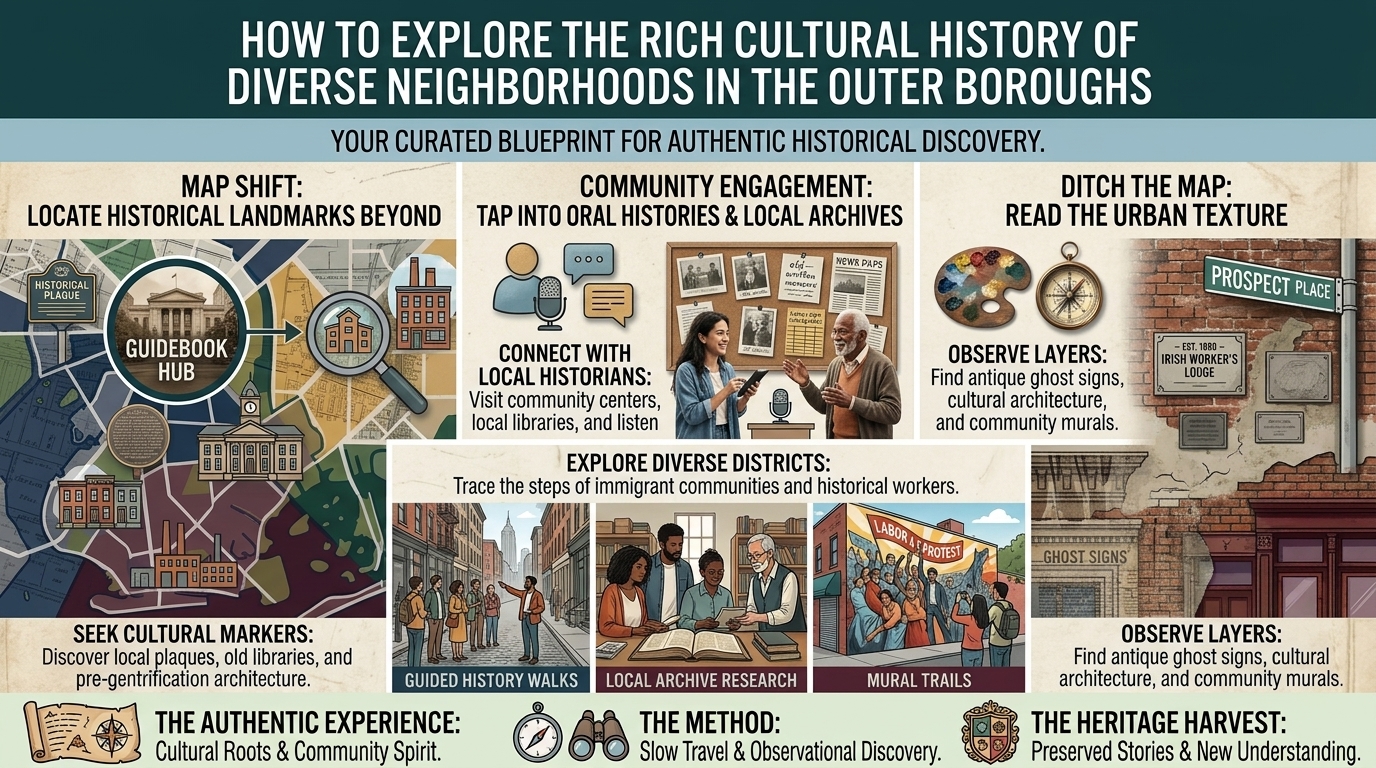
When visitors, remote transplants, or curious urban explorers first set foot in New York City, their gravitational pull almost always draws them toward Manhattan. They march through the bright lights of Times Square, weave through the grid of Midtown, or photograph the luxury facades of the Upper East Side.
Yet, anyone who has lived across the diverse regional landscapes of America—whether migrating from the broad horizon lines of Texas, the coastal creative enclaves of California, the evergreen canopies of Washington, or the tech-pioneering hills of San Francisco—quickly learns a vital urban truth: Manhattan is merely the glossy introduction; the outer boroughs are the deep, multi-volume masterwork.
Comprising Brooklyn, Queens, the Bronx, and Staten Island, the outer boroughs house the true architectural, culinary, musical, and immigrant soul of New York City. This comprehensive guide explores how to step off the beaten tourist path, navigate the historical layers of the outer boroughs, and immerse yourself in the rich cultural tapestries that define these extraordinary communities.
The Geography of Diversity: Why the Outer Boroughs Hold the Real Story
To understand why the outer boroughs are global capitals of cultural preservation, you must look at how New York evolved. On January 1, 1898, the historic consolidation act bound the separate cities, towns, and counties surrounding Manhattan into a single municipal giant.
Rather than erasing existing local identities, consolidation amplified them. As successive waves of global immigration washed over America throughout the 19th and 20th centuries, distinct ethnic groups settled along transit lines in Brooklyn, Queens, and the Bronx, creating resilient, close-knit enclaves that preserved their native languages, culinary traditions, and social structures with astonishing fidelity.
1. Queens: The Globe in a Single Borough
If you want to experience international cultural history without packing a passport, Queens is the undisputed capital. Recognized as one of the most ethnically diverse urban areas on earth, Queens tells the story of global migration through its bustling commercial corridors and historic neighborhoods.
Flushing: The Epicenter of Modern and Historical Asian Culture
While Manhattan’s Chinatown gets the bulk of tourist attention, Flushing in northeastern Queens is a massive, multi-layered cultural powerhouse.
- The History: Long before it became a bustling hub for Taiwanese, Korean, mainland Chinese, and South Asian communities, Flushing was the site of the Flushing Remonstrance of 1657—a foundational American document advocating for religious freedom under Dutch colonial rule. Today, walking down Main Street reveals a staggering density of culinary and cultural history, from centuries-old Quaker meeting houses to ultra-modern regional Asian eateries.
Jackson Heights: A Mosaic of Latin American and South Asian Heritage
Step off the 7 train in Jackson Heights, and you will witness one of the greatest architectural and cultural experiments in urban history.
- The Architecture: Designed in the early 20th century as one of America’s first planned “garden apartment” communities, Jackson Heights features gorgeous English-style garden courtyards hidden behind stately brick facades.
- The Culture: Today, these historic blocks pulse with life as a vibrant sanctuary for Tibetan, Colombian, Ecuadorian, Nepali, and Indian communities. Walking along 74th Street (known as Little India) and the surrounding avenues offers an unmatched education in global traditions, textile arts, and neighborhood activism.
2. Brooklyn: From Maritime Roots to Cultural Renaissance
Brooklyn is a massive borough composed of dozens of distinct former towns and villages, each carrying deep historical scars and triumphs.
Crown Heights and Weeksville: Preserving African American Autonomy
While neighborhoods like Williamsburg and DUMBO dominate modern real estate headlines, Brooklyn’s historical backbone runs deeper through central districts like Crown Heights and Weeksville.
- The History: Founded in 1838 by a community of free African Americans just decades before the abolition of slavery in New York State, Weeksville was an independent, self-sufficient land-owning settlement. Today, the Weeksville Heritage Center preserves the historic Hunterfly Road Houses—rare 19th-century wooden vernacular homes that stand as a testament to early Black urban self-determination.
Brighton Beach and Coney Island: The Immigrant Seaside
Traveling to the southern edge of Brooklyn brings you to the Atlantic shoreline, where the historic boardwalk of Coney Island meets the vibrant Russian-speaking enclave of Brighton Beach (often dubbed “Little Odessa”).
- The Culture: Settled by waves of Eastern European and Soviet Jewish immigrants starting in the late 20th century, Brighton Beach maintains a distinct old-world coastal atmosphere. Walking down Boardwalk shops reveals independent bakeries, traditional pharmacies, and cultural markets that look and feel worlds away from central Manhattan.
3. The Bronx: The Crucible of Global Music and Architecture
The northernmost borough, The Bronx, carries an immense historical legacy that shaped modern American culture, architecture, and civil rights.
The Grand Concourse: Art Deco Masterpieces
Modeled after the Champs-Élysées in Paris, the Grand Concourse is a sweeping 5-mile boulevard lined with one of the highest concentrations of pristine Art Deco and Moderne apartment architecture in the world.
- The History: Built in the early 20th century, these grand residential buildings once housed a thriving middle-class community, featuring sunken living rooms, wrought-iron elevators, and intricate terra-cotta ornamentation that rivals anything on the Upper West Side.
The South Bronx: Birthplace of Hip-Hop Culture
No discussion of global cultural history is complete without acknowledging the South Bronx. In the 1970s, amidst urban decay and systemic municipal neglect, local youth forged an artistic revolution born out of resilience.
- The Legacy: Groundbreaking cultural movements—including hip-hop, graffiti art, breakdancing, and park jam culture—were born on Bronx asphalt, transforming global music and fashion forever. Taking a guided historical tour through the Bronx yields a profound appreciation for creative survival and community power.
10 Frequently Asked Questions (FAQs)
1. Are outer borough neighborhoods safe for visitors exploring solo?
Yes. Major residential and commercial hubs across Brooklyn, Queens, and the Bronx are exceptionally vibrant, busy, and safe during daytime hours. Standard urban awareness and common sense apply, just as they would in any major global city.
2. How difficult is it to navigate the outer boroughs using public transit?
The New York City subway system connects all boroughs efficiently. However, because outer borough routes often require transfers or local trains, using navigation apps and checking MTA weekend service advisories is essential.
3. What is the best way to experience authentic food history in Queens?
Skip standard sit-down restaurants and explore neighborhood food walks, specialized bakeries, and food halls. Following local food historians or community-led cultural maps will lead you to authentic regional dishes.
4. Are there guided historical walking tours focused exclusively on the outer boroughs?
Absolutely. Independent historical societies—such as the Greater Astoria Historical Society, the Brooklyn Historical Society (Center for Brooklyn History), and the Bronx County Historical Society—regularly host expert-led neighborhood walking tours.
5. How long did it take for the outer boroughs to become part of New York City?
The formal consolidation of the five boroughs into the City of Greater New York occurred on January 1, 1898, unifying Manhattan, Brooklyn, Queens, the Bronx, and Staten Island under a single municipal government.
6. Can I visit the historic Weeksville houses in Brooklyn?
Yes! The Weeksville Heritage Center in Crown Heights offers public exhibitions, educational programs, and guided tours of the historic 19th-century frame houses.
7. Why are outer borough neighborhoods so culturally distinct from one another?
Because each borough was originally formed from independent colonial towns, farming villages, and industrial ports that developed isolated ethnic enclaves along 19th-century trolley and subway lines.
8. What is the best season to explore outer borough outdoor history and architecture?
Spring and autumn offer ideal walking temperatures. Exploring tree-lined historic districts like Jackson Heights in Queens or Park Slope and Prospect Lefferts Gardens in Brooklyn during these seasons is breathtaking.
9. How has gentrification impacted historical preservation in the outer boroughs?
Gentrification has brought both renewed economic investment to historic infrastructure and the threat of displacement for long-standing immigrant communities, making community-led historic preservation more vital than ever.
10. Why is exploring the outer boroughs essential for understanding New York?
Because Manhattan represents the financial and tourist facade, while the outer boroughs represent the authentic, beating heart where millions of working-class families, immigrants, and artists built the city’s true cultural foundation.
Conclusion
Exploring the rich cultural history of diverse neighborhoods in the outer boroughs is an eye-opening journey that shatters the myth that New York City’s story ends at the Manhattan border. From the multi-ethnic culinary tapestry of Queens and the revolutionary musical roots of the Bronx to the abolitionist history of Brooklyn, these communities preserve the authentic soul of urban America.
Step off the standard tourist path, embrace the outer grid, and discover more urban exploration guides, neighborhood histories, and lifestyle inspiration right here at nyattitude.com to help you master life in the greatest cities on earth!